| 29 October 2014 |

| |
| BBC Homepage | | |
| |||
| Contact Us | | |
Your StoriesYou are in: Tyne > People > Your Stories > On the turning away  Few young people use the centre On the turning awayBy Reuben Abraham Members at Newcastle Chinese Centre are worried that fewer youngsters are using its facilities these days. Why the change?
Every Sunday, almost with unfailing regularity, Andrew, a Chinese schoolboy, arrives at the Newcastle Chinese Centre, armed with his Erhu, an ancient two-stringed violin that has its origins in the Tang dynasty. The Erhu is hard to master and Andrew insists on learning it to keep alive the memory of his late father, an avid musician. "It's so hard to find anyone else willing to learn it," says Dr Yong Su Wu of his young protégé. 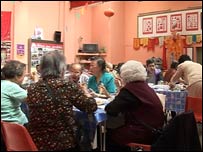 The centre is on Stowell Street "It's impossible to find other musicians in the community to give a public performance. Young Chinese have more interesting things to do now. Very soon, this tradition will die," he adds with despair. Next generationDecades ago, immigrants from Hong Kong came over to Britain and to the North East of England in search of work. They quickly prospered, setting up shops in the business of food and catering. Tucking into Chinese food quickly became a British habit. Traditionally, Chinese restaurants have always been a family affair, being passed on from one generation to another. But now the older generation are seeing a change in their young ones. While some are taking on the food business with an air of resignation, others are rebelling, leaving home for other careers. 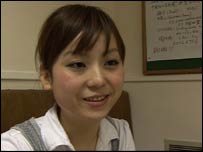 Sheng Hua helps the elders at the centre In the North East, this change is most noticeable at Stowell Street, in Chinatown, Newcastle. The Newcastle Chinese Centre was built by the older generation of immigrants as a place for rest and refuge, where one could discuss problems; a hub for bonding in the community. While there is always a steady stream of people coming in to partake of the sumptuous free meals most of them are elderly people. Young faces are noticeably rare. 'More English than Chinese'Victor Akwan Chan, the manager, says that it's slowly reaching crisis proportions. In spite of his efforts in conceiving projects for youngsters very few of them turn up. "They don't even speak our language now," he says. "In some families there is very little communication between the two generations because the parents speak only Chinese, and their children English. 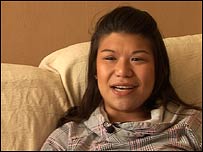 Mandy feels more British than Chinese "Parents have been so busy in their takeaways, they've never had the time to teach their children Chinese!" "The ones born here are not Chinese anymore, they are English," says Sheng Hua, an aspiring Miss China contestant. "They don't want to hold on to the past anymore. They want to move on." Mandy Wong is a striking example. "I used to go the Chinese school to learn the language. I looked around and realised I was more English than Chinese," she says. Meanwhile, as Andrew struggles to continue his father's legacy, there is a rising feeling of loss at the Newcastle Chinese Centre - that of old traditions being forgotten, of times changing, and the young ones turning away. last updated: 21/07/2008 at 13:05 You are in: Tyne > People > Your Stories > On the turning away |
| | About the BBC | Help | Terms of Use | Privacy & Cookies Policy |