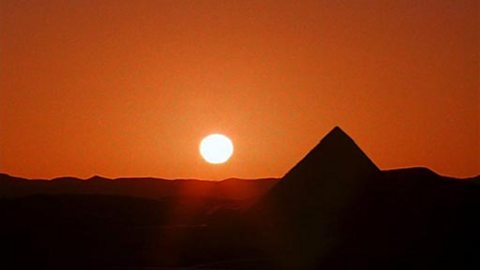
MIRANDA KRESTOVNIKOFF: Boats brought healthy, strong men like Nakht and Deba to work for the king. They built tombs, temples and pyramids - like this one. Nakht saw it from the boat. It's the first pyramid ever built - the Step Pyramid at Saqqara, on the banks of the Nile, just south of Giza.
NAKHT: Soon after we saw the great stone steps, we began to see boats. And more boats… and even more! I didn't think there were that many on the whole river! They were filled to overflowing with cattle, goats, pots, timber and stone. Then on the riverbank we could see a busy settlement. "This is it," I said to Deba. "This is where we are going."
As we turned towards the riverbank, Carramer told us that we had grown soft on the journey and would have to become hard now to survive in the service of the King. "But to do what in the service of the king?" we wondered.
Late in the morning we arrived at Giza, and began to climb. Away from the river and up towards the desert plateau above us. On the plateau was a row of huts, where we were told there was a place for us.
We found our place - a reed mat we were to share. All around us there were others - talking and eating…fruits, bread, beer. Every sort of food. And it was brought to them! Deba didn't speak - neither did I. This new place was different. Not like our village at all.
Just after sunrise the next morning, we were woken and led across the plateau. I heard the sound of the quarry before I saw it.When I did see it… I gasped! Everywhere there were men working. I'd never seen so many people working together in one place.
There were men standing high up in the rock chipping away at it, and using chunks of wood to break it into blocks. There were men carrying water, and others crouching over fires hammering metal spikes. There were groups of men hauling the great stone blocks cut from the rock on wooden sleds.
And the noise… I couldn't hear Deba speaking to me! The air was filled with the sound of metal on stone, of people shouting,of rock crashing to the ground. "What could our task be," I wondered, "in all of this?"
Video summary
In this reconstruction, we follow the journey of an enslaved worker as he travels up the Nile on a boat to Giza, where he joins an army of workers tasked with building a new pyramid.
This clip is from the BBC Primary History series, Pyramid - In the Name of the King.
Teacher Notes
Pupils could discuss the various jobs being completed at the quarry and note down each of these jobs, sequencing them in the order they must be completed. How was it decided who would complete each job?
Working in groups, these different jobs could be allocated to pupils. How many people would complete each job? Who is best suited?
Pupils could also discuss if there were some jobs that were better than others and who would get the 'better' jobs.
This could lead to a discussion about the ethical issues of labour on such projects and could link to studies on human and children's rights.
Please note, these clips contain a dramatised reconstruction of people building the pyramids, including some scenes of the working conditions they faced that young audiences might find disturbing. Teacher review is advised prior to showing to your class.
This video is relevant for teaching KS2 History in England, Wales and Northern Ireland and second level in Scotland.
Building the pyramids - part 1 of 5. video
How were the mighty pyramids built? This reconstruction shows how a young Egyptian boy is recruited to leave his family and work on an incredible project.
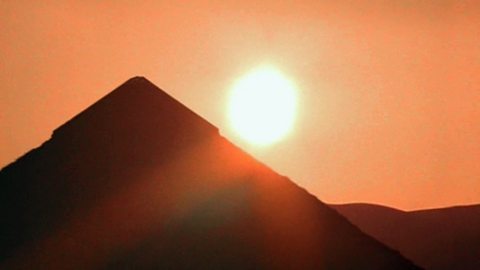
Building the pyramids - part 3 of 5. video
This reconstruction shows the young enslaved workers join an army of haulers dragging blocks of stone into position as the building of the pyramid begins.
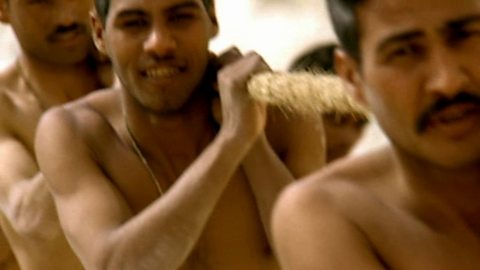
Building the pyramids - part 4 of 5. video
This clip presents an explanation of the kind of tools the ancient Egyptians used in fashioning stone blocks for the pyramids as the workers get a first glimpse of the huge project they are working on.
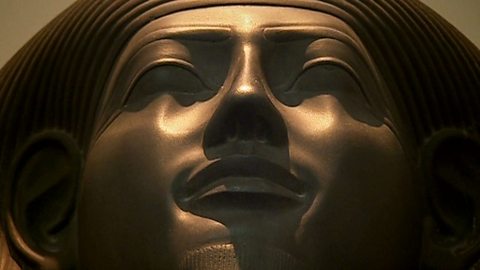
Building the pyramids - part 5 of 5. video
A video reconstruction describing how the final touches were added to the Great Pyramid of Khufu.
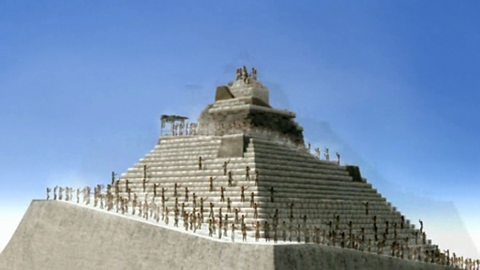
Building the pyramids accurately - part 1 of 2. video
To build the pyramids, the ancient Egyptians had to use incredible precision and exact measurements. In this clip, Miranda Krestovnikoff explains how they did this.
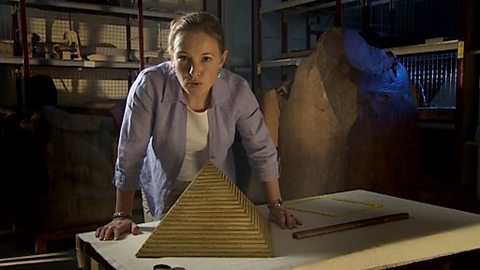
Building the pyramids accurately - part 2 of 2. video
The Egyptians needed to be precise in their calculations to build the pyramids. Miranda Krestovnikoff uses the example of the 'bent pyramid' in Egypt to show what happens when those calculations go wrong.
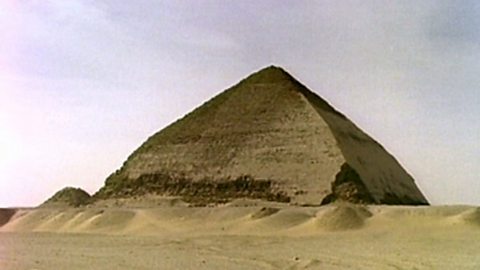
Ancient Egyptian beliefs and the construction of the pyramids. video
The ancient Egyptians believed in a God of the Sun who could be reborn in the afterlife. They also believed the position of the stars pointed the way to the afterlife.