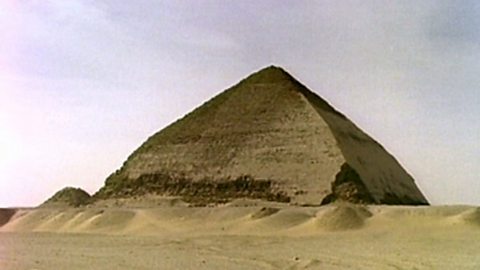
MIRANDA KRESTOVNIKOFF: According to ancient Egyptian myths, there was once, in the middle of eternal darkness, an endless ocean of lifeless water. Out of this ocean sprang the first mound of earth, the Sun God, and the first sunrise.
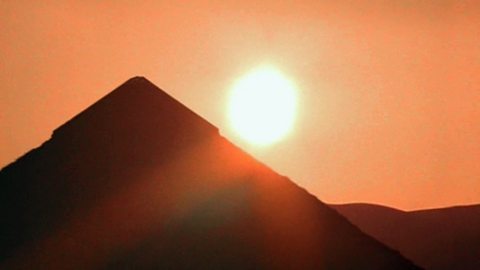
From that time on, the Sun God existed in a never-ending cycle of death and rebirth. Ancient Egyptians believed that each day, as the sun vanished below the horizon in the western sky, the Sun God died, travelled through the underworld in darkness and was born again next morning in the east.
By building the pyramids, ancient Egyptians believed they could make certain that, just like the Sun God, their king would be reborn in the afterlife.
These are the Pyramid Texts - they are spells and incantations describing what ancient Egyptians believed happened to their king after death. They say he journeys upwards as a falcon, or is carried by storms in the boat of the Sun God or on the ladder of the sky.They say that at the end of his journey, the king can go forth among the Indestructibles.
It seems the ancient Egyptians believed that the unchanging place in the sky occupied by the circumpolar stars was the location of the afterlife. And they constructed the Great Pyramid to send the king there. The pyramid is a solid mass of limestone blocks, except for passages and chambers.
From an entrance on the north face, passages lead to a chamber below ground, a second one above ground and a third, high up in the pyramid at the end of the Grand Gallery.
This third chamber is the most important. It was built as the final resting place of the king, and inside it is the great stone sarcophagus to hold his coffin.
Built into the walls is the opening to a narrow shaft, 20cm square. The other end of this shaft is high up on the side of the pyramid.It points, like a telescope, at the circumpolar stars, guiding the dead king, archaeologists think, to eternal life among the Indestructibles.
Video summary
In this video, the narrator explains the ancient Egyptian beliefs in the Sun God and how the pyramids were built so the Sun God could be reborn in the afterlife.
The Egyptians believed the unchanging position of the stars was the location of the afterlife, and this determined the way they constructed the Great Pyramid.
This clip is from the BBC Primary History series, Pyramid - The Great Pyramid of Khufu.
Teacher Notes
Pupils could research how the pyramids were built using the internet or school library.
They could then create their own Egyptian pyramid in the school sand pit. Being sure to dampen the sand beforehand, pupils could be given square containers to work with in order to create the bricks.
The pupils could begin with the base and each could take it in turn to create the bricks.
This video is relevant for teaching KS2 History in England, Wales and Northern Ireland and second level in Scotland.
Building the pyramids - part 1 of 5. video
How were the mighty pyramids built? This reconstruction shows how a young Egyptian boy is recruited to leave his family and work on an incredible project.
Building the pyramids - part 2 of 5. video
In this reconstruction, Nakht and Deba take a boat up the River Nile with other slave workers to start work on the building of the pyramid.

Building the pyramids - part 3 of 5. video
This reconstruction shows the young enslaved workers join an army of haulers dragging blocks of stone into position as the building of the pyramid begins.

Building the pyramids - part 4 of 5. video
This clip presents an explanation of the kind of tools the ancient Egyptians used in fashioning stone blocks for the pyramids as the workers get a first glimpse of the huge project they are working on.
Building the pyramids - part 5 of 5. video
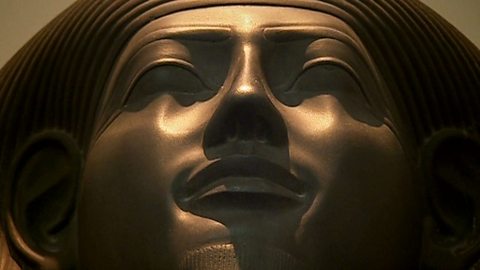
A video reconstruction describing how the final touches were added to the Great Pyramid of Khufu.
Building the pyramids accurately - part 1 of 2. video
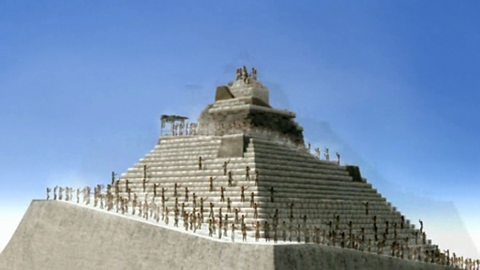
To build the pyramids, the ancient Egyptians had to use incredible precision and exact measurements. In this clip, Miranda Krestovnikoff explains how they did this.
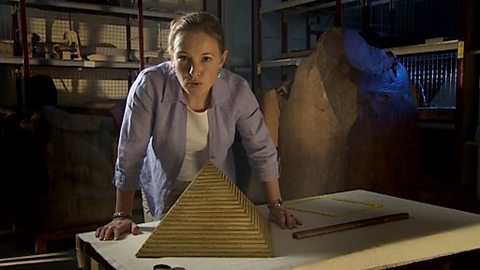
Building the pyramids accurately - part 2 of 2. video
The Egyptians needed to be precise in their calculations to build the pyramids. Miranda Krestovnikoff uses the example of the 'bent pyramid' in Egypt to show what happens when those calculations go wrong.