Ade Adepitan travels to Svalbard to find out how rising temperatures are affecting the local community.
Video
ADE: Hi, I’m Ade and I’ve come to Svalbard. It’s a series of islands just a few hundred miles away from the North Pole and it’s absolutely beautiful.
I wanted to understand how climate change is affecting people’s lives here and how increasing temperatures are becoming a problem. Martin Munck runs a dogsled business called Green Dog. He has around 200 huskies and makes his money taking tourists on dog sled tours.
MARTIN MUNCK: So up here we have these cages where they’re mainly used for giving birth. Come and have a look at these guys.
ADE: Yeah let’s have a look.
MARTIN MUNCK: They’re eager to get away.
ADE: Hello. How old are these pups?
MARTIN MUNCK: Born the 8th of September.
ADE: 8th of September. So these pups are coming up to about two months old. They're quite strong and sturdy for two months old.
MARTIN MUNCK: Growing super-fast.
ADE: When do you start putting them to work then?
MARTIN MUNCK: When they’re around 8 months old we put them on the sled and let them work. It's so funny to see how they when they're eight months old, they are making a lot of mess and fooling around and haven't figured out what the whole meaning of life is. And then you put them on the sled with some older dogs in front and it's like clicks in the brain and they're just so happy and so focused to go and to pull as a group. Getting frustrated that they're not out with their brothers.
ADE: Come on out. Look at all these puppies. Scared of the stairs. I know what it's like. I know what it's like with stairs. He's underneath my chair. He's just chilling out.
I was visiting when the snow wasn’t yet thick enough for proper sledding, but luckily for me we could use wheels instead of skis.
Look at them. They’re super-excited now. They know what time it is, it’s like Christmas has come early. Yo! What’s up tractors! Martin get back there! It’s like an engine revving up! They’re just tugging. I can feel the dog power.
MARTIN MUNCK: Yeah, OK, we go.
ADE: Yehoo! Whoo! What are you saying to them?
MARTIN MUNCK: It’s not so important what I’m saying it’s the way I say it. If I want to speed them up I try to sound happy.
ADE: Woooo!
MARTIN MUNCK: Yeah, exactly.
ADE: Oh, they’re going now! Wow, come on!
MARTIN MUNCK: They’re slowing down because there’s a speed limit in town.
ADE: Wow! So how cold does it get out here?
MARTIN MUNCK: So this winter we had minus 30 for quite a long time. But that’s not a problem. What we have to be careful about is the heat.
ADE: What sort of temperatures has it got up to?
MARTIN MUNCK: Well, we had the record this summer with the I think it was twenty-two degrees. It's never happened before that Svalbard had more than one day with 20 degrees. But this year we had four days with 20 degrees. If we go run these dogs in 20 degrees plus we kill them.
ADE: Seriously? It’s that dangerous?
MARTIN MUNCK: Yeah.
ADE: Have you lost any dogs to the summer?
MARTIN MUNCK: Yes, unfortunately, that's why I know. There's a lot of things that we are experiencing for the first time. I've been doing this for, what, twenty-three years and we never had that problem before that it's getting too warm.
ADE: Are you worried about this?
MARTIN MUNCK: Yeah. I mean business-wise I wouldn't… I'm not sure that you could actually do what we are doing in I don't know, 15 years.
ADE: Average winter temperatures here have risen by more than 6 degrees Celsius in just 50 years, a far greater increase than most other places on the planet. If things carry on like this, dogsledding on Svalbard could soon be a thing of the past.
Video summary
Download/print a transcript of the video.
Ade Adepitan travels to Svalbard to see the effects of rising temperatures on a dog-sled business.
Climate change is affecting Svalbard. Average winter temperatures have risen by more than six degrees Celsius in just 50 years - a far greater increase than most other places on the planet. Summer temperatures are also at record highs. Martin Munck's dog-sled business is already feeling the effects and he wonders if dog-sledding on Svalbard will soon be a thing of the past.
This clip is taken from the BBC Two series Climate change: Ade on the frontline.
Teacher notes
Download/print a pdf of the Teacher Notes.
Teacher Notes prepared in partnership with the Geographical Association.
Before watching the film
This film is set in Svalbard, a group of islands belonging to Norway, inside the Arctic Circle. You might want to ask students where Svalbard is and establish its northerly aspect. You could ask students how they think climate change is affecting people’s lives here.
You might also ask students to suggest some ways that people earn a living in these islands. These could be useful ideas to return to after watching the film and answering questions.
During the film
You may wish to stop at relevant points during this short film to pose questions and check understanding or wait until the end. Useful questions might include:
- What is this place like?
- Why do you think Martin runs a dog-sledding business? Why would this be attractive to tourists?
- How long has he been doing this job?
- What are the extremes of temperature? Martin says that minus 30 degrees Celsius is not uncommon but that days above 20 degrees are. It used to be unusual to have one day above 20 degrees and recently there were four, he says. You might want to note the huge temperature range – about 50 degrees! That is a lot to adapt to.
- What is the effect of higher temperatures on the dogs? Why is this?
- You might discuss how the dogs are adapted for the extreme environment, they live outside and are used to working by running at speed which would warm them up too. You might also discuss how the dogs run best on snow cover and that with increased melt, when they are pulling sleds on ground that is naturally stony, this could hurt their feet.
- How long does Martin say he thinks he has before this job is unworkable? He says about 15 years at most, but he admits he has already lost some dogs.
- You could ask the students what they would do in his shoes. What options does he have?
Following on from the film
You could check Svalbard on a map and look at aerial imagery to describe its terrain, as well as using ideas from what has been seen on the film. You might want to name some of the islands and locate the largest town, Longyearbyen. You could also ask students to research the land area and find out how many people live there.
Svalbard has seen an average winter temperature rise of six degrees in just 50 years. You could ask students to suggest why the effects of climate change, such as increased temperature, are being felt more in the Polar Regions? This could provide a useful discussion about feedback loops as ice melts and some reflectivity (albedo) is lost, meaning that more energy can be absorbed. Warming ocean currents also help to melt the ice and as permafrost melts, potent methane is released – increasing the effect of greenhouse gases in the atmosphere.
You might ask the students to check the temperature statistics in Svalbard over the past decades, using climate records, and predict what the average winter temperature might be in 15 years if climate change continues at the current rate.
Students could also research to check how accurate their ideas were about the jobs and employment opportunities on Svalbard.
You could ask students to imagine that they were Martin, and write three diary entries ten years apart, and as if climate change was continuing unchecked. They could write about their current life, their life in 10 and then 20 years’ time. What might Martin be doing then?
What other jobs, particularly traditional ones, are at risk for people living in the Arctic Circle because of climate change? Students could select and write about two case studies.
But it is not only humans who are affected by increasing temperatures in the Polar Regions. Ice cover and permafrost is disappearing. What is the impact of this changing landscape on the animals who usually live here, and will they be able to adapt? Students could research what is known about the changing populations of polar bears for example.
What mitigation strategies are there that we can do to halt the pace of climate change? You could ask students to identify what these are and explain how this might have beneficial impacts on places like Svalbard. Students might also identify adaptation strategies such as changing the way that people make their living.
Curriculum notes
This short film is suitable for teaching KS3 and KS4 students. It can be used alongside the other Ade Adepitan films about climate change or watched on its own. All the films build on students’ understanding of climate change issues and enable them to make global connections.
This film supports the KS3 geography curriculum through work on environmental and human interactions and issues, changing climate and human activity.
At KS4 this supports work on understanding natural hazards, particularly climate change and its related impacts.
This clip could be used to support the delivery of geography to KS3 and KS4 students. Specifically, this topic appears in OCR, Edexcel, AQA, WJEC KS4/GCSE in England, Progression Step 5/GCSE in Wales, CCEA GCSE in Northern Ireland and SQA National 4/5 in Scotland.
More videos from this series
Peatlands in Sweden. video
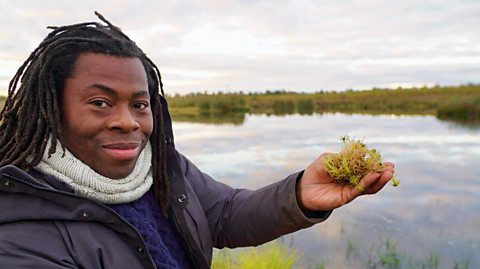
Ade Adepitan travels to Sweden to see how restoring peatlands can help us fight climate change.
Sustainable power in Copenhagen, Denmark. video
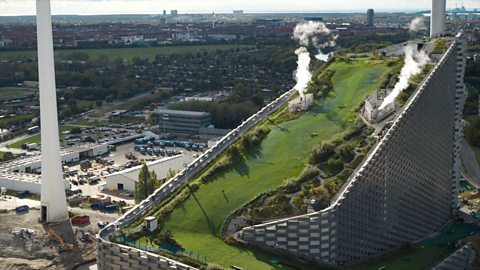
Ade Adepitan travels to CopenHill, an energy plant in Copenhagen that runs on rubbish rather than fossil fuels.
Hydrogen house in Gothenburg, Sweden. video
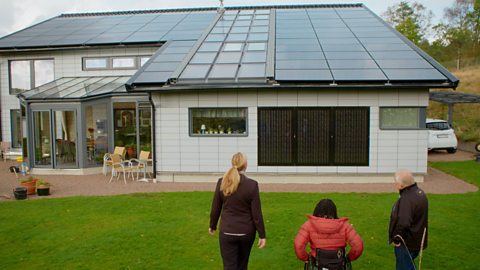
Ade Adepitan visits a special house in Gothenburg, which is powered by converting excess summer sun into hydrogen.