Aim
Inviting students to play along with a fictional maths problem game and use their numeracy skills to plan out a party. Building confidence with everyday mathematical applications.
The video
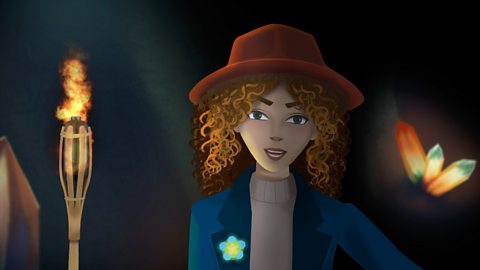
Hi guys! Thanks for joining me today - I want to show you this ancient game that my dad used to play. Yes, it’s that old - but I’ve found out it’s great to help me with my maths! Let’s get into it!
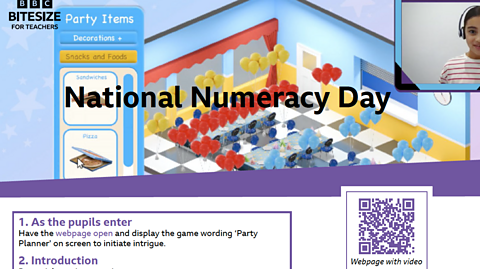
The game’s called Party Planner and you can plan your dream birthday party - all against the clock of course!
First up - the guest list.… How many people are coming? I’ve 23 friends, plus me, that’s 24 people in total, which means I’ll need a medium sized room, big enough for 20-30 people.
Ok, here’s my room. I like the retro look! To get things started I need to answer this question about area correctly!
If each of the tiles in my room is one metre squared, what is the total area?
So this is… 8 metres squared or 8 x 8 which is…64 so this room’s area is 64 square metres. Yay!
The party starts at 5 o’clock. It’s 4 o’clock now which means I’ve got an hour until the party starts. Loads of time I hope!
Right then. Tables and chairs. Each table can seat 8 people. I’ve 24 people. 24 divided by 8 is…3 - so we’ll need 3 tables.
Boom - tables unlocked.
Now onto decorations - and balloons are giving party vibes, am I right guys? But how many do we have?
There are different coloured balloons to choose from. I’ll get… 36 red balloons (my favourite colour!) ……27 blue, and …. let’s say 22 yellow.
But how many is that in total?
So in the first column we have 6 plus 7 plus 2 which equals 15, so 5 goes here and we carry the 1. Then the second column is 3 plus 2 plus 2 plus that carried over 1 which equals 8. We’ve got 85 balloons in total.
Quick time check - it’s ten to five which means I’ve only got 10 mins till the party starts! Argh we’re running out of time!
We can’t forget the party food! I need your help guys, sandwiches or pizzas? Do thumbs up for sandwiches and hearts for pizzas…
OK - looks like it’s pizza!
There are 24 of us, each person will want a quarter of a pizza.
I’m going to cut each pizza into quarters so one pizza gives us 4 slices.
How many pizzas will we need for 24 quarters?
We can work it out with division: 24 divided by 4 equals? 6 pizzas!
We can double check that if we know our times tables, 4 x 6 = 24.
Yay, pizzas unlocked.
And all just in time! 5 o’clock, time to get the party started!
I hope you enjoyed playing along with me today. Bye everyone!
Video summary
National Numeracy Day is celebrated every year on the third Wednesday in May. It is an opportunity to celebrate all things numeracy and build confidence with numbers. Each year has a theme.
This video explores the following:
- A student introduces a fictional maths-based computer game called ‘Party Planner’ where you plan a birthday party against the clock
- While planning the party, she uses different numeracy and problem-solving skills related to multiplication, division, fractions and addition, e.g. adding the number of different coloured balloons using column addition
- She finishes planning out the party just in time, and completes the game.
Video questions
Before watching the video:
Discuss with the students whether they enjoy maths lessons, numeracy and numbers. Can they offer suggestions for the kinds of fun activities that could be organised for National Numeracy Day in their school?
Ask the students to explain what they already know about maths problem solving, e.g. often it involves real life problems that need to be solved.
After watching the video
Discussion questions:
- Why do you think learning numeracy skills is important for things outside of school, like shopping, cooking or telling the time?
- Why do you think playing games (like the one in the video) is a good way to engage with numeracy and numbers?
- Can you think of a time in your own life when you used numbers or measurements to solve a problem?
Activity ideas:
- Students have a 'maths treasure hunt' where they have various maths clues they need to solve towork out the next location to go to in the school buildings/playground.
- Mark out a large number grid (with nine numbers) with chalk outside, or with masking tape inside. For younger students, the numbers could be below ten and for older children the numbers could be two digits. You call out a challenge, e.g. ‘jump with two feet onto an odd number’; ‘make seven by jumping onto two different numbers and adding them'.
Key terminology
Introduce key terminology, including:
- Numeracy: a good basic knowledge of mathematics; the ability to understand and work with numbers
- Mathematics: the study of numbers and shapes; branches of mathematics include arithmetic, algebra, geometry and trigonometry
- Problem solving: the act of finding ways of dealing with problems
- Reasoning: the process of thinking about things in a logical way; opinions and ideas that are based on logical thinking
- Addition: a thing that is added to something else
- Multiplication: the act or process of multiplying numbers
- Division: the process or result of dividing into separate parts; the process of dividing something or sharing it out
- Fraction: a small part or amount of something
- Area: the amount of space covered by a flat surface or piece of land, described as a measurement.
Resources
Suggested framework
1. Entry
Show a simple mathematics problem on the screen that has a fun real-life context.
2. Introduction
Potential starting questions:
- Were you able to solve the problem on the screen?
- Do you enjoy problem solving in numeracy/maths lessons?
- Do you know when Numeracy Day is this year?
3. Show the video
You may wish to stop at relevant points during this short film to pose questions and check understanding or wait until the end. Use full questions:
- What is the name of the game the student is playing in the video?
- How did knowing the area of the room help Florence with solving the maths problem?
- How was knowing her eight times table helpful for her when she worked out the number of tables and chairs that she would need?
- Did the way that Florence laid out her column addition look the same as the way you complete addition questions in maths lessons? Is there another way she could have calculated it?
- Do you think the division problem would have been more difficult if sandwiches rather than pizzas had been chosen? Why? Or why not?
- Could you think of your own game, like the one in the video, that could help you and your classmates with maths?
4. After the video - Time to talk
Some reflections on Numeracy Day and celebrating numeracy and numbers.
- How could children celebrate Numeracy Day at their school next year? [Students offer ideas.]
- Have a final moment for quiet reflection, e.g. the students can think about how important it is to increase our confidence with numeracy and numbers as it will help in our everyday lives; the students can think about how celebrating days like Numeracy Day can really help people to enjoy numeracy and numbers.
5. Opportunity to sing
If your assembly includes a song this is an opportunity to sing it. We have lots of songs to support assemblies and Collective Worship.
6. Closing the assembly
Some reflections on Numeracy Day and celebrating numeracy and numbers.
- How could we celebrate Numeracy Day at our school next year? [Invite responses.]
- Have a final moment for quiet reflection - eg pupils can think about how important it is to increase our confidence with numeracy and numbers as it will help in our everyday lives; they can think about how celebrating days like Numeracy Day can really help people to enjoy numeracy and numbers.
Related links
Super Movers 7-11 Maths Collection. collection
Discover active learning maths videos for 7-11 year-olds featuring Max and Harvey, Ben Shires and the Worst Witch.

KS2 Maths teaching resources: Measurement and Geometry. collection
In this collection of films two children learn and demonstrate geometry and measurement skills, to make sure that the key elements of a virtual city are measured and placed correctly.
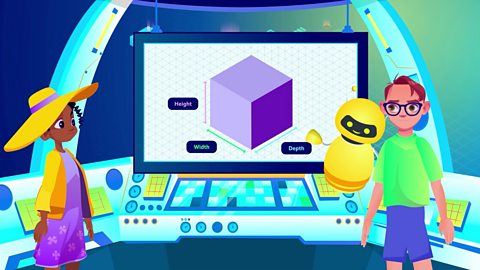
Hypatia's Mathematical Maze. collection
A series of short animated films for primary schools, following the adventures of Olivia and Hassan as they're challenged with maths problems to find their way through Hypatia's mathematical maze.