Aim
To learn about dinosaurs, palaeontology, and the ancient natural history of Earth and to consider the evolution of life on our planet and how fossils help us to understand the history of dinosaurs. Dinosaur Day is celebrated on 1 June every year.
The video
Kieran:
Dinosaurs roamed the earth for over 170 million years. They had a long reign, which came to a dramatic end around 66 million years ago.
A small group of feathered dinosaurs survived, and over millions of years evolved to become the birds we see today.
Some dinosaur remains were buried in the ground and fossilized over millions of years.
For thousands of years humans have probably been stumbling over fossils without knowing what they were.
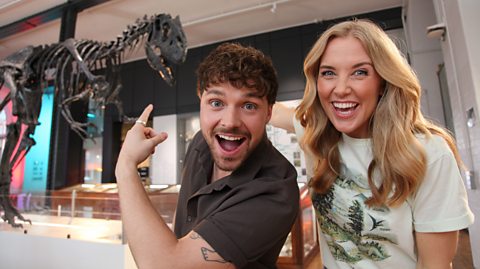
It’s only in the last few centuries that palaeontologists, that’s a word for a fossil expert like me, have pieced together what we understand about prehistoric life now.
Although it’s safe to say some mistakes were made along the way.
In 1663 scientists thought they had discovered the remains of a mythical unicorn.
In fact it was the fossilized bones from a now extinct woolly rhinoceros, woolly mammoth and a narwhal tusk.
This strange ‘mash up’ was known as the Magdeburg Unicorn.
It wasn’t until the 1800s that the first breakthroughs were made.
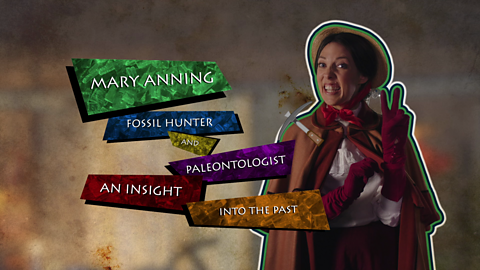
It was here on the Jurassic coastline in Dorset that Mary Anning found the first of many incredible fossil discoveries.
In fact, one of her first really famous fossil discoveries was when she and her brother Joseph found the first fossil to be called an Ichthyosaurus in 1811.
And the stones on the beach are still a treasure trove of prehistoric fossils today.
Okay, guys, so as we've been walking down here, we've been very fortunate that we've come across a very special type of rock which is called a nodule.
And it's a particular type of stone that has the possibility of having a really nice fossil inside.
Now, if this was still in the cliff, we wouldn't be allowed to take it.
But we're lucky that we found it loose on the beach and so we can safely open it up without breaking any rules.
Before we hit this, we need to make sure we're wearing our safety goggles.
I can see that you guys have already got yours on so that’s good.
Right, so fingers crossed, guys. Let's have a little look and see.
Oh look at that! There's a lovely little one there.
Child 1:
So how old is it?
Kieran:
So this ammonite here that we've just found is between 195 and 200 million years old, and it dates back to the early Jurassic period. To think how long it's been in there waiting for us to find it.
So these fossils have gone through the same process that dinosaur fossils have also gone through.
In 1824 the Megalosaurus was the first dinosaur to be named.
It means ‘great lizard’. Initially this carnivore was thought to have a lizard-like posture, but we understand now it had a more of a horizontal stance.
And it’s likely it had feathers!
In fact the name ‘dinosaur’ wasn’t created for another 18 years, combining the Greek words ‘deinos’, or terrible with ‘sauros’ which means lizard. Dinosaur literally means ‘terrible lizard!
The Iguanodon was an elephant-sized herbivore.
With only a few teeth and bones to work from, at first scientists imagined it looked like a lizard - but after a complete skeleton was discovered - palaeontologists thought it looked more like this… and the spike didn’t go on its nose but on its thumb instead. Much more practical!
Child 2:
What's your favourite dinosaur fact?
Kieran:
By the time T. rex appeared on our planet, Stegosaurs had already become fossils.
They didn't actually live together at the same time. That's how far apart those animals existed.
Child 3:
How do we know what dinosaurs look like?
Kieran:
I think the truth to that is we're never going to be 100% sure what they look like.
But there are some dinosaur fossils that are so well preserved that they give us a much clearer idea of what they would have looked like.
That's pretty amazing, isn't it? Yeah?
New discoveries are still being made, science and technology are always evolving.
I can't wait to find out what more we’ll discover in the future!
This video explores the following:
- When dinosaurs existed on Earth and how most were made extinct, except for a few that then evolved into birds
- Victorian discoveries of dinosaur fossils and the early scientific mistakes made in interpreting them
- How, in the 1800s, fossils became better understood and the word ‘dinosaur’ was first used
- Mary Anning made important discoveries in Dorset, including the first complete skeleton of a Ichthyosaurus
- A paleontologist called Kieran goes fossil hunting on the beach with some school students. He shows them how to find fossils like ammonites by breaking open rocks. He tells the students some interesting facts about dinosaurs and fossils.
Video questions
Ask the students if they have ever heard of Dinosaur Day. Explain that it is held every year on the 1st June and it’s a celebration of dinosaurs and palaeontology.
Show a map of the UK and point out Lyme Regis. Explain that Lyme Regis is a place on the ‘Jurassic Coast’. People have been finding fossils in the rocks on the beaches there for around 200 years.
Discuss with the students whether they know how a fossil is formed. Ask: ‘Do we only have evidence of the fossils of dinosaurs, or are there fossils of other living things?’
- Ask the students to explain what they already know about dinosaurs, e.g. they were reptiles; some were carnivores and some were herbivores; dinosaurs became extinct.
After watching the video
Discussion questions
- What do you think we can learn about the Earth from studying dinosaurs and fossils?
- If it were possible to, which dinosaur would you like to see in real life? Why?
- If you had the chance to meet a palaeontologist, what questions would you ask them?
Key terminology
Introduce key terminology, including:
- dinosaur: a reptile that lived millions of years ago but is now extinct
- extinct: a type of plant or animal that no longer exists
- fossil: the parts of a dead animal or plant that have become hard and turned into rock
- fossilise: to make an animal or a plant become a fossil; to become a fossil
- palaeontology: the study of fossils as a guide to the history of life on Earth
- palaeontologist: a person who studies fossils
- evolution: the slow steady development of plants, animals etc. during the history of the Earth, as they adapt to changes in their environment
- prehistoric: connected with the time in history before information was written down
- geology: the scientific study of the physical structure of the Earth, including the origin and history of its rocks and soil.
Resources
Suggested framework
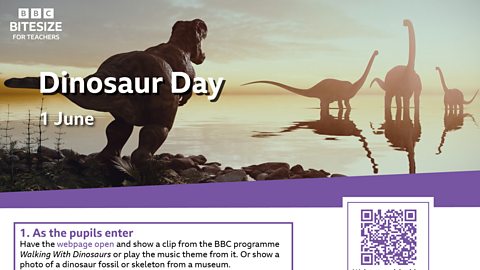
1. As pupils enter
Show a clip from the BBC programme Walking With Dinosaurs or play the theme music for it. Or show a photo of a dinosaur fossil or skeleton from a museum.
2. Introduction
Potential starting questions:
- Do you know what this is showing?
- Have you ever seen a TV programme or a film that shows dinosaurs?
- Do you know how long-ago dinosaurs lived on Earth?
3. Play the video
(Duration: 4min 24secs Final words: ‘…"we’ll discover in the future!'")
You may wish to stop at relevant points during the video to pose questions and check understanding, or wait until the end.
4. After the video - Time to talk
Lead a discussion by asking some or all of the following questions:
- When did the time of the dinosaurs come to an end?
- What do scientists think the feathered dinosaurs that weren’t made extinct evolved into?
- What did the remains of dinosaurs turn into over millions of years?
- In 1663 scientists thought they’d found a unicorn. What had they really found?
- In what year did Mary Anning find an Ichthyosaurus fossil in Dorset?
- Sir Richard Owen first used the term ‘dinosaur’ in 1842. He grouped the Megalosaurus with two other dinosaurs, Iguanodon and Hylaeosaurus. How is this evidence of Owen using scientific classification?
- Which dinosaur’s name do you think means ‘fish lizard’, Diplodocus or Ichthyosaurus?
- How did natural geology help Kieran and the students find a fossil on the Lyme Regis beach?
- What does ‘dinosaur’ mean if we look at its two Greek root words?
- How do we know what dinosaurs might have looked like?
5. Opportunity to sing
If your assembly includes a song this is an opportunity to sing it.
6. Closing the assembly
Some reflections on Dinosaur Day.
- Do you think you would like to learn more about dinosaurs and fossils in the future? [Ask for a show of hands]
- Have a final moment for quiet reflection, e.g. the students can think about the impact of dinosaurs in the past and up until today; the students can think about the importance of examining fossils to better our understanding of the history of life on Earth.
7. Music
You could play suitable music as pupils leave in silence.
Useful links
The following links could be used as research or provided to students after the assembly.
BBC Bitesize ‘Horrible Science: Meteor for the Dinosaurs’
BBC Bitesize ‘Science KS1 − Dinosaur Discovery’
BBC Bitesize ‘Dinosaurs − KS1’
BBC Bitesize article: ‘Are scientists bringing back dinosaurs?’
BBC Bitesize ‘Science/Biology KS2/KS3: How dinosaurs footprints get made in solid rock’
Related links
Watch again: Walking With Dinosaurs – Live Lesson. video
We take your class back in time in this Walking With Dinosaurs KS2 Live Lesson.
Fossils
Learn about fossils with this Year 3 Bitesize Science guide.
The work of Mary Anning. video
This vlog style film explores the work of Mary Anning; the famous paleontologist and fossil hunter.