Aim
To learn about the history and purpose of Black History Month in the UK, enhancing awareness and understanding of why it is so important, alongside the role that black British people have played in the advancement of civil rights.
The video
Black History Month is a time to recognise the achievements and contributions of black people.
It began in the United States in 1926 and has been marked in the UK every October since 1987.
Today, people take part in remembering, learning, and celebrating black individuals, campaigners and activists, whose work and actions have inspired others.
Around the world, people like Nelson Mandela, and Martin Luther King Jr. are remembered as symbols of the fight for equality and freedom.
Experiences of black people have shaped the civil rights movement in Britain and connected the struggles and achievement of people around the world.
In the 1700s, Ignatius Sancho, who was born enslaved, became the first black man known to vote in Britain, a remarkable act when slavery was still legal.
Ignatius bought himself a shop in this street, because he owned property, he was able to vote.
He was a writer and composer who used both his words and music, to challenge public attitudes and championed the right to be heard.
As time moved on, other pioneering black Britons continued to make an impact.
Mary Seacole was a Jamaican-born, British nurse who travelled to the Crimean War in 1855 to help the wounded.
When her offer to join the nurses on the battlefield was refused, she refused to give up. Instead, she used her own money to set up the British Hotel, where she treated soldiers fighting in the Crimean war.
Her courage and compassion made her beloved by the troops and today, she’s remembered as one of Britain’s pioneering black women.
After World War Two, people from the Caribbean came to Britain to live, work and contribute to the rebuilding of the country.
Known as the Windrush Generation, they brought skills, culture and traditions that shaped music, food and community life across the UK.
Another person who believed culture could unite people and heal communities was Claudia Jones.
She was a journalist and anti-racist activist who brought people together in what was to become the first ever UK Caribbean carnival in 1959.
What began as a small indoor gathering, has grown into today’s Notting Hill Carnival, a world-famous street festival bursting with Caribbean music, dance and pride.
Today, similar carnivals take place across the UK each year.
While some used culture to bring people together, others used protest to make their voices heard.
In 1963, The Bristol Omnibus Company refused to employ Black or Asian bus drivers - known as the colour bar.
Roy Hackett and several others organised and led a four-month boycott that overturned the ban.
This was a turning point in Britain’s fight for equality, inspiring campaigns that led to the Race Relations Act of 1965, the UK’s first law making racial discrimination illegal in the UK for the first time.
In 1968, Sislin Fay Allen became Britain’s first black female police officer. At a time when discrimination was widespread, she took on a job where she wasn’t always welcomed, showing that courage can change attitudes and open doors for others.
And history isn’t only in the past.
Stormzy - one of Britain’s biggest artists - is a leader for change.
The Stormzy Scholarship has paid the university fees for Black students at Cambridge University.
Black History Month explores both the struggle of Black resistance in the UK and a celebration of what has, and what can, be achieved.
These stories are Britain's story, shaping who we are.
They remind us that we all share the responsibility to speak out, challenge injustice, and build a fairer future together.
Video summary
This video explores the following:
- The history of Black History Month and why it is celebrated and remembered each year
- Inspiring black British people from history and their impact on our society today
- The positive themes and ideas linked to supporting black history and equality for all.
Context
Black History Month (BHM) is celebrated in different countries around the world. In the UK it is held in October and is a time to recognise the achievements and contributions of black people across society.
Key terminology
Introduce key terminology, including:
- Racism: discrimination, prejudice or antagonism against a person or people based purely on their race or ethnicity
- Equality: the ideal that all people are treated fairly and have access to the same rights and opportunities in life
- Discrimination: treating someone unfairly because of who they are, or a characteristic they have
- Stereotypes: making a generalised or over simplified belief about people or individuals based a particular characteristic.
Resources
Discussion questions
- Will there always be the need for a Black History Month celebration?
- Why do some people still discriminate against others because of the colour of their skin?
- How can we improve equality and respect for all people everywhere?
Activity ideas
- Students could design a poster or banner that could be displayed during Black History Month, it could focus on an inspiring historical person or theme not covered in this assembly
- Divide the class into groups to discuss the importance of Black History Month
- Design a Black History Month celebration, event or activity that could be held in the students’ own school.
Suggested framework
Related links
Small Axe. collection
Short educational films exploring the lives of London's West Indian community during the 1960s, 70s and 80s, produced alongside the BBC One collection of films directed by Oscar winner Steve McQueen. These films combine extracts from Steve McQueen's collection of films with archive and bespoke narration, to bring significant moments from recent black British history to life for students.

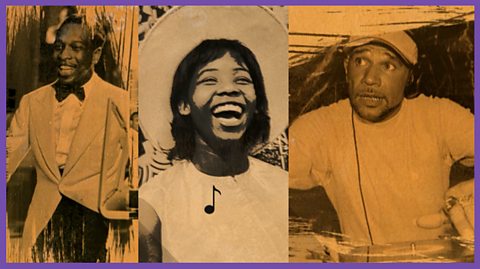
Celebrating black British music. video
Celebrating the contribution of black artists and composers to British music, suitable for Black History Month.
Beyond Black History Month: Teaching black and diverse histories and experiences. video
In partnership with TES, Beyond Black History Month broadcast live on Wednesday 21 October, 2020. This panel discussion programme for teachers was an opportunity to discuss and share ideas and best practice around teaching black and diverse histories and experiences.