Guardiola's legacy will echo through all ages for years to come
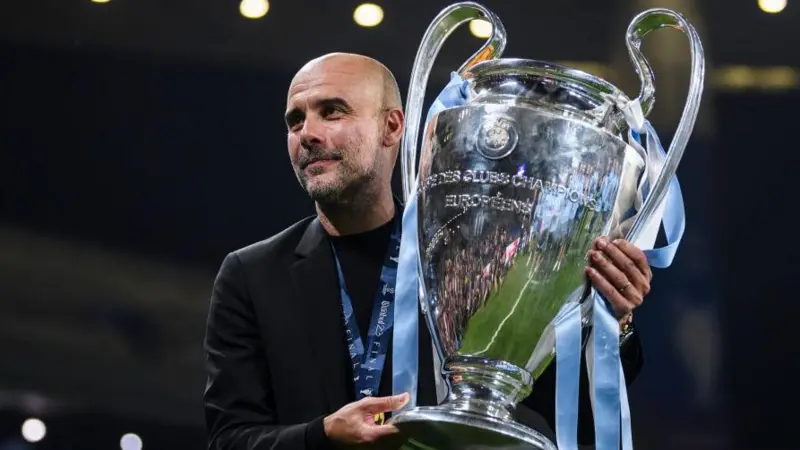
Pep Guardiola's tactical innovations and brushstrokes of genius will leave an imprint from elite to grassroots football
- Published
Pep Guardiola's great mentor and inspiration Johan Cruyff once said: "Winning is an important thing, but to have your own style, to have people copy you, to admire you... this is the greatest gift."
As the Catalan genius announces his departure from Manchester City after a decade in charge, Guardiola's legacy can be seen as a monument to the legendary Dutchman who cast his spell over him as a youngster at Barcelona.
Cruyff said: "Winning is just one day. A reputation will last a lifetime."
Guardiola's will, indeed, last forever.
Six Premier Leagues, the Champions League, three FA Cups, five League Cups, the Uefa Super Cup and Fifa Club World Cup won - all in his own brilliant style, or at least the style he feels Cruyff bequeathed him.
And it is one that has been admired and copied - a gift left behind for the domestic game to study for years to come.
Guardiola to leave Man City after 10 years as boss
- Published22 May
How Guardiola transformed the Premier League tactically
- Published22 May
Guardiola openly admits - with a hefty helping of modesty, it should be stressed - he "knew nothing" about football until he fell under Cruyff's instruction, describing him as "the most influential person in football history".
The high point of Guardiola's relationship with Cruyff came when Barcelona won the European Cup (now Champions League) for the first time against Sampdoria at Wembley in 1992. He was the Barca academy graduate who took his place in the so-called 'Dream Team' alongside stellar names such as goalscorer Ronald Koeman, Michael Laudrup and Hristo Stoichkov.
Now, as Cruyff did in Spain, Guardiola has created a legacy that has changed the face of football at every level in England.
In his decade at City, Guardiola has not just shaped elite football and the game in the league's pyramids. He has had an impact at every level down to grassroots, where even junior coaches adopt his strategies.
As Guardiola has micro-managed City's players like a great conductor from the sidelines, he has produced teams, styles, and tactical innovations that will provide a framework for the modern game, now and in the future.
Guardiola has effectively shaped the game's future at all levels, from Manchester City themselves to the Premier League and throughout Europe.
Mikel Arteta, who is on the verge of beating City to the Premier League title with Arsenal, was given his first senior coaching post as Guardiola's assistant.
Enzo Maresca, expected to succeed Guardiola at Manchester City, was another member of his coaching staff who then went to Leicester City, taking them back into the Premier League before winning the Europa Conference League and the Fifa Club World Cup at Chelsea.
Luis Enrique worked with Barcelona's junior teams under Guardiola before succeeding him and winning the Champions League in 2015. He has since won it again with a superb team at Paris St-Germain and is now in a second successive final against Arsenal in Budapest.
Vincent Kompany, now flourishing at Bayern Munich, learned from Guardiola while Manchester City's captain, while Xabi Alonso - just appointed as new Chelsea manager - worked under him when he moved from Real Madrid to Bayern Munich in 2014.
Quite simply, Guardiola's fingerprints touch football at all levels.
Managers and coaches follow the method of playing out from the back, with the goalkeeper needing to be as good with his feet as with his hands. It was one of the reasons Guardiola jettisoned Joe Hart upon arrival at Etihad Stadium.
'He's changed the face of English football' - Rooney on Guardiola
Watch football at any level and you will see coaches and players, young and old, mimicking what Guardiola has brought to the game. It is, admittedly, employed with varying degrees of success, but it is a Guardiola template.
In its simplest form, Guardiola's football is based on possession. The style formed a glorious contrast with the full-on explosive attacking approach utilised by his great, and greatly respected, rival Jurgen Klopp - manager of a Liverpool side with which City contested domestic and European honours.
Guardiola has said of his approach: "I need my team to have possession. You can lose with possession, but more likely you will lose with less possession. We must do what we believe. I believe in possession. I know everyone wants to copy the winner - but in football and sport no-one wins for ever."
From that foundation, using a "six-second rule" to regain lost possession, Guardiola has produced brushstrokes of tactical brilliance that his peers accept were ingenious and revolutionary.
He has used them to improve teams and players, once again leaving an imprint and leading for others to follow.
Fans in Manchester react to Pep leaving
Guardiola was the orchestrator of the 'false nine' - using a forward to drop deep and drag defenders out of position with Lionel Messi in the role at Barcelona. His sides have also featured 'inverted full-backs' coming inside to exert control in midfield rather than overlapping in orthodox fashion.
Guardiola has also demonstrated how coaches and managers can remove high-class players from their orthodox positions to use them in roles no-one would have regarded as natural.
It is another strategy he will leave behind.
Guardiola utilised diminutive Argentina midfielder Javier Mascherano as a central defender at Barcelona, then transformed Bayern Munich's outstanding right-back Philipp Lahm into an equally effective holding midfield player.
At Manchester City, his prime example has been the use of a world-class central defender in John Stones as a hybrid figure, stepping out of defence into a holding midfield role within games, as and when the situation demanded.
Guardiola used Stones in a 'number eight' role, which he had never played before, when City won the Champions League final against Inter Milan in 2023 in their historic Treble season when they also won the Premier League and FA Cup.
Stones enjoyed the challenge.
"From the start. It goes back to learning," Stones said. "Playing in there you appreciate other people's roles and see their positions from a different perspective."

Pep Guardiola regards legendary Dutchman Johan Cruyff as his mentor and inspiration after playing under him at Barcelona
It proved to be a Guardiola masterstroke - and latterly Matheus Nunes has been transformed successfully from a player signed as a midfielder from Wolverhampton Wanderers in a £53m deal into a right-back, despite the move being mocked as he struggled early in the transition.
Guardiola was occasionally accused of over-thinking, especially when he chose a starting 11 he had never previously used as a collective for the 2021 Champions League final against Chelsea in Porto.
He sent out an array of attacking talent to compensate for his decision not to use either of his outstanding midfield anchors - Fernandinho and Rodri - only for City to go down to a disappointing 1-0 defeat.
This was Guardiola the gambler. On this occasion it failed, but more often than not the workings of this brilliant football mind led to success.
Former City defender Joleon Lescott said: "Pep's legacy is far greater than Manchester City. His legacy and the importance he has had is huge throughout the football pyramid.
"Pep's influence on coaches and football in general is far greater than anyone realises."
It is an influence felt by his contemporaries down the divisions, as Karl Robinson admitted when his Oxford United side faced Guardiola at Manchester City for two seasons in succession in the Carabao Cup.
"Pep intrigues me," said Robinson, who is now head coach of Salford City.
"You can learn from him. I really enjoy his style. I enjoy coaching his style and I enjoy watching it. I have to enjoy the football we're producing in order to enjoy our job and I am sure he is the same.
"What did surprise me was that I had never come up against a coach as intense as him. It was like: 'Wow.' I said to him: 'Come on, do me a favour - we've not touched the ball for 40 minutes and you're asking for a throw-in. Can we at least have that?'"
Guardiola's legacy will not only be the tactical innovations that carry the hallmarks of genius, but the free thinking that has given other coaches right down the pyramid the courage to try their own new ideas, even if they are considered unorthodox. He has made it more mainstream to think outside what is regarded as the natural order of players and positions.
Guardiola has always been a trendsetter, a ruthless, driven winner determined to make his mark wherever he goes before moving on.
His greatest legacy at Manchester City will be the trophies won, the history he has created, the golden memories he leaves behind.
In the wider context and through all areas and ages of the domestic game, he will also leave a legacy of tactical creation and strategic brilliance that will be in plain sight and sustained for years to come.

