Has VAR become a lottery at the World Cup?
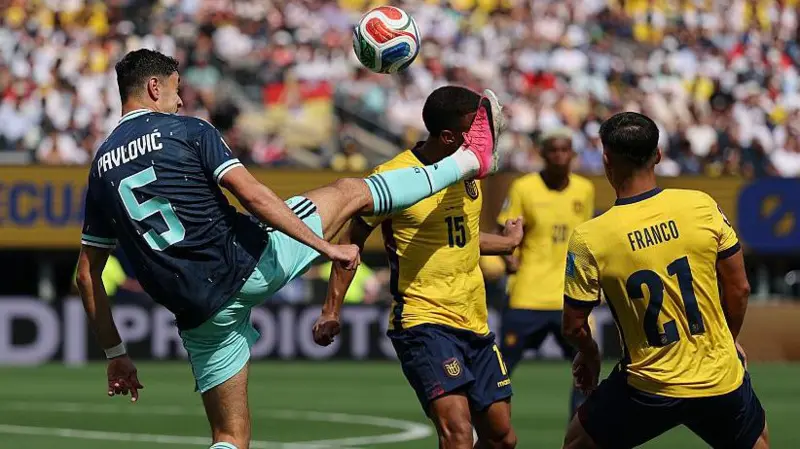
Germany took the lead against Ecuador in the second minute after the VAR opted not to intervene
- Published
Just a few days ago, people were asking whether the video assistant referee system was being used differently at the World Cup.
Now, after a week of strange decisions, fans seem confused about when the VAR is going to get involved.
From Ghana's penalty claim against England, to Brazil's disallowed goal against Scotland and Germany's opener versus Ecuador, it has been difficult to guess what the video official is going to do.
VAR at the World Cup so far is running along similar numbers to the Premier League.
In England last season there was 0.29 interventions a game, at the World Cup it is 0.28.
On subjective interventions, when the referee has to go the monitor, the Premier League had 0.15 per match and the World Cup stands at 0.17.
The longer the World Cup goes on, the more it shows just how difficult it is to have a consistently high bar with VAR.
Pierluigi Collina, Fifa's head of referees, believes that football is a contact sport, and that not all contact is a foul. He wants to see free-flowing games at a higher tempo at this World Cup.
If you let more strong challenges go on the pitch, then the VAR has to adjust accordingly. And the sweet spot for a clear and obvious error is harder to hit.
It is a problem the Premier League has struggled to solve.
'I'm shocked that it wasn't reviewed'

Ghana were denied a penalty which would have given them the chance to take the lead in their 0-0 draw with England
Other competitions have a lower bar for VAR, and the video officials get involved more often.
That creates a cloak of consistency, because people expect interventions, but it does not necessarily mean VAR is being used as originally intended, for the real howlers.
Take the Champions League as a comparison. At 0.47 interventions a game and 0.36 monitor visits a match the VAR is far more likely to get involved.
Handball is a prime example, with Uefa applying a strict interpretation - less room for subjectivity, fewer reasons for the VAR to leave it alone. If the ball hits the arm a defender is in trouble.
So, what has happened this week to cause such a fuss?
On Tuesday, Ghana coach Carlo Queiroz said that "VAR went for a coffee" after his side were not given a penalty against England for Ezri Konsa's challenge on Prince Kwabena Adu.
It was a clumsy tackle and a real surprise that there was no intervention in a game which finished 0-0.
Then on Wednesday, Brazil had a goal ruled out in their 3-0 win against Scotland for a foul by Vinicius Jr on Jack Hendry.
This time the high bar had been lowered. It seemed Hendry had kicked the Real Madrid forward, rather than there being a clear and obvious foul.
"I think Scotland are a little fortunate to be honest," former World Cup assistant referee Darren Cann said on MOTD.
"There is a little contact before the ball is played but I don't really feel that it's a foul."
Onto Thursday and Germany's 2-1 loss to Ecuador.
Leroy Sane's early goal for Germany was allowed to stand despite Alexandar Pavlovic's high boot clearly catching the head of Pedro Vite.
It felt an obvious VAR intervention, but the on-field decision of referee Tori Penso was allowed to stand.
"Every single player watching this World Cup right now would have seen this incident and said immediately, that's endangering an opponent, that's a high boot, that's a foul," Joe Hart said on MOTD.
"I think it's the wrong decision."
Ellen White added: "I'm shocked that it wasn't reviewed and it wasn't disallowed."
Then just after half-time, Penso pointed to the spot for a penalty after Kai Havertz went down under a challenge from Joel Ordonez.
Yet this time the VAR, Joe Dickerson, stepped in to tell the referee to cancel the penalty for a foul on the halfway line by Leroy Sane on Vite.
In isolation it could be seen as a fair intervention, even though Vite did appear to go down in instalments.
But in comparison with the high bar applied to potential Pavlovic's high boot it was not.
Maybe the VAR felt they were making up for the previous indiscretion.
But it did seem inconceivable that the VAR could give one foul and not the other.
The games that show the flaws in a 48-team World Cup
- Published26 June
Why are World Cup underdogs doing so well?
- Published26 June
From 42% to 5.26% - how Scotland's World Cup hopes are fading
- Published27 June
The big teams have done well with video review throughout the tournament.
The Brazil goal and Germany penalty are the only subjective interventions to go against the tournament favourites.
While France did not get a penalty against Senegal for Sadio Mane's challenge on Kylian Mbappe, it was recommended by the VAR but rejected by the referee.
As if to underline the perception of inconsistency, many people were shocked that Mbappe did not get the spot-kick.
Pierluigi Collina, Fifa's head of referees, has a lot more work to do with his team of 30 video match officials at their base in Dallas.
'Minimum interference for maximum benefit' was the original ethos of VAR when it was introduced, but it is very difficult to achieve.
But the whole idea relies on good on-field decision-making.
Minimum interference only works when referees are getting decisions correct.
And that does not seem to be happening right now.
Related topics
- Published18 July
- Published6 June
- Published1 April