England learning on the job in ODIs - Root
Root masterclass guide's England to victory
- Published
Joe Root says some England players are having to "learn on the job" in 50-over cricket because of a lack of exposure to the format.
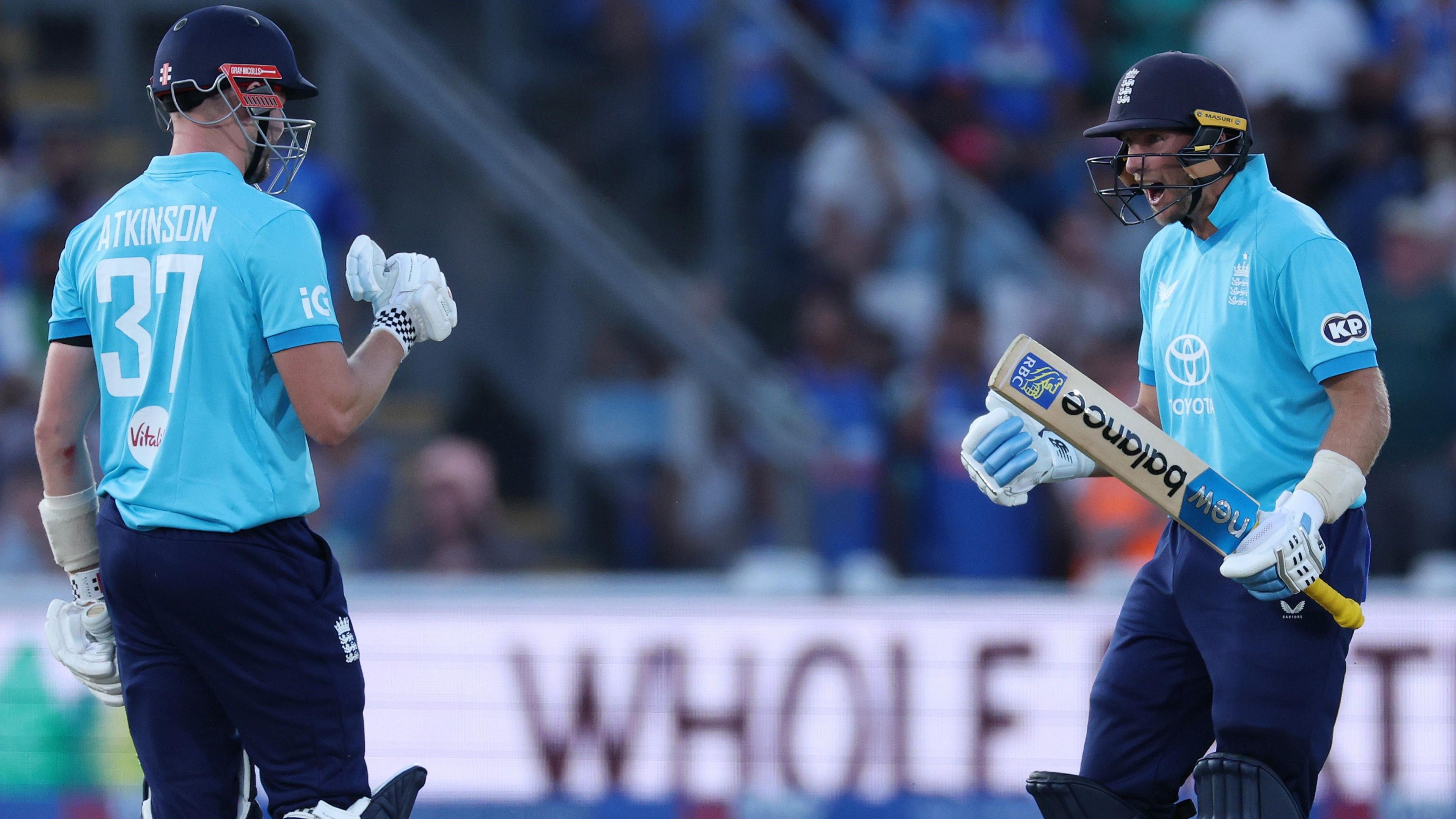
Root was a class apart in the second one-day international at Cardiff with a chanceless 99 that led England to a four-wicket win in tricky conditions.
In domestic cricket, the One-Day Cup is played in the same window as The Hundred and has therefore become more of a developmental tournament.
Collectively, England's top six batters on Thursday had played more than 400 matches fewer than their India counterparts in List A cricket (which combines one-day internationals with major domestic white-ball competitions).
"I think that's one of the biggest challenges for this team and the young guys coming through," Root, 35, said after England's win.
"Not just now, but in the next little while, anyone coming into this team does not have the wealth of experience and understanding of 50-over cricket because we are not exposed to it any more.
"There is not that element of grounding that happens before you get to this level, which happens elsewhere around the world, so it's understanding that there are going to be times where guys have to learn on the job and they have to learn quickly."
England reached their target of 234 in the 45th over in a game which resembled a more traditional ODI, where Root's knock - alongside Virat Kohli's 65 in India's innings - was based on strike rotation, playing the ball late and punishing anything loose.
Due to the conditions, it was a stark contrast to some of the batting produced by England's World Cup-winning squad of 2019, but Root highlighted the importance of being able to adapt.
"You've got to be brave and know that you can absorb pressure, because you have always got more time than you think and you can really make things up," Root added.
"The more gears you can have, then it'll make you a better player in the long run.
"Some guys will get out their tricks, sometimes you'll be on a pitch where 400 is a par score which can happen.
"But you have got to have range and the hardest bit for guys coming through in English cricket is that everyone who plays T20 cricket can manipulate the field and take the game on - but when you find yourself in a situation like that, a wicket like that, can you find a way of doing it ugly and just getting over the line?"
England have been inconsistent in ODIs recently - the defeat at Edgbaston in the series opener was their 14th defeat in 20 matches.
They are also eighth in the world rankings and need to make sure they stay in the top nine to secure automatic qualification for the next World Cup in 2027.
But Root also said he was hopeful the team would be judged on the present in terms of results.
"I hope that we get judged on our recent past, where we seem to be doing that [adapting] really well," he said.
"That first game against Sri Lanka earlier this year, we got things wrong but we adapted and learned very quickly and then ended up winning that series, the first team to do it in four years.
"At Edgbaston [in this series] we didn't read the situation or the surface as quickly as we'd have liked but we found a way to scrap, and then we've learned from that and understood how to go about it in this innings here."
England's top order has struggled so far as they continue to search for a consistent opening partner for Ben Duckett. So far, Jacob Bethell - who has only played 23 ODIs - has made 14 and four in his new role.
Root and former captain Jos Buttler - with 191 and 201 ODI caps respectively - are the only surviving batters from England's 2019 win, but Root hopes this new group can still emulate their success.
"I'm delighted we found a way of doing it that doesn't suit some of those guys and how they're used to playing – but that's a big step forward for this group against the number one team in the world," he added.
"We'll go to Lord's [for the series decider against India on Sunday] with everything to play for, a high-pressure game ahead of a World Cup.
"If we can keep developing and understanding different situations and scenarios, by the time that World Cup comes round we'll be in a really strong place.
"That's what we did in the build-up to 2019, we had a group of 15-16 guys who were all playing consistently and playing together.
"We haven't quite got that yet but there's no reason why we can't, with the resources that we have, learn and develop in a similar sort of manner."
Related topics
- Published3 hours ago