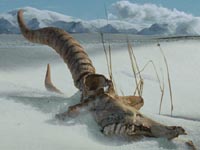
North America's lost wild heritageBetween 13,000 and 10,000 years ago, over 70% of all the large mammals in North America became extinct. In just a few thousand years the most charismatic animals of the Ice Age were gone - about 35 to 40 species in total. What happened to all these amazing animals? TheoriesThe cause of the ice age extinctions has fascinated scientists since the discovery of the first mammoth fossil 200 years ago. Theories fall into two broad camps - overkill by humans and rapid climate change. It remains a hotly debated topic. OverkillIs it coincidence that so many large mammals died out as human hunters began to colonise the land? Fossil evidence suggests these people were very effective hunters. Large animals are often slow to reproduce and therefore vulnerable to over-hunting. Similar patterns have also occurred elsewhere. Australia lost all its very large mammals (including giant wombats and giant kangaroos) around 50,000 years ago, not long after the first people are thought to have reached its shores. However, overkill has increasingly been seen as too simplistic and lacking in hard evidence. Whilst spear points have been found with mammoth and mastodon remains, none have been recorded for other extinct herbivores, such as horses and camels. Reinterpretation of radiocarbon dates for the extinctions has also lead some to argue that many species were dying out before people arrived. Rapid climate changeThis theory suggests that as the Ice Age ended, changing climate upset the long established ecological balance between plants and animals during the Ice Age. In some areas this may have lead to the total disappearance of vital habitats. Those who argue against climate change as an explanation point out that there have been more than 20 other glaciations and all the big mammals lived through the changes unharmed. However there is some evidence to suggest that the last ice age ended too abruptly for many species to adapt and survive.
|