

Voiceovers.
8th Aug 2008, Gerald
We made a decision early on in the project to use a mix of subtitles and voiceovers in our programmes. Using voiceovers would allow the younger end of our audience to keep track of what was going on in the programmes but using subtitles at some points (we decided when the main character wasn't talking to camera) would mean that our audience still got to hear some Mandarin. No one wants to watch a TV programme about China and then not hear any Chinese Mandarin.
So today and tomorrow we are recording all the voiceovers for the programmes.
I have worked with all of the actors that we are using to voice our Chinese characters and so it will be good to see them again. Some of them I have worked with to do a similar kind of thing where we were re-voicing Portuguese speakers from Brazil, so I know that they will do a great job.
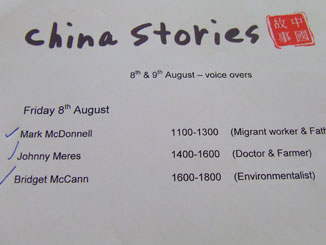
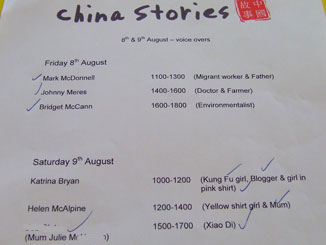
This is one of the best bits of my job. To be able to remove our guide tracks and replace them with professional voices is great. A good voice over artist just makes so much difference - they can really bring emotion to the translated words.
Of course it's important to think carefully about who you employ to do the voices - it has to be someone who is able to match the character they are voicing. It has to be appropriate or it ends up sounding really odd.
Xiao, our translator, is coming in to keep us right with our pronunciations. She hasn't been involved in this bit before so hopefully she will enjoy it.


The eighth day, of the eighth month, 2008.
8th Aug 2008, Maria
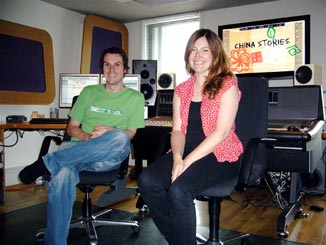
Today is the eighth day, of the eighth month, 2008 - eight is a very lucky number for the Chinese so they've chosen this as the date to hold the opening ceremony of the Olympics Games in Beijing. Team China Stories have sent me down to London to record a voice over with the actress Kelly MacDonald. I'm a big fan of her movies so I had my fingers crossed she wasn't going to be unfriendly or display any diva-like tendencies - and it was my lucky day because she was lovely, very down to earth and a good laugh.
The sound on our films is just as important as the pictures. A really critical element to get right is the voice of the narrator. All our stories are intimate "day in the life" style portraits so we wanted someone with natural warmth; someone with very clear diction (there are a few complicated Chinese words to pronounce); someone who sounds young and (hopefully) someone Scottish. We'd heard Kelly speak on ads and interviews and we thought she could have the qualities we were looking for. And she did.
To play this audio you require Flash. Find out more about the Adobe Flash player.
Another lucky thing was that I had Wenlan, a producer from BBC's Video Nation, to help with any tricky mandarin pronunciations and it turned out that Matt, the dubbing mixer who recorded Kelly's voice, had been a runner at an Edinburgh production company the same time as Gerald - apparently they both made tea, a lot.
dàng àn
(eng. archive)
Key Dates:
háng huà
(eng. jargon)
Guide Track
A Director or Producer might record a temporary narration in the edit. This will often be voiced by them rather than a professional and is normally replaced in the dub (sound mixing session). A guide track ensures that the voice over fits and is suitable. It is often re-recorded a number of times until it sounds right.
BBC iD
BBC iDBBC navigation
BBC links

BBC © 2014The BBC is not responsible for the content of external sites. Read more.
This page is best viewed in an up-to-date web browser with style sheets (CSS) enabled. While you will be able to view the content of this page in your current browser, you will not be able to get the full visual experience. Please consider upgrading your browser software or enabling style sheets (CSS) if you are able to do so.
