Happening in Holyrood
Twenty years after the creation of the Scottish parliament, how have ordinary people campaigned to shape policy in Holyrood. How have lives in Scotland been impacted?
20 years after the creation of Scottish Parliament, this documentary reveals how ordinary people have campaigned to shape policy in Holyrood; how lives in Scotland have been impacted by these changes and how the next generation of Scots can use their Parliament to mould Scotland into a country they want to live in.
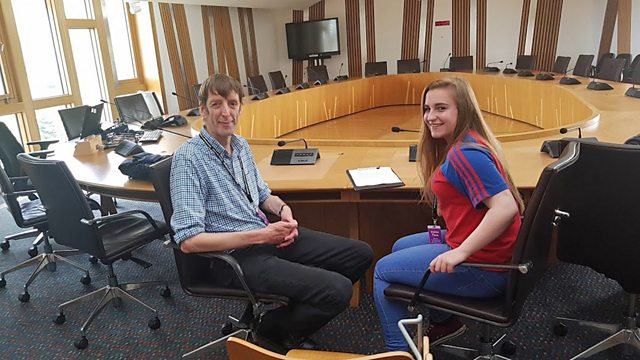
14 year old Scottish high school student Rachael is passionate about a lot of issues; from human rights to LGBTQI+ equality. The climate change protests instigated by 16 year old Swedish activist Greta Thunberg in 2018 not only inspired her to join her local school strikes, but to create her first online petition to reduce waste in the school canteen. As the signatures for her online petition mount up, Rachael admits that despite her drive for change, she had never considered petitioning the Scottish Parliament. It's not an institution that feels either accessible or relevant to her. But if real change can be enacted through Parliament, then how is it done? What are the opportunities and barriers to making a tangible difference?
With the help of mentors such as BSL campaigner Erin McCluskey, LGBTQI+ activist Tim Hopkins, Petitions Convener Johann Lamont and Youth Engagement Officer Hayley Forrester, Rachael studies some of Parliament's most successful cases of the past twenty years and explores the ways and means Parliament can be accessed to make changes for the better.
Rachael also hears from young voices similar to hers on what they'd like to see happening in Holyrood during their lifetime and uncovers just what is happening right now in Holyrood.
Last on

Happening in Holyrood - Transcript
HAPPENING IN HOLYROOD - Transcript
MUSIC
BBC NEWS ARCHIVE:
‘This is our first democratic parliament in Scotland for some 300 years. Our people have waited for it, our people deserve it – we must give them what they want. (Donald Dewar)
“I have trust in the good judgement of the Scottish people and I am confident in the future of Scotland” (HRH Queen Elizabeth II)
“A new chapter in Scotland’s history begins” (Jackie Bird)
“Welcome to Holyrood”
“(singing) …and a’ that”
“Welcome to the new Scots Parliament”.
HAYLEY MILLAR:
Twenty years have passed since that historic day on the 12th of May 1999 when the Scottish Parliament met for the very first time since 1707. In those twenty years, Scotland has seen some remarkable and ground breaking changes in government policy, shaped by the extraordinary campaigning of ordinary people.
The next twenty years belong to a new generation of Scots, many of whom have never known life without Holyrood. And a new era brings new challenges; whether it’s the environment, demographic change or growing political apathy – whatever your passion, how do you make your voice heard?
In this programme, we’ll be hearing from a selection of young people and one teenager in particular, about how they’re hoping to bring about change. With that in mind, a project launched by youth organisation Young Scot asked for letters from young people on what they’d like to see happening in Holyrood in the next twenty years. The letters are serialised in a new book released to celebrate the anniversary, and here’s a taste of what they had to say:
MUSIC
EWAN/DIONNE/CLAIRE: Dear Scottish Parliament, dear Scottish Parliament, dear Scottish Parliament….
EWAN:
Twenty years ago the Scottish people were granted a voice. We were given the power to change our country. In twenty years, I hope that I will be sitting in that parliament, as an MSP. And my big dream is to become the first gay First Minister of Scotland.
DIONNE:
I want to continue to see the Scottish Parliament celebrating diversity, and opportunities for everyone regardless of their background.
QUINN:
As a young person living in Scotland, here are some improvements I would like to see the Scottish Parliament make. Working to tackle and eradicate major problems such as homelessness and substance abuse and dependency.
CLAIRE:
Imagine growing up and never experiencing the more creative side of things. All children deserve the chance to thrive.
QUINN:
Imagine a Scotland where young people are happy with the world handed down before them. Imagine a Scotland where everyone is accepted. Imagine this Scotland.
EWAN:
I would like to show children you can be a change maker too. It only takes one person to stand up, make a change, and the rest will follow.
HAYLEY MILLAR:
….From one group of inspirational young people to another tenacious teenager who is already making waves on the activist scene penning petitions and speaking at demonstrations:
RACHAEL:
Hi my name’s Rachael, I am 14 and I am from Cumbernauld.
MUSIC
RACHAEL:
My petition is about reducing – or eliminating – school canteen waste. I was inspired to write it when I’d seen, leaving the canteen, just littered about was single use plastics, polystyrene cups…. It seemed so unnecessary when there are so many better ways you could deal with it; producing proper plates and cutlery, or the home baking that they serve in the cellophane? Having it covered by, like, a glass, to try and cut all the unnecessary waste they have.
I wrote a petition on Change.org to see if maybe I could send it to Brakes which is a major supply company for schools. I’ve had lots of teachers from my school sign it, I’ve had loads of my friends sign it, I’ve had people in Sweden signing it – I never expected it to take off the way it did. People are really wanting to make a difference and that’s really inspiring.
I’ve always loved the environment and I’ve always been really interested in things like biodiversity. I remember for my Christmas one time actually, my Mum bought me three encyclopaedias, and I think that was the best Christmas I’ve ever had, to be honest. There are hundreds of species going extinct and we might be next, so we need to do something now.
There’s a lot of people that I’ve drawn inspiration from in terms of campaigning and activism, one being Greta Thunberg. She’s 16 and has Aspergers, and it gives you a lot of hope to see that this little girl who was sitting outside with a wee cardboard placard is suddenly going and addressing world leaders and telling them to their faces that everything they’re doing is wrong and they need to change. It’s inspiring as.
HAYLEY MILLAR:
Rachael’s been one of her school’s only representatives on the Fridays for Future climate strikes, selected to speak at the Green Industrial Revolution event in Glasgow’s George Square back in June, her enthusiasm for activism has definitely been ignited. But politics? Well, that’s a different matter….
RACHAEL:
…Actually you caught me at a brilliant time because this is when I’m just starting to make all my life decisions! Going to that Green Industrial Revolution and all that, I got asked a question if I wanted to do this as a job. Obviously I’ve never been into politics, I’ve never understood it – I’ve never wanted to understand it, but then, it like, got me thinking that maybe this would be a really interesting job ‘cause I could help to try and create that change.
But parliament to me, is a building. You never hear anything about it, really. It doesn’t have much significance to me because the voting age is 16 and anyone under that age kind of feels like they don’t have a voice.
HAYLEY MILLAR:
We’ll be following Rachael and her mum Julie as they head to Holyrood to meet MSP’s, professional campaigners and former students to explore whether, twenty years on from its creation, it’s still possible to enact real change through the Scottish Parliament today.
So how does Rachael feel at the beginning of her journey?
RACHAEL:
I am….a bit nervous to be honest. I’m not really aware of how to get an issue to Scottish Parliament. I want to come away with a sense of understanding, to be able to put the knowledge out there of how to get a point across in Parliament and say this is how you do it, this is who you need to speak to, and this is what you need to have to manage to get it through – would be really valuable. I’m just wanting to learn as much as people can teach me.
HAYLEY FORRESTER:
…We need a visitor pass, as well….
RACHAEL:
It’s very big and fancy…honestly just very…proper.
JULIE:
This is actually a pretty amazing looking building. It really is…it’s quite good.
RACHAEL:
Yeah.
HAYLEY MILLAR:
Guiding Rachael and Julie around Holyrood, Youth Engagement Officer Hayley Forrester.
HAYLEY FORRESTER:
This is the main hall of the Parliament building so for anyone that comes to see the building, obviously there’s lots of opportunities for them to find out a bit more about what the Parliament is and what it does. And we’ve got our brand new part of our exhibition here which gives people’s personal stories of their experiences of working with the Parliament and sharing their views and making change happen. And Lea who’s with us just now, is featured!
RACHAEL:
Hey, how are you?
LEA TSUI:
Very good, thank you!
HAYLEY MILLAR:
In 2002, Lea Tsui, then a student at Firhill High School in Edinburgh was one of a handful of high school students who campaigned against smoking in public places, submitting a petition to the Scottish Parliament. Their school project which aimed to raise their awareness of Parliament’s procedures led to Lea and her classmates giving evidence to the Petitions Committee.
Four years later in March 2006, Scotland became the first nation in the UK to ban smoking in enclosed public places. Lea and her friend’s voices had been heard.
Keen to meet someone who had also campaigned as a teenager, Rachael got straight to the questions.
RACHAEL:
How old were you when it all started?
LEA TSUI:
So, in 2002 I would have been 14, and then when we were giving evidence we would have been 15, 16 at the time.
RACHAEL:
Awesome, I’m actually that age. That’s quite…woah…!
I couldn’t really imagine going into a restaurant and seeing everyone smoking, or going on a bus and being instantly hit with like, all of the…pollution, essentially. It just does not seem nice at all.
How was giving evidence to such a large group of important people at such a young age?
LEA TSUI:
I think if I’d probably known what the experience was going to be now, I’d probably would have never done it! [LAUGHS]
And looking back – so we have some footage of the time when we gave the evidence and we were speaking and you kind of take it in your stride at the time because you have no other choice, but looking back and reading the transcripts you think god I had a lot of gumption or a lot of sass at that point to have done it! [LAUGHS] But you don’t think of it at the time….you just do it.
RACHAEL:
Yeah.
LEA TSUI:
…Because it’s the right thing to do.
RACHAEL:
Well, like I suppose at that age you have that like, drive and that dedication. So….were you like, nervous to speak in front of everyone?
LEA TSUI:
Definitely nervous because you don’t know what questions they’re going to ask, you don’t know how they’re going to react to you, you don’t know if they’re supporting, against… So you just have to go and try and be as prepared as possible with the evidence that you have and the research that you’ve done and give your opinion in the best way possible.
HAYLEY MILLAR:
From the parliamentary archives, here’s a clip of Lea giving evidence back in 2004.
ARCHIVE CLIP
MSP: Well, my view about the restaurants that have non-smoking bits and smoking bits is that it really is worthless . I wonder if you could comment on that? Do you think separate bits are effective?
LEA TSUI: I don’t think they work because all the smoke’s just circulating and it does just the same as sitting - because sometimes in smoking and non-smoking bits you’re right beside the smoking bit, and it doesn’t make any difference.
RACHAEL:
Were you allowed to have notes of any kind before going in?
LEA TSUI:
We ‘d done a lot of research when we submitted the petition – data from NHS,
Ash Scotland – so we’d got those sort of statistics with us. Presenting and doing the Q&A’s we had a
lot of stats in our head. Did we bring
notes? I couldn’t tell you – I can’t
remember it was so long ago! [LAUGHS]
RACHAEL:
That’s alright! Um, what advice would you give me or people like me who had never given evidence in the Scottish Parliament before to win the MSP’s over?
LEA TSUI:
I would just say, if you feel really strongly or passionately about an issue then you’ve got to go for it, you’ve got to see it through, because you will find there’ll be a lot more support than you’d ever think of. And being so young, it will make a really big impression on MSP’s, the public….they’ll be so impressed that somebody so young will have that enthusiasm and bravery to stand up and be spoken for and represent their country.
RACHAEL:
Cool.
MUSIC
LEA TSUI:
From what I’ve been told, you want to know what kind of impact that you can make and how parliament can represent you as a young person now?
RACHAEL:
Well, a couple of weeks ago I started a petition actually, to completely reduce the use of single use plastics and polystyrene in school canteens because, it’s like a massive issue especially in my school where it’s like all in like, polystyrene or cellophane with plastic cutlery and it’s just unnecessary when there are so many other cheaper options that we could go through with.
I also joined the Scottish Youth Climate Strikes so like, every Friday we like, strike outside of the City Chambers in Glasgow to try and get them to not only declare a climate emergency like they did, but act on it and make steps towards getting our voices heard and doing something about it.
LEA TSUI:
Sounds excellent! Best of luck! I’m sure you’ll have lots and lots of support.
RACHAEL:
So, would you say it’s possible to make change today, even if you’re a school student and not old enough to vote?
LEA TSUI:
Oh, absolutely – absolutely! And the processes are here in place for anyone to make a change, whether they are young, old, whatever. So, you’ve got to do it, absolutely got to do it. And don’t be afraid , because there’ll be so many more people supporting you than you ‘ll ever think.
RACHAEL:
I really appreciate you taking the time to come and speak to me.
LEA TSUI:
Fab, thank you for having me!
MUSIC
HAYLEY MILLAR:
In 2015, the Scottish Parliament passed the British Sign Language (Scotland) Act, the first BSL specific law in the UK. This law aims to give British Sign Language users the same access to services and information as anyone else, and has been instrumental in raising the profile of British Sign Language across Scotland.
A keen advocate of this bill is young BSL user and campaigner Erin McCluskey, who was also selected as one of the Members of the Scottish Youth Parliament for Cunninghame North in June of this year. Via the web, Erin chatted to Rachael about how she first got interested in politics at as a young teenager.
ERIN McCLUSKEY (voiced by FIONA JONES):
At that time, I thought that because I’m Deaf and because I’m too young, it wasn’t possible for me to get involved. That was until I joined the National Deaf Children’s Society’s Young Campaigners; a group full of inspirational young people. They’re all amazing. When I first joined when I was aged 13, I was heavily involved with the national plan for BSL and Deaf people’s rights. I love to use my free time campaigning, that’s usually when I’m at my happiest.
RACHAEL:
(Keyboard typing sounds) That sounds so interesting. You’ve had such a rich life and you’re only 17! So, what do you think you have to do to be a change maker?
ERIN McCLUSKEY (voiced by FIONA JONES):
Personally, I think you have to be very passionate, determined, care about
others and be willing to participate in the political process. And make sure you represent your constituents
in an honest way.
RACHAEL:
Thank you so much for your time.
HAYLEY MILLAR:
In Holyrood, Youth Engagement Officer Hayley Forrester leads the way.
HAYLEY FORRESTER:
So, we’ll take you now…obviously this is a public area of the building and what we’ll do is take you through to some of the working areas so we can have a bit of a behind the scenes look at what actually happens at Parliament.
RACHAEL (to her Mum Julie):
So, what are you thinking?
JULIE:
I’m just trying to soak it all in, actually. My eyes are everywhere – I can’t help but look at different things! I think I should really make a wee visit up here more often, have a little bit more involvement in what’s going on myself – a wee bit more knowledge…
RACHAEL:
Yeah!
JULIE:
…and a wee nosy!
HAYLEY FORRESTER:
So yeah, welcome to the Debating Chamber! This is obviously where all of the members of Parliament, the MSP’s meet to debate and decide on issues that are important to Scotland, so pretty big decisions get made in this room. So, have you got questions about anything specific?
RACHAEL:
Umm….probably the structure of the room?
HAYLEY FORRESTER:
It’s designed to sort of, encourage all the MSP’s to work together and reach consensus. There’s no pillars, so that there’s nothing obstructing your view if you’re sitting watching a debate up in the public gallery at the back of the room. And it’s free to get tickets, you can come and watch what’s happening.
RACHAEL:
I think I’m too emotional for Parliament. I’m really like, passionate about things.
HAYLEY FORRESTER:
Caring about people and about issues is probably what most MSP’s would tell you is what has brought them to the job, so I think that’s definitely a key quality and one that shouldn’t put you off.
HAYLEY MILLAR:
Getting an issue debated in Parliament can happen in various ways. One of the most popular is to highlight an issue by submitting an online petition to the Public Petitions Committee. It’s convened by former Scottish Labour leader Johann Lamont. Eager for some pointers, Rachael met Johann to see what she could glean about the process.
RACHAEL:
I’m 14, see if I wanted to launch a petition, could I?
JOHANN LAMONT:
Absolutely. The most important thing is going through the process. It’s important to remember you only need one signature and that’s your own, so there’s no bar on it, and actually the number of people who support it is interesting but it’s not crucial. It can’t be about an individual issue for an individual person,
RACHAEL:
Right…
JOHANN LAMONT:
…It has to be something that is within the authority of the Scottish Parliament. So for example, a petition we had is round a public awareness campaign around sepsis. Now, it came from the tragedy of an individual family losing somebody to sepsis, so it wasn’t about enquiring about why that death had happened but realising actually people don’t know about sepsis. They don’t know the signs and so the campaign petition was to have a public awareness campaign, and eventually the Scottish Government agreed to that.
The other thing about the Public Petitions Committee – it can also be about people’s love and passion for things. So, people who are talking about the market in illegal puppy farming, people’s love of the land and of animals very often have found their way to the Public Petitions Committee saying ‘can we shine a light on this?’ Some people have petitions that matter so deeply to them, we need to be very sensitive that when we’re talking about an interesting issue, it can actually be somebody’s life that you’re talking about.
HAYLEY MILLAR:
Back in Holyrood’s Debating Chamber, Rachael had some more pressing questions for Hayley….
MUSIC:
RACHAEL:
Is there any points where people get really heated in the debate? Like, is there a lot of tension?
HAYLEY FORRESTER:
There definitely can be and I think it comes back to what you were saying about that passion and that getting emotional about things. When MSP’s are debating about things you know, that they really care about, or things that really matter to the people that they represent then yeah – absolutely. It can get quite heated when you’re standing up for what you think is right. So, people can get quite shouty getting their point across!
JULIE:
I can see my wee debater! I’ll be sitting on the couch watching the telly going, ‘GO, RACHAEL!’
RACHAEL:
…That’s my future decided for me! [LAUGHTER]
HAYLEY MILLAR:
Tim Hopkins is the Director of the Equality Network. Back in 2013, he gave evidence to the Equal Opportunities Committee when they were consulting on people’s views to the rights of civil partnership and to marriage. Tim and the Equality Network have been campaigning for more rights for LGBT+ People for as long as the Parliament’s been established, and he’s keen that it upholds its commitment to equality as one of its core principles.
Curious to know more, Rachael chatted to Tim about Equal Marriage and the barriers he’s come up against in his campaigning.
TIM HOPKINS:
The biggest challenge is the opposition that you get. You always get opposition, so where does it come from and how do you handle it? So – typically you get the people who are fundamentally opposed to what you’re doing. So when we campaigned for equal marriage, some of the churches were fundamentally opposed to it. And then you get people who are not fundamentally against it, but they don’t really understand what’s going on, and they can be influenced both by information being put out by you but also by opponents. So what you quite often get is inaccurate information being put out. For equal marriage for example, some people said if you pass this bill, then the Catholic Church will be forced to do same sex marriages and that was never the case. We’d been quite clear from the very start that that was not what we were asking for, you know, churches should be free to decide for themselves. But that kind of misinformation gets circulated and then reasonable people think, well, maybe there’s something in that and therefore maybe this isn’t such a good idea to make this change. So you have to make sure you get accurate information out to reassure those people in the middle. And then the final point about that is, the thing that really changes people’s views is humanising things where they get to know somebody. So, with our campaigns at the moment on Trans equality. Part of the difficulty is that fewer Trans people are out currently than LGB people because it’s a lot more difficult to be out – so a lot fewer people know, or think they know – a Trans person. And it’s when you meet somebody and you realise that they’re just like you, apart from the fact that they might be a lesbian or they might be Trans, then you realise that actually they’re not ogres and that giving them rights is not going to cause any damage.
HAYLEY MILLAR:
Understanding people’s needs and how politics can change their lives for the better is the key. Johann and Rachael:
RACHAEL:
What would you say to young people who don’t feel that the Scottish Parliament is accessible to them and that petitioning’s a waste of time?
JOHANN LAMONT:
Well, first of all I’d say that the Petitions Committee in the Scottish Parliament is not a waste of time. The more you engage with it the more effective it will be, the more you’ve already seen that it’s part of a broader campaign. So you don’t just have the public petition, but you have other things round about it that you’re raising awareness and speaking to MSP’s and so on. The bigger picture of people being engaged with the Scottish Parliament – it is the extent to which people feel that political debate is in any way related to their lives.
RACHAEL:
Yeah.
JOHANN LAMONT:
And it’s also something that as citizens people need to take responsibility for. And even though it feels a bit daunting, please believe me – if I get a letter from somebody whose address is in my constituency, I’ll pay attention to that. That dialogue and that conversation is really important. I mean, I’m thinking back to when I was very young. There was a big storm, a lot of houses they lost their rooves, and I can remember the local MP came to our house and it was like, utterly the most astonishing thing that an MP would come.
RACHAEL:
Yeah.
JOHANN LAMONT:
I remember my family being really shocked that the MP was willing to come. I regard it as a badge of honour as an MSP that I have a responsibility to meet with people, to have surgeries where people can come along whatever their issues are.
RACHAEL:
Yeah, I feel like there could be a lot more done with MPs working with people in the community.
JOHANN LAMONT:
The vast majority of people in elected office of whichever party do want to engage, particularly with young people who have taken the trouble to contact them and have a passion and interest in something.
RACHAEL:
Yeah.
JOHANN LAMONT:
They will want to recognise that and I think in my lifetime that has changed. I think you see a great deal more activism by young people but you also see the organisations round young people – The Scottish Youth Parliament but not just that – where people are getting the opportunity to show that they really care about stuff. They’re not cynical, they do believe you can change the world.
RACHAEL:
Yeah.
JOHANN LAMONT:
Cynicism is the most corrosive kind of thing, I think. So, I genuinely think there’s a job for Scottish Parliament to be open and for elected members to be open but there’s also an opportunity for young people to test that openness and test that transparency by asking questions and getting actively involved.
RACHAEL:
Thanks for coming in today.
JOHANN LAMONT:
Our conversation today makes me more optimistic in a world where politics very often feels a bit grim. So thank you for your interest, and I’ll look forward to your petition coming forward in front of the Public Petitions Committee soon.
RACHAEL:
Thank you.
MUSIC
RACHAEL:
I now know a little bit more about getting something brought up in Parliament, especially about the petitions route. Honestly, it’s been amazing. Speaking with Johann taught me that Parliament actually want to hear our views, so it’s really empowering to know that no matter what – even if it’s something as small as a petition – people are actually trying to listen and trying to help.
HAYLEY MILLAR:
Back in Holyrood, it’s out of the Debating Chamber, and into the world of the Committee.
HAYLEY FORRESTER:
OK, so this is now one of the Parliament’s Committee Rooms. Biggest difference between the Chamber and the Committees? This is where members of the public can come and actually speak to members directly during Parliamentary business and give their views.
RACHAEL:
How do I get Committees to talk about the way we could reduce school canteen waste?
HAYLEY FORRESTER:
First thing to do I guess would be to find out which of the committees that is the responsibility of. You’re maybe looking at more than one committee with that one, because there’s education obviously from a schools point of view, and then the environment from the waste side of things. So, you can contact them in different ways. You can get in touch with the clerking team which supports the committee and let them know about the issue, you can write directly to the convener of the committee and explain to them what your issue is and why you think it’s important, and you can arrange meetings as well. You could arrange to meet with the clerks or the conveners and tell them more about your issue and why you think the committees should be looking at it.
RACHAEL:
Cool!
HAYLEY MILLAR:
Whilst the committee is instrumental in getting bills passed in the Scottish Parliament, there are many different stages to get through before an issue goes before them and lots of different ways to go about it. Rachael and Tim, again:
RACHAEL:
So what do you think people should know about getting a bill passed that not
everyone knows a lot about?
TIM HOPKINS:
There’s two ways to get a bill passed in our experience. One is to persuade the government to do it. So to do that, the best thing to do is to get on to the parties before an election and get them to put it in their manifestos. And then, you know, if you get them all to do that then it doesn’t really matter who gets elected because they’ll all have it in their manifestos! And then, if they stick to what they’ve said, they will introduce a bill.
The other way to do it is to introduce what is called a ‘Member’s Bill’, where an individual MSP can put forward a proposal for a bill. So if you can find an MSP who will support doing something – for those kind of bills it’s best if it’s something fairly small – then that can be done just by being led by that MSP.
HAYLEY MILLAR:
Back in the Committee Room with Hayley, Rachael is taking stock.
RACHAEL:
With the information that I’m getting, it’s starting to make me see that it is easy to see what’s going on in the Parliament, but not without that information. What would you say to someone trying to get in to becoming either a representative for the Youth Parliament or an MP?
HAYLEY FORRESTER:
I don’t think there’s typical qualities, there’s certainly no qualifications that you need to have. I think if you have that desire to change things and make things better for other people, that’s enough. And yeah, you can put yourself forward to be an MSP or to be a member of the Youth Parliament. I think the Youth Parliament’s a great place to start – get the views of young people put on that national platform.
HAYLEY MILLAR:
Still on the hunt for advice, Rachael asks Tim for a few final pointers.
RACHAEL:
So if you were me right now, not old enough to vote but passionate enough about LGBT rights and environmental causes in particular, what would you do to make yourself and your causes heard?
TIM HOPKINS:
I would definitely work with my friends because a group of voices is louder than just one voice. I would try to do stuff that’s public – so somehow get the media involved. That might be something you do at your school – some kind of demo or perhaps something with a banner. If you have people at your school who are able – and obviously this is very difficult, especially for young people – to say ‘I am an LGBT person’ (so, thinking about LGBT rights) then that is something that can be very powerful. The media love to talk to people who are talking about themselves and their experiences. The same thing applies to climate change or anything else that you’re working on. Make it personal and say why is it important to me? Of course you can do all the other stuff like writing to your MSP and all of that is really useful as well.
RACHAEL:
Thank you for all your work before I was born because you made life easier for every LGBT person living in Scotland right now.
TIM HOPKINS:
You’re very welcome. We’ve all been standing on the shoulders of people who came before – even before Stonewall actually – and I hope it will long continue. So I hope you don’t get disheartened and carry on campaigning.
RACHAEL:
Thank you.
MUSIC:
HAYLEY MILLAR:
So after meeting some of Holyrood’s key figures and getting advice about just how to make change in Parliament, how does Rachael feel about the experience?
RACHAEL:
When I first came into Parliament today I thought that it was a really impressive building and I thought that….like, stepping into it gives you a sense of almost like you’re changing something just by entering, so I felt really proud to be able to be standing here and saying that I’d came to Parliament.
I feel like that since coming here I’ve learned a lot about how to make Parliament work for me, and how I can make a difference as a young person.
I’m just kind of….trying to process it all, because it’s just…it’s really strange to be talking to people that are so high up and that managed to create change that is still having a massive impact on my life today. So I hope to one day be that for someone my age.
HAYLEY MILLAR:
With young people like Rachael around, the Scottish Parliament of the future will be in great hands. I just can’t wait to see what she does next.
You’ve been listening to ‘Happening in Holyrood’ with me, Hayley Millar. If you’d like to hear the programme again, you can find us on BBC Sounds. Thanks for listeningBroadcasts
- Tue 30 Jul 201913:30BBC Radio Scotland
- Sun 4 Aug 201907:00BBC Radio Scotland
- Fri 27 Dec 201917:30BBC Radio Scotland
