The risks of climate change, the pro's and con's of road charging and how science is taught in schools are among the issues which will be covered over the coming months.
The Yorkshire Philosophical Society, which was formed in 1822 to pursue the study of natural sciences, today sees an important part of its role as being to make science more accessible. Its message is that science is not just for boffins, it's for all of us.
Science and technology affects everyone, it plays an increasingly important part in our lives and if presented in the right way should be of interest to anyone.
Forget the rigid way in which science is divided up at school into physics, chemistry and biology, because the society's lectures cover a wide range of subjects in the fields of science archaeology history and sociology.
All the lectures have titles which catch your attention. 'Illuminating the Dark Ages - the contribution Islam made to science and technology' is the lecture being given by Professor Mohamed El Gomati on November 20th, whilst Dr Peter Edwards talk is titled 'Dinosaurs from Dust - the worlds most powerful particle smasher'.
The season began on October 9th with an examination of vision and whether there is more to what we see than meets the eye.
Dr Tim Andrews, from York Neuroimaging Centre, will look at how we see. He says that although most of our impressions of the world - and our memory of it - are based on sight, the mechanisms that underlie vision are not at all obvious.
Dr Andrews will look at whether what we see is actually there, or whether we just think it is!
You can find out more about some of the lectures by listening to the following interviews:
Help playing audio/video
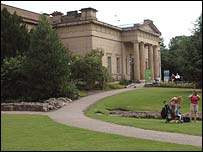
All the lectures are held in the Yorkshire Museum's Tempest Anderson Hall in York's Museum Gardens. They are all open to the public and admission is free, although donations are welcomed from people who are not members of the Yorkshire Philosophical Society.
The YPS has a long and illustrious history. It was founded almost a decade before the British Association for the Advancement of Science (1831), it built the Yorkshire Museum and created the Museum Gardens. Although the museum and gardens were handed to the City of York in 1960 the society still actively keeps members and the general public aware of scientific matters.
YORKSHIRE PHILOSOPHICAL SOCIETY
PROGRAMME OF LECTURES 2007-2008
Theme for the Year: "Controversy and Risk"
- October 9th 2007 (Tuesday) - 7.30 pm
More to Vision than Meets the Eye
Dr Tim Andrews, York Neuroimaging Centre - October 23rd 2007 (Tuesday) - 7.30 pm
How should we teach science to the young?
Prof Robin Millar, University of York - November 6th 2007 (Tuesday) - 7.30 pm
Road user charging: don't shoot the economist (Joint lecture with the Royal Geographical Society & PLACE)
Prof Colin Bamford, University of Huddersfield - November 20th 2007 (Tuesday) - 7.30 pm
Illuminating the Dark Ages - the Contribution of Islam to Science and Technology
Prof Mohamed El Gomati, The Foundation for Science, Technology & Civilisation - November 24th 2007 (Saturday) - 2.30 pm
Debate on Climate Change - December 11th 2007 (Tuesday) - 7.30 pm
Seahenge - excavation and preservation of a contested monument (Joint lecture with York Archaeological Trust)
Brian Ayers, FSA, MIFA, County Archaeologist for Norfolk - December 18th 2007 (Tuesday) - 7.30 pm
Eat and drink, for tomorrow we die - or do we? The perils and pitfalls of epidemiology
Dr Simon Crouch, University of York - December 29th 2007 (Saturday) - 2.30 pm
Designer Magnets (Christmas Family Lecture)
Dr Sarah Thompson, University of York - January 8th 2008 (Tuesday) - 7.30 pm
Every child matters? How sensible is our care and custodial system for the young?
Prof Ewan Anderson, University of Durham - January 22nd 2008 (Tuesday) - 7.30 pm
The end of nature conservation as we know it? (Joint lecture with the Yorkshire Wildlife Trust)
Dr Robert Stoneman, Chief Executive, Yorkshire Wildlife Trust - February 5th 2008 (Tuesday) - 7.30 pm
Joint lecture with the Institute of Physics, Yorkshire Branch
(Details to be announced) - February 23rd 2008 (Saturday) - 2.30 pm
Debate on Trident
Dr Geoff Sloan (University of Reading) v Prof Liam Anderson (Wright State University, USA) - March 4th 2008 (Tuesday) - 7.30 pm
Rivalry and Restoration: The Wentworths of South Yorkshire (Joint lecture with Yorkshire Gardens Trust)
Dr Patrick Eyres, Wentworth Castle Heritage Trust - March 15th 2008 (Saturday) - 2.30 pm
Dinosaurs from Dust - the world's most powerful particle smasher (Family Lecture for Science Week)
Dr Peter Edwards, University of Durham - March 18th 2008 (Tuesday) - 7.30 pm
Geological Hazards
Dr David Bell, University of Oxford - April 1st 2008 (Tuesday) - 7.30 pm
Social Evils in Schools, Prisons and among the Public (Joint lecture with University of York Senior Common Room, King's Manor)
Julia Unwin, Director of the Joseph Rowntree Foundation - April 5th 2008 (Saturday) - all day
The People of Roman Yorkshire and the North - A Day School, jointly with the Yorkshire Archaeological Society, Roman Antiquities Section
(Details and cost will be published nearer the time) - April 15th 2008 (Tuesday) - 7.30 pm
Have we got the energy? - Myths and reality
Prof Philip Wright, University of Sheffield - April 29th 2008 (Tuesday) - 7.30 pm
Are radio waves dangerous?
Dr Stuart Porter, University of York - May 13th 2008 (Tuesday) - 7.30 pm
Life on the Moon in the Age of Reform: a controversy of the 1830s (Joint lecture with the Historical Association, York branch)
Prof Jim Secord, University of Cambridge - May 27th 2008 (Tuesday) - 7.30 pm
Economic Risks of Climate Change (The British Association for the Advancement of Science Lecture)
Dimitri Zenghelis, HM Treasury