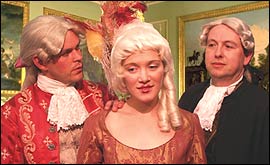
Anyone who rates Mozart's music should see this for the snatches of wonderful music. But that's not why we're here. This is a fulsome, colourful, impassioned and highly charged production. It's beautifully directed and played with confidence to an appreciative audience. My acid test is always do I leave enough of the world behind to forget about my shopping, next day's work, my weary bones and how long I've left the car in the multi-storey? And yes, this time, I am transported. I'm told a lot of resources and effort have gone into this particular production, and it shows. The costumes are sumptuous - remember this was the era of huge coats, beehive wigs... and that's just the men! The scenery with its scrolls, cherubs and figurines are reminiscent of an ornate era long gone. The nub of the story centres on two characters. Salieri is well in place as court composer, producing mediocre works for his royal master, Emperor Joseph, when Mozart bursts onto the scene. He's loud, vulgar and indecently talented, making everything Salieri has written look dull and plodding. No wonder Salieri is jealous of Mozart's genius. Though history doesn't accuse him of killing Mozart, he helped to destroy him, mostly through the lack of a paid job. Salieri is played with pace and passion by David Lambert. He's a decent man who wanted to blaze like a comet across the firmament of Europe and believes he's been abandoned by God. Mozart, played ably by Turlough Lloyd, never steps out of the sunlight: his music magical, his genius unstoppable. Neville Miller hasn't lost his touch for gentle humour. He shows exactly how it should be done with his ageing and humourless Emperor Joseph and his catchphrase, "Well, there it is!" Look out for these, there are quite a few. Vince Hadley, as always portrays a strong, senior Van Swieten, who never disappoints. It's a serious play over all, and meant to make the audience think a little, and it's an intriguing angle on why Mozart met an early death. Who's to say it never happened? There is plenty of Mozart music in there too, ending with the beautiful Requiem, which might have been written for his own funeral. | 




 View
View