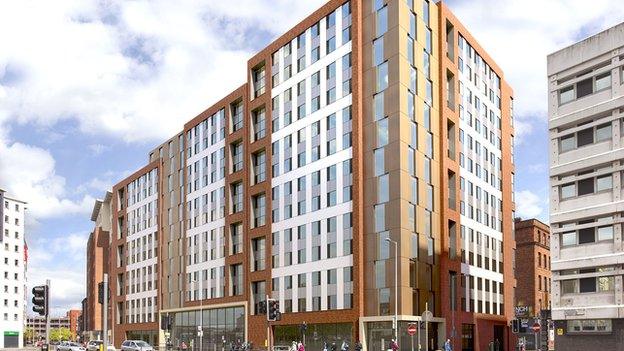
Planning permission has been sought for student accommodation at Ulster University's Belfast campus near the Cathedral Quarter
Student accommodation in Belfast has traditionally involved clubbing together with friends to find a shared house.
The Holyland area of south Belfast - the streets between Queens University and the Ormeau Road - is dominated by student housing.
But all that could be about to change.
The Ulster University is massively expanding its Belfast campus which sits on the northern edge of the city.
That investment has been followed by a flood of planning applications from private sector housing developers who see an opportunity.
There are currently at least 16 applications in the system which represents about 7,000 bed spaces.
Mark Royal House
Three schemes have so far been given the go-ahead and the first of them has just opened for business.
Mark Royal House is just seconds away from the campus and all of its 45 rooms have been booked.
Among the first tenants are Portadown student Sasha Treanor and Kjelsie Hass from Florida.
Sasha had been commuting from her home town and but wanted somewhere close to the university for her final year.
For Kjelsie, as an international masters student, it has been a way to quickly meet new people.

Sasha Treanor and Kjelsie Hass are among the first tenants at the new Mark Royal House near the University of Ulster campus in Belfast
They are prepared to pay a premium for it - the well finished bathrooms and concierge service means this option is more expensive than a Holyland houseshare.
The private sector clearly believes there is plenty more demand for similar schemes in this area.
Some of the planning applications are for developments with 20 times as many rooms as Mark Royal.
For some people already living nearby that is a worry.
The working class communities of Carrick Hill and New Lodge are among those closest to the campus.
"This is not regeneration, this is degeneration," says Frank Dempsey, chairman of the Carrick Hill Residents Association.

Frank Dempsey has warned that wide-scale expansion of student accommodation could lead to an increase in anti-social behaviour
He fears what he calls a "concrete jungle" of high rise development, the loss of land for social housing and the anti-social behaviour which has plagued the Holyland.
Developers argue that the type of management plans which must accompany these schemes means the risk of anti-social behaviour is lowered.
Belfast City Council points to planning policies which mean that student developments cannot be built in what are designated "primarily residential" areas.
The council has also recently updated its student accommodation guidance.
"It will look at location, it will look at clustering, it will look at all the things that will potentially have an impact on those communities, " says the council's planning chair, Councillor Matt Garrett.
However, the guidelines will not have determining weight in decisions. Ultimately any "policy deficiencies" can only be addressed in the longer term in a new Local Development Plan.
Supply and demand
It is not certain that all the schemes being considered by the council will get planning permission.
Some of those which are allowed may not necessarily be built.
It seems unlikely that there will be enough demand for all 7,000 units and some of the proposed sites look speculative.
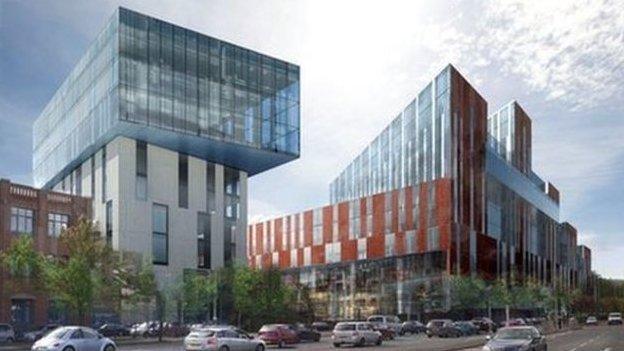
One scheme which is definitely going ahead is John Bell House - a 400-bedroom joint venture between local developer Lacuna and Watkin Jones from Wales.
It is an example of what student-led regeneration should be about as it will bring back into use the city centre building which for a century was Belfast's main technical college.
- Published26 August 2015
- Published29 May 2015