Summary

  1. Clog dancers finding it hard going in the heatpublished at 16:25 BST

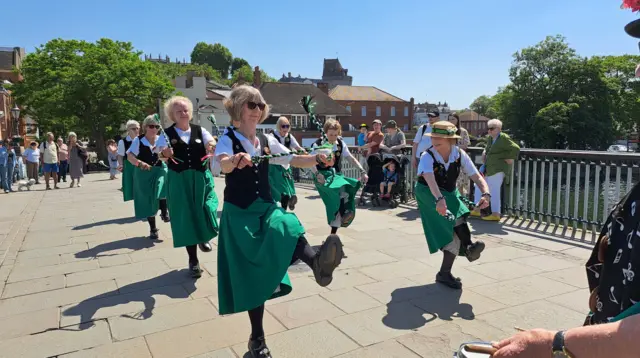
    A troupe of eight clog dancers on a paved river bridge. They are wearing calf-length green skirts, black waistcoats and white, short-sleeved collared shirts. They are jigging and holding tassels. People are watching.Image source, Fiddlesticks
    Image caption,

    Fiddlesticks performing on the footbridge over the River Thames between Windsor and Eton in Berkshire on Monday

    Norwich-based clog dancing group, the Fiddlesticks, says it had to adapt its bank holiday Monday displays along the Thames Valley as temperatures soared to 34.8C (96.4F) in parts of London.

    The genre is similar to Morris dancing, but the dancers wear wooden clogs. On very hot days, routines can be sweaty, stamina-testing challenges.

    Julie Brown, from Fiddlesticks, says: "We've been modifying our dances a little bit, putting our most energetic dances at the start of our sets."

    For the Fiddlesticks' members - who range in age from 20-somethings to people in their 80s - Browns says performing has "been really, really hot for both our band and our dancers... it's been tough."

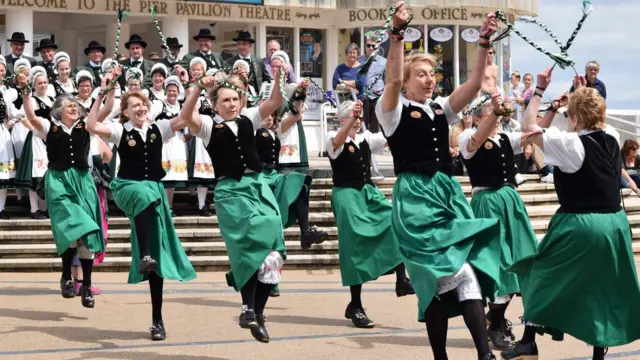
    A troupe of seven female clog dancers in long green skirts, black waistcoats and white short-sleeved collared shirts. They are jumping with their arms in the air in front of wide steps leading up to the entrance to a pleasure pier. More clog dancers are standing on the steps, in different costumes.Image source, Fiddlesticks
    Image caption,

    Fiddlesticks in cooler times at Cromer Pier in Norfolk

  2. It's not raining, so what's with all the umbrellas?published at 16:16 BST

    Madeleine Lake
    Reporting from Regent's Park

    Two ladies in Regent's Park with an umbrella smiling in the sun
    Image caption,

    Akiko (L) enjoying the sun in Regent's Park with a friend

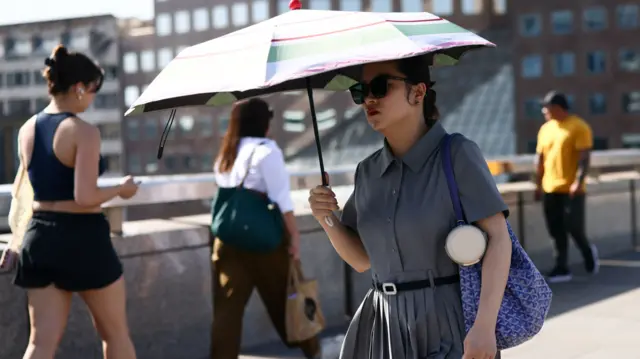
    There's not a cloud in sight or sign of any rain, yet I'm seeing an abundance of umbrellas.

    Across parks in London and even on the busiest streets, they are everywhere.

    Akiko Bird, 67, is from Tokyo and has lived in London for over 25 years.

    She says a Japanese umbrella is a common way to protect yourself from the heat.

    "The heat in Japan especially in the north can reach 40C, in the summer and the ladies don't like getting tanned so they use this. You can use it for the rain but it blocks the light as well", she says.

    Akiko says it's an essential for her to have in hot weather, "I do prefer London summer here, Tokyo can be unpleasant because it's so humid, you just sweat constantly."

    She's faced many spells of hot weather before and tells me she remembers resorting to putting wet towels around her neck during the 2020 UK heatwave.

  3. Wales sees new hottest May day record - as Cardiff hits 32.3Cpublished at 16:05 BST
    Breaking

    Derek Brockway
    BBC Meteorologist

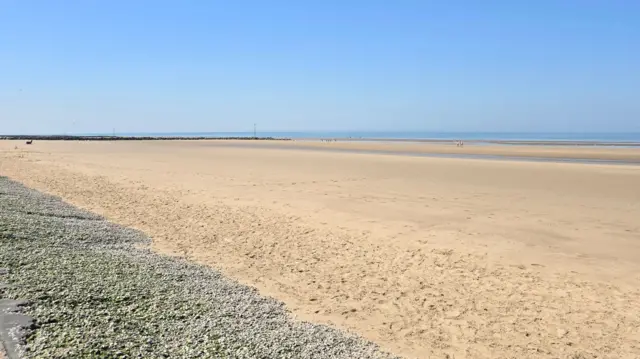
    A picture of a clear beach in PrestatynImage source, BBC WEATHER WATCHERS/Shropshire Liam
    Image caption,

    Clear skies in Prestatyn as Wales records its hottest day of the year

    It’s been the hottest May day ever recorded across Wales.

    A temperature of 32.3C was recorded at Bute Park in Cardiff today.

    That breaks yesterday’s new record of 32.2C at Hawarden Airport in Flintshire.

    The previous May record had stood at 30.6C, set in Newport on 29 May 1944.

  4. Awareness of climate change spiking anxiety in young people, educator sayspublished at 15:54 BST

    Freya Scott-Turner
    Live reporter

    A head and shoulders photograph of Edd Moore, pictured outside.Image source, EDD MOORE

    For some, headlines on this week's record-breaking heat could cause "eco-anxiety".

    The government defines this as , external"the distress and worry that people may feel due to the threat of climate change" and says that young people are thought to be most at risk.

    Heat, long dry spells and extreme weather have made young people more aware of climate change, says Edd Moore, a climate education consultant who works with schools and young people.

    "For many children, that growing awareness can bring real anxiety about what their future world will look like", he tells the BBC.

    Moore recommends that people with this anxiety spend more time in nature, focus on small practical actions within their local communities, or connect with others who share their concerns. This can "restore a sense of control, hope and resilience", he says.

  5. Warmest May day record broken again across Irelandpublished at 15:44 BST
    Breaking

    Barra Best
    BBC News NI weather presenter

    It’s been the warmest May day ever recorded across the island of Ireland.

    A temperature of 29.7C was recorded at Oak Park in County Carlow today.

    That breaks yesterday’s new record of 28.6C at Shannon Airport in County Clare.

    The previous May record had stood at 28.4C, set in County Kerry in 1997.

    The final figures could be higher when they come in later.

  6. Lancashire Police responding to reports of child who got into difficulty in waterpublished at 15:35 BST

    Lancashire Police is investigating reports that a child has got into difficulty in a river in Ribchester.

    In a statement, the police force says its officers were called at around 14:00 today "to a concern for the welfare of a child who had gone into the river at Ribchester".

    "The child, a boy, had got into difficulty while swimming with friends," it says, adding that emergency services are at the scene and "searches are ongoing".

  7. Today is hottest May day on record - Met Officepublished at 15:14 BST
    Breaking

    It is the hottest May day on record, breaking the record set on Monday.

    "Today is now the hottest day in May on record with Heathrow and Kew Gardens provisionally reaching 35.0C," the Met Office says.

    "Until yesterday the highest temperature in May was 32.8C, but we've now exceeded that record on consecutive days by a full two degrees Celsius."

    Yesterday, temperatures reached 34.8C at Kew Gardens.

  8. No plans to introduce rules on maximum workplace temperature, says No 10published at 15:02 BST

    Damian Grammaticas
    Political correspondent

    Keir Starmer sits next to a child in a red capImage source, PA Media
    Image caption,

    Prime Minister Keir Starmer has been visiting a nursery in sunny East Sussex today

    Downing Street has said that the idea of setting a maximum legal temperature for workplaces "is not something [they] are looking at".

    Some countries do have such limits.

    In Spain, for instance, the maximum legal working temperature indoors is 27C for sedentary work and 25C for light physical work.

    Amid the heatwave, a Downing Street spokesperson says that "the government would always encourage people to follow health advice from the UK Health Security Agency in order to keep cool in these temperatures".

    Asked whether the prime minister would encourage people to consider working from home, the spokesperson says that is "a matter for individual employers".

  9. Take care in water today, says Met Office as it warns of ‘cold shock’published at 14:49 BST

    A blue sea alongside a stretch of rocky coastImage source, Weather Watchers/TweeterofWit
    Image caption,

    Temperatures can be much lower in the sea, says the Met Office

    The Met Office is warning of the potential for "cold shock", as sea and other open water temperatures are much lower than the highs being felt during this heatwave.

    The forecaster has shared a map which shows that even in the south-east of England, sea temperatures are around 14C.

    What is cold water shock?

    When our bodies enter cold water abruptly, it can lead to cold shock. This shock causes the blood vessels in the skin to close, increasing the resistance of blood flow, the Royal National Lifeboat Institution (RNLI) explains.

    It also increases heart rate, meaning the heart has to work harder and your blood pressure goes up, the RNLI says, warning that cold water shock can cause heart attacks even in those who are young and healthy.

    "The sudden cooling of the skin by cold water also causes an involuntary gasp for breath. Breathing rates can change uncontrollably, sometimes increasing as much as tenfold. All these responses contribute to a feeling of panic, increasing the chance of inhaling water directly into the lungs," the RNLI adds.

    A map of sea surface temperatures shared by the Met OfficeImage source, Met Office
  10. Man suffers cardiac arrest on Cornish beach, making four deaths at English swim spots over bank holidaypublished at 14:32 BST

    Part of Tregirls Beach near Padstow in Cornwall. The waves are crashing into the sand. A craggy area of the coast is in the background.Image source, Andy F/Geograph
    Image caption,

    Devon and Cornwall Police said the incident happened at Tregirls Beach near Padstow

    A man in his 60s has died after running into the sea to help two relatives who had got into difficulty on a beach in Cornwall, according to police.

    The incident happened at about 15:50 BST on bank holiday Monday on Tregirls Beach near Padstow.

    Devon and Cornwall Police said the man, who lived locally, suffered a cardiac arrest after reportedly entering the water to assist two family members, who were brought to safety by other people at the beach.

    He was pronounced dead at the scene. His death follows news of three others at swimming sites across England:

    • A body was recovered from the water at Rother Valley Country Park in South Yorkshire in the early hours of Tuesday morning after a teenage boy went missing on Monday
    • The body of a teenage girl was recovered from Kingsbury Water Park in Warwickshire on Monday evening
    • A 13-year-old boy died after getting into difficulty while in a reservoir in Halifax, Yorkshire, on Monday afternoon
  11. Homes in Kent still without water after days of disruptionpublished at 14:18 BST

    A man in a high-vis yellow jacket unloads bottled water on a crate
    Image caption,

    A delivery of bottled water in Challock, Kent

    Dozens of homes in Kent have been left with little or no water for the third day as the hot weather continues.

    The outages began on Saturday and peaked on Sunday when about 800 properties in the villages of Charing, Challock and Molash were unable to get water.

    South East Water (SEW) says teams are working hard to restore drinking water supplies across the region following "high demand during the exceptionally hot weather", which led to "storage reservoirs running low in parts of Kent".

    The company says it is having to pump more water than usual to higher ground due to this demand, and customers in these areas may experience low pressure or supply interruptions, especially at peak use times.

    A SEW spokesperson adds:

    • Around 64 properties in the Radfall area of Whitstable are experiencing low pressure or no water as a pump has failed
    • Fewer than 20 properties on higher ground in the Ulcombe area of Kent are also experiencing ongoing water supply problems
    • Repairs have also been carried out on a burst water main in the Decoy Drive area of Eastbourne, where water should now be returning to 168 properties
  12. Struggling to sleep? Look no furtherpublished at 14:07 BST

    With Kenley in London experiencing the warmest May night on record - at 21.3C - and similarly balmy conditions felt more widely across the UK, we've compiled some handy tips to make sleeping a little more bearable.

    This Flourish post cannot be displayed in your browser. Please enable Javascript or try a different browser.

  13. Cruise passengers delighted by sunshine in Shetlandpublished at 13:54 BST

    Cameron Angus-Mackay
    Reporting from Shetland

    People in Shetland are pleased to see a brighter day after a run of cold and cloudy weather.

    It's only 11C in Lerwick, but the sun is bringing people out for lunch around the harbour.

    The town feels quite busy this afternoon because of two large cruise ships. Tourists are stopping to photograph island scenery and popping into local shops.

    Belgian couple Claudia and Thierry are on a 12-day cruise. "We have 30C back home, but when we set off on the boat it was raining, raining, raining," they say.

    Cruise passengers Claudia and Thierry stand together in Shetland wearing a number of layers despite the sun still shining
    Image caption,

    Claudia and Thierry

  14. Surrey pub offering free sun protection to customers sitting in gardenpublished at 13:41 BST

    Joe Coughlan
    Live reporter

    Two bottles of suncream on a table with a chalk sign saying: "Please help yourself to suncream."Image source, Eanna Hermbusche

    Staff at the Grantley Arms pub in Wonersh are offering free sunscreen for those in their garden.

    Eanna Hermbusche, the Surrey pub's general manager, tells me that the initiative started last year after management ordered a bulk amount of sunscreen for the staff - before deciding to offer the surplus to patrons.

    "In the outside areas we have got cutlery stations, so we put a few bottles on those and people can help themselves," Eanna adds.

    He says the offering has spread locally through word of mouth, with parents appreciating the extra protection for their children during school holidays.

    "It's been received very positively. People are very gracious of the fact it's being given out for free as everything costs money these days," Eanna says.

  15. 'We're from Utah but the heat is worse here'published at 13:30 BST

    Kieran Kelly and Maddie Lake
    Reporting from Regent's Park

    Alyssa McCave, 19, Jayda Masina, 23, and Autumn Cook, 21, three women from the United States, pose for a photograph in Regent's Park, London
    Image caption,

    Alyssa McCave, 19, Jayda Masina, 23, and Autumn Cook, 21, are visiting London during the heatwave (L-R)

    In Regent's Park, we bumped into three people who are all too familiar with stifling heat.

    Autumn Cook, 21, and Jayda Masina, 23, are from Utah, while Alyssa McCave, 19, is from Texas in the United States.

    Both states experience intense heat, but Jayda and Autumn tell us that the current UK heatwave is "way worse".

    Autumn says the "lack of air conditioning" is a "big" problem, while Jayda adds that more air conditioning would make the heatwave more "tolerable".

    While they described the heat as "inconvenient", they told us they had still enjoyed their time in London.

    Prickly pear cacti in the sandstone landscape along the trail to the Bowtie and Corona Arch near Moab, Utah, United States.Image source, Getty Images
    Image caption,

    Temperatures in Moab, Utah - close to where this picture was taken last year - are expected to reach 24C today (75F)

  16. How unusual is this heat?published at 13:21 BST

    Mark Poynting
    Climate reporter

    It can be easy to forget just how quickly the UK’s climate is changing.

    Days exceeding 30C (86F) - known as “very hot” days by the Met Office - might feel normal, but they used to be much rarer.

    During the last decade, the number of these “very hot” days more than trebled compared with the 1961-1990 average, according to the Met Office.

    These temperatures are especially rare in May.

    The Met Office says that 30C has been reached in May in only a handful of years since 1900.

    And yesterday's provisional high of 34.8C is simply unprecedented in May since records began, smashing the previous high by a full 2C.

    The UK’s weather varies a lot naturally, so new records won’t fall every year.

    But this early season heat is consistent with the long-term trend of rising temperatures because of human-caused climate change.

    Line graph titled “How much hotter could it get?” showing change in average global temperature relative to 1850–1900. The horizontal axis runs from 1950 to 2100, and the vertical axis ranges from about -1°C to 5°C. A grey line shows observed temperatures rising to just over 1°C above the baseline by around 2020. From there, several coloured lines project future scenarios: the highest (orange) reaches close to 5°C by 2100 under intensive fossil fuel use, while lower lines (purple, blue, and green) show smaller increases, with the lowest reaching around 1.5°C–2°C under more sustainable pathways. Labels highlight “Observed temperatures,” “Future with intensive fossil fuel use,” and “Future based on sustainability,” with a bracket noting “Different possible scenarios.” Source cited as IPCC 2021, with a BBC logo at the bottom.
  17. Much of England and Wales in an 'official' heatwavepublished at 13:11 BST

    Simon King
    Lead weather presenter, BBC Weather

    For an official heatwave to be declared, a location has to reach a threshold temperature for three days in a row. That's 25C for northern and western areas of the UK up to 28C in London and the Home Counties.

    Greater London, Surrey, East and West Sussex and parts of Essex and Suffolk are now up to their fourth or fifth consecutive day.

    Elsewhere, with temperatures this afternoon now exceeding the threshold for the third day in a row, we can now confirm that much of England and Wales is in an official heatwave.

    Map shows Ireland and the UK. It highlights parts of England and Wales that are in an official heatwave.
  18. Increase in hospital admissions during latest heatwave, says NHS urgent care doctorpublished at 12:54 BST

    Malu Cursino
    Live reporter

    Group of women holding lightbulb and plug socket propsImage source, Ron Fassbender
    Image caption,

    For Powell and others who are part of Mothers Rise Up, a shift to renewable energy (like solar) is the only way to "stop making the problem worse"

    An NHS urgent care doctor tells the BBC she's seen an increase in the number of patients being admitted to her east London hospital during the current heatwave.

    Dr Lorna Powell, who is also co-director of climate action group Mothers Rise Up, says she and her colleagues are seeing more older patients with complex health needs requiring treatment. These patients can struggle to regulate their body temperatures - making it difficult to stay cool during heatwaves.

    Even without other health issues, extreme heat takes a toll on all of us. That's because "your body has to work overtime to keep you cool and maintain a stable core temperature", Powell explains.

    We also become dehydrated more easily in high temperatures, and our blood vessels dilate putting an additional strain on the heart.

    Higher-than-normal temperatures are becoming more frequent due to human-induced climate change. To mitigate the health impacts, Dr Powell says we should adapt our homes to extreme heat and educate people about how they can stay safe.

    Elsewhere, Stuart Crichton, director of 999 operations at London Ambulance Service, told BBC London yesterday was the service's "busiest day in the last 12 months as we get into the amber heat warning".

  19. Amber health alert issued for south-west Englandpublished at 12:41 BST

    Newquay beachImage source, BBC Weather Watchers / Jojo
    Image caption,

    Newquay beach in Cornwall - an area now under an amber alert for heat

    The UK Health Security Agency has issued an amber heat health alert for south-west England, bringing the number of amber alerts during the heatwave to six.

    Amber alerts were earlier issued for much of England, including the West Midlands, East Midlands, east of England, south east and London regions, all scheduled to expire at 17:00 on Thursday.

    The alert indicates an increase in the likelihood of deaths, particularly among people over 65. It also warns of an increased demand on health and social care services, and demand for power exceeding capacity.

    Yellow alerts are also in place for the north east, north west and Yorkshire and the Humber until Thursday.

  20. Temperature climbs to 32.2C at Heathrowpublished at 12:30 BST
    Breaking

    Elizabeth Rizzini
    Lead weather presenter

    Marazion, Cornwall, earlier todayImage source, BBC Weather Watchers / silverloon
    Image caption,

    Marazion, Cornwall, earlier today

    As the intense May heat ramps up again today, we have the latest temperatures in from 12:00.

    In Heathrow in London, the temperature has risen to 32.2C.

    Meanwhile the weather station at Camborne in Cornwall has just recorded 28.8C, passing not just its May record, but its June highest temperature record too.

    It's significant that the June record has been broken, as it is typically warmer in June than in May.

    Here are some of the previous records set in Camborne:

    • The previous May record was 24.5C in 1990 - but it's been broken for three days straight as of today
    • June's previous highest temperature record was 27.7C, set in 2017
    • Camborne's all-time maximum temperature is 30.4C