Government publishes report on HS2 failurespublished at 13:50 BST
The Lovegrove report - which has looked into lessons learned from HS2's failures - has just been published.
We're combing through it and will bring you the key lines shortly.
Transport Secretary Heidi Alexander is announcing a new cost and timescale for the high-speed railway line between London and Birmingham -watch live at the top of the page
She says the line will now cost between £87.7bn and £102.7bn, with trains not running from Birmingham to Old Oak Common in west London until between 2036 and 2039. High speed trains to Euston won't begin until at least 2040
Alexander also say trains will run at a maximum of 320 km/h (199mph), down from a previous maximum of 360 km/h (224 mph)
Cost: In 2011, it was estimated that £32bn (around £49bn in today's prices) would be spent on the railway, including the now-cancelled Leeds and Manchester legs
Timescale: The first phase of HS2 was initially supposed to open in 2026
The Lovegrove report - which has looked into lessons learned from HS2's failures - has just been published.
We're combing through it and will bring you the key lines shortly.
Mayhew asks Alexander what the new cost figures include.
He asks whether they cover the cost of all of the rolling stock (the trains) and to what extent the funding of Euston station is included.
"Ultimately the government is right to take steps to reduce costs on this project," he says, adding that "errors were made and should be rectified".
Mayhew adds that he is glad to see the continued support for HS2 Ltd CEO Mark Wild and his team.
In response, Alexander says taking credit for the appointment of Wild is bit like "an arsonist demanding praise for calling the fire brigade".
She adds that reducing the speed of the trains to 320km/h (199 mph) will mean the trains are "running as fast as bullet trains in Japan".
On bat tunnels, Alexander says no more will be built on the HS2 project, and that the government has changed legislation that will lead to a "different approach to protected species in future".
 Katy Austin
Transport correspondent
The transport secretary has said the first HS2 services are now not expected to run from Old Oak Common to Birmingham Curzon Street until sometime between May 2036 and October 2039.
The most recent target date had been 2033.
The full scheme between London Euston and Handsacre Junction is not expected to open until between May 2040 and December 2043.
Shadow transport minister Jerome Mayhew has responded for the Conservatives.
He accepts "it is true" that the early years of HS2 were beset with issues, as HS2 Ltd failed to maintain control of the budget - and the government transport department allowed them to get away with it.
But he says the appointment of current CEO of HS2 Ltd Mark Wild - under the Tories - has meant the organisation is in better shape.
Where there are actions that can reduce cost, the Conservatives will support them, he adds.
But Mayhew urges the government to set out how new measures will save money and deliver against the new timetable, given concerns about trust in the project.
Alexander confirms that "it could cost almost as much to cancel the line as it would to finish it, while delivering none of the benefits".
So, she says, the Labour government will deliver the project "to completion".
She says previous prime ministers in her view "created the world's most expensive slow-motion car crash and they barely batted an eyelid".
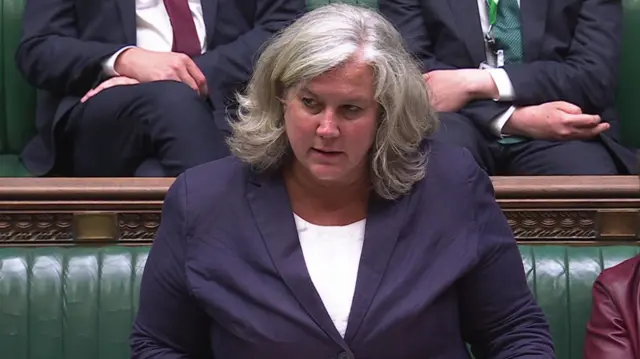 Image source, House of Commons
Alexander now turns to what she calls the "gold-plating" of HS2. She says this included a focus on the "highest possible speeds" resulting in a "bespoke and highly engineered design", describing it as a "massively overspec-ed folly".
Mark Wild, HS2's CEO, has been asked to remove this "gold-plating" from the project, Alexander says, adding that speed will now reach 320 km/h, which she says will lower the cost by £2.5bn and see the project completed one year sooner.
Alexander lets her frustration show.
"If it seems like an obscene increase in time and costs, it is because it is," she tells MPs.
"If it seems like I'm angry, it is because I am," she adds.
She also expresses her frustration on behalf of taxpayers and rail construction workers, as well as passengers who continue wait for new services.
Alexander says the expected cost of completing HS2 is now between £87.7bn and £102.7bn - priced in 2025.
She says two thirds of this increase is due to "past misunderstanding of the work required" and "issues within the control of HS2 Ltd, some of its suppliers and previous governments". The remaining third is linked to inflation, she says.
She says the government expects first services to run from Old Oak Common to Birmingham Curzon Street between May 2036 and October 2039.
She adds: "Lessons have been learnt from the Stewart review, meaning HS2's costs and schedules are now built on more solid foundations, with credible estimates published as ranges to ensure they better stand the test of time."
The transport secretary now says the first trains will run from Birmingham to Old Oak Common in west London at some point between May 2036 and October 2039.
Trains will run to Euston at a point between May 2040 and December 2043.
Alexander says the previous government spent most of HS2's budget without laying a "single metre of track".
"Today is about ending that era of neglect," she says.
Six major construction milestones have been reached earlier than planned in the past year, she says.
She adds that HS2 Limited is reviewing the supply chain contracts of the project, and the incentives within them to "ensure we finish the job at the lowest reasonable cost", in addition to improving oversight.
She says there is "no getting away from the fact" that the "vast majority of HS2's previous budget was blown on completing about a third of the project".
Heidi Alexander says the cost of HS2 will now be between £87.7bn and £102.7bn in 2025 prices.
Transport Secretary Heidi Alexander begins her statement by referencing promises made last summer to be "straight" with the country about how the government planned to "reset" the HS2 project.
As part of this, she says she is publishing the Lovegrove report today.
Alexander goes on to tell MPs about the "litany of failure" Labour inherited, including soaring costs, and huge contracts handed out without price improvements.
"Instead of signalling the country's ambition, HS2 became a signal of the country's decline," she suggests.
After more than five years of construction and £40bn spent, the country was no closer to having the HS2 railway than before construction began, she adds.
Transport Secretary Heidi Alexander is now up in the House of Commons. She is set to issue a statement on HS2.
As a reminder, you can follow her statement live at the top of this page.
Transport Secretary Heidi Alexander is due to address MPs in the Commons shortly.
We expect her to give an update on the expected cost of HS2 and announce that trains are set to run slower than planned in an effort to save money.
We will bring you the latest updates as we get them and you can watch live at the top of this page.
A review into HS2 - carried out by the UK's former National Security Adviser Stephen Lovegrove - is also due to be released, and our team of experts will be combing through it to pull out the key lines.
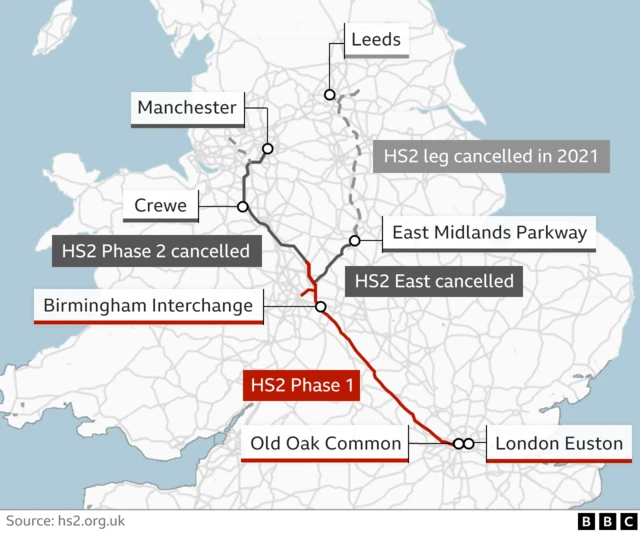
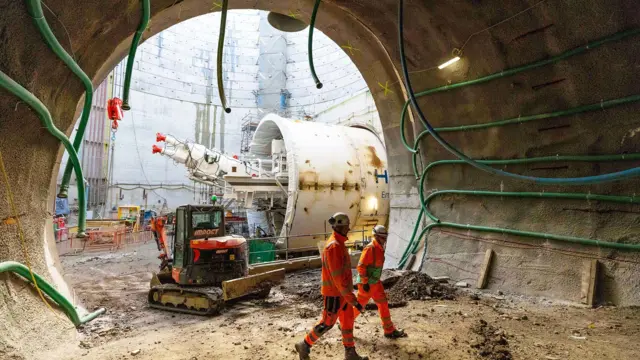 Image source, Getty Images
In short, we're still not sure.
When the project was announced in 2012, its "first leg" - linking London to Birmingham - was supposed to be up and running by 2026.
It is now 2026, and the project remains nowhere near completion despite two whole other legs - one to Manchester and one to Leeds - being scrapped.
The most recent target for the project's opening was between 2029 and 2033, however, HS2 boss Mark Wild said in December that this "cannot be achieved".
Transport Secretary Heidi Alexander is expected to set out a new schedule for when HS2 will open in her speech to the Commons this afternoon.
 Theo Leggett
International business correspondent
As designed, the railway would have an operating speed of up to 224 mph (360 km/h). That is faster than any other conventional railway in the world.
The Channel Tunnel Rail Link (HS1) for example operates at up to 186mph (300km/h).
This creates a problem, because the new trains can’t be tested at those speeds on existing tracks, so the whole process would have to wait until HS2 itself is complete – or a bespoke test track has been built.
Officials at the Department for Transport believe reducing the planned top speed by a relatively small amount would make the testing process easier and quicker, and result in big savings.
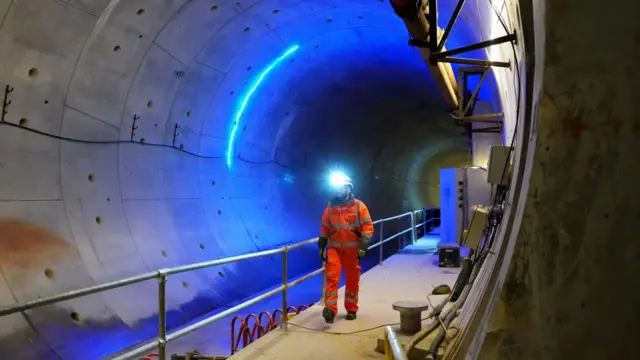 Image source, PA Media
HS2 had been designed to allow trains to run up to 224 mph (360 km/h), making the line faster than any other conventional railway in the world.
Most high-speed trains in the UK run at around 125 mph (200 km/h) , while HS1 - the Channel Tunnel Rail Link - reaches speeds of up to 186 mph (300 km/h).
But it's not just the project that could be slowing down, but the speed of the trains themselves.
In March, Transport Secretary Heidi Alexander said she was exploring cutting the speed to cut the costs.
Today it's expected that she will announce that the maximum speed of services will be 199 mph (320 km/h), meaning services will still be faster than Japan’s bullet trains, which reach up to 177 mph (285 km/h).
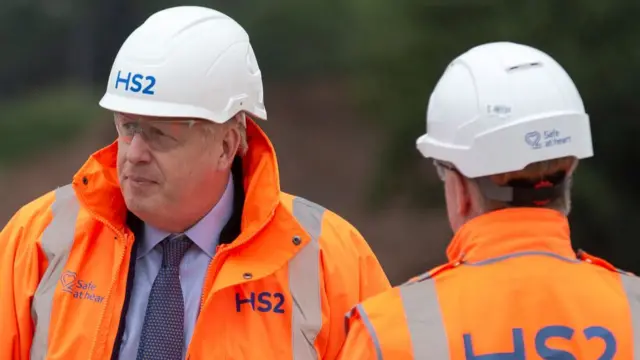 Image source, AFP via Getty Images
HS2 was intended to solve a pressing transport problem: congestion on the rail network.
Trains out of London to Leeds and Manchester were in high demand and a brand-new high-speed railway was seen as the solution.
It was first proposed by the Brown government in 2009. The plan was then taken on by the Conservative-Liberal Democrat coalition in 2010.
Two years later the route was confirmed, with plans for the project to run from London to Birmingham to then split into two separate lines going north to Manchester and Leeds.
After the 2015 election, the project was overseen by the Conservative government.
Some of the preparation had already been done but construction work officially began in 2020, with then-Prime Minister Boris Johnson saying it would "fire up economic growth and help to re-balance opportunity".
Have you been affected by the construction of HS2? What is your response to the findings in the report?
You can share comments, pictures and videos with us in the following ways:

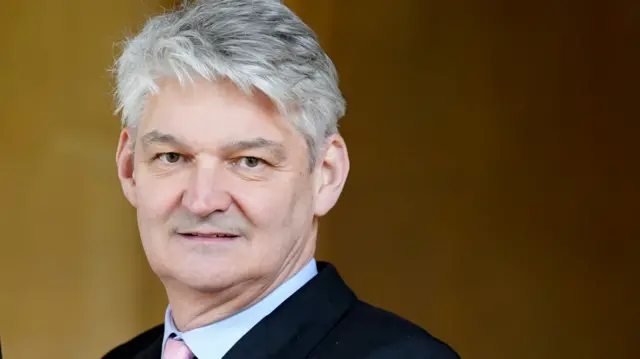 Image source, Getty Images
The UK's former National Security Adviser Stephen Lovegrove was tasked in June last year with looking into what lessons could be learned from the handling of the HS2 project.
The review, which is due for release soon, is expected to be critical of a focus on achieving the highest possible speeds "resulting in [a] bespoke and highly engineered design", which added to the overall costs.
HS2 had been designed to allow trains to run up to 224 mph (360 km/h), which would have made the line faster than any other conventional railway in the world.
Transport Secretary Heidi Alexander is set to announce today that HS2 trains will run slower than planned to save money.
Lovegrove's report is also expected to agree with a previous review, external that HS2's so-called "original sins" included changing political priorities and ballooning costs.
The Guardian quotes Lovegrove as finding that there was “little doubt that all players, certainly at HS2 Ltd and the Department [for Transport], felt under significant pressure from ministers to keep things moving".
