Summary

  1. Diplomacy 'only viable means' to lasting stability in Middle East - Pakistan foreign ministrypublished at 15:44 BST

    Pakistan’s foreign ministry has posted on X sharing details of a meeting today between deputy Prime Minister Ishaq Dar and Natalie Baker, deputy chief of mission at the US embassy in Islamabad.

    The post says Dar underscored “Pakistan’s consistent emphasis on dialogue and diplomacy as the only viable means to address challenges and achieve lasting regional peace and stability.”

    The foreign ministry goes on to say Dar “stressed the need for engagement between the United States and Iran, urged both sides to consider extending the ceasefire, and to give dialogue and diplomacy a chance."

    It adds that Baker “conveyed US appreciation for Pakistan’s constructive and positive role in promoting regional peace and facilitating dialogue.”

  2. Analysis

    Pakistan's role as a negotiator is already being sorely testedpublished at 15:12 BST

    Paul Adams
    Diplomatic correspondent

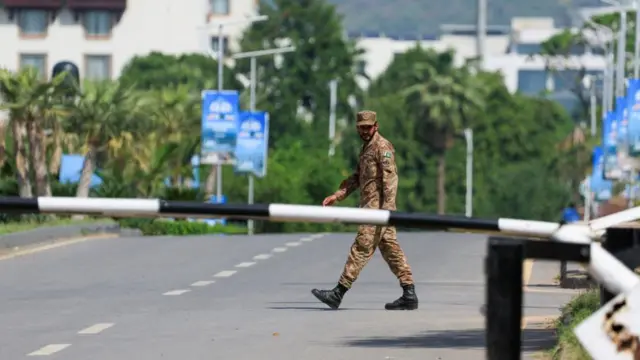
    Pakistani security personnel walking behind a black and white security gate.Image source, Reuters

    There’s a metaphorical door, deep in Islamabad’s blocked off red zone, marked “US-Iran Deal”. Holding the door open, looking nervous, is the government of Pakistan, conscious that its newly found reputation as a mediator is being sorely tested.

    The scene is set, but the guests have yet to arrive.

    The last 48 hours have been something of a roller-coaster. American and Iranian ambassadors have been meeting Pakistani government officials. Giant American C-17 aircraft have been arriving at a nearby military airbase. Streets around the Serena Hotel, where the last round of negotiations took place, have been sealed off. There’s talk of snipers posted on nearby buildings.

    Will it be Vance and Ghalibaf again? Or, since he himself mooted it in a social media post, President Trump himself?

    On the face of it, the omens don’t look good, but neither side wants to come to Islamabad only to see the delicate diplomatic process blow up in their faces. The frenzied nature of the contacts going on suggests some kind of deal is being thrashed out behind the scenes. Something in which both sides make concessions, but which both can sell as a win.

    With the two-week ceasefire due to expire at the end of Wednesday, a deal would at least buy more time for negotiation. Could we see the mutual lifting of Iranian and American naval blockades? That would be a significant start.

  3. Tehran will have ‘hand on trigger’ if it negotiates - spokespersonpublished at 14:57 BST

    Ghoncheh Habibiazad
    Senior reporter, BBC Persian

    An Iranian government spokesperson has told the state news agency IRNA that Tehran has got its “hand on trigger” during potential negotiations and that defence forces are in “full readiness”.

    Fatemeh Mohajerani did not explicitly confirm or deny whether Iran will take part in the next round of negotiations in Islamabad.

    “We have two strategies in front of us: the first is the strategy of war and the second is the strategy of diplomacy,” Mohajerani said.

    "We do not want to be attacked again, but if such attacks occur, we will definitely respond more harshly than before."

    She also said Iran’s negotiating team would “not compromise even slightly on national interests".

  4. US mulling financial help for Gulf countries, Trump sayspublished at 14:49 BST

    Bernd Debusmann Jr
    White House reporter

    US President Donald Trump has suggested that he may offer financial assistance - or a currency swap - with Gulf countries he believes have proven to be reliable allies with the war in Iran.

    Earlier this week, the Wall Street Journal reported that Emirati officials have opened talks with the US about a "backstop" in case the Iran war deepens an economic crisis in the country.

    During the CNBC interview, Trump specifically said that a currency swap with the UAE is "under consideration".

    "It's been a good ally of ours," he said. "These are unusual times."

    Trump subtly acknowledged, however, that there could be a domestic backlash against a financial lifeline for a wealthy country.

    "I'm surprised," he said. "They're really rich."

    While Trump said that Saudi Arabia isn't "asking for anything" at the moment, he praised them as allies.

    "They're fighting. They're helping us," Trump said. "They're helping us on the Strait. They're helping us all over."

    In contrast, Trump's views on Europe and Nato were on full display the interview.

    "The ones that aren't helping are Nato," he said. "We'll never need them. Actually, they'll need us. They need us desperately, because they're a paper tiger."

  5. Analysis

    Trump optimistic, but threat of strikes still loomspublished at 14:15 BST

    Bernd Debusmann Jr
    White House reporter

    The US president is, it seems, so far optimistic about the prospect of negotiations in Iran, telling CNBC there's still time to reach a "great" deal that can be acceptable to the US and help Iran in the future.

    But still, Trump is using a carrot-and-stick approach with regards to Iran. While a deal is still on the table, Trump noted that the US has used the two-week ceasefire to replenish its forces in the region, and that he is prepared to continue strikes if need be.

    Notably absent from his comments, however, is what concessions he is willing to make in the negotiations. We also don't know the deal he hopes for, other than his red line of Iran "never" being able to manufacture or possess a nuclear weapon.

    We still have no official confirmation that Vice President JD Vance and the rest of the negotiating team has left for Pakistan. But Trump has put something of a ticking clock on those talks by suggesting he does not want to extend the ceasefire.

  6. Trump says Iran has 'no choice but to send' delegates to Islamabad talkspublished at 14:07 BST

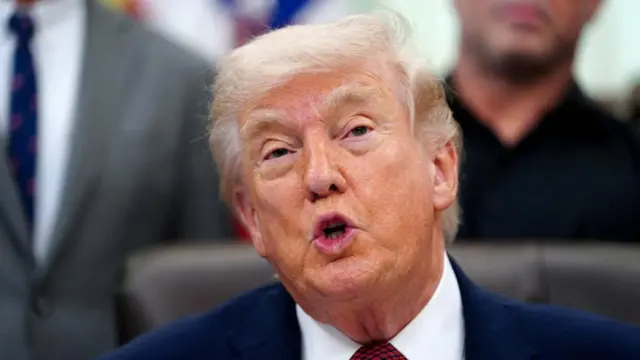
    US President Donald Trump speakingImage source, Reuters

    Donald Trump says Iran has "no choice but to send" delegates to Pakistan for talks with the US.

    In an interview with CNBC, the president says he is confident the US will "end up with a great deal".

    He says that the US is "not dealing with the nicest people" but are doing so "successfully", before calling the US naval blockade a "tremendous success".

    Asked if he would extend the ceasefire if negotiations seemingly progress, the US president says: "I don't want to do that".

    Trump later says: "I expect to be bombing 'cause that would be a better attitude."

    He says there is not "much time" to reach a deal, and that Iran can get themselves on "a very good footing" if they reach one with the US.

  7. Iran also accused Washington of breaching trucepublished at 13:34 BST

    Trump is not the first to make the accusation of a ceasefire breach during this two-week period.

    On Sunday, Iran's military vowed to retaliate against what it called the US's "act of armed piracy". A US destroyer fired on an Iranian-flagged cargo ship in the Gulf of Oman. Washington said the ship was trying to evade its naval blockade.

    In response, Iran's military headquarters said the US operation was a “violation of the ceasefire".

  8. What were the terms of the US-Iran ceasefire?published at 13:29 BST

    Donald Trump earlier accused Iran of violating the ceasefire between itself and the US multiple times.

    As a reminder, Iran and the US agreed to a conditional two-week ceasefire on 8 April, which is due to expire on Wednesday.

    US President Donald Trump said the deal was agreed on the condition that Tehran reopens the Strait of Hormuz, a vital shipping route for oil and other exports from the Gulf.

    Tehran said at the time it agreed to allow vessels through the Hormuz Strait for two weeks, with their passage coordinated by the Iranian military.

  9. Trump to speak shortly on US morning TV after ceasefire breach accusationpublished at 13:16 BST

    James FitzGerald
    North America reporter

    It's possible that we'll learn a little more from Donald Trump shortly with regard to the ceasefire violations that he says Iran has committed.

    The US president is scheduled to speak to CNBC at 08:30 local time (13:30 BST).

    A short time ago, Trump posted on his Truth Social platform to say: "Iran has Violated the Cease Fire numerous times!" He did not offer any further information, and we're yet to see any response from Iran to the post.

    It's worth us mentioning that Iran has made similar accusations against the US. On Monday, foreign ministry spokesman Esmail Baghaei was quoted by Al Jazeera as saying that the American attack and seizure of a cargo ship in the Gulf amounted to a violation of the ceasefire.

  10. BBC Verify

    What we know about the tanker boarded by the US in the Indian Oceanpublished at 12:50 BST

    By Thomas Copeland

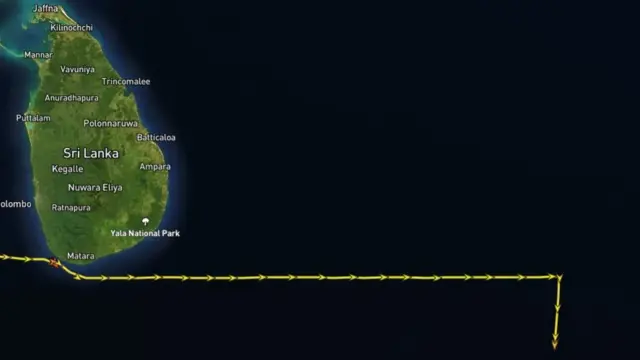
    Ship-tracking data shows a tanker intercepted by the US military in the Indian Ocean made a sharp turn in the early hours of this morning and is now broadcasting its location around 700km (430 miles) south-east of Sri Lanka.

    Data from MarineTraffic shows the crude oil tanker Tifani, which has a capacity of close to 300,000 tonnes, is currently loaded with cargo.

    The tanker has been sanctioned by the US Office of Foreign Assets Control and is linked to an Indian shipping company which is also subject to American sanctions over links to Iran.

    Location data shows Tifani left the Gulf region on 10 April and briefly stopped close to the Sri Lankan port of Galle on 18 April before it was intercepted by the US. It was estimated to arrive at its reported destination of Singapore on Sunday, according to MarineTraffic.

    A screengrab from MarineTraffic showing the ship's track east before turn sharply southImage source, MarineTraffic
  11. Pentagon says US forces boarded 'sanctioned' tanker overnightpublished at 12:31 BST
    Breaking

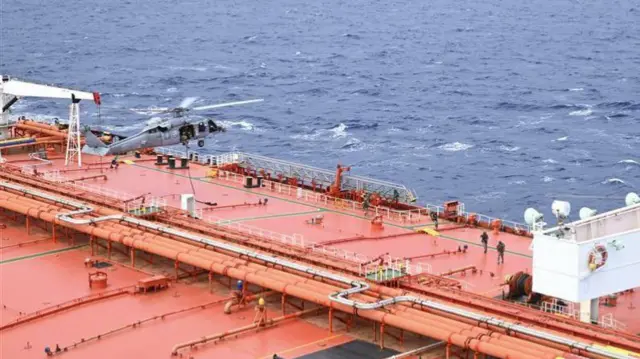
    A still from the footage posted by the Pentagon on X, showing a US helicopter landing on the vesselImage source, US Department of War
    Image caption,

    A still from the footage posted by the Pentagon on X, showing a US helicopter landing on the vessel

    The Pentagon says US forces boarded a sanctioned tanker overnight "without incident" in the Indo-Pacific region in efforts to "disrupt illicit networks" supporting Iran.

    In a post on X, the US Department of War says it "conducted a right-of-visit, maritime interdiction and boarding of the stateless sanctioned M/T Tifani without incident".

    The department shared this update with pictures and videos of the operation.

    The department says it continues to "pursue global maritime enforcement efforts to disrupt illicit networks and interdict sanctioned vessels providing material support to Iran - anywhere they operate".

    "International waters are not a refuge for sanctioned vessels," it adds.

  12. Trump accuses Iran of violating ceasefire 'numerous times'published at 12:18 BST

    US President Donald Trump has accused Iran of violating the ceasefire agreement "numerous times".

    The accusation was made in a post on Truth Social a short time ago, and he doesn't give any more information about what he's referring to.

  13. Kuwait 'disposing' of strike remnants, meaning explosions may be heard therepublished at 12:05 BST

    Away from Iran for a moment, Kuwait's army says it "is dealing with remnants of shrapnel and explosives" until this later evening.

    "Any explosion sounds that may be heard during this period result from the process of disposing of the shrapnel and explosives," the army says in its statement.

    Since the US-Israel war in Iran began, Kuwait has been one of the countries in the Gulf region that has reported being targeted by Iranian drones and missiles. Iran has previously said it was targeting US assets in these countries.

    Kuwait last reported Iranian attacks in its territory on 10 April - two days after the ceasefire began, it is due to end tomorrow.

  14. 'Our minds need to focus on other things': Iranians navigate daily lifepublished at 11:33 BST

    Fataneh Farajollahi
    BBC Persian

    Two women sit at a cafe table with drinks in Tehran on April 21, 2026, amid a ceasefire in the regionImage source, Getty Images
    Image caption,

    In Tehran, many people are continuing their daily lives as usual (those pictured are not featured in the text below)

    There are signs of a partial return to everyday life in Iran, but posts shared by some Iranians on social media continue to paint a layered picture of daily life.

    These accounts describe efforts to maintain a sense of normality alongside reports of psychological fatigue, economic pressure, and ongoing debate over unequal access to the internet, as outlined in our previous post.

    While these accounts reflect only a portion of individual experiences - and are not necessarily representative of society as a whole - they suggest that concerns raised in recent weeks persist.

    Among the posts, there is a noticeable divide over how people should respond to the current situation. Some users have criticised others for sharing everyday activities such as shopping or going to cafés, arguing that such posts overlook the impact of the war.

    Some are defending their right to continue with daily life. One user wrote that even after “crying several times since last night,” they might still “wear nice clothes and go out with friends”, adding that this should not be judged.

    Another, referring to posting about a football match, said: “Our minds also need moments to focus on other things… so don’t criticise people for it.”

    A further post reads: “It’s not strange… our minds need to engage with other things at times, so we don’t fall apart. This is likely how our lives will be for a long time.”

  15. Iran still under near-total internet blackout, but no indication on when restrictions may be liftedpublished at 11:04 BST

    Ghoncheh Habibiazad
    Senior reporter, BBC Persian

    Iran is still under a near-total internet blackout, which started on the first day of the war in February.

    While Iranian officials have cited reasons such as “protecting cyberspace” for restricting online access, even with the ceasefire, limitations on the internet have not been lifted.

    Domestic messaging apps and websites are available, but the BBC understands that there have been disruptions and crashes.

    Two main groups now have access to the internet. Some officials, pro-establishment users, journalists and academics, as well as some business owners.

    Some Iranian officials have rejected this so-called “tiered” access to the internet, but they have not specified when restrictions might be lifted.

    The other group are ordinary people who are paying a lot to stay connected, mainly via connections routed through satellite internet provider Starlink.

    Using or possessing Starlink in Iran can lead to up to two years in prison, and Iranian authorities have confiscated hundreds of Starlink devices since the war started.

    The BBC understands that the second group, when buying expensive internet connections, have sometimes been scammed on messaging app Telegram.

    There is also the fear among ordinary Iranians that the BBC talks to is that internet access might never go back to the situation before the war, even though it was restricted then as well. But many circumvented the restrictions to access Western websites and social media apps.

    It is still not clear when ordinary Iranians will be able to access the internet, but what is clear is that not everyone in Iran can afford to access at the moment.

  16. War and internet restrictions affecting livelihoods of Iran's most vulnerablepublished at 10:33 BST

    Jiyar Gol
    Reporting from Islamabad

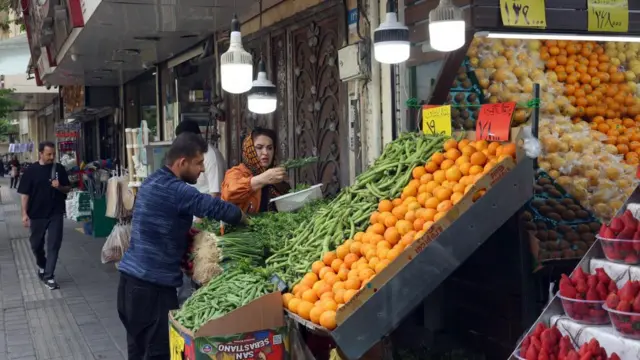
    Iranians shop for bight coloured fruit and vegetables, oranges, beans, strawberries, in a market in a street in TehranImage source, EPA/Shutterstock
    Image caption,

    Food prices have doubled in Iran over the last year

    Many inside Iran, including defenders of the Islamic Republic, are urging people to tighten their belts and prepare for even greater economic hardship.

    The question is can the Iranian government pay its employees if the blockade of the Strait of Hormuz continues? Can Tehran afford to abandon negotiations?

    Before the conflict, sanctions, inflation, and currency depreciation had driven many households into an economy of survival, with families spending only on essential needs.

    Now, shuttered businesses and bounced cheques, along with damaged petrochemical, steel and aluminium industries have intensified recessionary pressures.

    With food prices doubling over the last year and exports declining, the rial, Iran’s currency, faces further erosion, driving even higher inflation.

    Iranian officials estimating economic damage reaching $270bn (£200bn) reflect the scale of the shock.

    The impact has been especially severe for women running small online businesses. Internet blockades and disruptions have cut off many women who sold handicrafts through social media and online marketplaces, wiping out vital income streams for families overnight.

    Their losses reflect a broader reality: war and internet restrictions are not only damaging infrastructure but affecting livelihoods across Iran’s most vulnerable communities.

  17. China expresses 'full support' for Pakistan facilitating US-Iran talkspublished at 10:04 BST

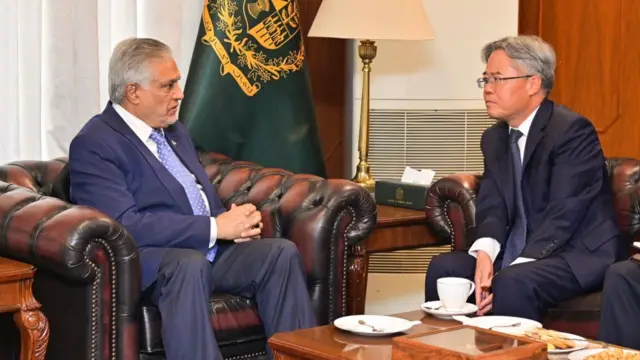
    Dar and Zaidong face each other to speak as they sit on separate brown leather sofas next to one anotherImage source, Pakistan Ministry of Foreign Affairs via X
    Image caption,

    Pictures of the face-to-face meeting have been shared by Pakistan’s foreign ministry

    China's ambassador to Pakistan has expressed Beijing’s "full support" for Islamabad’s efforts to facilitate peace talks between the US and Iran.

    Pakistan's foreign ministry says that Deputy Prime Minister Ishaq Dar - who also serves as foreign minister - met with Jiang Zaidong to discuss developments in the region.

    During the meeting, Zaidong expressed "appreciation of Pakistan’s continued efforts to facilitate engagement” between the US and Iran “for sustained peace and stability in the region and beyond", the foreign ministry says.

  18. Iran's 'mixed messages' a reflection of Trump's inconsistency, analyst tells BBCpublished at 09:37 BST

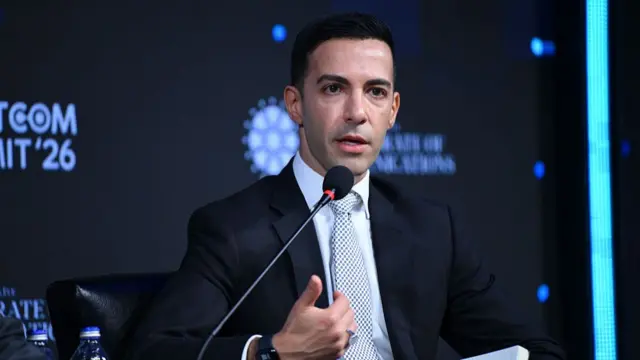
    Ali Vaez, Iran Project Director and Senior Adviser at the Crisis Group attends a panel titled 'From Regional Tensions to Global Fractures: Strategic Implications of the Iran War' within the STRATCOM Summit 2026 in Istanbul, Turkiye on March 28, 2026.Image source, Getty Images

    Iran's regime is consistent in its stance, its mixed messages are a reflection of Iranians reacting to President Trump's "inconsistent positions", International Crisis Group's Iran project director told BBC Radio 4's Today programme earlier.

    Ali Vaez said Iran had "maintained a high degree of coherence" in terms of policymaking and its position on negotiations with Washington.

    "People are reading too much into some of the mixed messages coming out of Tehran, and that to me is more a reflection of the Iranians reacting to President Trump's inconsistent positions," Vaez argued.

    He added: "For instance, when the Iranians announced that they had removed the blockade of the Strait of Hormuz, this was before President Trump said that he's going to maintain the US blockade.

    "Therefore, the Iranian military came out and said they would re-impose their blockade. That wasn't a sign of infighting, it was just a tick tock of events."

  19. No Iranian delegation has travelled to Islamabad yet - state broadcasterpublished at 09:12 BST

    Ghoncheh Habibiazad
    Senior reporter, BBC Persian

    Iran’s state broadcaster says in a post on its Telegram channel that “so far, no delegation from Iran has travelled to Islamabad, neither a primary nor a secondary, neither initial nor follow-up.”

    The post rejects what it calls “rumours” about the departure or arrival of the delegation and the estimated date of its arrival by “international outlets and regional sources.”

    It also repeats the stance of Iranian officials, including the parliament speaker and Iran's top negotiator Mohammad Bagher Ghalibaf, who has previously said Tehran does not accept negotiations “under the shadow of threats.”

  20. Pakistan is in a unique position to host talks, but there are significant risks for the countrypublished at 08:44 BST

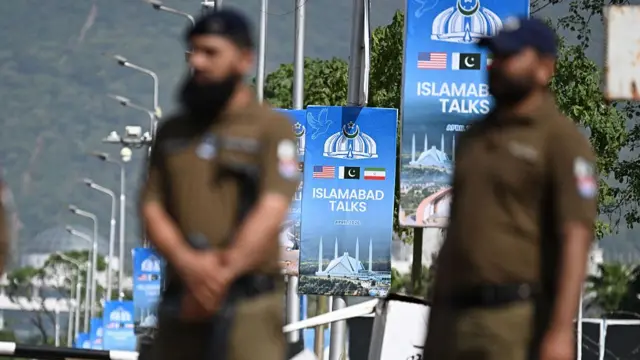
    Two security guards stand in front of lamp posts with posters reading Islamabad talksImage source, Getty Images

    As Pakistan prepares to host a second round of peace talks - despite uncertainty over whether they will go ahead - security is being ramped up in Islamabad, and posters reading "Islamabad Talks" are lining the streets of the capital.

    The country is in a unique position as it is trusted by the US, Iran and the Gulf countries.

    But close ties with America didn’t stop Pakistan officially condemning the first US-Israeli attacks on Iran. And when Iran bombed the oil fields of Saudi Arabia, a military ally, Pakistan also issued a strongly worded statement against Tehran.

    If negotiations collapse, Pakistan could get dragged into fighting with its neighbour Iran. Pakistan signed a mutual defence pact with Saudi Arabia last year, one of the Gulf countries that has been victim to Iranian drone strikes before the current ceasefire, which is due to expire tomorrow.

    The stakes for the world are high, but they are especially significant for Pakistan in many ways.