Summary

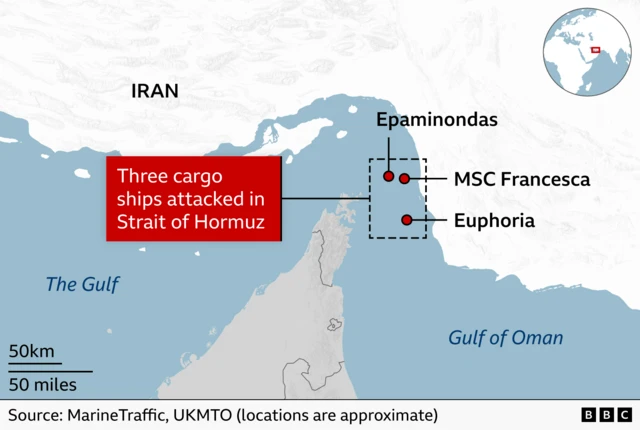
  • Iran has attacked three cargo ships in the Strait of Hormuz, Iranian reports say, after Donald Trump said he was extending the US-Iran ceasefire. BBC Verify has located the attacks here

  • The Islamic Revolutionary Guard Corps (IRGC) says it has seized two of the three ships, and is escorting them to the Iranian coast - here's a round-up of the attacks

  • The ships may have tried to make a "run for it" when the strait reopened briefly last week, Jonathan Josephs writes

  • Trump said last night he was extending the ceasefire, while also maintaining the US blockade of Iranian ports, which is designed to put pressure on Iran before talks with the US in Pakistan

  • But the status of those talks is unclear - US Vice-President JD Vance did not depart for Pakistan as expected on Tuesday

  • The Strait of Hormuz is now too dangerous for all but a trickle of traffic, writes Frank Gardner - it is deeply damaging for both Iran and the global economy

  1. Lebanese president condemns killing of second French peacekeeperpublished at 16:21 BST

    Lebanon's President Joseph Aoun has condemned the killing of a second French peacekeeper in southern Lebanon following an attack on a United Nations Interim Force in Lebanon (Unifil) patrol.

    Earlier, French President Macron announced the death of the second French citizen following Saturday's attack, which he blamed on the Iran-back group Hezbollah - which has denied involvement.

    In a statement posted by Aoun's office, it says he "renewed his condemnation of the incident, reiterating his condolences to the French state and the Unifil leadership".
  2. Greece denies ship seized by Iran in Strait of Hormuzpublished at 16:01 BST

    The Greek-owned container ship Epaminondas has "not been detained" by the Islamic Revolutionary Guard Corps (IRGC), according to Greek Foreign Minister Giorgos Gerapetritis.

    Speaking to CNN earlier, he said it was attacked and has faced "extensive damage". Greek media is reporting that the shipping ministry also denies that it has been detained.

    Earlier, the IRGC said that the ship, along with the MSC Francesca, was "seized" and directed towards the Iranian coast, Iranian media reported.

    The UK Maritime Trade Operations Centre said it was approached by an IRGC gunboat, which opened fire and caused significant damage to the bridge.

    A satellite image shows the Liberia-flagged Epaminondas container ship, April 22, 2026Image source, COPERNICUS SENTINEL-2/Reuters
    Image caption,

    A satellite image shows the Epaminondas container ship

  3. Trump says talks with Iran 'possible' in next few dayspublished at 15:47 BST

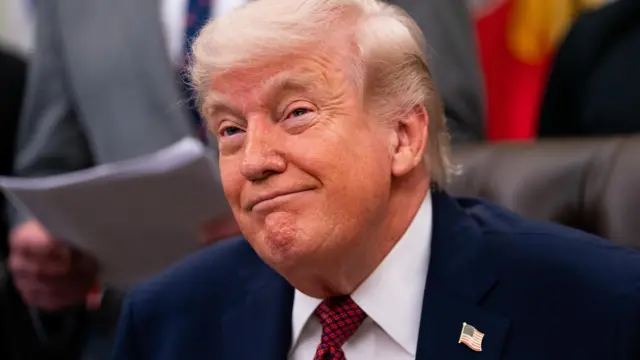
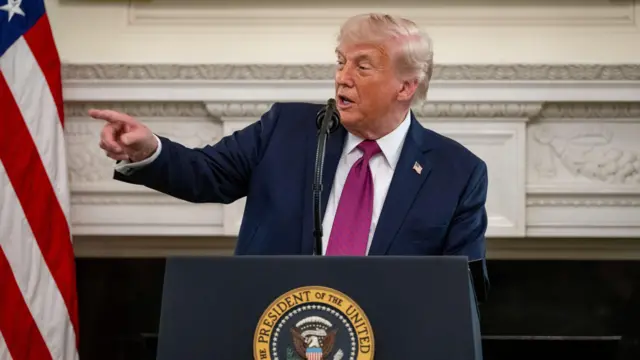
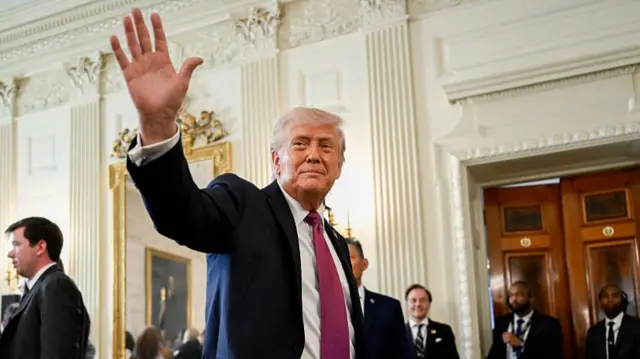
    US President Donald Trump departs after speaking in the State Dining Room of the White House in Washington, DC, US, on Tuesday, April 21, 2026Image source, Getty Images

    Donald Trump says "it's possible" that a second round of peace talks with Iran could begin by Friday, according to the New York Post.

    The newspaper says it was told by Pakistani officials that talks might be possible within the next "36 to 72 hours". When the Post put this to Trump, the US president replied in a text message: "It’s possible! President DJT."

    Yesterday, Trump announced that he would extend the ceasefire with Iran, set to expire on Wednesday evening, to allow the regime more time to create a "unified proposal" to end the war.

  4. Analysis

    Some Iranians trying to get on with their lives, while others are defiantpublished at 15:22 BST

    Lyse Doucet
    Chief international correspondent, in Iran

    The first reactions here to President Trump’s ceasefire extension, by spokesmen on social media, was predictable, sceptical, defiant.

    Mahdi Mohammadi, an adviser to Iran’s lead negotiator, dismissed it as meaningless, a ploy to buy time for a surprise attack. It underlines the deep distrust here about US diplomacy.

    Previous rounds of talks - last year and this year - were shattered by surprise Israeli-American attacks.

    Iran has its own commitment to keep as part of this ceasefire. But it’s making it clear it won’t open the strategic Strait of Hormuz, on its conditions, until the US lifts its naval blockade and releases its seized vessel - that’s the political logjam now.

    And there’s no clear sign of how and when it will be resolved. When we speak to Iranians here, we hear a range of views, not surprisingly. Iranians taking to the main squares in this city every night in response to the government’s call to show solidarity, are also defiant.

    Others tell us they’re just trying to get on with their lives, exhausted by years of failed nuclear talks, spiralling prices, tightening security and surveillance, and all the many restrictions on their lives, their futures.

    The BBC's chief international correspondent Lyse Doucet is reporting from Tehran on condition that none of her material is used on the BBC's Persian Service. These restrictions apply to all international media organisations operating in Iran.

  5. Second French peacekeeper killed in Lebanon, says Macronpublished at 15:05 BST

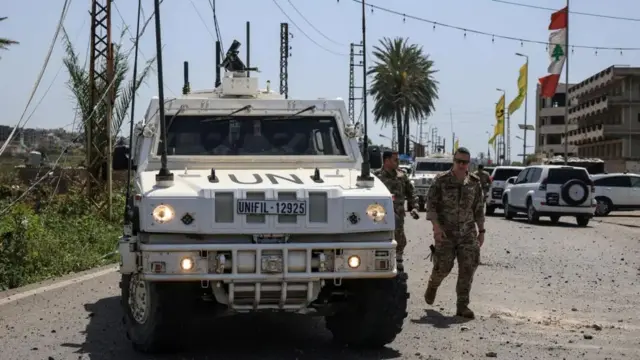
    A large UN patrol truck with two soldiers wearing camouflage gear walking next to it in LebanonImage source, Reuters
    Image caption,

    File photo of Unifil peacekeepers in southern Lebanon on 16 April

    A second French peacekeeper has died after being seriously wounded by Hezbollah fighters, says French President Emmanuel Macron.

    In a statement on X, Macron says Corporal Anicet Girardin was repatriated yesterday and died this morning.

    On Saturday, a French peacekeeper who was serving with the UN mission in southern Lebanon, Unifil, was killed after a patrol came under fire. Macron blamed Hezbollah for the attack, though the Iran-backed armed group denied "any connection" to the incident.

    Two other peacekeepers have been injured.

    Macron said earlier that he "fully" supports the ceasefire between Hezbollah and Israel, and is concerned that it may "already be undermined by the continuation of military operations". He called for Hezbollah to renounce its weapons and for Israel to respect Lebanese sovereignty.

  6. BBC Verify

    Owner of attacked tanker denies cryptocurrency scam claimspublished at 14:54 BST

    By Kayleen Devlin

    The company which owns an Indian-flagged tanker that was attacked in the Strait of Hormuz over the weekend, despite its captain saying the ship had been granted clearance by Iran, has denied the vessel had fallen victim to a cryptocurrency scam.

    In a statement sent to BBC Verify, Sanmar Group says “these reports are completely false” and that it is working closely with the Indian government to ensure the vessel’s safe passage.

    The denial comes after Greek maritime risk management firm Marisks issued a warning, first reported by Reuters,, external that some shipping companies with vessels stranded in the Strait of Hormuz have received fraudulent messages promising safe passage in exchange for cryptocurrency.

    Cryptocurrencies like Bitcoin are a type of digital money which operate outside traditional banking systems, often allowing payments to be made quickly and with a degree of anonymity.

    There have been reports of several ships being struck since Iran said it had closed the strait again on 18 April, with some claiming they had been given clearance to transit.

  7. The war of words: What Iran has said about talks with the USpublished at 14:39 BST

    Carrie Davies
    Pakistan correspondent in Islamabad

    As with President Trump, Iran has used social media to lay out its demands and position as well as taunt the US and issue threats.

    The internet monitoring organisation Netblocks has reported an internet blackout in Iran, so how many of these posts are for domestic rather than international consumption is questionable.

    Mohammad Bagher Ghalibaf is Iran’s parliamentary speaker and led the delegation that met Vice President JD Vance in Islamabad last week.

    In the run up to those talks, he’s used his X account to declare in English that Iran would not negotiate without a ceasefire in Lebanon and troll Trump over the high gas prices the war is has created.

    Indeed, trolling has been a common theme, often coming from Iran’s foreign embassies. The Iranian embassy in Zimbabwe, for instance, has shared multiple posts including of an AI generated Trump dressed as a pirate on a film poster titled Pirates of the Hormuz.

    Both the US and Iran are using online platforms to try to undermine the other; the question too is what impact the flood of messages has on the delicate dance of negotiations.

  8. Two killed in Israeli strike on car - Lebanese state-run mediapublished at 14:29 BST

    Two people have been killed in an Israeli attack on a car in the village of al-Tiri, southern Lebanon, according to state-run National News Agency.

    Yesterday, the Israel Defense Forces issued a warning to residents to stay away from the Litani River, Wadi al-Salouqi and Wadi al-Salhani, citing "ongoing terrorist activities of Hezbollah".

    A ceasefire between Israel and Lebanon was announced on 16 April and is due to last 10 days. Washington is due to host ambassador-level talks on Thursday.

    Both Hezbollah and Israel have accused each other of violating the ceasefire agreement. The IDF said earlier that Hezbollah launched an attack on Israeli forces in southern Lebanon.

  9. BBC Verify

    MarineTraffic data shows probable, approximate locations of cargo ship attackspublished at 14:14 BST

    By Paul Brown

    BBC Verify’s analysis of vessel-tracking data has identified the probable and approximate locations of the three cargo ships when they were attacked in the Strait of Hormuz this morning.

    The positions being broadcast on MarineTraffic for Euphoria, MSC Francesca and Epaminondas show all three cargo ships changed their direction at the time they were reportedly attacked.

    This tracking data also matches with the approximate locations for two incidents given by UKMTO - and MSC Francesca’s change in direction fits with the time of the attack reported to BBC Verify by maritime intelligence firm Vanguard.

    Location data monitoring has limitations as ships can turn their trackers off - or attempt to hide their location by broadcasting a false position, known as “spoofing”.

    Iran says it has seized the MSC Francesca and Epaminondas, but it has not commented on the status of the Euphoria.

    Here’s a map showing the approximate locations of these three incidents in the strait:

    Map of the Strait of Hormuz showing the approximate locations all three ships were attacked in the eastern side of the strait
  10. Were ships making a run for it through the Strait of Hormuz?published at 13:59 BST

    Jonathan Josephs
    Business reporter

    It appears that that two of the three ships that have been targeted by Iran were part of a convoy belonging to the world’s biggest shipping company, MSC.

    The Strait of Hormuz seemed to reopen briefly on Friday for a short window and that might have been sufficient encouragement for them to try and make a run for it.

    The MSC Francesca and MSC Epaminondas, as well as four others, had been trapped in the Gulf since before the start of this conflict.

    However, the others, MSC Clara, MSC Grace, MSC Margrit XIII, and MSC Madeleine are now safely on the eastern side of the Arabian sea, according to transponder data analysed by maritime data firm Linerlytica.

    Those four all seemed to turn off their transponders to hide their locations whilst they made the hazardous journey. Two other container ships also made it out.

    However, despite being relatively smaller cargo vessels the MSC Francesca and MSC Epaminondas don’t seem to have been so lucky and have been seized by Iran’s Islamic Revolutionary Guard Corps (IRGC) forces, apparently for inspection.

    There’s no word from MSC, which normally tries to keep a low profile. Despite being headquartered in landlocked Switzerland, its ships handle about 20% of all the world’s goods that move by sea.

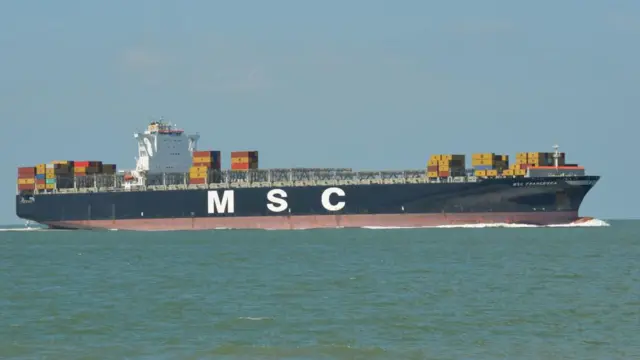
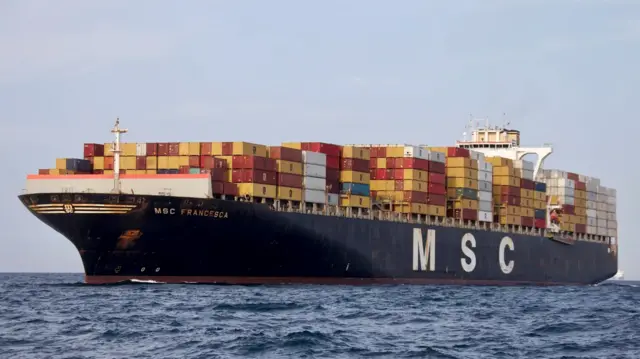
    MSC FrancescaImage source, (C)2007 {Henk de Winde}, all rights reserved
    Image caption,

    A file photo of the MSC Francesca

  11. Analysis

    The Iranian regime appears to fear renewed unrestpublished at 13:48 BST

    Jiyar Gol
    BBC Persian, reporting from Islamabad

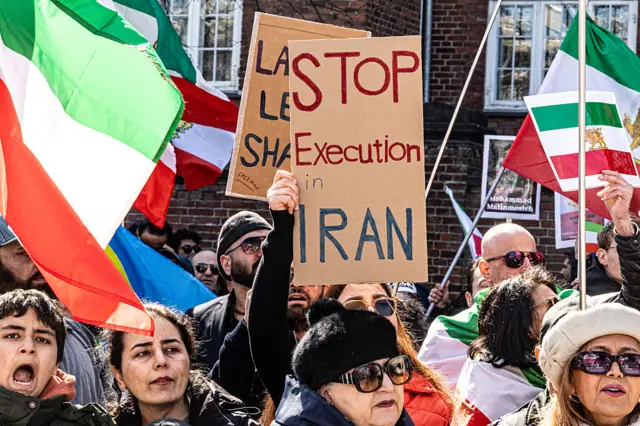
    A group of protesters holding Iranian flags and placards. A placard in the foreground reads: "Stop execution in Iran".Image source, Getty Images
    Image caption,

    A demonstration against Iranian executions, held in Copenhagen, Denmark on 11 April

    Authorities in Iran appear to be trying to control the narrative by restricting internet access and presenting an image of widespread public support.

    It remains uncertain how much hardship people can endure under ongoing economic pressure and censorship.

    Just yesterday, another protester who was arrested during the nationwide protests in January was executed. Iran’s judiciary identified him as Amir Ali Mirjafari, alleging that he set fire to a mosque in Tehran.

    Human rights groups say that at least 14 people have been executed in recent weeks and report that a growing number of death sentences have been handed out to protesters - some of them accused of espionage.

    The executions are a stark sign the regime is deeply fearful of an uprising.

    In January, the regime killed tens of thousands of protesters demanding change.

    Basiji militias commanders appear on state television warning that dissent will be punished in the same way the regime claims to confront foreign enemies like the US and Israel.

  12. Iran executes another man accused of spying for Israelpublished at 13:40 BST

    BBC Monitoring

    Iran on Wednesday executed a man convicted of spying for Israel's Mossad intelligence service.

    Iranian media says the man had worked in a sensitive state organisation's passive defence committee and had extensive contact with a Mossad officer.

    On Tuesday, Iran executed another man in connection with the January protests, also accusing him of having contacts with Mossad.

    Iran has executed more than a dozen people since the beginning of the conflict, with some accused of spying for Israel, others for their alleged membership of the exiled opposition group Mojahedin-e Khalq Organisation, or for their role in the January unrest.

    Meanwhile, Iran's judiciary on Tuesday dismissed reports that eight women were facing imminent execution, after Donald Trump called for their release.

    The judiciary-run Mizan News Agency said the US president had been misled by "fake news" spread by "hostile" opposition media, saying that several of the women have already been released, while others faced charges not carrying the death penalty.

  13. IDF says it is 'unaware' of strike in Lebanon reported to kill one personpublished at 13:28 BST

    The Israeli military says it is "unaware" of a strike reported by Lebanese media to have killed one person and injured two near the Litani River.

    Lebanese state-run National News Agency said the strike hit Western Bekaa, an area near the Litani River, at dawn.

    On Tuesday, the Israel Defense Forces issued a warning to residents to stay away from the Litani River, Wadi al-Salouqi and Wadi al-Salhani, citing "ongoing terrorist activities of Hezbollah".

    Lebanon and Israel agreed to a 10-day ceasefire last week, and Washington is due to host ambassador-level talks on Thursday, though both Hezbollah and Israel have accused each other of violating the ceasefire agreement.

    Meanwhile, Israel says on Wednesday it has intercepted a hostile aircraft launched by Hezbollah towards Israeli military forces operating in southern Lebanon.

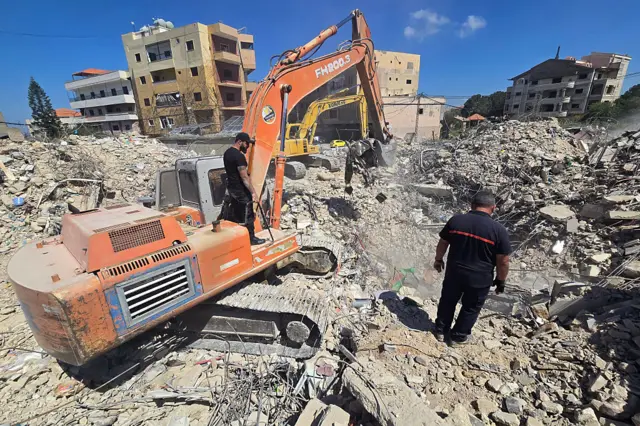
    Two diggers operate amid piles of rubble. A man stands on the outside of one of them, and another man is surveying the scene.Image source, Getty
    Image caption,

    Rescue teams work to remove rubble from a building previously hit by the Israeli army, in the southern Lebanese village of Hanaouay

  14. Communications under way to extend Israel-Lebanon ceasefire, Lebanese president sayspublished at 13:14 BST

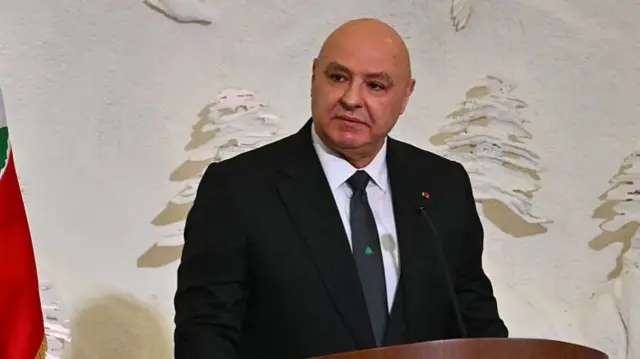
    Headshot of Aoun who looks to the side while he stands at a dark wooden podium which has a small microphone on a stand pointing up at himImage source, Getty Images

    Communications are under way "to extend the ceasefire deadline" between Israel and Lebanon, Lebanon's President Joseph Aoun says.

    It comes ahead of the second round of talks in Washington DC on Thursday between the two countries, which are in the midst of a temporary 10-day truce that took effect from 17:00 EST (21:00 GMT, midnight local time) on 16 April.

    In a post on X, Aoun says the talks being prepared are "based on a complete halt to Israeli aggressions, achieving the Israeli withdrawal from Lebanese territories, the return of prisoners, the deployment of the army to the international borders, and the start of reconstruction of what was destroyed during this war".

    Aoun says that Lebanon's position on "negotiations is clear: no concessions, no bargaining, and no surrender except for what achieves Lebanese sovereignty and the interests of all Lebanese".

    The support from the US has provided Lebanon with an "opportunity that we must not squander," the post from his office adds.

  15. Ceasefires and talks on two fronts - a timeline of how we got herepublished at 12:54 BST

    US President Donald TrumpImage source, EPA/Shutterstock

    Here's a reminder of how two ceasefires on different fronts of the conflict in the Middle East came to be:

    US and Iran

    8 April: Pakistan, acting as mediator, announces a two-week ceasefire between the US and Iran, which is due to end on 22 April.

    Trump said the deal was agreed on the condition that the Strait of Hormuz reopen. Pakistan said Lebanon was included. Iran agrees, but the US and Israel dispute this.

    11 April: Senior US and Iranian officials, including Vice-President JD Vance and Iran's Foreign Minister Abbas Araghchi, meet in Pakistan. After 21 hours of back and forth, Washington and Tehran remain far apart on key sticking points.

    12 April: Trump announces a blockade of Iranian shipping as Iran continues its own blockade of the Strait of Hormuz after the failure of the Islamabad talks.

    21 April: Trump agrees to extend the ceasefire for an unspecified time so negotiations can continue.

    Israel and Lebanon

    14 April: Lebanon and Israel hold their first diplomatic talks since 1993, a rare encounter aimed at ending fighting between Israel and the Iran-backed Hezbollah militant group, which operates in southern Lebanon.

    16 April: The US announces a 10-day ceasefire has been agreed between Israel and Lebanon, which is due to expire on 26 April.

    Trump urged Hezbollah, which had been trading fire with Israel, to abide by it. Israel's Prime Minister Benjamin Netanyahu has meanwhile said troops will remain stationed 10km (6.2 miles) into southern Lebanon, despite the ceasefire.

  16. Iran will take 'necessary measures' to protect Iranian interests - foreign ministerpublished at 12:30 BST

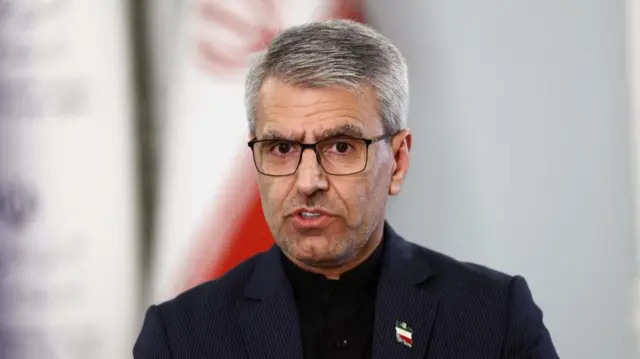
    Esmail Baghaei is pictured in a head and shoulders image wearing a dark jacket with an Iran lapel pin.Image source, Reuters

    Iran's foreign ministry spokesman Esmail Baghaei says the country is "closely monitoring developments" in the political arena, in response to requests for a ceasefire from Pakistan, according to the state-run Islamic Republic News Agency (IRNA).

    In a post on Telegram, IRNA quotes Baghaei as saying Iran will take “necessary and appropriate measures to safeguard Iran’s national interests and security”.

    Last night, US President Donald Trump announced he would extend the ceasefire on Pakistan's request, citing what he called Iran's "seriously fractured" government.

    On the possibility of further negotiations with Washington, Baghaei says: “Diplomacy is a tool for securing national interests and security, and whenever we conclude that the necessary and reasonable conditions exist to use this tool… we will take action.”

  17. IRGC claims two ships transferred to Iran waters for 'inspection'published at 12:18 BST

    Ghoncheh Habibiazad
    Senior reporter, BBC Persian

    Iranian outlets, including Iran’s state TV Telegram channel, have published a statement by the Islamic Revolutionary Guard Corps (IRGC) Navy.

    In the statement, the IRGC Navy says that two ships, MSC Francesca and Epaminondas, have been transferred to the territorial waters of Iran for “inspection of their cargo, documents, and records”.

    It says that the ships were "operating without authorisation" and committed "repeated violations", accusing them of trying to leave the Strait of Hormuz "in secret" and tampering with navigation systems.

    The BBC cannot independently verify this claim.

    The IRGC Navy has warned that it is “monitoring” movements through the strategic Strait of Hormuz and has vowed “firm” action against the “violators”.

    In this statement there’s no mention of the ship Euphoria, which we earlier reported was also targeted on Wednesday.

    A file photo of the Panama-flagged MSC Francesca, loaded with containersImage source, AGUSTIN ALAPONT VIA MARINE TRAFFIC
    Image caption,

    A file photo of the Panama-flagged MSC Francesca

  18. Analysis

    Ship strikes put added pressure on US-Iran trucepublished at 11:59 BST

    Sebastian Usher
    Middle East analyst

    Donald Trump speaks at a microphoneImage source, EPA

    Hours after President Trump announced an extension of the ceasefire, Iran seems to be stepping up its control of the Strait of Hormuz - which has been a key obstacle in making progress towards a peace deal.

    Gunboats from the Islamic Revolutionary Guard Corps are reported to have intercepted vessels trying to cross the waterway.

    No casualties or major damage have been reported, but the move will put added pressure on the renewed truce, while also underlining the risk the current deadlock runs of allowing the conflict to re-ignite.

    In his latest comments, President Trump portrayed the closure of the Strait of Hormuz as an economic own goal for Tehran - but it's the political pressure it brings to bear on the US that Tehran seems intent on maximising.

  19. Why is the Strait of Hormuz important?published at 11:47 BST

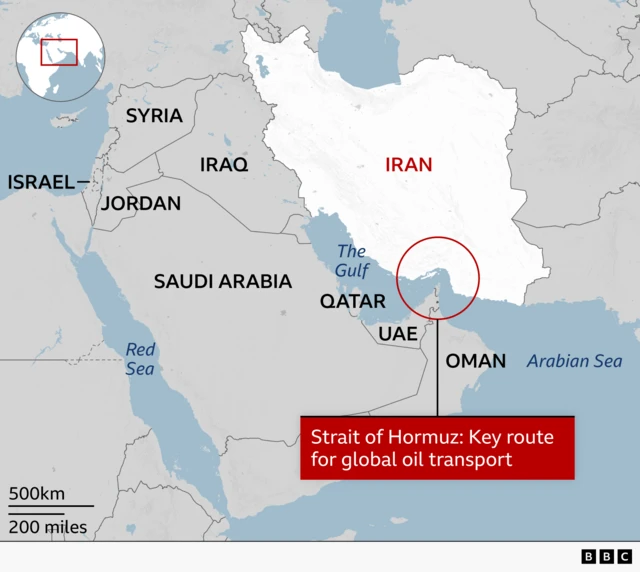
    Map showing where the Strait of Hormuz is in the Gulf of Oman, a key route for global oil transport. The strait lies between Iran and the peninsula of the United Arab Emirates and Oman. The map also shows countries in the wider Middle East region including Saudi Arabia, Iraq, Jordan and Israel

    A third ship has been hit by gunfire in the Strait of Hormuz, the world's busiest oil shipping channel, where sea traffic there has been significantly reduced.

    Tehran effectively stopped all traffic after the US and Israel attacked the country on 28 February, and the US then introduced a naval blockade on Iran's ports.

    US forces boarded an Iranian-flagged cargo ship on Sunday and the Pentagon said forces boarded a "sanctioned" tanker in the Indo-Pacific region linked to Iran yesterday. Iran described this as an act of "piracy".

    What has the US said?

    President Donald Trump says the US-Iran ceasefire was agreed on the condition that Tehran reopens the strait, and he claims his blockade of Iran's ports is costing the country $500m (£370m) per day.

    He said on Truth Social that the US was winning the war by "a lot" and that it will not lift its blockade on Iranian ports until a deal has been reached with Tehran.

    After days of uncertainty about whether Iran would attend negotiations as the ceasefire was coming to an end, Trump extended the truce until talks between the countries progress.

    What has Iran said?

    Senior Iranian lawmaker Ebrahim Azizi told the BBC Iran would "never" give up its control of the strait, and foreign ministry spokesperson Esmail Baghaei said the US blockade was "an act of aggression".

    Iran said it had reopened the strait for commercial vessels using designated safe lanes last week. However, when Trump said he would continue the naval blockade, Tehran again closed it.

  20. What has been happening in the Strait of Hormuz?published at 11:30 BST

    Three cargo ships have been attacked in the Strait of Hormuz by Iran's Islamic Revolutionary Guard Corps (IRGC), Iranian media say.

    Here is the latest on what we know:

    Attack one:

    The UK Maritime Trade Operations Centre (UKMTO) reported an IRGC "gun boat" opened fire on a container ship in the Strait of Hormuz, 15 nautical miles northeast of Oman causing heavy damage to the vessel's bridge. The vessel involved was the Epaminondas, owned by a Greek company.

    Attack two:

    The Panama-flagged Euphoria, which is owned by a UAE-based company, also came under attack eight nautical miles west of Iran, according to Vanguard and the UKMTO. The crew are said to be safe and no damage is reported to the vessel.

    Attack three:

    The Panama-flagged MSC Francesca was targeted about six nautical miles off the coast of Iran while it was heading south out of the Strait and into the Gulf of Oman, maritime intelligence firm Vanguard told BBC Verify. The ship has reported "damage to the hull and accommodation".

    The IRGC Navy says the MSC Francesca and Epaminondas were "seized" and directed towards the Iranian coast, alleging they were "operating without the necessary permits and tampering with navigation systems".