Summary

  1. From memorandum of understanding to Strait of Hormuz standoff - a timelinepublished at 11:59 BST

    On 17 June, the US and Iran agreed a plan to bring an end to the conflict, with a 14-point agreement that included safe passage through the Strait of Hormuz, an extension to the ceasefire and an end to a naval blockade.

    A lot has changed between then and now, here's a recap:

    • 26 June: The US launches fresh strikes on Iran after Donald Trump accuses the country of a "foolish violation" of its truce, following an attack on a cargo ship in the Strait of Hormuz
    • 7 July: The US launches approximately 80 more strikes at Iran in response to attacks on ships in the Strait of Hormuz, while Iran targets US military sites in Bahrain and Kuwait
    • 8 July: Trump declares the ceasefire with Iran "over", calling the country's leadership as "scum" and "cuckoo" - see clip below
    • 11 July: US Central Command says that during three nights that week US forces struck more than 300 targets to degrade Iran's ability to attack civilian mariners and commercial vessels passing through the strait
    • 12 July: US launches its latest wave of attacks on Iran following further attacks in the strait, Iran retaliates with several strikes at US bases in the region
    • 13 July: Washington says it will reinstate a naval blockade of Iranian ports from 16:00 EST (20:00 GMT / 21:00 BST) on 14 July, as well as imposing a 20% charge on all cargo shipped through the Strait of Hormuz
    • 14 July: The US military says it's carried out another wave of strikes on Iranian military targets overnight, the third consecutive night of strikes in a row. The UAE condemns Iran's latest strikes targeting cargo ships crossing the Strait of Hormuz. Delhi summons Iranian ambassador as Tehran's strikes killed an Indian seafarer and injured others
    Media caption,

    On 8 July President Trump said the ceasefire was over and called Iranian leaders 'scum'

  2. Fire onboard tanker hit by 'unidentified external device' off Omani coastpublished at 11:38 BST

    A tanker struck by an explosion caused by "an unidentified external device" off the coast of Oman has said a fire took hold in the engine room, but no one was hurt in the incident.

    The Stolt Magnesium was passing through the Arabian Sea when it was hit, according to the shipping company.

    "All seafarers of Stolt Magnesium are safe an accounted for. Following the incident the master activated the ship’s emergency response procedures and the crew started fighting the fire on board," it adds.

    Stolt says it has contacted the next of kin of the vessel's crew and "All relevant authorities and parties" have also been informed.

    The company confirmed it was the same vessel referred to in a report received by the UK Maritime Trade Operations (UKMTO), which said a tanker was hit by "an unknown projectile" off the coast of Qalhat in Oman last night.

  3. Analysis

    Tanker strikes show Iran can still launch attacks despite heavy US bombingpublished at 11:21 BST

    Chris Partridge
    BBC News weapons analyst

    Iran's tactic to target ships again, including oil tankers, plays into its larger strategic goal of wanting to maintain control of the Strait of Hormuz.

    These attacks again demonstrate Tehran's ability to launch strikes, despite the sustained and heavy bombing campaign earlier this year by the US and Israel.

    That points to two things. Either the intense bombing effort failed to sufficiently destroy those Iranian weapons, or Iran is somehow now able to replenish its stocks from elsewhere. We don't know.

    What we do know is that there are more targets popping up for the United States to continue to strike - both from the air and, more interestingly, from the sea.

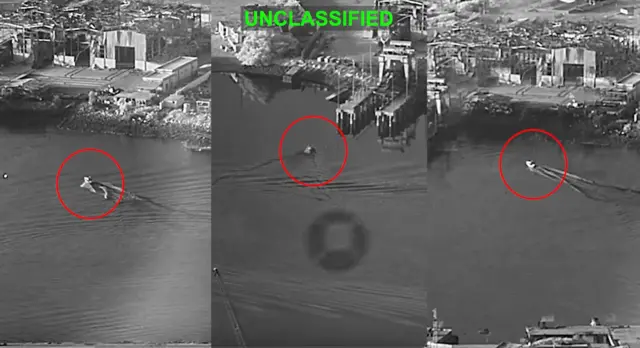
    The United States' use of one-way, uncrewed surface vehicles to attack Bandar Abbas Naval Base reminds us of the use of such technology by Ukraine in its war with Russia, a conflict which has largely rewritten the way that war is fought.

    But, looking further east, it is the law of unintended consequences that has again shown how maintaining leverage over the Strait of Hormuz has proved to be Iran's most effective weapon.

    Still of US sea drones travelling towards Iran's Bandar Abbas Naval Base.Image source, US Central Command
    Image caption,

    The US used one-way attack surface drones to hit Iran's Bandar Abbas Naval Base

  4. Explosions heard in multiple locations - Iranian state mediapublished at 11:10 BST

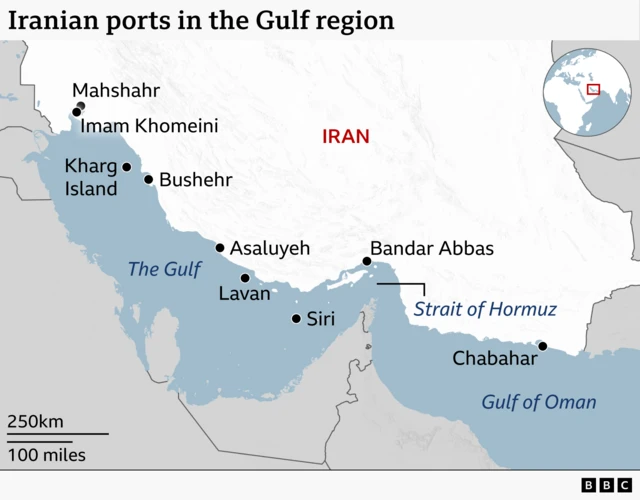
    Several explosions have been heard near the port city of Bandar Abbas, according to Iranian state media.

    The state-run IRNA has also said four locations were hit by projectiles in the city of Bushehr, with the Fars news agency saying residents have reported hearing multiple explosions.

    We've contacted the US Central Command for comment on this.

    Map titled “Iranian ports in the Gulf region” showing the southern coastline of Iran along the Persian Gulf and the Gulf of Oman. Labeled Iranian ports include Mahshahr, Imam Khomeini, Kharg Island, Bushehr, Asaluyeh, Lavan, Siri, Bandar Abbas, and Chabahar. The Strait of Hormuz is marked between the Gulf and the Gulf of Oman. Iran is highlighted in light grey, surrounding waters in blue, with a distance scale in kilometers and miles.
  5. India summons Iranian ambassador over attacks that killed Indian crew memberpublished at 10:50 BST

    India's Ministry of External Affairs spokesperson Randhir Jaiswal speaks during an Inter-Ministerial Briefing at the National Media Centre in New DelhiImage source, Hindustan Times via Getty Images
    Image caption,

    India's Ministry of External Affairs spokesperson Randhir Jaiswal

    India's Ministry of External Affairs says one Indian crew member was killed and 10 others were injured in Iranian attacks on two vessels in the Strait of Hormuz.

    Two tankers - named in the statement as the "Al Bahiyah and Mombasa" - carrying a combined 46 crew members, were struck by Iranian cruise missiles off the coast of Oman overnight.

    One of 12 Indian nationals onboard the Al Bahiyah was killed in the attack, while another was injured, according to a statement issued on X by ministry spokesperson Randhir Jaiswal.

    There were 18 Indian nationals onboard the Mombasa, of which nine sustained injuries, including two who are reported to be seriously injured, it adds.

    India's Ministry of External Affairs says it has summoned the deputy ambassador of Iran to lodge "a strong protest against these attacks".

    "We strongly condemn these attacks and acts of violence targeting seafarers and disrupting free and safe navigation through international waterways like the Strait of Hormuz," the statement adds.

  6. Analysis

    Trump's 20% tolls are another curve ball in negotiations over Strait of Hormuzpublished at 10:30 BST

    Lyse Doucet
    Chief international correspondent

    President Trump has thrown another curve ball in saying the US will now start charging tolls of 20% in the Strait of Hormuz.

    Shipping experts say that could double costs through an already all too costly maritime corridor. It also contradicts what the Secretary of State Marco Rubio has repeatedly said is US policy – that no one should charge tolls in what they regard as international waters.

    It’s not clear this is legally, politically, or logistically possible. Iran has swiftly exploited the president’s remark to underline what they see as their right to impose some form of fees.

    The foreign minister Abbas Aragchi posted on social media that “20% is of course too much. We will be fair.” For Tehran, its presence in this strategic strait is non-negotiable.

    Yesterday Iran’s parliament introduced a “Strategic Action” plan to manage the waterway. The hard-line head of the national security committee, Ebrahim Azizi, wrote “we remain steadfast in defending our red lines.”

  7. Three killed in US strikes in Iran - state mediapublished at 10:13 BST

    Three people have been killed in the US strikes in Iran overnight, according to Iranian state media.

    The attack took place in Hormozgan province, the Fars news agency says, which is in the south of the country.

    Posting on Telegram, state broadcaster IRIB added the family of an environmentalist were the victims of the strike.

  8. Analysis

    Vague and imprecise language leaves US-Iran deal hanging by a threadpublished at 10:00 BST

    Lyse Doucet
    Chief international correspondent

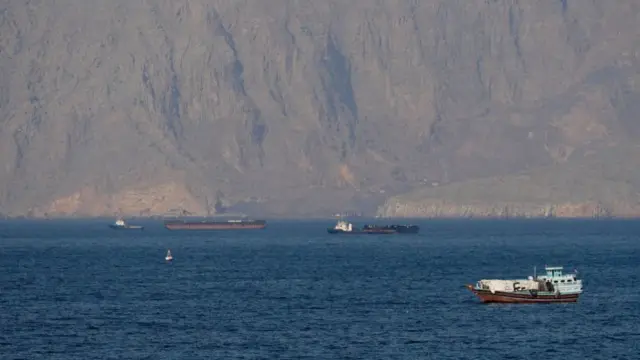
    Vessels at the Strait of Hormuz, as seen from Musandam,Oman, July 13, 2026Image source, Reuters

    President Trump, in his latest remarks, accused Iranof violating its deal with the United States because there was "something in the deal they didn’t like".

    One of the many problems with this memorandum of understanding is both sides can find what they like in its imprecise language.

    Iran can look at the 5th clause and say "the deal gives us a role in the Strait of Hormuz to decide its future management".

    Trump can look at the clause above it and say "no, the deal says the strait must be open for the free flow of maritime traffic".

    Other points are also putting pressure on this deal. It says Iran will conduct a dialogue with Oman, which controls the southern coast of the strait. Sources involved in mediating this say Oman did not want to be specifically mentioned.

    And now there are signs of disagreements between longstanding allies over the management of this strategic waterway.

    Tension over this strategic strait – an issue created by this war – will continue to plague efforts to find a way out of it.

  9. European stock markets fall as oil prices risepublished at 09:43 BST

    Nick Edser
    Business reporter

    European stock markets have fallen again on Tuesday as investors continue to keep a wary eye on the latest escalation of hostilities between the US and Iran.

    In the UK, the FTSE 100 index is down 0.6%. while Germany’s Dax index is 0.7% lower and France’s Cac 40 has fallen 0.9%.

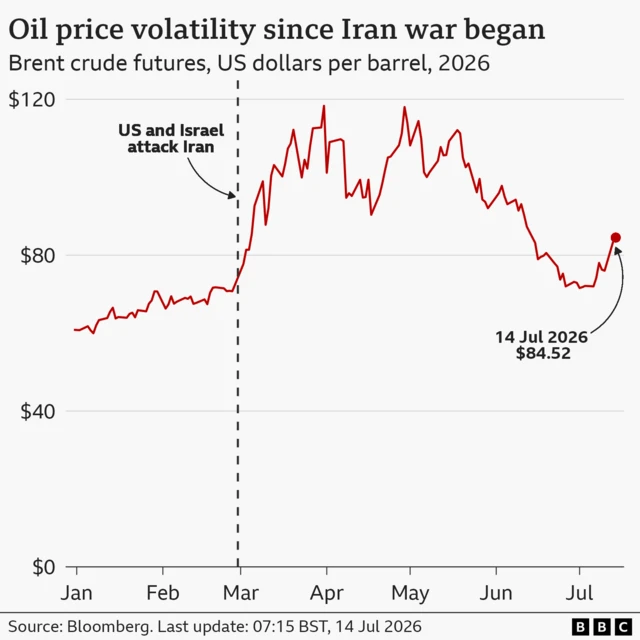
    Oil prices have continued to rise, with benchmark Brent crude up more than 3% at $86.07 a barrel. The price had fallen close to $70 a barrel earlier this month when a peace agreement appeared to be holding.

    However, despite the latest increases, prices are still well below the $120 a barrel mark Brent reached at the end of April.

    This Flourish post cannot be displayed in your browser. Please enable Javascript or try a different browser.

  10. UKMTO reports two vessels struck by missiles off coast of Omanpublished at 09:31 BST

    The UK Maritime Trade Operations (UKMTO) says it has received reports of two tankers being hit by missiles off the coast of Limah in Oman.

    The vessels were transiting outbound of the Strait of Hormuz "on the southern route" when they were attacked, it adds in a post on X.

    Both reports were made on 13 July, although it is unclear at what time, and authorities are now investigating.

    A third tanker also reported being attacked off Qalhat, further east of Oman's coastline, at 21:04 UTC (22:04 BST) last night.

    "The master of a tanker reports being hit by an unknown projectile on the starboard side engine room. All crew are safe and accounted for with no environmental impact reported," the UKMTO says.

    Overnight, the UAE Ministry of Defence said two tankers - the "Mombasa and Al Bahiyah" - were targeted by Iranian cruise missiles while transiting the Strait of Hormuz in Omani waters.

    This resulted in the death of an Indian crew member, with eight others injured - six of whom are Indian and two Ukrainians, it said.

    It is unclear if the "Mombasa and Al Bahiyah" are among the tankers referred to in the UKMTO reports.

  11. Shipping boss says Trump's 20% Hormuz fee is unworkablepublished at 09:13 BST

    Nick Edser
    Business reporter

    President Trump has said the US plans to impose a 20% charge on all cargo shipped through the Strait of Hormuz, but is it workable?

    "In short, no. I have a very hard time seeing that ever becoming a reality," Lars Jensen, chief executive of Vespucci Maritime shipping and a former director at shipping giant Maersk, tells the BBC’s Wake Up To Money programme.

    "The only way that could potentially work is if the US for some reason would say: 'Fine, we will send you a bill. You will have to pay the money, or we will impound your ships', which would basically go against any international shipping rules," he says.

    "I do not see how this could work in practice."

    Jensen adds that, despite all the comments from the US over whether the Strait of Hormuz is open or closed, "the Iranians de facto control the strait".

  12. Operator of attacked tankers condemns strikespublished at 08:56 BST

    In a statement posted on its website, operator ADNOC Logistics and Services has said it "strongly condemns this attack on civilian shipping and the innocent seafarers serving aboard its vessels".

    The tankers "sustained significant damage in the attacks", the company said.

    The UAE Ministry of Defence previously said the strikes resulted in the death of an Indian crew member, and injured eight others. ADNOC Logistics and Services said it extended its "deepest condolences" in its statement.

  13. Bahrain intercepts a number of Iranian strikespublished at 08:39 BST

    Bahrain's military command says it intercepted a number of air strikes fired by Iran towards its territory on Tuesday morning.

    It accuses Iran of continuing it's "hostile" approach and claims its attacks are targeting Bahraini civilians - which it says constitutes a "flagrant violation" of international law.

    Earlier, Iran's Islamic Revolutionary Guard Corps (IRGC) said it had hit and destroyed a number of US targets within Bahrain, including several weapons depots, a satellite communications centre, a building that housed US forces and a US Navy air traffic control radar.

  14. Postpublished at 08:31 BST

    This Flourish post cannot be displayed in your browser. Please enable Javascript or try a different browser.

  15. Iranian toll was 'reasonable' compared to Trump's 20% charge, says shipping expertpublished at 08:26 BST

    Richard Meade, editor of shipping journal Lloyds List, sits at his desk while wearing a white shirt and glasses
    Image caption,

    Richard Meade says ships could pay up to $17m under Trump's toll

    Donald Trump's 20% toll on ships going through the Strait of Hormuz could see ships paying up to $17m (£12.7m) per ship, according to a shipping expert.

    Richard Meade, editor of shipping journal Lloyds List, tells the BBC that Iran's pricing structure appeared more "reasonable" than Trump's fees, although there is no "international legal basis" for imposing either.

    He says a fully laden gas carrier or an oil tanker could be forced to pay between $16m and $17m for passing through the strait with the imposed fees.

    "For comparison, the Iranian fees initially started out in the range of £1m to £2m and then descended back down to around £100,000 to £200,000 per ship in some cases," he adds.

    Meade says insurance costs will also be "skyrocketing" as the conflict escalates, just as they were going down.

    He adds the problem is "we are yet to see any details" of how Trump will impose the 20% toll, adding the president "has mentioned these things before and then walked away from them".

    The continuation of attacks from the Houthis in Yemen will also add further costs for ships transiting oil from Saudi Arabia through the Red Sea and the Bab al-Mandab Strait, Meade says.

  16. BBC Verify

    What we know about the tankers attacked by Iranpublished at 08:07 BST

    By Shruti Menon

    BBC Verify has pieced together the recent movements of the latest two ships hit by strikes, named by the UAE as the crude oil tankers Mombasa B and Al Bahyah.

    Mombasa B had not been publicly transmitting its location for over 10 days before the attack. It had departed from Zirku oil terminal in UAE on 2 July and was bound for Khor Fakkan in the UAE, according to data from maritime tracking website MarineTraffic.

    Satellite imagery reviewed by BBC Verify shows the vessel conducting a ship-to-ship transfer with another tanker called He Rong Hai off the coast of Fujairah on 8 July. According to maritime intelligence firm TankerTrackers, Mombasa B was loaded with 1.9 million barrels of Emirati oil which it was feeding into He Rong Hai.

    Crude oil tanker Al Bahyah had also not been broadcasting its location for nearly seven days. Its last reported location on MarineTraffic was off the coast of Fujairah in the UAE. The ship was loaded with 1.9 million barrels of Emirati oil, according to TankerTrackers.

    Correction: An earlier version of this post misidentified one of the vessels involved. The vessel was crude oil tanker Al Bahyah, not LNG tanker Al Bahiya. This has now been updated to reflect the movements of the correct tanker.

  17. US and Iran behaving as if peace deal is deadpublished at 07:51 BST

    Barbara Plett Usher
    Reporting from Jerusalem

    The most significant thing that President Trump has said in the last 24 hours is that the US will reimpose its naval blockade on Iran.

    At the core of their memorandum of understanding signed last month was agreement that the US would lift the blockade and Iran would open up the Strait of Hormuz.

    But the Americans accuse Iran of preventing free navigation of the strait - by dictating what Tehran says is the authorised route near its coast and firing on ships that don’t take it - so the US blockade is going back into effect.

    This almost gets us back to the status quo before the deal. Diplomatically it's a huge blow.

    For the Iranians, it's a big economic blow because they need access to the strait to export their oil.

    And the Americans say that they’ll take comprehensive action: they're going to stop all ports and oil terminals from getting traffic along the entire Iranian coastline.

    That will almost certainly escalate the conflict in what is an already tense and volatile climate.

    Neither side has said the memorandum of understanding is completely dead, but more and more, they are behaving as if it is.

  18. Tehran wants to turn military conflict into economic war - Iran expertpublished at 07:33 BST

    The Strait of Hormuz is now Iran's main source of both leverage and deterrence in its conflict with the US after its proxy groups have been left in "disarray", according to Mehran Kamrava, professor of government at Qatar's Georgetown University.

    He says Iran's so-called axis of resistance, which includes groups like Hamas in Gaza, Hezbollah in Lebanon and the Houthis in Yemen, are in "disarray, or at least militarily depleted" due to the war.

    "For Iran the Strait of Hormuz is a main source of leverage... [its] main source of deterrence," Kamrava tells Radio 4's Today programme.

    As a result, he says the US is "determined to wrest control of the strait from Iran", but adds that how the US can do this is something he does not believe that even "planners in the Pentagon" know the answer to.

    "Related to this is the fact that Iran is keenly aware that it cannot go toe-to-toe militarily with the United States, and so it wants to turn the military conflict into an economic one," he adds.

  19. What do we know about the US blockade of Iran's ports?published at 07:15 BST

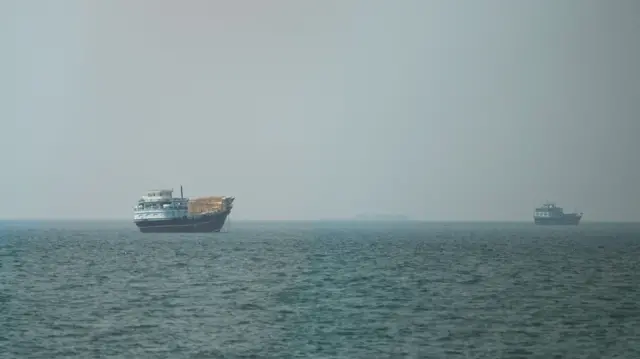
    Ships and tankers in the Strait of Hormuz off the coast of Musandam, OmanImage source, Reuters

    As the US and Iran's dispute over the Strait of Hormuz escalates, Donald Trump announced yesterday that the US would reinstate a naval blockade of Iranian ports. Here's what we know so far:

    • The blockade will stop "Iran’s ships or customers from entering or leaving" the Strait of Hormuz, while all other countries "will have fair and open use" of the shipping route
    • Trump said "as a matter of fairness" the US will also impose a 20% charge on all cargo shipped through the strait
    • This will go towards covering any and all costs of "providing safety and security to this very volatile section of the World"
    • It is unclear how the US will impose the toll and the International Maritime Organization said there is "no legal basis" for such a move
    • The blockade will be enforced by US Central Command and will come into effect from 16:00 Eastern Time (20:00 GMT) on Tuesday
  20. Oil prices move higher as Strait of Hormuz conflict escalatespublished at 07:01 BST

    Peter Hoskins
    Business reporter, Singapore

    Oil prices have risen in Asian trade this morning, with Brent crude up by 1.9% at $84.87 (£63.48) a barrel, while US-traded oil rose by 2% at $79.75.

    That followed a 9% jump in the price of Brent on Monday as the conflict escalated.

    Energy prices on global wholesale markets have swung wildly in recent months as traders reacted to developments in the conflict.

    Shortly after the US and Israel attacked Iran on 28 February, Tehran effectively closed the Strait of Hormuz, which around 20% of the world’s oil and liquefied natural gas (LNG) usually passes through.

    Despite the latest increases, prices are well below the $120 a barrel mark Brent reached at the end of April.

    A line chart showing how brent crude oil prices have fluctuated since the USA and Israel attacked Iran on February 28th. The price rose rapidly above $80 from early March and peaked at just below $120 in April. The current rate as of 14 July 2026 is $84.52.