Summary

  • Iran's Islamic Revolutionary Guard Corps (IRGC) says it has hit two UAE tankers in the Strait of Hormuz, as the US carries out a third night of strikes in a row on Iran

  • The UAE called the attack "brazen", adding that an Indian crew member was killed and eight others were injured

  • The IRGC also confirmed they had targeted an air base in Jordan with ballistic missiles overnight

  • Meanwhile the US military says it has completed strikes on military targets aimed at degrading "Iran's ability to attack commercial shipping"

  • It comes after US President Donald Trump said the US was reinstating a naval blockade of Iranian ports and would impose a 20% charge on all cargo shipped through the Strait of Hormuz

  • He said on Truth Social on Monday the US would be the "guardian" of the waterway - how this will work in practice is unclear, writes our White House reporter

  1. Iran launches attacks against sites in Bahrain and Jordanpublished at 06:52 BST

    Elsewhere in the Gulf overnight, both Jordan and Bahrain reported attacks in their territory.

    Bahrain's Ministry of Interior sent three separate alerts overnight urging resident to seek the nearest shelter, while Iran's Islamic Revolutionary Guard Corps (IRGC) reported it struck several US targets in the country.

    In a statement published by Iranian state news agency IRNA, the IRGC said it had destroyed several weapons depots, a satellite communications centre, a building that housed US forces and a US Navy air traffic control radar.

    Jordan's state news agency reports that it intercepted four missiles over its territory early on Tuesday morning, resulting in no casualties or "material damage".

    In a statement the IRGC said it had targeted US facilities within Jordan, adding that it bears "no enmity" towards the government or people of Jordan.
  2. US military completes third night of strikes on Iranpublished at 06:41 BST

    The US military says it carried out another wave of strikes on Iranian military targets overnight.

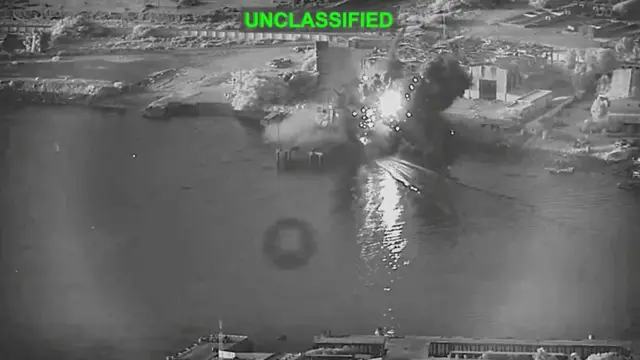
    US Central Command (Centcom) says it launched attacks in Bushehr, Chah Bahar, Jask, Konarak, Abu Musa, and Bandar Abbas "to further degrade Iran's ability to attack commercial shipping".

    Strikes were carried out using "precision munitions", targeting Iranian coastal defence systems, missile and drone sites, and maritime capabilities, it adds.

    It is the third consecutive night of strikes carried out by the US against Iran.

    Centcom says they will continue "imposing a heavy cost on Iranian forces and degrade their ability to attack innocent civilians and commercial shipping in the Strait of Hormuz".

    A screenshot from a video released on 13 July by the US military, which it says shows an attack on a maintenance facility in Bandar Abbas, IranImage source, Reuters
    Image caption,

    A screenshot from a video released on 13 July by the US military, which it says shows an attack on a maintenance facility in Bandar Abbas, Iran

  3. UAE says one killed in 'brazen' Iranian attacks on tankers in straitpublished at 06:34 BST

    Overnight, the UAE Ministry of Defence said two tankers were targeted by Iranian cruise missiles while transiting the Strait of Hormuz in Omani waters.

    This resulted in the death of an Indian crew member, with eight others injured - six of whom are Indian and two Ukrainians, it said.

    It adds that both tankers, the Mombasa and Al Bahiyah, were damaged in the attacks, which caused fires to break out.

    The UAE says it condemns the "brazen" attacks and calls them a “serious violation” and a “clear breach” of international law, adding that it reserves its “full right to respond” with “all necessary measures”.

    Iran's Islamic Revolutionary Guard Corps (IRGC) later confirmed the strikes via a statement to Telegram, where it said two tankers had ignored warnings, turned off navigation systems and attempted to pass through a mined route.

    It added that "co-operation with the aggressor enemy" would only lead to regret, damage and delays in opening the strait - as well as the "creation of an energy crisis in the world".

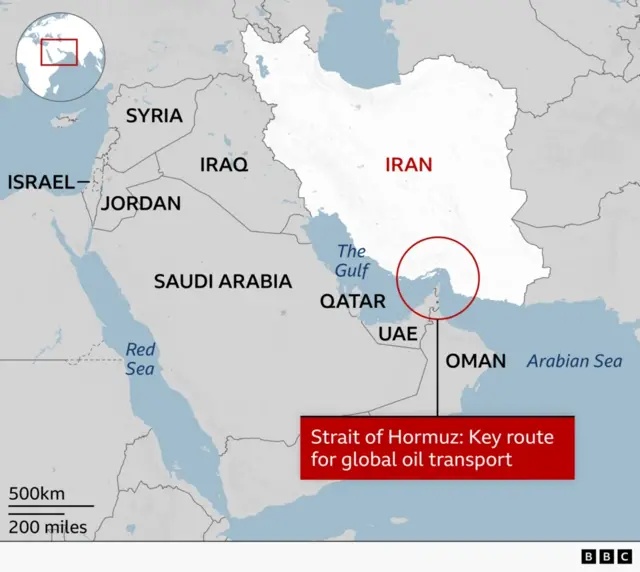
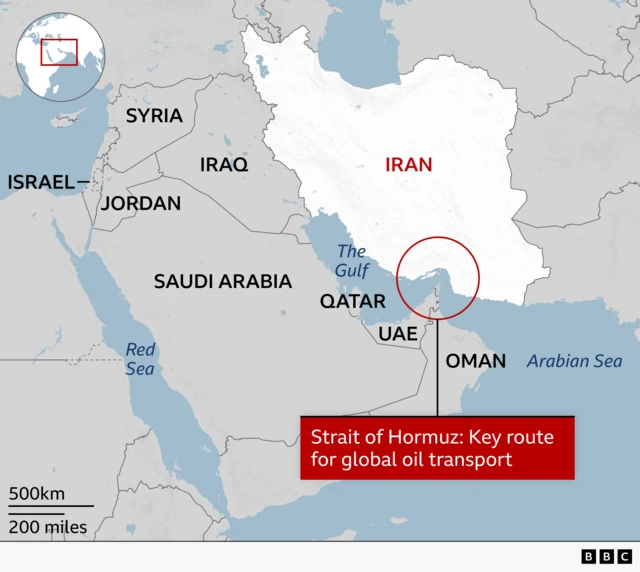
    Map showing where the Strait of Hormuz is in the Gulf of Oman, a key route for global oil transport. The strait lies between Iran and the peninsula of the United Arab Emirates and Oman. The map also shows countries in the wider Middle East region including Saudi Arabia, Iraq, Jordan and Israel
  4. US launches fresh strikes as Iran targets tankers in Strait of Hormuzpublished at 06:31 BST

    The US military has carried out a third consecutive night of strikes against Iran, as tankers in the Strait of Hormuz were hit by Iran's Islamic Revolutionary Guard Corps (IRGC).

    President Donald Trump said the US was hitting Iran "very hard" amid escalating attacks between the two countries.

    Iran was accused by the UAE of a "brazen" attack on two tankers in the strait, killing one and wounding eight others, four of which were serious.

    The IRGC confirmed the strikes, saying two tankers had ignored warnings, turned off navigation systems and attempted to pass through a mined route.

    The dispute over control of the Strait of Hormuz threatens to derail efforts to end the war.

    On Monday the US reimposed its naval blockade of Iranian ports. President Trump said that the US would also impose a 20% charge as part of its operations to control the waterway.

    We'll have the latest news lines from the region and analysis from our teams throughout the day, so stay with us.

  5. Trump reinstating naval blockade of Iranian portspublished at 21:01 BST 13 July

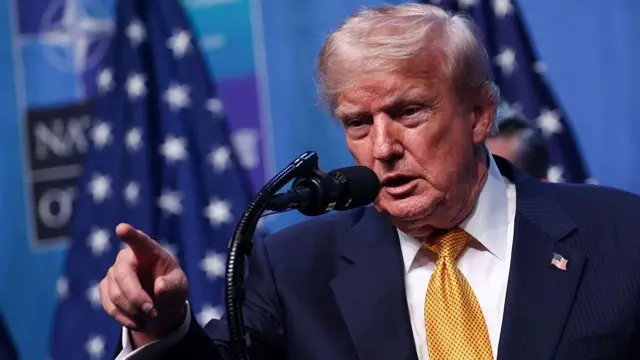
    US President Donald Trump wearing a yellow tie, white shirt, blue suit and American flag pin. He stands at a microphone and is pointing, his mouth open.Image source, NurPhoto via Getty Images

    We're about to close this live page, but before we go here's a quick recap of some of today's key developments.

    • President Donald Trump has said the US is reinstating a naval blockade of Iranian ports and will impose a 20% charge on all cargo shipped through the Strait of Hormuz
    • He said this would stop "Iran's ships or customers" from entering or leaving the key oil shipping route, but "all other countries will have fair and open use of the Strait"
    • The blockade will be in effect from 16:00 Eastern Time (20:00 GMT) on Tuesday
    • Iran's foreign minister later said whoever provides safe passage "should be compensated for this service", but Iran would remain the strait's "GUARDIAN" - using Trump's word
    • Tehran and Washington clashed over the strait's control after exchanging strikes in the region overnight
    • The US said it carried out strikes against military targets in Iran, targeting air defence systems, coastal radars, and missile and drone sites
    • Iran said it responded by striking US military bases in Kuwait, Jordan and Bahrain, and radars in Oman

    You can continue reading with our latest story.

  6. Trump to address the nation on Thursday on unknown topicpublished at 20:42 BST 13 July

    US President Donald Trump has announced that he will be “making a Speech to the Nation” on Thursday - although he hasn't indicated what the address will be about.

    In a post on his social media platform Truth Social, he says he will speak at 21:00 EDT (02:00 BST).

    He last addressed the nation regarding the war in April.

  7. Iran-backed Houthis say they have targeted airport in Saudi Arabiapublished at 20:30 BST 13 July

    The Iran-backed Houthi group in Yemen says it has targeted Saudi Arabia's Abha International Airport with ballistic missiles and drones.

    Houthi spokesperson Yahya Saree says the Houthis were responding to "Saudi aggression that targeted Sanaa International Airport".

    Saudi Arabia has not yet commented.

    Earlier, there were reports Yemen's army had targeted a runway at the Sanaa airport in Yemen to prevent an Iranian plane from landing. The Houthis blamed Saudi Arabia for the attacks.

    Afterwards, the Saudi-led coalition in Yemen said its air defences had dealt with ballistic missiles launched by the Houthi rebels towards the southern region, without specifying if it meant in Saudi or Yemen.

    Yemen's internationally-recognised government has the backing of Saudi Arabia, but the Houthis control parts of the country including the capital Sanaa.

  8. Letter to Congress shows Trump informing senator that military activities have restartedpublished at 20:19 BST 13 July

    Cai Pigliucci
    Reporting from Washington DC

    The BBC has confirmed that Donald Trump formally notified Congress that military activities against Iran resumed.

    On July 10, the US president wrote a letter to Senator Chuck Grassley, president pro tempore of the United States Senate, to inform of military activities that resumed on 7 July.

    In the letter, Trump says the strikes are defensive and designed to "protect Americans and United States' interests at home and abroad".

    He also describes them as "limited, measured, planned, and executed in a manner designed to minimize civilian casualties".

    "I am providing this report as part of my efforts to keep the Congress fully informed, consistent with the War Powers Resolution," Trump adds.

    Under the resolution, it states that the president must inform lawmakers within 48 hours of launching a military attack.

  9. UN shipping agency says 'no legal basis' for US tolls in Strait of Hormuzpublished at 20:03 BST 13 July

    The UN's International Maritime Organization (IMO) says it has "always been consistent" its in stance on fees, following President Trump's announcement that the US will impose a toll on ships passing through the Strait of Hormuz.

    A spokesperson says: "IMO stands firmly against charging fees for passage through straits used for international navigation.

    "There is no legal basis through which to introduce mandatory tolls simply to transit through a strait."

    The agency says it is aware of Trump's social media post announcing his plans and is "awaiting more information".

  10. Joint Maritime Information Centre issues advice ahead of blockade resumptionpublished at 19:52 BST 13 July

    An advisory note from the Joint Maritime Information Centre (JMIC) issues advice, ahead of the US naval blockade on Iranian ports beginning on Tuesday.

    The UK's Maritime Trade Operations shared the notice on X, writing that the regional maritime security threat level remains severe.

    "Further deliberate hostile activity" is likely under current condition, the notice adds.

    Mariners should expect a "sustained naval presence, increased IRGC hailing and monitoring along transit routes," and enforced protection measures should be anticipated.

    They are told to consider complying with the directions of blockading forces, demonstrating clear transit intentions and report unusual activity.

  11. US blockade to resume Tuesday, Centcom sayspublished at 19:35 BST 13 July

    US Central Command (Centcom) says the Strait of Hormuz blockade will resume at 16:00 ET (21:00 BST) on 14 July.

    Earlier, Donald Trump said the blockade would begin "immediately".

    "Centcom forces will enforce the blockade against vessels transiting to or from Iranian ports and coastal areas," the US military says in a post on X.

    "The US military continues to support traffic flow through regional waters for all vessels not violating the blockade."

    It urges all mariners to monitor broadcasts and contact US naval forces when operating in the Gulf of Oman and Strait of Hormuz approaches.

  12. Iran's foreign minister mocks Trump's blockade of Iranian portspublished at 19:22 BST 13 July

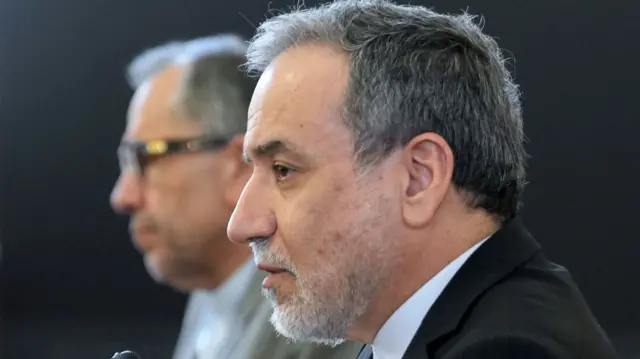
    Abbas Aragchi picturd from the side speaking into a microphone and wearing a grey suitImage source, EPA/Shutterstock

    Iran's Foreign Minister Abbas Araghchi has posted a mocking reaction to Donald Trump's announcement that America will impose a charge on cargo passing through the Strait of Hormuz.

    "POTUS is absolutely right," he says on X. "Whoever provides secure and safe passage of commercial vessels through the Strait of Hormuz should be compensated for this service."

    "Iran has always been the GUARDIAN of the Strait and will remain so FOREVER," Araghchi says.

    "20% is of course too much. We will be fair," he adds.

  13. Donald Trump speaks at White House Grand Prix showcase eventpublished at 19:01 BST 13 July

    The US president is attending a Grand Prix showcase event with race car drivers at the White House.

    We're listening across to Trump's remarks in Washington and will bring you any lines from him that are relevant to Iran.

    You can also watch live at the top of the page.

  14. Iran's foreign ministry condemns reported attack on Yemen's airportpublished at 19:00 BST 13 July

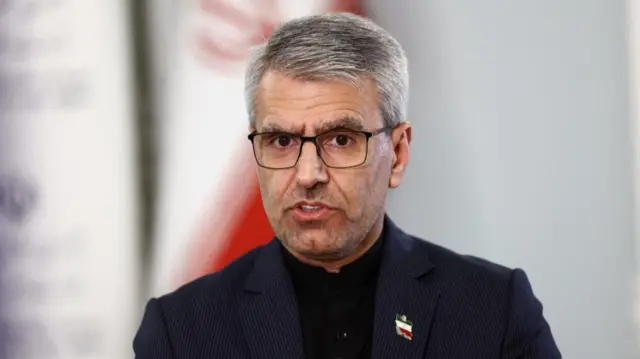
    Iran's Foreign Ministry spokesperson Esmail BaghaeiImage source, Reuters

    Iran's Foreign Ministry spokesperson Esmail Baghaei has condemned the reported attack on the airport in Yemen's capital, Sanaa, calling it a "blatant violation of international aviation law".

    Yemen's armed forces reportedly targeted the runway earlier today to prevent an Iranian aircraft from landing.

    Yemen's capital Sanaa is under the control of the Iran-aligned Houthi group, while the internationally-recognised government, which has the backing of Saudi Arabia, operates out of Aden in southern Yemen.

    Houthi media subsequently said the Iranian plane had landed anyway.

    The details of the incident remain unclear, but it already appears to be the most significant escalation in the largely dormant conflict between the Yemeni government and the Houthis for several years, our correspondent wrote earlier.

  15. Analysis

    Where is Iran’s Supreme Leader?published at 18:44 BST 13 July

    Ghoncheh Habibiazad
    BBC Persian

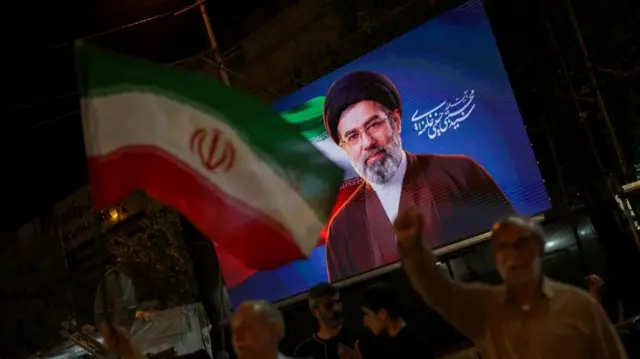
    Mojtaba Khamenei pictured on screen during a rally in Tehran, supporters hold up an Iranian flagImage source, Reuters
    Image caption,

    Mojtaba Khamenei pictured on screen during a rally in Tehran, 2 July

    Iran’s Supreme Leader Mojtaba Khamenei has not been seen in any verified videos or photos since his succession to the position of his father in early March.

    He was reportedly injured in the same strike that killed his father Ali Khamenei on 28 February in Tehran, when US and Israel attacked Iran in the first day of the war. But Iran’s health ministry has rejected claims that his injuries were severe.

    US President Donald Trump said about Mojtaba Khamenei today that he’s “90 per cent gone”.

    So far, since 8 March, we have seen several written messages attributed to Mojtaba Khamenei. In the latest one two days ago, Khamenei vowed to avenge his father’s killing. Iranian officials have followed suit recently.

    Mojtaba Khamenei did not appear publicly during the week-long commemoration ceremonies held in early July for his father, although brothers of Mojtaba Khamenei did.

    The question still remains about his whereabouts.

    But Israel had vowed before and after Mojtaba Khamenei became Iran’s supreme leader that it would target him, although we are yet to see when, or if, he will appear if public.

  16. Trump reimposes US blockade after striking Iran military targetspublished at 18:09 BST 13 July

    If you're just joining us, here's a quick rundown of events this afternoon:

  17. Trump's Hormuz plan - expected or a contradiction?published at 17:50 BST 13 July

    Bernd Debusmann Jr
    White House reporter

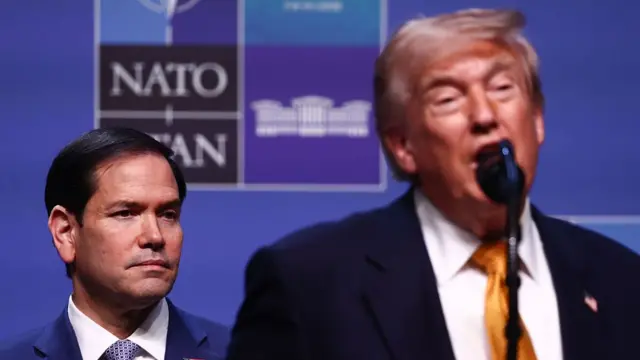
    Donald Trump speaking into a microphone, Marco Rubio stood behind him.Image source, Getty Images
    Image caption,

    US Secretary of State Marco Rubio had previously said that no country should "charge tolls or fees on an international waterway"

    On one hand, President Trump's announcement that the US will impose a 20% toll on all cargo passing through the Strait of Hormuz is one that, broadly, is in line with his foreign policy.

    Trump often remarks that US allies do not pay enough for their own defence or security. The US, he claims, shoulders the financial and logistical burden for global security issues.

    Reimbursement for the heavy commitment of US naval and air power to secure shipping in the Gulf is aligned with that sentiment, even if allied nations push back on it.

    On the other hand, it directly contradicts recent statements from his own Secretary of State, Marco Rubio.

    "No country is allowed to charge tolls or fees on an international waterway," Rubio told reporters in early July.

    "That’s existing international law. That’s the way it is in international waterways all over the world, and that’s the way we expect it’ll be here."

    Moving forward, the White House is likely to take steps to publicly differentiate between the tolls Trump announced and those that have been called for by the government in Tehran.

  18. Why is the Strait of Hormuz so vital?published at 17:34 BST 13 July

    The Strait of Hormuz connects the Gulf with the Arabian Sea and is deep enough for the world's biggest crude oil tankers to pass through.

    In 2025, about 20 million barrels of oil and oil products passed through the Strait of Hormuz per day, according to estimates from the US Energy Information Administration (EIA).

    About 20% of the world's oil and liquefied natural gas is shipped through the strait. The oil comes not only from Iran but other Gulf states such as Iraq, Kuwait, Qatar, Saudi Arabia and the UAE.

    About 3,000 ships usually sail through the strait each month but this dramatically decreased during the US-Iran war.

    At the narrowest point, the strait and its shipping lanes lie entirely within Iran and Oman's territorial waters - making it a particularly prominent sticking point in the ongoing hostilities.

    Map of Strait of Hormuz.
  19. 'We don't need foreign workers to protect the strait' - Iranian parliamentarianpublished at 17:11 BST 13 July

    We've heard from Iranian parliamentarian Ebrahim Rezaei, a spokesperson for the country's National Security and Foreign Policy Commission, following Trump's announcement of a new blockade of Iranian ports.

    In response to the US president's assertion that the US will be the "guardian" of the Strait of Hormuz, he writes on X: "We don’t need foreign workers to protect the strait!"

  20. BBC Verify

    How much oil is thought to have left Iran since the first US blockade was lifted?published at 16:55 BST 13 July

    By Thomas Copeland

    After the deal to end the war between the US and Iran was signed on 17 June, Washington lifted its two-month blockade of Iranian ports in the Strait of Hormuz.

    It also eased decades-old sanctions by allowing for the temporary sale of Iranian oil.

    This was due to expire on 21 August but the US withdrew its permission after a series of attacks on ships in the strait early last week.

    In the month since the license was issued, 59 tankers left the Gulf laden with oil and petrochemicals, according to United Against a Nuclear Iran, an advocacy and monitoring group.

    It says the exports amounted to about 72 million barrels of oil which could provide potential revenue of more than $5.5bn (£4.1bn) for the Iranian government.