Summary

  1. Does the technology exist to ban children from taking explicit images?published at 10:47 BST

    Joe Tidy
    Cyber correspondent

    In short, yes - but only in limited cases. Apple already uses technology which can detect nudity on devices through its Sensitive Content Warning system.

    On Apple devices, nude images received via iMessage, AirDrop, FaceTime video messages and shared photo albums can be blurred automatically, with users warned: “This may be sensitive”. Parents can also receive alerts.

    Android has a similar feature, though it currently only works in Google Messages.

    So the technology already exists for detecting received nude content but the bigger challenge is stopping people from sending them - which is far harder to enforce.

    Much of the Child Sexual Abuse Material involving coerced children is shared through end-to-end encrypted services such as WhatsApp, Signal, Discord and FaceTime, where only the sender and recipient can view messages.

    Apple does include FaceTime in its warning system through a workaround, suggesting broader protections may be possible.

    But attempts to expand scanning systems have previously sparked major backlash from privacy campaigners concerned about surveillance and encryption.

  2. Is an under-16s social media ban still on the table?published at 10:36 BST

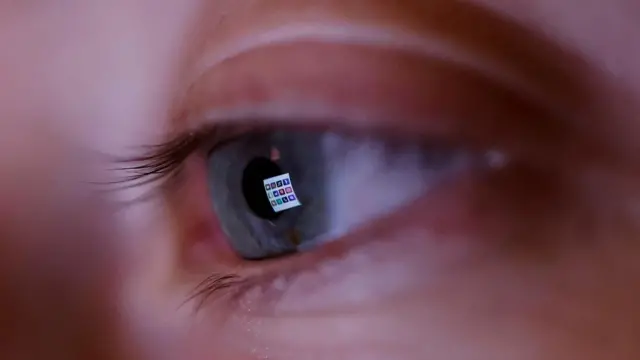
    Social media apps reflected in an eyeImage source, Reuters

    Starmer's speech today comes after months of debate around a social media ban for under-16s.

    The government's consultation on the matter drew to a close at the end of May, with Technology Secretary Liz Kendall saying new measures will be brought by the end of 2026, and a response to the consultation will come in the summer.

    The government has been considering whether to introduce a legal minimum age for social media, alongside limits on features such as autoplay and infinite scrolling, and stronger age checks.

    Starmer has vowed to take "decisive" action to tackle to impact of social media on children in the UK.

    The prime minister has been subject to mounting pressure and told families and campaigners who insist their children died as a result of social media use that "it is important that we act and will act".

    Meanwhile, a separate consultation will lead to guidance for parents on when a child should get their first smartphone and how long under-16s should spend in front of screens.

  3. What are the UK’s existing online safety laws?published at 10:21 BST

    Liv McMahon
    Technology reporter

    Hands holding a white iPhone.Image source, PA

    The UK has already introduced laws to try to protect children online.

    Foremost is the Online Safety Act - laws and duties online platforms must follow - implemented and enforced by media regulator Ofcom.

    The act requires firms to remove illegal content, including child sexual abuse, controlling or coercive behaviour or promoting suicide or self-harm.

    It has also created offences to make sending unsolicited sexual imagery - known as cyber-flashing - and sharing "deepfake" pornography, creating using AI, illegal.

    Under Ofcom’s Protection of Children Codes, companies must also prevent children from being exposed to harmful content relating to suicide, self-harm, eating disorders and pornography. The regulator has already fined some firms for not complying with these requirements.

    Earlier this year the government also banned so-called nudification apps.

    But child safety campaigners have urged the government to go further to stop children seeing or sharing nude images, amid concerns about online grooming and sextortion.

  4. NSPCC welcomes 'transformational change' but warns it must be 'delivered quickly'published at 10:14 BST

    Starmer's call for tech companies to block children from sending, receiving or seeing explicit images has been welcomed by the National Society for the Prevention of Cruelty to Children (NSPCC).

    The charity's chief executive, Chris Sherwood, says online grooming, sexual exploitation and proliferation of child sexual abuse material could be prevented if the companies "did the right thing" and introduced nudity-blocking technology on children's phones.

    "Every day these protections are not in place, more children will continue to face devastating harm in the online world," he says.

    "That's why we strongly support government's decision to make it mandatory for these companies to block inappropriate material at device level."

    He says "time is up for big tech" and the government must now focus on "holding them to account to ensure this transformational change for young people's safety is quickly delivered".

  5. Tech companies have a 'moral duty' to act - home secretarypublished at 10:09 BST

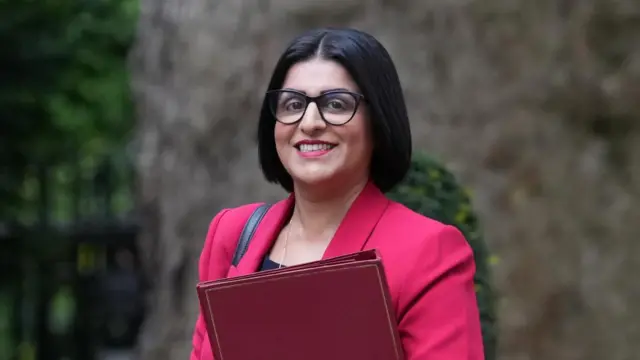
    A file photo of Home Secretary Shabana Mahmood walking up the streetImage source, PA Media

    Home Secretary Shabana Mahmood says tech companies have a "moral duty to act" and make it impossible for children to take, share or view nude images.

    "As a society, we have not kept pace with the changing threats that children face. Abuse online is far too common, and we will not tolerate it," she says.

    Technology Secretary Liz Kendall says that "no parent should have to worry that giving their child a smartphone opens the door to abuse and exploitation."

    She says the government is holding social media platforms to account and "will soon announce our next steps to keep children safe online".

    But she says this doesn't stop with the platforms because "the devices themselves are part of the problem" and can be "part of the solution".

    "We are giving them three months to show us that they will do the right thing," she says.

  6. Companies will have three months to act or face new laws, government sayspublished at 10:02 BST
    Breaking

    The government has released further detail about Starmer's announcement that the government wants tech firms to prevent children from sending and receiving explicit images.

    Here's an overview:

    • Britain will become the first country in the world where it is impossible for children to take, share or view naked pictures on their devices, the government says
    • Big tech companies like Apple and Google must activate built-in features or implement technical solutions to detect and block nude images for children on both new and existing smartphones and tablets it says, which would block nudity across the whole device by default
    • Those over 18 would still be able to take, share or view nude content through an age verification process, it says
    • If the companies do not act within three months, the government will bring forward legislation to force them to activate blocking technology, it says
    • This would include fines for companies failing to comply, it says, adding "nothing is off the table", and as a last resort the government is exploring criminal liability for tech bosses who fail to comply
    • The government says 91% of online child sexual abuse reports recorded in 2024 contained self-generated content from children themselves and the average child now views pornography by age 13
  7. Home Office releases details over plans for explicit image controls for childrenpublished at 09:49 BST
    Breaking

    The Home Office has just released further details on the changes announced by Starmer over device controls preventing children from sending and receiving explicit images.

    We're going through the document now - we'll bring you the key details shortly.

  8. 'Pace of change will not slow down' - Starmerpublished at 09:42 BST

    Starmer says he will not "pretend to know" what the world will look like in 10 years time but that there will be new technologies and tools we use everyday.

    He says the pace of change will not "slow down" but what matters is whether Britain is ready for it.

    He adds that the government has "made its choice" to take control of the future, to be ambitious and to make AI work for the whole of the country.

    "We choose to build a stronger, fairer Britain," he says, ending his speech.

  9. Starmer outlines new government AI initiatives for young people and jobseekerspublished at 09:30 BST

    Starmer pictured talking in front of a pedestalImage source, PA Media

    Moving on from online harm, Starmer turns to young people.

    He says they need to be equipped for the future workforce, announcing that AI tutors will be rolled out to 450,000 children on free school meals to close the attainment gap.

    He adds that AI is already helping in places, delivering faster diagnoses in the NHS and reducing court backlogs.

    The prime minister also announces the government's new AI job tool "to help those out of work find the right jobs, create their CVs and get back into work".

    Starmer also says a new strategy will develop sovereign computing capabilities, and the government will commit to purchasing specialist AI chips worth over £400 million.

    He says this will provide a "generational opportunity" for Britain's most "promising start ups".

  10. Starmer: Government will act with 'decisiveness' if companies fall shortpublished at 09:27 BST

    Starmer says while there are exciting developments in tech, he knows there are worries too, including around jobs and child safety.

    The pace of change cannot be an excuse for harm and where tech poses a threat to "our people, to our children" the government will act "quickly" and "firmly".

    He says earlier in the year X allowed its AI tool, Grok, to create "disgusting" and explicit AI images.

    "We took them on," he says, saying other tech companies should know if they fall short on their responsibilities to keep people safe the government will act with the "same decisiveness".

    He says that if companies operating in the UK do not introduce device controls to prevent children from sending and receiving sexually explicit images, the law will be changed, he says.

    "Standing by is not an option."

  11. Starmer tells tech companies to introduce device controls over explicit imagespublished at 09:23 BST
    Breaking

    Starmer says today he is calling on tech companies operating in the UK to introduce device controls that prevent children from sending and receiving explicit images.

    "If they choose not to, then we will act, and we will change the law," he says.

  12. 'We're on the precipice of something truly extraordinary'published at 09:17 BST

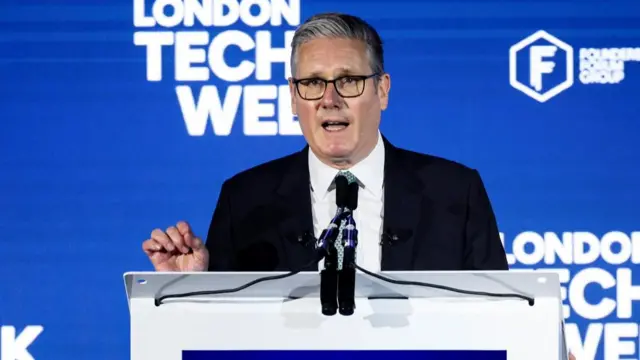
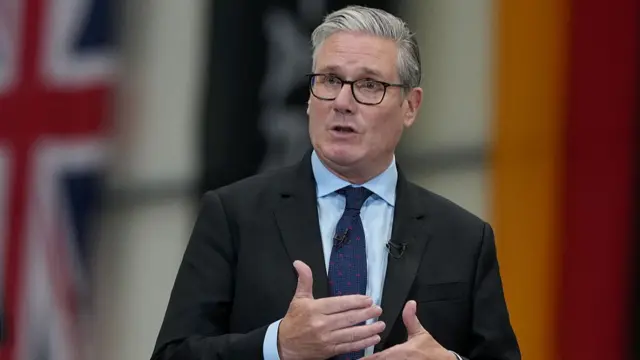
    Keir Starmer speaking in front of audience members, wearing a blue tie and suitImage source, Getty Images

    Starmer continues, and says tech companies need the right conditions to succeed, saying they need the freedom to move fast.

    He says the government has simplified regulations, created a global talent task force and unlocked investment for them to do so.

    Britain has every reason to be confident, he says, adding "we're on the precipice of something truly extraordinary".

    A technology revolution is coming, he says, and the question is "what kind of country we want to be as it unfolds", and whether the UK shapes the change or allows it "to shape us".

  13. Starmer says soap factory being turned into AI centre is a glimpse into technology revolutionpublished at 09:14 BST

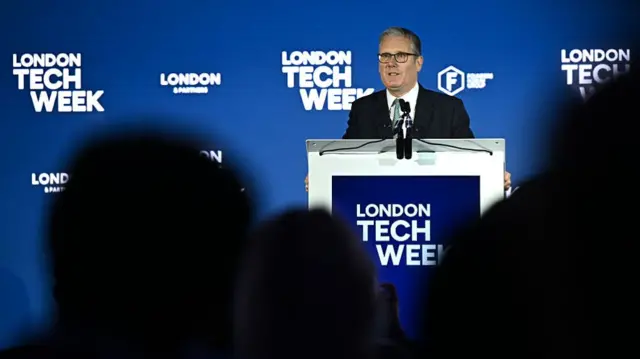
    A photo of Keir Starmer stood at a podium, speaking at London Tech WeekImage source, Reuters

    Keir Starmer begins by saying it's tempting to jump straight to the future when talking about AI and technology - but chooses to talk about what is happening today.

    He focuses on Warrington, a town in Cheshire. He says the closure of a long-running soap factory became "a symbol of a community left behind".

    But now that factory is being transformed into a new AI data centre, creating new investment, skilled jobs, and opportunities.

    "Young people can look at that site and see not what their community used to be but what it can become," he says.

    Starmer says stories like this are a glimpse into an "emerging revolution in technology" - which Britain is "uniquely placed" to lead as the third-largest technology economy in the world.

    He adds that half of all European investment in tech this year occurs in the UK.

  14. Starmer begins speechpublished at 09:06 BST

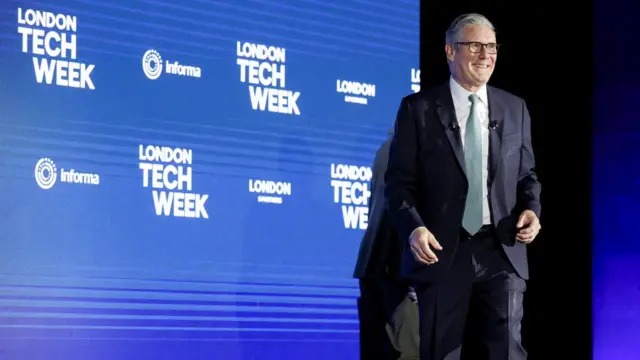
    Keir Starmer walking on stage, in front of a back drop advertising London Tech WeekImage source, PA Media

    UK Prime Minister Keir Starmer has started delivering his speech on the government's latest announcement on tech reforms.

    We'll be bringing the latest lines and analysis of his speech and remember you can watch liveat the top of our page.

  15. Skills minister: We want young people to benefit from tech opportunitiespublished at 09:01 BST

    Skills Minister Jacqui Smith says the government's technology announcements this morning will "help young people actually to be able to benefit from the opportunities that our success in the UK in technology should be able to bring to everyone, not just to a few".

    Speaking to BBC Radio 4's Today programme on the new AI tech tool the government has described as a "jobcentre in your pocket", she says that young people who are on universal credit will still have face-to-face consultations.

    Pressed on the challenges for businesses who feel they cannot afford to take on young people, Smith stresses that businesses taking on apprentices under the age of 25 do not have to pay any National Insurance and if businesses take on young people under 21 also do not have to pay any National Insurance.

    She also outlines job grants for businesses taking on apprentices and people who have been out of work.

  16. A 'jobcentre in your pocket' - PM to announce new AI toolpublished at 08:50 BST

    Keir StarmerImage source, Reuters

    The prime minister has vowed to make AI work "for everyone" as he prepares to unveil a new AI tool that will help jobseekers get into work.

    The AI assistant will provide 24/7 guidance on topics such as career development and job applications through a "CV builder" feature.

    It will be trialled for three months online and officials hope it will serve as a "jobcentre in your pocket" for people seeking employment.

    An AI "bootcamp scheme" will also be rolled out across England over the summer to provide resources to those at risk of becoming out of education or training.

    It comes as the most recent data from the Office for National Statistics shows the number of those aged 16-24 not in employment, education or training has risen above one million. You can read more about that here.

    Starmer is expected to say "we’re using tech to bring opportunity to every corner of the country – helping people into work, tackling inequalities, boosting skills and building a fairer future".

  17. Starmer to deliver speech on tech reformspublished at 08:45 BST

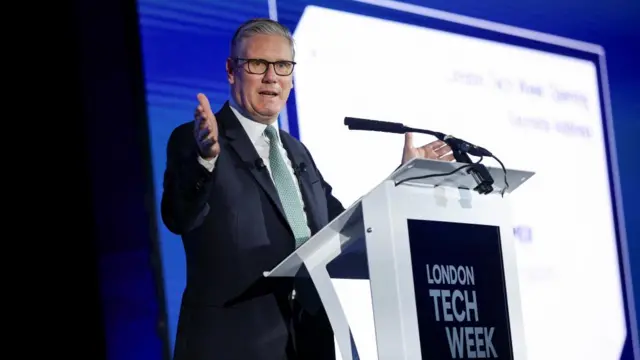
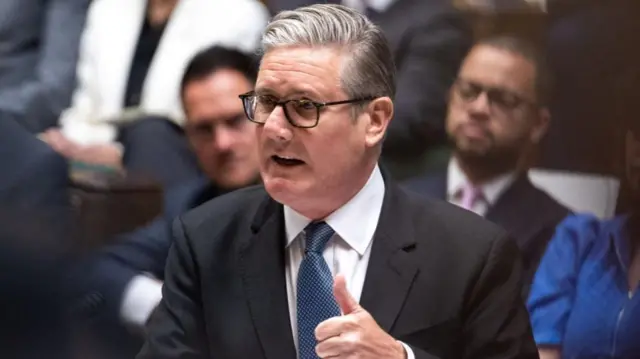
    Prime Minister Keir Starmer gesturing while speaking.Image source, Getty Images

    Prime Minister Keir Starmer is set to deliver a speech this morning on tech reforms.

    As part of his address, which will take place shortly after 09:00 BST, the prime minister expected to speak about the use of AI, as well as harms associated with technology use.

    The speech comes as Starmer vows to make tech work "for everyone, not just the privileged few" as the government announces an AI assistant to help jobseekers in a new trial.

    It also comes as the government consults on screen time guidance for families with children. Labour has also been consulting on whether to ban social media for under-16s, as scrutiny of tech companies builds following a world-first ban in Australia in December.

    We'll bring you updates from the prime minister's speech, which you can also watch live on the stream at the top of the page.