Summary

  • Part of a SpaceX rocket hurtling towards the Moon is thought to have made impact

  • The Falcon 9 rocket was launched last year - its 4,000kg upper section was shed in space, as planned, but went on to be in an accidental collision course with the lunar surface

  • The crash, due to occur around 07:35 BST, will be confirmed by specialist telescopes monitoring the event - our science correspondent explains why there are no live images

  • Nasa spokesperson Jimi Russell says the collision poses "no danger to Earth" and the US space agency will "collect lunar data from the event and refine techniques for tracking objects in space"

  • Meanwhile, astronomer Matt Bothwell warns about the dangers of space debris - human-made objects in orbit - which carries a collision risk to future missions

  • "It could feasibly be, within a few decades, hard to get past Earth's orbit because space is so crowded," Bothwell tells BBC Breakfast

Send your photos

  1. SpaceX rocket thought to have hit Moon - a recappublished at 09:39 BST
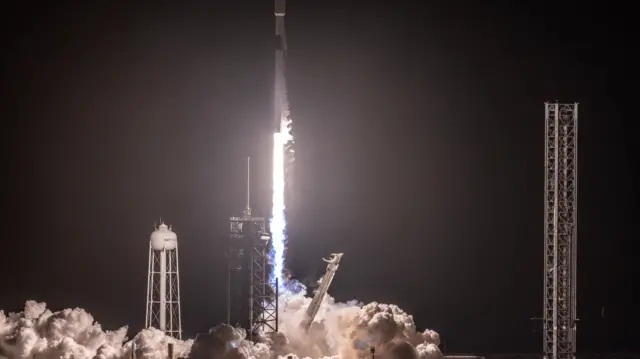
    A SpaceX Falcon 9 rocketImage source, Reuters
    Image caption,

    An image of a SpaceX Falcon 9 rocket from February 2026

    A stray piece of a SpaceX rocket hurtling towards the Moon is thought to have made impact.

    If you're just joining us, here's what you need to know:

    • The crash, which was due to occur around 07:35 BST, will be confirmed by specialist telescopes monitoring the event
    • We're still awaiting images - with a delay because none of the spacecraft orbiting the Moon were positioned to capture it live
    • The first job for scientists is to compare before-and-after pictures of the Moon's surface to spot the new scar - a process which takes time to plan and execute, writes our science correspondent
    • Nasa says the collision poses "no danger to Earth", with experts calling this an opportunity to "collect lunar data from the event and refine techniques for tracking objects in space"
    • But there are some concerns over space debris and how that might impact future missions - with today's collision meaning the Moon now has roughly 3,000 human-made objects

    Stick with us for further updates on the collision and its impact.
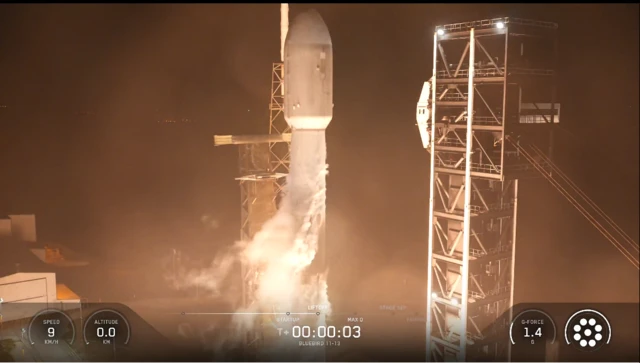
  2. SpaceX launch another rocket into orbit in separate missionpublished at 09:12 BST

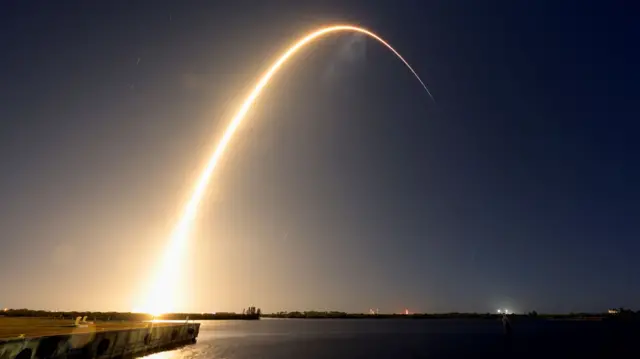
    Space X launch a Falcon 9 rocket carrying three satellitesImage source, Space X
    Image caption,

    Space X launch a Falcon 9 rocket carrying three satellites

    SpaceX has just launched a Falcon 9 rocket in a separate mission from its site in Florida.

    The mission, called BlueBird 11-13, is launching three satellites into orbit.

    Space X says in a statement on its website that this will be the 30th flight for the Falcon 9 first stage booster supporting this mission.

    As we've been reporting, the Falcon 9 was launched last year, with part of the rocket being reusable and designed to return back to Earth for its next mission.

    We're still waiting for images of another Falcon 9 rocket which is thought to have made impact with the Moon earlier this morning.

  3. Have you been following along? We want to hear from youpublished at 08:53 BST

    A purple Your Voice banner

    While the crash would not have been visible to the naked eye, people with access to a sophisticated telescope may be able to see a flash radiating off the Moon's surface.

    Have you tried to capture any images of the collision? You can get in touch in the following ways:

    Please read ourterms & conditions andprivacy policy

    In some cases a selection of your comments and questions will be published, displaying your name and location as you provide it unless you state otherwise. Your contact details will never be published.

  4. The Moon's growing junkyard - and the threat it could pose to future missionspublished at 08:33 BST

    Pallab Ghosh
    Science correspondent

    Today's crash means the Moon now has roughly 3,000 human-made objects, weighing around 190 tonnes combined.

    These have built up since the Soviet Union's Luna 2 became the first spacecraft to reach the lunar surface in September 1959.

    NASA's own tally lists 796 items from its Moon programme alone, mostly left behind by the six Apollo missions; the wider 3,000 figure emerges once you add every other nation and company's hardware too, from Soviet and Chinese landers to crashed rocket stages like today's.

    Unlike pollution on Earth, this debris poses no threat to an ecosystem, since the Moon has no atmosphere or biosphere to damage.

    But scientists are concerned about a few other things.

    Debris from the SpaceX Falcon 9 rocketImage source, Adam Borucki
    Image caption,

    Space debris from The SpaceX Falcon 9 rocket

    One is protecting historic sites, such as the Apollo landing zones, from being disturbed or damaged as more missions arrive.

    The other is preserving areas valued precisely because they're untouched, since undisturbed lunar soil holds billions of years of geological history that scientists want to study before it's scattered by debris.

    The more pressing worry, raised by Nasa and SpaceX this week, is collision risk to future missions, as landings and orbital traffic around the Moon are set to rise sharply over the next decade.

  5. Collision is 'nice experiment' - but pay off will come later, says astronomerpublished at 08:25 BST

    Dr Matt Bothwell, astronomer at the University of Cambridge, sits on the BBC Breakfast sofa wearing a white shirt

    The "big pay off" from the SpaceX rocket crashing into the Moon will come in around a week's time, according to an astronomer.

    Dr Matt Bothwell, astronomer at the University of Cambridge, tells BBC Breakfast this is when a lunar orbital satellite will pass the crash site and scientists will be able to create before and after pictures of the crater.

    Bothwell adds that the collision is a "nice little neat experiment on the Moon", but warns that space is becoming more crowded with space debris - human-made objects in orbit around the Earth.

    "It could feasibly be within a few decades hard to get past Earth's orbit because space is so crowded. It's called space debris and we should absolutely worry about it," he says.

  6. We're waiting for pictures of crash - and the crater it will have leftpublished at 08:01 BST

    Pallab Ghosh
    Science correspondent

    None of the spacecraft orbiting the Moon were positioned to capture the collision live, so the first job for scientists is simply comparing before-and-after pictures of the surface to spot the new scar, a process that itself takes time to plan and execute.

    South Korea's Danuri orbiter had the best chance of catching something close to real time, having passed near the impact site shortly beforehand, but its team has told Korean news outlets that any footage will only be released once analysis by research institutes is complete, with no fixed date given.

    NASA's Lunar Reconnaissance Orbiter will be in position to photograph the site over the coming days.

    Meanwhile, ground telescopes in the Americas, where it was still dark, had the best shot at catching the brief flash and dust plume, but turning raw detections into confirmed, cleaned-up images typically takes hours, and sometimes days, as scientists check the data for accuracy.

  7. Scientists estimate SpaceX-Moon collision will have happened by nowpublished at 07:52 BST

    Pallab Ghosh
    Science correspondent

    According to the scientists studying this impact, the SpaceX rocket should by now have crashed into the Moon.

    The crash will be confirmed by telescopes in the Americas monitoring the event.

    We'll bring you more on the collision as we get it.

  8. More on SpaceX's Falcon 9 - and the 4,000kg piece set to hit the Moonpublished at 07:36 BST

    SpaceX Falcon 9 rocket lifts off from NASA's Launch Complex.Image source, EPA/Shutterstock

    SpaceX's Falcon 9 is a reusable, two-stage rocket designed and manufactured for, what the company calls "the reliable and safe transport of people and payloads into Earth orbit and beyond".

    This specific rocket was launched as part of a US and Japanese mission to carry a pair of lunar landers and scientific equipment to the Moon last year.

    Part of the Falcon 9 is reusable and designed to return back to Earth for its next mission. But some parts of the rocket are shed in space and remain there, stuck in orbit unless they eventually collide with another celestial body.

    According to Nasa's Centre for Near-Earth Object Studies (CNEOS), the upper stage (section) of one of rockets will "impact" the Moon.

    The US space agency reached the conclusion after independent astronomers, using public data, noted that a portion of the rocket from a January 2025 launch was on an accidental collision course with the Moon.

    The piece in question is about the size of a five-storey building, with a weight on Earth of at least 4,000kg.

  9. How visible will the impact be?published at 07:22 BST

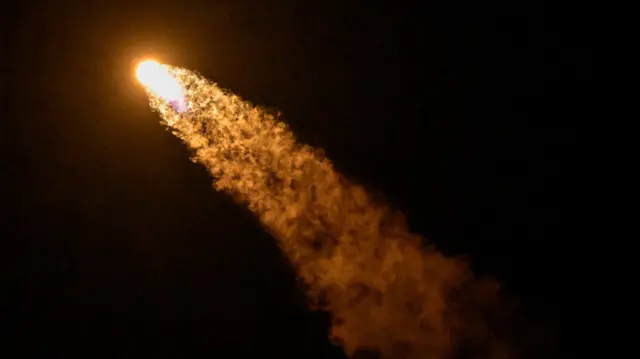
    A SpaceX Falcon 9 rocket launchesImage source, Reuters

    The SpaceX object will land near the Einstein crater, which is on the part of the Moon that receives daylight and is visible from Earth, according to astronomer Bill Gray.

    But experts say ordinary eyes on Earth will not be able to see the impact itself.

    Instead, people with access to a sophisticated telescope may be able to see a flash radiating off the Moon's surface.

    Big telescopes in the Americas, plus Nasa's Lunar Reconnaissance Orbiter and South Korea's Danuri probe, will track the flash, plume and new crater, and a citizen‑science project is signing up keen amateurs to film the impact too.

    By catching the dust plume in action, astronomers hope to turn this accidental crash into a useful experiment.

  10. Analysis

    The fact we know this is happening, ahead of time, is exciting for scientistspublished at 07:11 BST

    Libby Jackson
    Head of space at the Science Museum

    This collision is exciting for scientists, because we know it's happening, and we know the speed and the mass of the rocket stage that will crash into the Moon.

    We don't normally know that for meteors that crash into the Moon every day.

    That means scientists will have a lot more information as they study the debris that will be caused by the collision.

    By studying the light that is reflected from that material, scientists can determine its composition - helping them understand how the Moon has developed and how planetary systems evolved and were formed billions of years ago.

  11. No danger to Earth from collision - Nasapublished at 06:47 BST

    Matt Bothwell smiling in front of a black background
    Image caption,

    Matt Bothwell, astronomer at the Institute of Astronomy at the University of Cambridge

    The collision between the Moon and a drifting SpaceX rocket is not thought to be dangerous, including to Earth, according to experts.

    Nasa spokesperson Jimi Russel says while Nasa will continue to observe the site of impact for scientific purposes, "there is no danger to Earth".

    Nasa scientists are planning to collect lunar data from the event and refine techniques for tracking objects in space.

    "It's something really huge smashing into the Moon. It's not remotely dangerous, we can just watch the show," says Dr Matt Bothwell, public astronomer at the University of Cambridge.

  12. How a SpaceX rocket ended up hurtling towards the Moonpublished at 06:27 BST

    Pallab Ghosh
    Science correspondent

    The story began in January last year, when a Falcon 9 rocket blasted off from Florida carrying two lunar landers into space.

    The rocket's job was to fire its upper stage hard enough to send both landers out of Earth orbit and onto a path towards the Moon, and it succeeded.

    But the spent stage was left drifting in a long, looping orbit that swung it out towards the Moon and back again.

    Over the following 18 months, the gentle gravitational tug of the Earth, Moon and Sun - along with even the faint push of sunlight itself - gradually altered its path.

    Astronomers tracking the object eventually worked out that those small nudges had put it on a course toward the Moon, picking up speed by the day and heading for an almighty crash.

  13. SpaceX rocket travelling at 5,400mph set to crash into Moonpublished at 06:19 BST

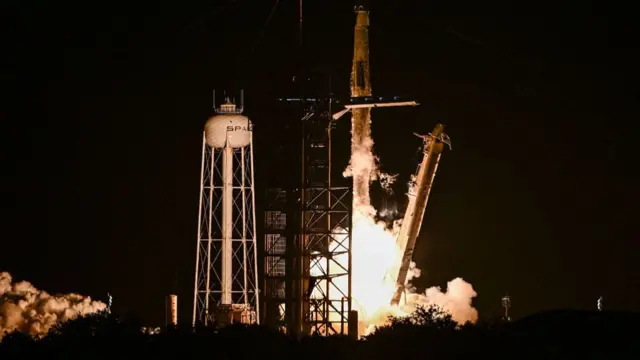
    A SpaceX spacecraft during a night-time launch, showing a roar of white flames and smoke against a dark sky.Image source, AFP via Getty Images

    A stray piece of a SpaceX rocket that has been hurtling in orbit at around 2.43 kilometres per second (about 5,400mph) is expected to collide with the Moon.

    It's the upper section of a Falcon 9 spacecraft, about the size of a five-storey building and weighing at least 4,000kg.

    The collision, according to US space agency Nasa, is predicted to happen at about 07:35 BST.

    Experts say it will not be visible from Earth with the naked eye, but people with access to a sophisticated telescope may be able to see a flash radiating off the Moon's surface.

    It is also not thought to be dangerous - including to Earth - with scientists instead considering this to be a unique opportunity to study what happens when an object hits the Moon.

    Stick with us as we bring you the latest updates and expert analysis on what this all means.