Summary

  • An Australian court is hearing the appeal of Erin Patterson, who was sentenced to life in prison last year for murdering three relatives and trying to kill another

  • The 51-year-old served her estranged husband's family beef Wellington containing poisonous mushrooms, but has always maintained it was an accident

  • Patterson's lawyers are appealing against her conviction, arguing the judge allowed evidence he should not have, the prosecution behaved improperly, and the jury was tainted by an unusual accommodation bungle

  • Her lawyers cite a "catastrophic" arrangement before the verdict, wherein the jury stayed in the same hotel as some prosecutors and a key witness. They say this "undermined" the integrity of the conviction

  • The two-day hearing will include an appeal from prosecutors who argue Patterson's sentence is "manifestly inadequate" as it allows for the possibility of parole

  1. What do we know about Patterson's time in prison?published at 02:57 BST
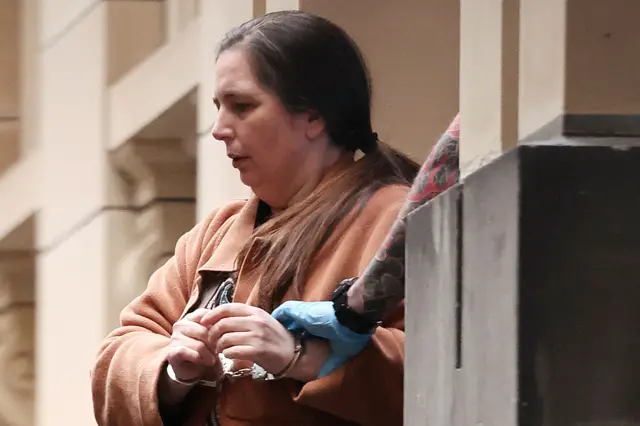
    A picture of Erin Patterson in handcuffsImage source, Getty Images

    As he handed down the sentence in September last year, Justice Christopher Beale provided some insight into Erin Patterson's day-to-day life behind bars.

    Given the severity of her crimes and her public profile, Patterson has a "maximum security rating", he said.

    As a result, the triple murderer had been spending 22 hours a day in her cell, with meals and medicine "delivered though a flap in [the] cell door", Justice Beale described. She also had access to a small concrete yard - 2m by 1.5m - where she could exercise and get fresh air, he said.

    It was there that she could talk to her neighbouring prisoner through a mesh wire fence. That prisoner was serving a lengthy sentence for terrorism offences and had attacked other inmates, Justice Beale said.

    Inmates were also allowed to use the prison library twice a week for 20 minutes but due to staff shortages, Patterson had not been able to access it on a regular basis.

    We haven't heard much about her time in prison since, but we expect we may get an update when the prosecution discusses their appeal, given these conditions are central to their arguments.

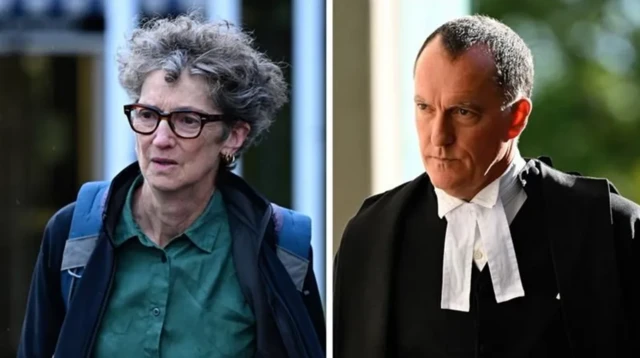
  2. No evidence Patterson ever saw posts in question, defence sayspublished at 02:36 BST

    Patterson’s team are fleshing out why they say evidence of death cap mushroom reports on iNaturalist and cell towers we mentioned a few minutes ago should not have been allowed.

    Patterson’s lawyer Veronika Drago tells the judges that during the trial, the prosecution had tried to turn "evidence of nothing into something".

    She is stressing that the trial judge had been clear during a pre-trial hearing that the cell tower evidence only “possibly” showed where Patterson had been and also that both parties had agreed “there was no evidence that [Patterson] had ever accessed or seen those posts (on iNaturalist)".

  3. The mushroom sightings and the mobile phone tower datapublished at 02:29 BST

    Simon Atkinson
    Australia producer

    Some context on this next ground of appeal for you.

    We don’t know exactly where Erin Patterson got the death cap mushrooms she used in her deadly meal.

    But during the trial prosecutors put forward a theory: that she found two sightings reported online near her hometown, then quickly went looking for them.

    Jurors heard her phone connected to cell towers in both of those areas - something which the prosecution said indicated she’d visited those spots.

    Hours after her phone pinged in one of these locations, she bought a food dehydrator which was used to prepare the mushrooms for the lunch - and which Patterson then dumped at a rubbish tip days afterwards.

    There was evidence that Patterson had used iNaturalist online database in the past, but her team says there is nothing to say she definitely saw posts about these two sightings – though many of her devices were wiped before police inspected them.

    It is worth noting that, when sentencing Patterson, the judge said this evidence wasn’t really central to the case - it didn’t really matter where she sourced the deadly mushrooms from, it was abundantly clear that she had.

  4. The hotel crossover occurred during the most important week of trialpublished at 02:25 BST

    While the defence team admits that there is no evidence suggesting that the jurors communicated with other parties when they stayed in the same hotel, they highlighted that the lodging accident happened during the week of jury deliberation - which is the "most critical stage of the trial".

    After a bit more back and forth, the defence is moving on to another ground of appeal.

  5. Media articles suggest possible jury issues, Patterson's lawyer arguespublished at 02:22 BST

    Lana Lam
    BBC News, Sydney

    Patterson's barrister now brings up media articles from last year's trial as possible evidence that jury members might have seen members of the prosecution while in the same hotel.

    He's been repeatedly asked by the panel for evidence to show possible contact but is coming up short.

    “The other aspect of that week of deliberations and the sequestration is the number of media articles that were published in the event or after the event," he says.

    "There appears, at least, on that material, some contact which we don't find anywhere else."

    But the judges push back.

    "Why should we prefer a media report over an email from a prosecution solicitor that says we confirm that the prosecution solicitors did not interact with the jury at any stage," asks Justice Lesley Taylor.

  6. Watch: Why is Australia's mushroom killer back in court?published at 02:15 BST

    In this short video explainer, BBC's Australia correspondent Katy Watson explains why Erin Patterson is back in court today.

    Media caption,

    Why is Australia's mushroom murderer back in the headlines?

  7. How is Patterson reacting?published at 02:07 BST

    The BBC is not in court today – and the public video feed we're watching from does not include a view of Erin Patterson in prison.

    But those in court in Melbourne can see it.

    According to our news partner the Australian Broadcasting Corporation, Patterson is “sitting forward, listening intently to this legal back-and-forth about whether the jury could have been compromised by the sequestration arrangements".

    Their reporter Kristian Silva adds: “Those who spent plenty of time with her in the courtroom last year have seen these mannerisms before: rapid blinking, a stern face and a bit of fidgeting.”

  8. The panel pushing back against Patterson's lawyerspublished at 01:58 BST

    Patterson's barrister started this hearing by insisting this accommodation snafu was "catastrophic" for the trial.

    Under sustained questioning from the appeal judges, Edney appears to be softening his language. It was "undesirable" that the jury was staying in the same hotel as prosecutors and a police witness, he said moments ago.

    Justice Lesley Taylor interjects: "Perhaps not as strong as catastrophic?"

    Edney responds: "We maintain that this was a very serious breach of sequestration".

    Earlier, he had said there was a "reasonable possibility" that some jury members saw the police informant at the hotel - but he conceded there's no evidence they interacted.

  9. Judge never would have allowed jury to stay at same hotel as partiespublished at 01:54 BST

    Fan Wang
    Live reporter

    Patterson's legal team are answering questions from the three judges, and as we say earlier, they're asking why it matters if the jury accidentally ended up in the same hotel as other parties, given they were under constant supervision.

    The oath jurors take only bars them from discussing the case with others, Justice Lesley Taylor says.

    Patterson's barrister Richard Edney says the meaning of contact and interaction should be conceived of in a broad way, and the jurors staying in the same location with the others in itself "is an interaction". Even if there was no communication, there may have been "subconscious influence", he says.

    He adds that had it been suggested that the jury and the others would all stay in the same hotel due to the accommodation shortages, the trial judge would have rejected such a "preposterous proposal".

  10. Trial-famous lawyers not appearing in this hearingpublished at 01:46 BST

    Simon Atkinson
    Australia producer

    Nanette Rogers and Colin MandyImage source, EPA
    Image caption,

    Dr Nanette Rogers and Colin Mandy SC became familiar faces to many during the trial

    After sitting through the many weeks of Erin’s Patterson’s trial, the barristers grew familiar to us - and not just in the courthouse.

    In the small town of Morwell, you’d spot them in the local cafes and restaurants too, and as they walked in and out of court steadfastly ignoring the barrage of cameras.

    But in this appeal, different figures are representing the two sides.

    Patterson is using the same law firm, but they have appointed Richard Edney and Veronika Drago to lead her case. Her barrister from the trial, Colin Mandy, is not involved here.

    And while it was Dr Nanette Rodgers lead the prosecution last year, today Victoria’s Director of Public Prosecutions Brendan Kissane KC and prosecutor Jeremy McWilliams are appearing for the crown.

  11. 'So what' if jurors saw other parties to the case, judge askspublished at 01:40 BST

    Edney concedes that there is no evidence that the jurors had any interaction with the prosecution team or the key witness who were staying at the same hotel - but says the accommodation bungle was still "catastrophic".

    The judges are trying to get to the nub of why he thinks that.

    One says that, in any criminal process, jurors see other parties all the time - in corridors, or even nearby cafes - and they're supervised by jurykeepers whose job it is to ensure there's no improper communication.

    “So I suppose my question is... if they did view or see the practitioners, so what?” the judge asks.

    “Is there any evidence there has been a breach of the communication embargo? If there has been no breach of that where’s the fundamental irregularity?”

  12. 'Fundamental irregularity' over where jury stayed during casepublished at 01:33 BST

    Lana Lam
    BBC News, Sydney

    Erin Patterson's legal team has just begun voicing its arguments - their focus is on where the jury was staying as they deliberated the case.

    "A fundamental irregularity occurred while the jury was sequestered," the lawyer tells the court.

    The jurors were supposed to be isolated, but accommodation shortages meant they shared a hotel with members of the prosecution, a key police witness, and journalists - though the judges have just now pointed out there’s no evidence they interacted with any of these other guests.

    Still, Patterson's barrister Richard Edney said this "undermined the integrity of the verdicts and requires the quashing of the convictions".

    A retrial is required "so that justice can not only be done but be seen to be done".

    Those words are profoundly important to the integrity of the legal system and the public's confidence in it, he says.

  13. The panel of three judges will decide this casepublished at 01:30 BST

    Justice Stephen McLeish, Justice Lesley Taylor and Justice Peter Kidd are the judges hearing the case in Melbourne today and tomorrow.

    As appeal court judges, they had no involvement with the trial in Morwell last year.

    It'll be up to them to decide whether or not the appeals by both Erin Patterson and the public prosecutor are successful.

    If they do not all agree on the decision, the case will be decided by a majority vote (two to one). And so the opinion of the two agreeing judges becomes the final order of the court.

  14. Lunch survivor Ian Wilkinson in courtpublished at 01:27 BST

    Katy Watson
    Australia correspondent

    The appeal hearing is being live-streamed and for those tuning in, it’s a split-screen.

    On one side, you can see the three appeal judges, and on the other, the view is of the rest of the courtroom which looks pretty full.

    Both the prosecution barristers and Erin Patterson’s lawyers are in vision - we can't see the convicted murderer herself though.

    Sitting on the benches behind the legal teams is Stephen Eppingstall, who was in charge of the police investigation. And next to him is Ian Wilkinson, the only survivor of the lunch.

  15. Appeal hearing about to beginpublished at 01:15 BST

    Erin Patterson's appeal hearing is about to get underway shortly in Melbourne. Stay with our live coverage - we will bring you the latest.

  16. What are Patterson’s appeal arguments - in a nutshellpublished at 01:13 BST

    Patterson’s legal team say she did not receive a fair trial. A three-page document filed last year hints at the arguments they’ll make today.

    There were bits of evidence the jurors should never have seen, her lawyers argue, and others from their own case which were wrongly excluded.

    The defence also say the prosecution was inconsistent on their evidence about a motive, and that the five days of cross-examination of their client was “unfair and oppressive”.

    And finally, they say a “fundamental irregularity” occurred while the jury were deliberating which “fatally undermined” the integrity of the verdicts.

    The jurors were supposed to be isolated, but accommodation shortages meant they shared a hotel with members of the prosecution, a key police witness, and journalists - though there’s no evidence they interacted with them.

  17. The never-ending interest in the mushroom murderspublished at 01:11 BST

    Katy Watson
    Australia correspondent

    Without doubt, this is the story I am most asked about in all my years of reporting.

    Family, friends and colleagues are keen to know what it was like in court, how Erin Patterson seemed as she gave evidence – but most of all, why would she have done it?

    Her motive was always in question – in fact, the prosecution argued right from the start that a motive wasn’t necessary to prove she was guilty of murder. But the mystery over her reasons for killing three relatives is partly why this trial drew so much attention.

    An average family, having an average family lunch that ended in such tragedy.

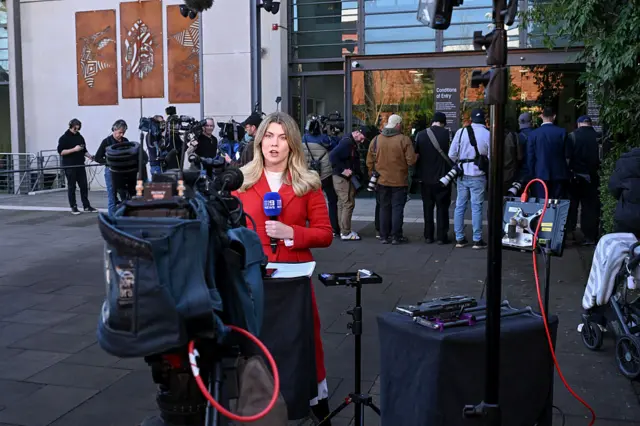
    A media pack is seen outside the courthouse in Morwell on the day Erin Patterson was convictedImage source, Getty Images
  18. Patterson won't be in court todaypublished at 01:05 BST

    Simon Atkinson
    Australia producer

    Erin Patterson was ever-present during her trial last year in Morwell – either quietly sitting in the dock or answering questions in the witness stand.

    She was also there in person in Melbourne to hear those affected by her crimes talk about their devastating impact.

    But Patterson, who turns 52 next month, is not in the room for this appeal. Instead she’s watching via video link from the Dame Phyllis Frost Centre, a maximum-security women's prison in the western suburbs of the city.

    Patterson did have the option to attend in person, but indicated when the appeal application was made last November that she wouldn’t, and has stuck by that.

    Previous appearances have seen hordes of photographers and camera crews camp out in an attempt to snap a fleeting image of her - remarkable photos of Patterson in a prison van last year are perhaps her defining image.

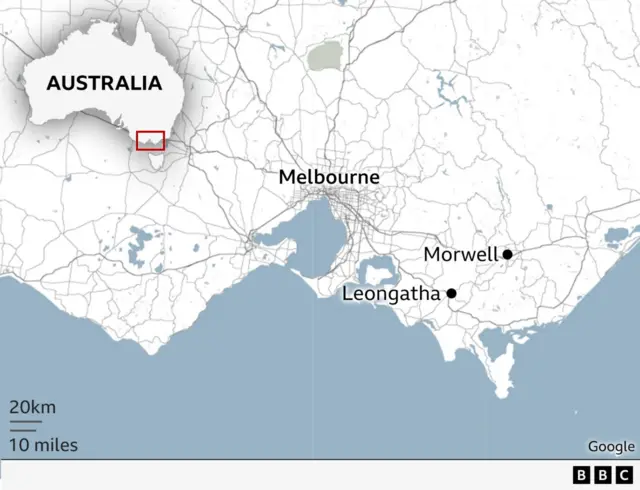
    A map showing Morwell, Leongatha and Melbourne in Victoria
  19. Who were the victims?published at 01:00 BST

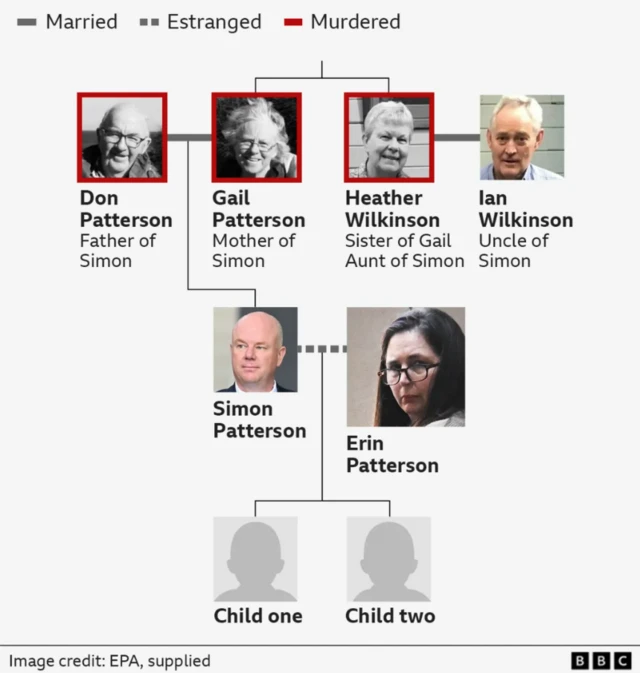
    The three people who died in hospital in the days after Patterson’s lunch were Patterson's in-laws, Don and Gail Patterson, both 70, and Gail's sister Heather Wilkinson, 66.

    Heather's husband, local pastor Ian Wilkinson, recovered after weeks in an induced coma and still has ongoing health issues related to the poisoning.

    Simon Patterson, Erin's estranged husband with whom she has two children, had been invited to the lunch too, but pulled out the day before.

    Graphic of attendees of fatal mushroom lunch in Australia
  20. What are we expecting today?published at 00:54 BST 19 August

    There are two appeals taking place.

    Firstly, Patterson is trying to get her convictions overturned, claiming there were several reasons a "substantial miscarriage of justice" had occurred at her trial.

    Her team's complaints fit into three categories - problems with evidence, the actions of the prosecution, and an unusual snafu with the jury.

    At the same time, prosecutors will also be appealing against her sentence. The judge said Patterson could apply for parole after 33 years, swayed by the "harsh prison conditions" she would likely face.

    The prosecution says that's "manifestly inadequate" and the triple murderer should never be freed.