Summary

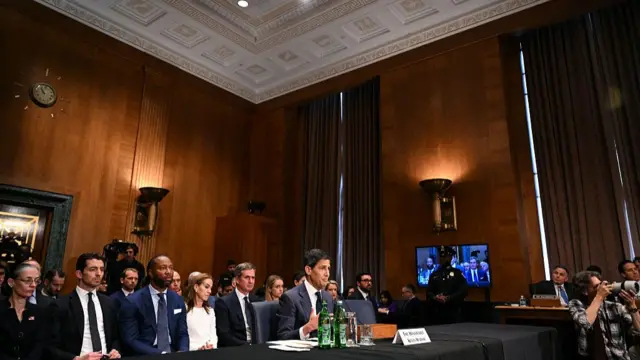
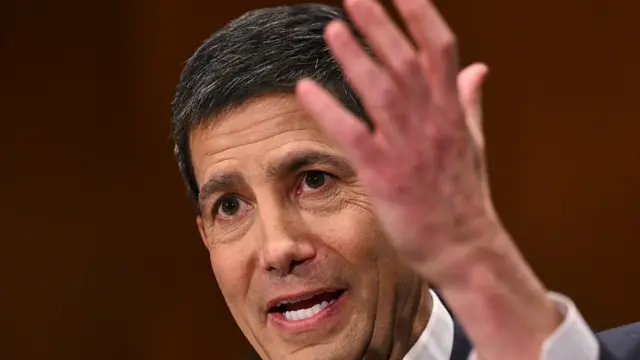
  • US senators have questioned Kevin Warsh, President Donald Trump's pick to be the next chair of the country's central bank

  • Current Federal Reserve Chair Jerome Powell's term ends in May

  • Trump and Powell have repeatedly clashed - particularly on the issue of raising interest rates. Warsh says he supports lowering them

  • Senator Tim Scott, the Republican chair of the Senate committee questioning Warsh, says the nominee is "battle-tested" for this job, while Democratic ranking member Elizabeth Warren says Warsh would be a "sock puppet" for Trump to further his economic agenda

  • Warsh counters that he would "absolutely not" be a puppet for Trump if confirmed for this position and would act independently

  • Senator Thom Tillis, a Republican and key member of the committee responsible for confirming Walsh, has stated he may block Warsh's confirmation until a federal probe into Powell is dropped

Media caption,

Republican on why he may block new Fed chair confirmation

  1. Independence of the US central bank the dominant theme of the daypublished at 18:49 BST
    Simon Jack
    Business editor

    Kevin Warsh - Donald Trump's pick to be next chair of the US central bank - came under intense questioning today about his personal wealth and whether he would maintain the traditional independence of the Federal Reserve from the White House.

    Several Democrats challenged him on Trump, quoting the president's remarks that he was confident that interest rates would be cut "when Kevin was at the Fed".

    Warsh asserted that he had made Trump no promises about lowering interest rates, and that there was no "deal" with the president that earned him his nomination. The Fed should be independent when it comes to rate setting, he said, but he is open to reform.

    Republicans across the board seemed to think Warsh is qualified for the job - though one senator, Thom Tillis, maintained that he will not vote to confirm him until the federal government drops its criminal probe into current Fed Chair Jerome Powell.

    Soon, Warsh's nomination will go to a full Senate vote. A simple majority of 51 votes is required to confirm him. Republicans hold the majority, but it remains to be see how Tillis' possible abstention will affect their numbers.

    We're closing our live coverage on this page shortly, but stay with us for future reporting on changes at the US central bank.

    You can read a summary of the day's events here.
  2. What you need to know about Kevin Warsh's confirmation hearingpublished at 18:22 BST

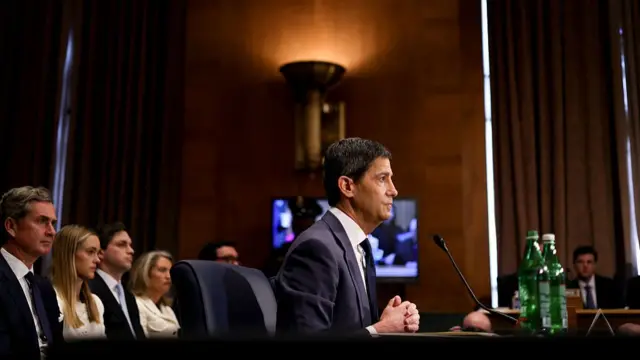
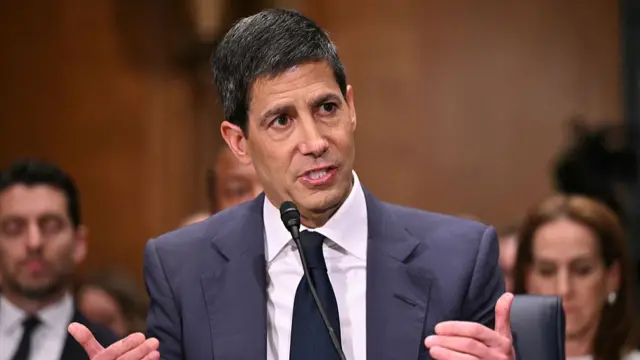
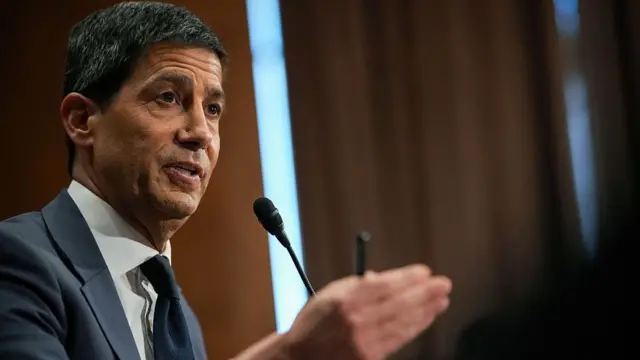
    Kevin Warsh speaks at his confirmation hearingImage source, Getty Images

    Kevin Warsh's confirmation hearing to become the next chair of the US Federal Reserve wrapped after nearly three hours.

    Both Democratic and Republican senators on the Banking Committee peppered the Trump-nominee with questions about his background, his policy positions, and if he would keep the central bank independent from presidential influence.

    Here's a recap of the key moments:

    • Democrat Elizabeth Warren said Warsh is "uniquely ill-suited" for the job, and warned he would be a "sock puppet" for Trump
    • Warsh hit back at this throughout the hearing, saying Trump has not pressured him to cut interest rates, and that they did not "make a deal" ahead of his nomination
    • He also repeatedly stressed that the Fed's independence is important
    • Walsh declined to address President Trump's repeated clashes with current Fed Chair Jerome Powell, whose term ends in May
    • He also said he wants to see major reforms to the central bank, including a new framework for dealing with inflation
    • Asked about his millions of dollars in investments, Warsh said he has committed to divesting if and when he is confirmed as Fed chair
    • Republicans were generally positive about him, praising him as very qualified for the role
    • Republican Senator Thom Tillis however reasserted his position that he will not vote for Warsh until the justice department drops its probe into current Fed chair Jerome Powell. This could potentially hold up the confirmation
  3. Analysis

    'Fed independence means everything to me', says Warshpublished at 17:43 BST

    Anthony Zurcher
    North America correspondent

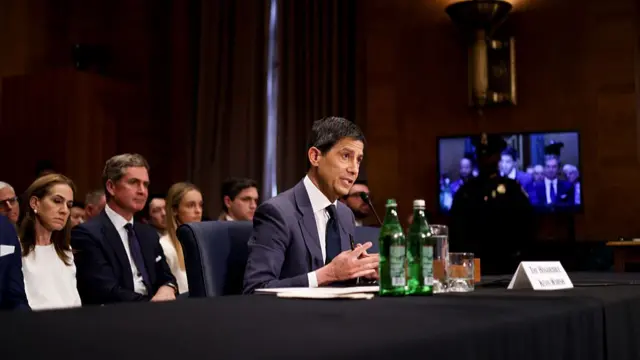
    A side view of Kevin Warsh sitting for Senate questioning. Audience members can be see behind himImage source, Getty Images

    As we have previously noted, Donald Trump has been a frequent vocal critic of the Federal Reserve interest rate policies since he returned to office last year. There’s been more to his efforts to shape monetary policy, however.

    Last year, he attempted to fire Fed governor Lisa Cook – who supports higher interest rates to control inflation – citing what he said was financial misconduct surrounding a mortgage application she filed prior to entering government service.

    The legality of Trump’s move is now being considered by the US Supreme Court.

    He has also threatened to fire Fed Chair Jerome Powell if he stays in office after his term expires in May and his replacement has not been confirmed by the Senate.

    Maryland Democrat Angela Alsobrooks asked Warsh to offer his views on these efforts, but the nominee mostly dodged the questions.

    “Fed independence means everything to me,” he said.

  4. Trump never asked me to lower interest rates, Warsh sayspublished at 17:30 BST

    Kevin Warsh has asserted multiple times in his sworn testimony that President Trump never pressured him to lower interest rates if he were to be confirmed as Federal Reserve chair.

    Democratic Senator Ruben Gallego referenced a recent Wall Street Journal article which contradicts that, saying Trump had in fact pressed Warsh on cutting rates.

    "I think those reporters either need better sources or better journalist standards," Warsh says.

    He adds that the president "didn't ask for it. He didn't demand it. He didn't require it, nor would I have ever done so."

  5. Analysis

    'No more pressing question than the cost of living' - Warshpublished at 17:21 BST

    Anthony Zurcher
    North America correspondent

    In his opening remarks, Kevin Warsh said that there is “probably no more pressing question than the cost of living”.

    US public opinion surveys – and recent election results – certainly bear that out.

    Over the course of the morning’s hearing, Warsh has painted a picture of a US economy that he believes is improving.

    “Broadly speaking, the economy is running close to full employment,” he said.

    When questioned by New Jersey Democrat Andy Kim, however, Warsh acknowledged that many Americans are still feeling the pinch of inflation and have a less optimistic view of the nation’s economic situation.

    “Central bankers should not be second-guessing what people feel and see in their own lives,” he said.

  6. A famous face in the packed room todaypublished at 17:18 BST

    Ana Faguy
    Reporting from Capitol Hill

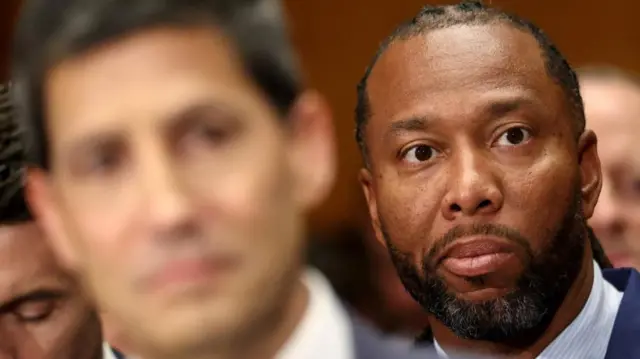
    Larry Fitzgerald Jr sits behind WarshImage source, Reuters
    Image caption,

    Former NFL player Larry Fitzgerald Jr is present today

    When I first entered the Senate room, about 30 minutes before the confirmation hearing began, the reporters' seats were largely filled and some members of Warsh's personal support system were standing in the front rows.

    I did a double take when I saw who I thought was former NFL football player Larry Fitzgerald Jr seated directly behind the nominee.

    I figured it must have been a doppelganger and moved on. But in the two hours since the hearing started, we've learned it was, in fact, Fitzgerald, a former Arizona Cardinals player.

    Some outlets are reporting Fitzgerald and Warsh are personal friends, but the reason why he turned up here is still unclear.

  7. What does the Fed chair do?published at 17:07 BST

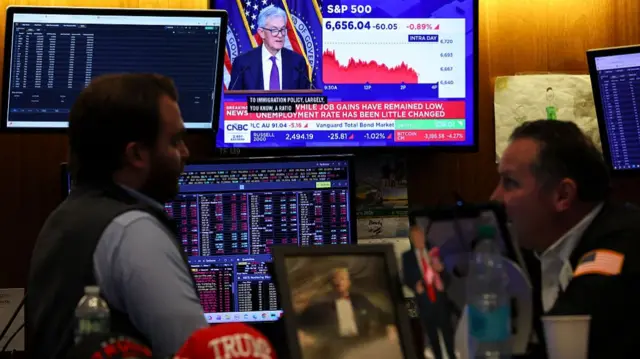
    Traders stand in front of a bank of screens, one of them showing Fed Chair Jerome Powell, with Trump memorabilia in the foregroundImage source, Getty Images

    The Federal Reserve has a dual mandate: to maximise employment and keep prices stable.

    Its chair, currently Jerome Powell, guides the bank’s approach to interest rates, one of its main tools in promoting economic stability.

    While the chair has just one vote on the committee which eventually decides interest rate changes, they are hugely influential in guiding the discussion and building a consensus for cuts or increases.

    The chair is also the public face of the bank, reporting twice yearly to Congress on its policy objectives and frequently testifying on other issues.

  8. Fed independence is up to the Fed, Warsh sayspublished at 17:02 BST

    Anthony Zurcher
    North America correspondent

    Looming over today’s confirmation hearings is Donald Trump’s repeated demand that the Federal Reserve lower inflation rates – and his complaint that it has been too reluctant to do so during his first year back in the White House.

    Lower rates would ease the cost of borrowing, juicing US economic growth, improving public confidence and, the president hopes, leading to a political windfall for Republicans.

    He has given current Fed Chair Jerome Powell the nickname “too late” for his reluctance to lower rates in the face of persistent inflation. And early today, he said he would be “disappointed” if Warsh didn’t quickly lower rates upon his confirmation.

    At least so far today, Warsh has seemed more concerned with the dangers of inflation than with rate cuts. He said the Fed made a “fatal policy error” in 2020, which he said let higher inflation “take hold” and that Trump has never asked him to “predetermine, commit, fix, decide on any interest rate decision”.

    Presidents, he said, always want lower interest rates. The difference with Trump is that he makes his views very public.

    “But Fed independence is up to the Fed,” he concluded.

  9. Warsh says he hasn't told Trump his thoughts on interest ratespublished at 16:59 BST

    Kevin WarshImage source, Getty Images

    Warsh is asked what conversations he's had with Trump about interest rates.

    The president has repeatedly called for the central bank to lower those rates, and Democratic senators today have expressed concern that Warsh will kowtow to Trump's desire if he is confirmed.

    Warsh answers that he never told Trump where he thinks interest rates should be, adding that too many Fed officials opine on those matters in advance when they shouldn't.

    "That's unhelpful," he says.

    Instead, he says, he wants to oversee Fed officials that are "open-minded, that can react when we have good data, when events strike us".

  10. Room is packed as hearing approaches two-hour markpublished at 16:51 BST

    Ana Faguy
    Reporting from Capitol Hill

    Kevin WarshImage source, Getty Images

    Though we're more than halfway through the hearing, the room is still tightly packed with spectators.

    If you're watching on our stream above, it may look spacious where the senators are sitting on the dais, but in the gallery, we're packed like sardines in a can.

    Each time someone vacates their seat, new folks come in and fill their place.

    It's clear that at a time when gas prices are on the rise, interest rates remain high and economic uncertainty persists, there is widespread interest in Warsh's confirmation hearing.

    The proceedings are approaching the two-hour mark, and at least seven senators still have their question time left.

    Stay with us.

  11. How could AI change the US economy?published at 16:43 BST

    Simon Jack
    Business editor

    The Federal Reserve has two jobs.

    Keep inflation under control and support the fullest possible level of employment in the US economy.

    The arrival of AI could change both those jobs according to Donald Trump's pick for the next chair of the Fed, Kevin Warsh.

    Warsh tells senators that productivity gains from AI could be "so consequential" that it would allow growth to be higher without stoking inflation, while at the same time it would present changes to the job market.

    Warsh said that the Fed needs to "change its models".

  12. Warsh denies he made a deal with Trump for jobpublished at 16:29 BST

    Simon Jack
    Business editor

    That was the question asked by Republican Senator John Kennedy from Louisiana - echoing others on a Senate Committee grilling Donald Trump's pick to be the chair of the Federal Reserve, perhaps the world's most important financial institution.

    Questions on Warsh's independence have dominated the first hour of the hearing with both Democrats and Republicans quoting remarks by the president that he "wouldn't appoint anyone who wasn't going to lower interest rates".

    Warsh denied that he had "made a deal" with Donald Trump to lower rates if approved.

    Inflation has been above the Fed's target for several years but Warsh told the committee he had low confidence in traditional measures of inflation - signalling that inflation being above target would not be a barrier to lowering rates.

  13. Analysis

    Tillis likes Warsh - but still plans to block his confirmationpublished at 16:25 BST

    Anthony Zurcher
    North America correspondent

    Thom TillisImage source, Getty Images

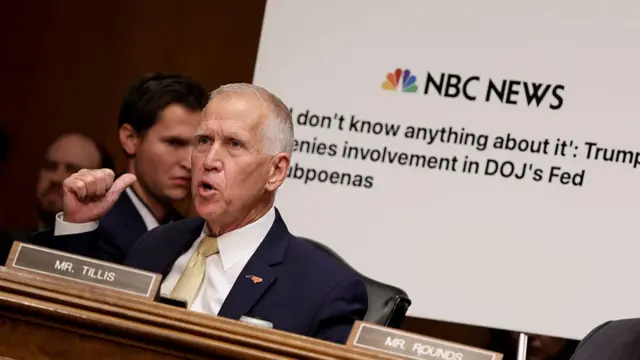
    Republican Senator Thom Tillis of North Carolina has been a key roadblock to Kevin Warsh's confirmation as Federal Reserve chairman. During remarks at today’s hearing, he made clear that he thinks Warsh would be a good pick for the job. His objection has been to the ongoing federal criminal investigation into the Fed’s multi-billion-dollar renovation project at its Washington DC headquarters.

    Donald Trump has repeatedly suggested that the project, which has been beset by cost overruns, was mismanaged and potentially fraudulent – and has laid the blame at the feet of Jerome Powell, the current Fed chair. Early today, the president said "it's possible" that Powell was personally profiting from the renovations and declined to commit to ending the investigation.

    Tillis took nearly the entirety of his five minutes during the hearing to debunk the president’s allegations. He said the cost overruns while “unfortunate” were “legitimate”, noting the structural issues with the existing building and the rising cost of construction materials.

    He added that a federal prosecutor "thought it would be cute" to investigate Powell, but that the criminal inquiry should stop immediately. Only then, he said, would he join with Republicans in the narrowly divided Senate to back Warsh's confirmation.

  14. A debate over the idea of a 'sock puppet'published at 16:24 BST

    Senator John Kennedy uses his allotted time to initiate an exchange about...sock puppets.

    He's referencing Elizabeth Warren's comment earlier that Warsh would be a "sock puppet" for Trump if confirmed.

    Kennedy asks Warsh: "What is a sock puppet?"

    "I think it's a thing you stick your hand in," Warsh answers, to which Kennedy says "Like this?" while mimicking a puppet with his hands.

    "Are you going to be the president's human sock puppet?" Kennedy asks.

    "Absolutely not," Warsh replies. "I'm honoured the President nominated me for the position, and I'll be an independent actor if confirmed as Chairman of the Federal Reserve."

  15. The moment we've waited forpublished at 16:15 BST

    Ana Faguy
    Reporting from Capitol Hill

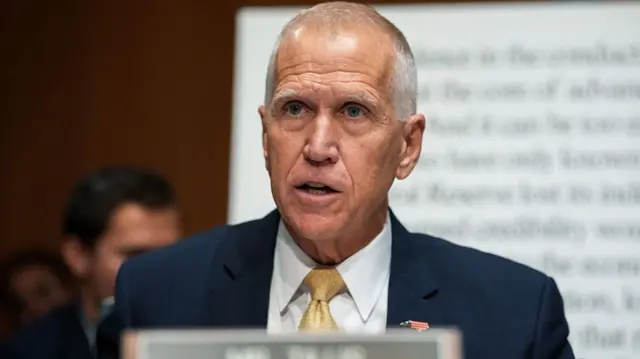
    Tillis sits on the dais in the US Senate. He wears a dark suit and gold tieImage source, Getty Images
    Image caption,

    Republican Senator Thom Tillis

    We've been waiting to hear from Republican Senator Thom Tillis, and the time has now come.

    Remember: Tillis has said leading up to today's hearing that he will vote against Warsh's confirmation until the federal government drops its criminal probe into current Fed Chair Jerome Powell.

    During his allotted time, Tillis says he's not going to question Warsh; he'll leave that to the Democrats on the committee.

    "They're going to beat you until you bleed," Tillis says of Democrats.

    Instead, he pivots to the construction at the Federal Reserve building.

    That's the construction project that is currently part of the US Justice Department's investigation into Powell.

    He says Warsh is extremely qualified for the job, but it appears his stance to try and hold up the confirmation process has not changed.

  16. Federal Reserve's 'independence has to be earned', Warsh sayspublished at 16:10 BST

    The independence of the Fed is "critically important", Warsh says, but he adds that "independence has to be earned".

    It's an interesting statement given the Federal Reserve's traditional independence from the White House. The central bank's mission is to focus on making long-term economic decisions, not bowing to short-term political pressures.

    But Warsh says independence is earned by delivering on promises and commitments the Fed has made, which, in his view, the Fed hasn't done.

    "We shouldn't be surprised that we hear politics that are entering the room at the Fed, and you get the politics out of it so the Fed can focus on its day job," he adds.

  17. Warsh says he will divest his investments after becoming Fed chairpublished at 16:06 BST

    Kevin Warsh in Senate hearingImage source, Getty Images

    Senators are pressing Warsh on his financial assets and investments - and moreover whether he will divest them before taking on the role of Federal Reserve chair.

    Democratic Senator Jack Reed asks: "Will you agree to not take the oath until you have fully disposed of all the assets that have been identified?"

    Warsh highlighted an agreement he has struck with the Office of Government Ethics to sell off at least $100m (£74m) of investments and holdings if and when he is confirmed.

    He says he has gone “above and beyond” on transparency and ethics, vowing to sell off "virtually all" of his investments.

    Warsh says the central bank “needs to re-establish its credibility, because the conduct of policy depends on it”.

    But Reed, as well as the ranking Democrat Elizabeth Warren, have continued to question exactly what holdings Warsh has and how he will dispose of them. Her questions relate mostly to one fund held by Warsh, the underlying assets of which he has not yet disclosed.

  18. What is Warsh worth? And how much will he sell to be Fed chair?published at 16:01 BST

    Anthony Zurcher
    North America correspondent

    Kevin Warsh is a very wealthy man, with a net worth estimated to be somewhere between $135m (£100m) and $226m (£167m), according to financial disclosures filed as part of his confirmation process.

    Warsh has promised to sell approximately $100m of his investments within 90 days of becoming Fed chair in order to avoid “the appearance of anything inappropriate”.

    The first big fight during these hearings came when Democratic Senator Elizabeth Warren asked if Warsh would disclose whether any of those assets including investments in companies affiliated with Donald Trump or his family, China or Jeffrey Epstein.

    Warsh declined to answer the question, later saying only he would move his assets into something that's “plain vanilla”.

  19. Warsh probed on if he has financial links to Jeffrey Epsteinpublished at 15:53 BST

    The ranking Democrat on the committee, Senator Elizabeth Warren, is now probing Kevin Warsh on whether he has any financial ties to Donald Trump, late paedophile Jeffrey Epstein, China or companies which have facilitated money laundering.

    The questions relate to an investment held by Warsh in a fund worth at least $100m, the underlying assets of which are not disclosed.

    “Do the [funds] invest in any companies affiliated with President Trump or his family, companies that have facilitated money laundering, Chinese-controlled companies or financing vehicles established by Jeffrey Epstein?” Warren asks.

    Warsh doesn't answer the question directly, but says he planned to divest his holdings if and when he is confirmed as Fed chair.

  20. Warsh wants to see major reforms to the US central bankpublished at 15:49 BST

    Kevin WarshImage source, Getty Images

    Kicking off the questions, Republican Tim Scott asks Warsh how he will address a rising cost of living if he is confirmed as Federal Reserve chair.

    Warsh says that the central bank is still grappling with policy errors from four or five years ago.

    To fix it, he suggests "fundamental policy reforms" including establishing a new inflation framework, as well as new tools and new communications.

    He adds that he wants to see the Fed adopt more "incremental deliberation" rather than continuously "compounding its errors".

    For context: The Federal Reserve is responsible for setting interest rates and has a dual mandate to maximise employment and keep prices stable.