Summary

  • US President Donald Trump is threatening to impose new tariffs on Canadian vehicles on 1 January

  • Meanwhile, Canada's prime minister, Mark Carney, is preparing a response to fresh tariffs imposed by the US on Canadian goods this weekend after trade talks collapsed

  • Carney confirmed he would match Trump's tariffs "dollar-for-dollar" from 8 September, including levies on steel, dairy, appliances and electronics

  • Both countries were optimistic of a deal, but talks fell apart with each accusing the other of making last-minute changes

  • "They asked too much and they offered too little," Carney said

  • Chief US trade negotiator Jamieson Greer also accused the Canadian side of wanting more

  • Carney is expected to speak at 1200 EST today

  1. A lot can happen in four months...published at 16:56 BST

    Anthony Zurcher
    North America correspondent

    Donald Trump has set a start date - January 2027 - for his new tariffs on key Canadian industries.

    The 50% duties to be imposed on steel and automotive exports would be devastating to Canadian industries. But the fact that they don’t kick in until next year leaves plenty of runway for further negotiations.

    The president's announcement was cloaked in bellicose rhetoric – “ripping America off” and “we don’t need Canada, they need us” – but the bottom line is he’s buying more time before this dispute with America’s second-largest trading partner expands into a full-on trade war.

    A lot can happen in four months. The US has midterm congressional elections that could bolster Trump’s position or change the political dynamic in Congress, adding new restraints on his political power.

    Cooler heads could prevail, if Canadian and US negotiators return to the table to hammer out details outside of a harsh international spotlight.

    Or this could just be a delay in a showdown that could further redefine relations between America and one of its closest allies.

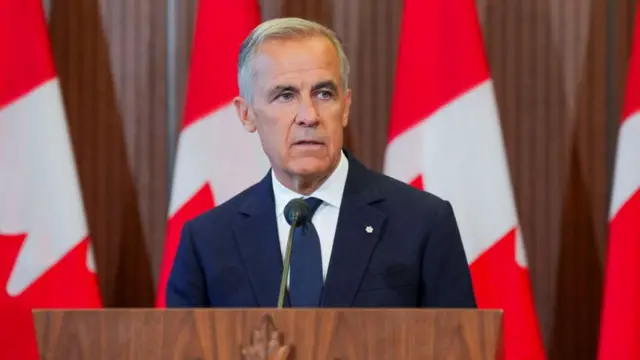
  2. Carney to speak from Quebec - a politically crucial provincepublished at 16:42 BST

    Nadine Yousif
    Reporting from Toronto

    Mark Carney stands at a lecturn in a blue suit and tie with a white shirtImage source, Reuters

    The location of Prime Minister Mark Carney’s latest press conference, which is due to take place shortly, is no accident.

    His second public remarks since trade talks with the US collapsed are set against the backdrop of a Quebec shipyard, where he will be speaking alongside Quebec premier Christine Fréchette about funding for trade and defence.

    This is meant to convey a message of unity and defiance in the face of US tariffs, while also reminding Canadians and others watching that the country is open for business and is looking for trade partners elsewhere.

    Carney is also speaking directly to Quebecers, a crucial, French-speaking voting bloc whose support can often sway Canadian elections.

    Quebec's unique language laws were caught in the crosshairs of the recent trade talks, with the prime minister saying that one of the sticking points was a US request for Canada to drop its requirement of American businesses to write manuals and labels in French for Quebec consumers - something US negotiators have denied.

    Carney and Premier Fréchette have characterised that alleged request as a nonstarter that infringes on Canada’s culture and, as the prime minister put it on Saturday, “our sovereignty”.

    “It is a non-negotiable issue. It is simply off the table,” Carney said.

  3. Business owner doubtful Canada can win trade war with USpublished at 16:29 BST

    Ana Faguy
    US reporter

    Lind Furniture has been in business for almost 60 years in the Canadian province of Ontario - selling leather furniture to big store clients like Sears and Costco.

    Sales dropped when Trump took office in 2025. "As soon as there were tariffs in the air, people put purchases on hold," Michael Saifer, general manager of Lind Furniture, tells the BBC.

    Now, his concern centres around Canadians' chances for victory.

    "Everyone wants to sell to the Americans - they can buy from whoever they want," he says. "I don't know that we're going to win a war with them; we may get killed."

  4. How did we get here?published at 16:19 BST

    Jessica Murphy
    Canada digital editor

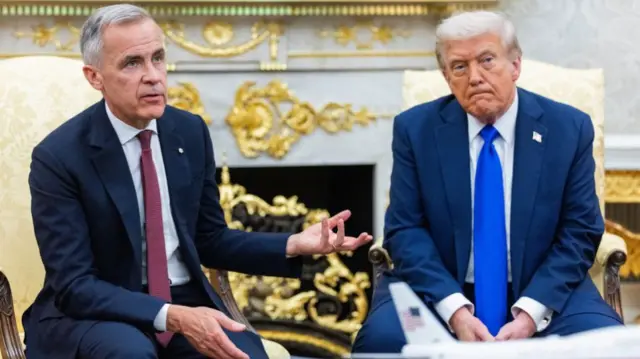
    Mark Carney and Donald Trump sit in the Oval OfficeImage source, EPA/Shutterstock

    Looking back, it can seem inevitable that the US and Canada ended up at the impasse they find themselves in.

    Before Trump was even back in the White House for his second term, tensions were rising between the neighbouring nations.

    In late 2024, Canada's then Prime Minister Justin Trudeau flew to Florida for a dinner meeting with Trump at his Mar-a-Lago resort to address the incoming president's threat to tariff Canadian imports at 25%.

    It was at that dinner that Trump reportedly first floated the idea of Canada becoming a 51st US state.

    Once in office, Trump quickly implement sweeping tariffs on Canada and Mexico, accusing both of allowing fentanyl and illegal immigration to flow across the borders, which many in Canada felt was unjustified.

    Canada's current Prime Minister Mark Carney was elected that March in large part in response to concerns that Canada's largest trading partner suddenly posed a threat. Despite a couple of feel-good Oval Office meetings between the two leaders, trade talks never got off the ground and were sometimes called off altogether.

    Trump has long accused Canada of taking advantage of the US, including its defence protections, and recently called Canadian negotiators “nasty”.

    On Saturday, Carney listed his own series of grievances, including a constantly shifting rational by the Trump administration for imposing its duties and seeking to undermine Canadian sovereignty.

    It was in that pressure cooker that trade negotiators were trying to finalise a complex deal that would be palatable to both sides - an endeavour that clearly failed.

  5. Canadian officials condemn US tariffspublished at 16:06 BST

    Nadine Yousif
    Senior Canada reporter

    A number of Canadian leaders have been reacting since trade talks collapsed on Friday.

    Canada's Prime Minister Mark Carney says the US has presented "unacceptable" terms that are too restrictive, including curbing Canada's ability to strike new trade deals with other countries.

    We are expecting to hear from him in about an hour. His latest comments will come after Donald Trump's latest threat of further tariffs.

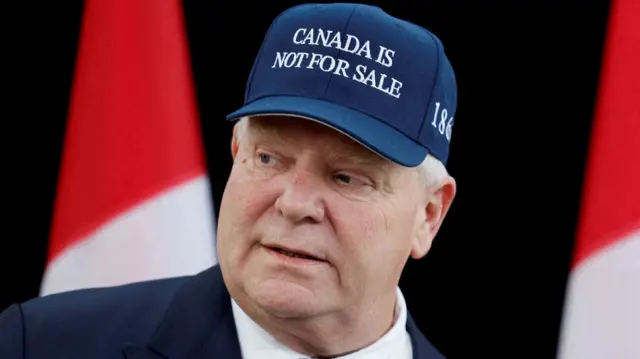
    Doug Ford, the leader of Canada's most populous province Ontario, backed Carney and says Trump "can't be trusted".

    British Columbia Premier David Eby says the US demand for restrictions on Canada's ability to have other trade deals "would reduce us to the economic equivalent of the 51st state".

    The Conservative opposition leader Pierre Poilievre also appeared to support Carney, calling the latest US levies "unjustified".

    Quebec's premier, Christine Fréchette, warned jobs would likely be lost as a result of the new US tariffs and vowed to introduce measures to support impacted sectors.

    Alberta Premier Danielle Smith, whose oil-rich province has worked to make inroads with the Trump administration, urged both sides to resume talks.

    A close up shot of Doug Ford, who wears a hat saying Canada is not for saleImage source, Reuters
    Image caption,

    Doug Ford is calling for Canada to remain united in the face of US tariffs

  6. Small businesses fear effects of trade warpublished at 15:55 BST

    Ana Faguy
    US reporter

    Cindy Baldassi is in the foreground wearing sunglasses and a dark hoody and navy blue dress. She is looking at the camera and behind her is a beautiful blue lake and towering mountain peaks with snow on top of them.Image source, Jason S Anderson
    Image caption,

    Most of Cindy Baldassi's US sales will be wiped out, she says

    Cindy Baldassi relies on American buyers to keep her Canadian stone-and-glass jewellery company going.

    Some 75% of sales of pieces includingamethyst, sea glass and agates from her business, CindyLouWho2 - which is based in Calgary, Alberta - come from Americans.

    But after trade talks between the US and Canada collapsed over the weekend and leaders of both countries pledged to slap 50% tariffs on each other's products, business owners on both sides of the border are bracing for the fallout.

    With a majority of the items she sells falling under US President Donald Trump's newly imposed tariffs, Baldassi says she will need to add 50% to the price of most of her products to stay afloat.

    "It's quite likely that it will wipe out most of my US sales," Baldassi tells the BBC. "I expect that at least half of my business will be gone."

  7. Why does Trump keep announcing tariffs?published at 15:39 BST

    Michael Race
    Business and economics reporter

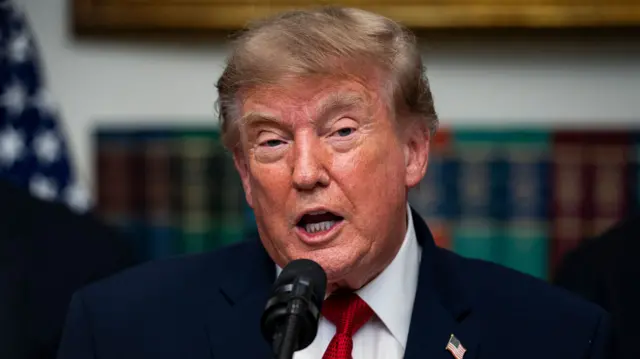
    Donald Trump speaks at a lecturnImage source, EPA/Shutterstock

    This isn't the first and it likely won't be the last time President Trump announces a raft of tariffs on goods being imported to the US from overseas, or in this case, neighbouring Canada.

    Since he has re-entered the White House, Trump has upended the global trade order using tariffs, which are a tax paid for by businesses importing goods to the US from abroad.

    Trump believes that by introducing tariffs he can boost American jobs and manufacturing, by either companies making goods in the US as opposed to importing them, or foreign firms moving production to the US.

    There have been signs that tariffs have worked in Trump's favour so far. Apple, for example, opened a manufacturing site in Houston earlier this month after being hit hard by tariffs and pressure over making most of its products in China.

    However, many economists say that consumer prices can rise if companies that rely on imports, such as the car making industry, pass on the higher costs they face through to customers. American businesses that rely on exporting to other countries can also be hit hard by counter tariffs being imposed.

  8. US trade official blames Canada for breakdown of talkspublished at 15:26 BST

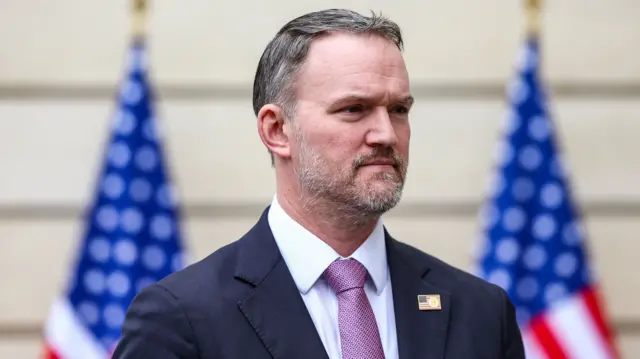
    A man wears a suit with a pink tie and a US flag badge on his right lapel. He is looking off to the right side of the camera.Image source, Reuters

    US Trade Representative Jamieson Greer says Canada is to blame for the breakdown of trade talks between both countries last week.

    “We progressed to a point Tuesday night where we had enough agreement among the parties to announce that we had we had found the way to a deal,” Greer tells CNBC’s Squawk Box.

    “Then we set about to finalise it, and then in the last hours, I think there were things that the Canadians just — you know, they wanted more,” he adds.

    Over the weekend, Canada's PM Mark Carney blamed the US for the failed negotiations, saying they made "last-minute changes" that were "unfair" and "uneconomic".

  9. A recap of recent US-Canada trade negotiationspublished at 15:16 BST

    Nadine Yousif
    North America reporter

    US and Canadian trade negotiators had been engaged in intense talks since July, after Donald Trump threatened to impose a 50% levy on nearly $20bn (C$28bn; £14bn) of Canadian imports by 19 August.

    Trump had temporarily paused those tariffs last week, saying the two sides were close to signing a trade deal that was "very good" for both countries.

    Negotiators were reportedly discussing a deal that would reduce US tariffs on Canadian steel and aluminium from 50% to 25%, and on Canadian autos from 25% to 15%.

    In exchange, Carney had asked Canadian provinces to restore US alcohol to store shelves.

    But minutes before the Friday deadline for a deal, Canadian Prime Minister Mark Carney ended the negotiations, saying the US's proposed terms "were unfair, uneconomic, and called into question the reliability of any deal".

    Trump then imposed the 50% tariff on some Canadian exports, and Carney said he would match that "dollar for dollar" on US exports.

    The breakdown of the talks puts the US-Canada relationship in uncharted territory, and will be a major test for Carney's premiership.

  10. Trump threatens further tariffs on Canadian vehiclespublished at 15:03 BST
    Breaking

    President Trump says he will be increasing tariffs on Canadian cars, trucks and automotive parts to 50% starting in January, up from their current 25%.

    He accuses Canada of "ripping off" the US for years, imposing "ridiculously high" tariffs on American farmers, and being one of the "worst Nations in the World to deal with".

    "Build in the US and there are ZERO TARIFFS," Trump writes on Truth Social. "Canada will be treated like a State no longer!"

  11. US and Canada point fingers after trade talks collapsepublished at 14:59 BST

    Talks between the US and Canada to reach a trade deal fell apart late on Friday, sparking a trade war between the neighbouring countries.

    As a result, US President Donald Trump imposed a 50% tariff on a range of Canadian goods, effective immediately, while Canada’s Prime Minister Mark Carney said he would match Trump’s tariffs “dollar for dollar" starting 8 September.

    Both sides have accused the other of asking for too much with Trump saying Canada wants "the benefits of being a state, without being one" and Carney saying the US “asked too much and they offered too little”.

    We’ll be hearing more from representatives in both countries throughout today, and we’ll keep you updated here on the latest news and ongoing fallout.