Summary

  1. Demonstrations take place in Tehranpublished at 00:19 BST

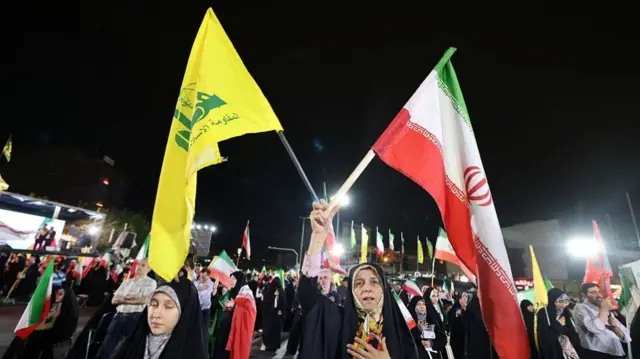
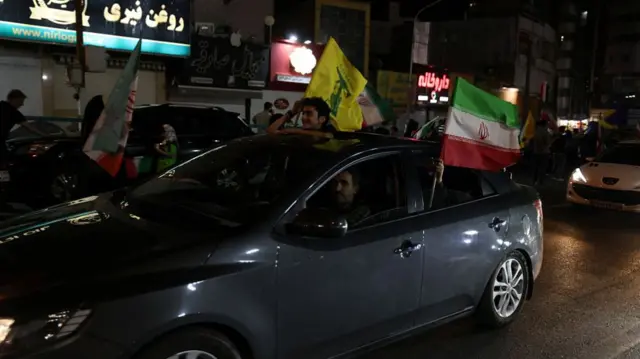
    We're getting some pictures now of pro-government demonstrations taking place in Tehran, following the Israeli strikes on Beirut's southern suburbs.

    Many of the protesters in the photos are carrying the flags of Iran and Hezbollah, the Iran-backed political and military group in Lebanon.
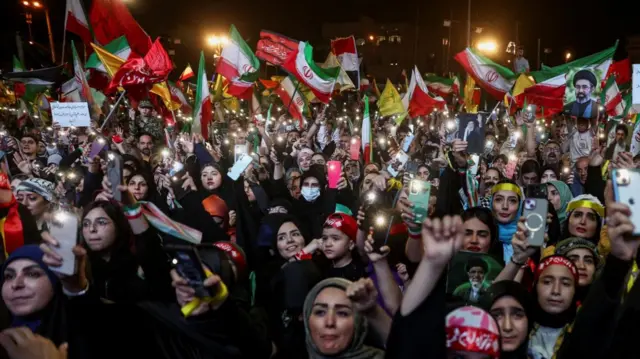
    People chant during an anti-U.S. and Israeli rally after Iran's missile attack on Israel.Image source, Reuters
    A woman holds the flag of Iran and Hezbollah at a protest.Image source, AFP
    Pro-government Iranian demonstrators wave flags of Iran and Lebanon's Hezbollah movement.Image source, AFP
  2. US embassy in Jerusalem closed on Mondaypublished at 23:57 BST

    The US embassy in Jerusalem will be closed on Monday due to the "current security situation in Israel".

    In a statement, the embassy said that it has directed all US government employees to "shelter in place, and be prepared to move to a protected shelter".

  3. Trump says Netanyahu will have no choice but to accept dealpublished at 23:39 BST

    Trump has just told the Financial Times that Israeli Prime Minister Benjamin Netanyahu will have no choice but to agree to whatever deal the US strikes with Iran.

    "He won’t have any choice," Trump told the Financial Times , externalover the phone. "I call the shots. I call all the shots. He [Netanyahu] doesn’t call the shots."

    Trump told Axios earlier that he was going to ask Netanyahu not to retaliate against Iran for the latest attack to make sure the three sides could salvage a deal.

    Trump told the Financial Times that the latest strikes have not had "any impact on the deal".

    "We’ll see how it ends up," Trump said. "It’s one of those things that’s been going for 3,000 years, or 47 years, depending on how you count."

  4. Analysis

    Fears of escalation drive questions over the limits of US influencepublished at 23:25 BST

    John Sudworth
    Reporting from Beirut

    As we've been reporting, the IDF earlier said it was "preparing for potential fire" after it struck what it called Hezbollah targets in the Lebanese capital Beirut.

    Beirut has become a geopolitical battleground of its own within the wider Israel-Lebanon conflict.

    In many ways, what is happening in the capital pales in comparison to the fighting in southern Lebanon, where Israel's ground offensive and aerial bombardment have continued daily and intensified in recent weeks.

    But Beirut has been treated differently for political reasons. While there have been one or two targeted strikes in recent weeks, there has also been a sense that US pressure was helping to restrain Israeli action in the capital.

    That appeared to end today, not just with the strike on Beirut's southern suburbs with the scenes of heavy damage to an apartment building, people rushing the wounded to hospital, and reports of fatalities, but with the warning from the IDF that more was to come.

    "To be continued", one of its spokesmen wrote on X.

    The strike came after a warning from the Israeli military that further action could follow.

    Israeli officials said two Hezbollah projectiles crossed the border earlier in the day, and Hezbollah later claimed responsibility.

    From Israel's perspective, this appeared to mark a final loss of patience.

    Despite US pressure, Israel has consistently maintained that it reserves the right to strike Beirut if it deems it necessary for its security.

    But today's attack raises fears of the very escalation many had been warning about.

    And with reports out of Washington suggesting Trump did not authorise the strike, it also raises questions about the limits of US influence over its Israeli partner and the narrowing range of options available to the world's biggest superpower as it tries to get itself out of a war it began three months ago with such confidence.

  5. Who has said what?published at 23:12 BST

    So far, we've heard from Trump, Iran's foreign ministry as well as the Israeli military about today's strikes.

    • Israel's National Security Minister Itamar Ben-Gvir said in a post on X that Tehran "must burn" after the strikes, while a spokesperson for the Israel Defense Forces said Iran made a "grave mistake"
    • Iran's foreign ministry said any attack from Israel against Lebanon or Iran would be met with a "crushing and comprehensive response", blaming the US for strikes on Iranian ships last week
    • US President Donald Trump, meanwhile, told Axios that he would call Israeli Prime Minister Benjamin Netanyahu and ask him not to retaliate because he was worried the attacks would "blow up" a deal between the three sides
  6. 'Both sides must show restraint and de-escalate immediately' - UK foreign secretarypublished at 22:56 BST

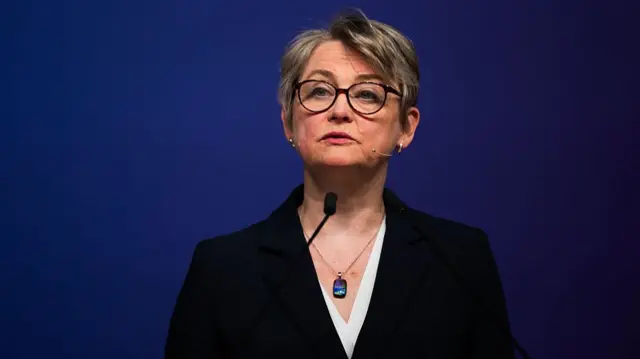
    Yvette Cooper, UK foreign secretary, during the Global Partnerships Conference in London, UK, on Wednesday, May 20.Image source, Getty Images

    UK Foreign Secretary Yvette Cooper says the "resumption of conflict between Iran and Israel is in no one’s interest".

    "Both sides must show restraint and de-escalate immediately," she adds in a post on X.

    Cooper also says "negotiations must continue towards the lasting settlement that we all need, for peace and stability in the region, and for the full restoration of global trade".

  7. Iran's foreign ministry warns of 'crushing' response if Israel retaliatespublished at 22:37 BST

    Iran's foreign ministry says its armed forces hit several "military targets" north of the "occupied Palestinian terroritories".

    In a statement, the ministry says the strikes come after a "repeated violation" of the April ceasefire between the US, Iran and Israel, including US attacks on Iranian ships and targets in the south of the country.

    A ceasefire has been in force since 17 April - in name only - and has been violated repeatedly by both Israel and Iran.

    The US said last week that it hit Iranian military sites over the weekend, while Tehran said it responded by targeting a US base.

    Iran's foreign ministry adds the country is defending its security and national interests, warning that any attack from Israel against Lebanon or the Islamic Republic of Iran would be met with "a crushing and comprehensive response".

  8. Israel will 'strike the enemy as soon as the order is given' - military chiefpublished at 22:30 BST

    In a post on Telegram, the Israel Defense Forces (IDF) says its chief of the general staff is conducting a situational assessment.

    Israel's military says Lt Gen Eyal Zamir vows the country "will strike the enemy with determination as soon as the order is given".

  9. Trump tells Axios: 'I don't want final deal with Iran to blow up because of what is happening'published at 22:27 BST

    US President Donald Trump, speaking to Axios, says he will tell Israeli Prime Minister Benjamin Netanyahu "not to retaliate" against Iranian missiles.

    "I am going to call Bibi right now and tell him not to retaliate," Trump told the outlet, external. "Each of them had their fun. Israel had its strike, and Iran had its strike. We don't need another one."

    "We are very close to a final deal with Iran. It is going to be a good deal. I don’t want it to blow up because of what is happening now," Axios cites the president as saying.

    Trump says that if Israel strikes back, the conflict will just continue for "47 years — or the last 3,000 years", according to Axios.

    Separately, Axios reporter Barak Ravid writes on X that Trump has called Netanyahu, citing a US official.

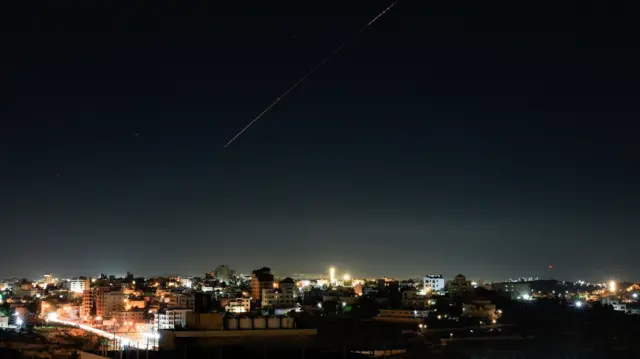
  10. Missiles seen over northern Israelpublished at 22:01 BST

  11. Israel 'prepared for possibility of additional fire' - IDF spokespersonpublished at 21:59 BST

    We can bring you more now from Israel Defense Forces (IDF) spokesperson Brig Gen Effie Defrin, who said said Iran has made a "grave mistake".

    In a briefing, delivered in Hebrew, he says the Israeli military "will not allow continued fire" from Iran towards Israel's citizens.

    He says Israel is "prepared for the possibility of additional fire".

    Air defense systems are "deployed across the entire country" and the IDF's chief of general staff is holding a "situational assessment" following the attacks, Defrin adds.

    "The IDF will continue to operate throughout Lebanon and will deepen the blow to the Hezbollah terrorist organisation."

  12. What's the latest?published at 21:50 BST

    • Iran has launched a wave of missiles at Israel for the first time since the April ceasefire between Israel, Iran and the US came into effect
    • Iran's Islamic Revolutionary Guard Corps (IRGC) says the attack marked the beginning of "a full week of continuous strikes"
    • Israel says it intercepted the missiles in northern Israel, there are no reports of injuries
    • Earlier on Sunday, Israel said it struck Hezbollah targets in southern Beirut, prompting threats of an Iranian response
    • A spokesperson for the Israeli military says Iran has made a "grave mistake"
    • Fox News reports Trump has urged Iran: "That's enough. Get back to the table"
    • Iran has made good on its threat, but much will now depend on Israel’s response, writes the BBC's Seb Usher in Jerusalem
  13. Iran has made a 'grave mistake' - Israeli military spokespersonpublished at 21:40 BST
    Breaking

    A spokesperson for the Israel Defense Forces (IDF), Effie Defrin, says in a brief statement that the Iranian regime has made a "grave mistake".

  14. Analysis

    Iran has made good on its threat, but a lot now depends on Israel's responsepublished at 21:27 BST

    Sebastian Usher
    Global affairs correspondent, reporting from Jerusalem

    An Israeli air-defence missile flies in the sky over Israel.Image source, Reuters
    Image caption,

    An Israeli defence missile seen in the sky

    The tension between Iran, Israel and the US over Israel's offensive against Hezbollah in Lebanon has been building in intensity in recent days.

    When Israeli Prime Minister Benjamin Netanyahu gave his military the green light to strike the southern suburbs of Beirut again last week, Tehran threatened that it would carry out new strikes on northern Israel if it did so.

    The possibility of a major new escalation in Lebanon prompted US President Donald Trump to tell Netanyahu in the strongest possible language to hold back, for fear that any such action would derail the already fraying ceasefire between the US and Iran.

    Netanyahu agreed, but on condition that Hezbollah would fire no more rockets into northern Israel.

    A sketchy new ceasefire was subsequently agreed between the Israeli and Lebanese governments at talks mediated by the US. But once again, that ceasefire didn't seem to have much effect on the ground.

    And it now appears to have collapsed, after Israel carried out strikes on the southern suburbs of the Lebanese capital Beirut in response to continued rocket fire by Hezbollah into Israel.

    Just a few hours later, Iran has made good on its threat, firing a barrage of missiles and drones into Israel. Iran's Revolutionary Guards has promised to continue for seven days, although there are other signs that this new salvo may have been intended as a warning.

    Much will now depend on Israel’s response.

    There could be a new round of tit for tat attacks between the two countries that could reignite the Iran war.

    How President Trump reacts will also be key. For now, he still seems set on trying to defuse the situation.

    One thing this latest development has made even clearer is how central a role the conflict in Lebanon now plays in determining what happens in the wider conflict.

  15. 'Promise fulfilled', says IRGC commanderpublished at 21:15 BST

    Ghoncheh Habibiazad
    Senior reporter, BBC Persian

    Iranian media reports Iran's Islamic Revolutionary Guard Corps (IRGC) Aerospace Commander Majid Mousavi has said "promise fulfilled", following Iranian strikes on Israel.

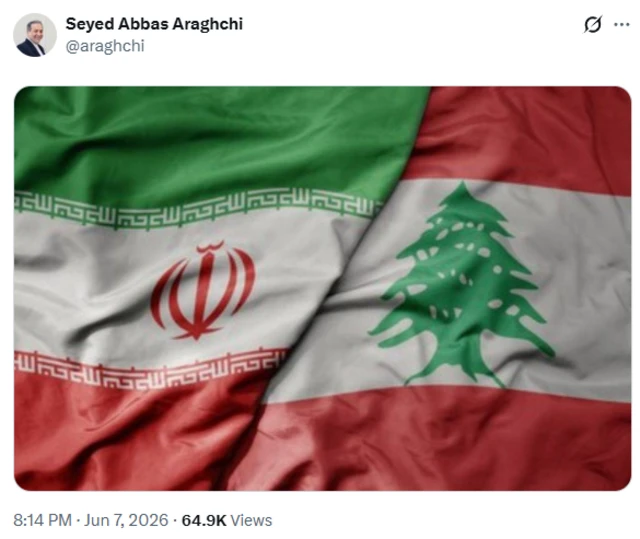
    Iran's Foreign Minister Abbas Araghchi posted a photo of the flags of the Islamic Republic and Lebanon on X shortly after the start of tonight's attacks.

    Senior Member of Iran's Parliament, Ebrahim Rezaei, had vowed a "painful and decisive response" to Israel's attacks on Beirut, Lebanon, earlier today.

    "Watch the sky of the occupied territories tonight," Rezaei posted on X before the Iranian attacks took place.

    A screenshot of a tweet from Abbas Araghchi showing a photo of the flags of the Islamic Republic and Lebanon.Image source, Abbas Araghchi/X
  16. 'Tonight Tehran must burn!' - Israel's national security ministerpublished at 21:08 BST

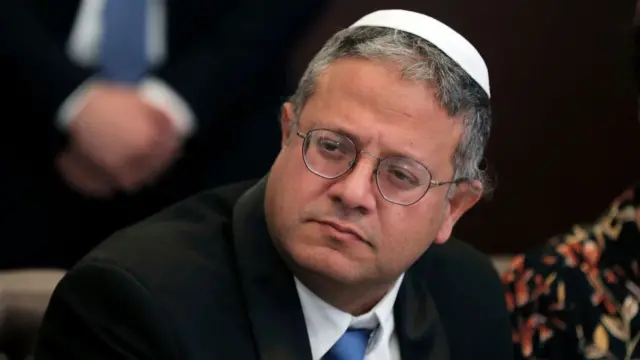
    Ben Gvir at a weekly cabinet meeting.Image source, AFP via Getty Images

    Tehran "must burn", says Israel's far-right National Security Minister Itamar Ben-Gvir, following Iran's newest strikes targeting northern Israel.

    "Tonight Tehran must burn!" he says in a short post written in Hebrew on X.

  17. Attacks 'served as a warning' - Iran's Revolutionary Guardspublished at 21:00 BST
    Breaking

    Ghoncheh Habibiazad
    Senior reporter, BBC Persian

    Iran’s Islamic Revolutionary Guard Corps (IRGC) says in a statement that tonight’s attacks on Israel “served as a warning”.

    It adds that should Israel's "acts of aggression" - referring to its attack on Lebanon earlier today - be repeated, further responses would be "broader", encompassing "all" US and Israeli targets in the region.

    The IRGC has claimed that it targeted the Ramat David Airbase, located to the south-east of Haifa, using ballistic missiles.

    It also accused the US and Israel of "failing to honour their commitments" under the ceasefire between Iran, the US and Israel, which came into effect in early April.

  18. 'That's enough. Get back to the table' - Trump to Iranpublished at 20:58 BST
    Breaking

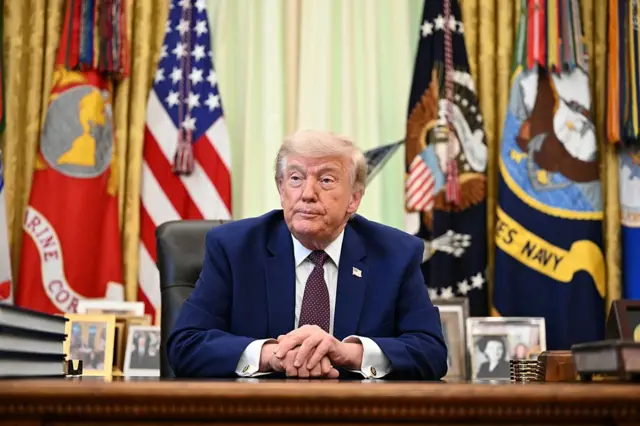
    Trump speaks to the press in the Oval Office,Image source, Getty Images

    US President Donald Trump has urged Iran to return to the negotiating table, after it launched missiles at northern Israel.

    A Fox News correspondent quotes Trump as saying: "You've shot your missiles. That's enough. Get back to the table and make a deal."

  19. Trump has been briefed on Iran strikes, White House confirmspublished at 20:53 BST
    Breaking

    US President Donald Trump has been briefed on the strikes Iran launched at Israel, the White House confirms to the BBC.

  20. IDF says it has intercepted all missiles launched from Iranpublished at 20:41 BST
    Breaking

    The Israel Air Force says it has intercepted "all the missiles launched from Iran so far".

    It adds that "additional launches" have been identified and Israel's military is "continuously detecting and intercepting threats".