Summary

  1. Analysis

    Trump's comments about Israel are his most outspoken yetpublished at 15:22 BST

    Tom Bateman
    US State Department correspondent
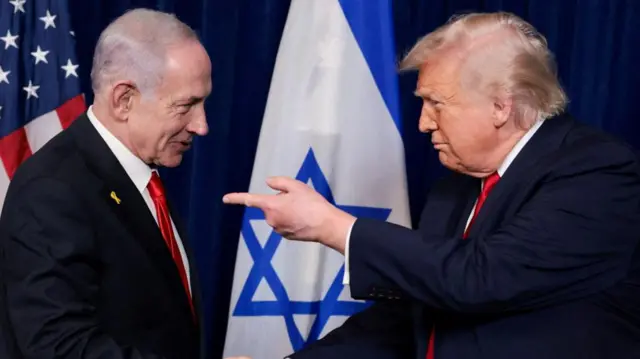
    Netanyahu and Trump in front of US and Israeli flags. They are looking at each other and Trump is pointing his finger at the Israeli leaderImage source, Reuters
    Image caption,

    Trump and Netanyahu following a news conference last year

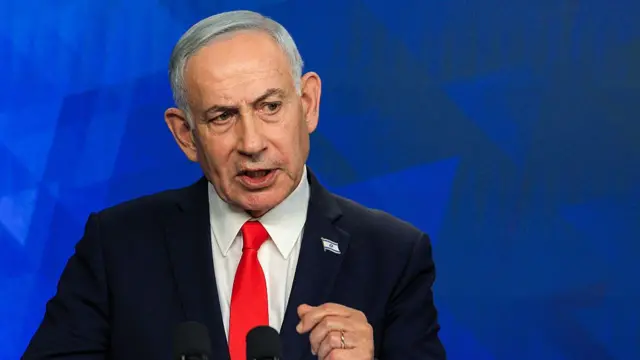
    President Trump’s comments about Israel are among his most outspoken yet, showing the extent of his current angry spat with Prime Minister Benjamin Netanyahu.

    On several occasions as Trump has moved closer to diplomacy with Iran, the Israeli leader has escalated in Lebanon - Israel says this is in response to drone or missile fire by Hezbollah.

    But Trump described the Israeli strike on Beirut this weekend - just as he was on the verge of a deal with Tehran - as "vicious".

    He diminished the importance of the Israel-Hezbollah conflict, called on Netanyahu to be more responsible and appeared to accuse him of using disproportionate force.

    "You don't have to knock down an apartment house every time you're looking for somebody," Trump said. "If Israel can't do the job without killing everyone else... Syria will do the job," he said, referring to the Syrian president Ahmed al-Sharaa.

    Trump suggested al-Sharaa had, unlike Netanyahu, dealt with Hezbollah more quickly in Syria.

    Al-Sharaa is a former Sunni jihadist militant now leading Syria with Western backing, who Trump appeared to be suggesting to lead a fight against Hezbollah in Lebanon. This was another remarkable comment, given Lebanon’s sectarian fragility and history of civil conflict aggravated by past Syrian intervention.

    As for Netanyahu, he is again likely to brush off Trump’s latest reprimand - he will point to him also saying the pair had an "unbelievable relationship".

    But the president’s readiness to publicly excoriate his ally is becoming more pointed as he feels Netanyahu has threatened his ability to extricate himself from the war on Iran.

    It also highlights the deepening backlash within a faction of Trump’s MAGA movement against traditional Republican support for Israel.
  2. US and Iran to sign deal at Swiss resortpublished at 15:06 BST

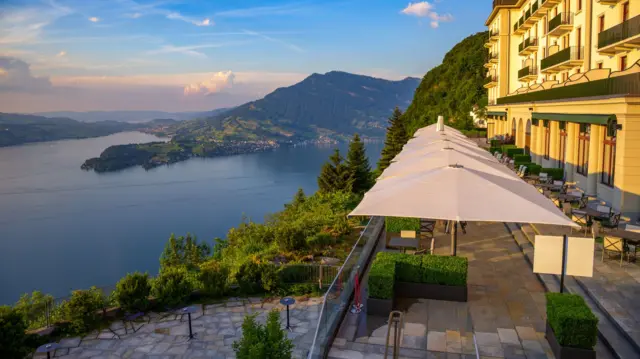
    Iran and the US will be officially signing the deal in the Swiss resort of Burgenstock, Switzerland's Foreign Ministry tells the Schweiz Heute newspaper.

    The delegations are expected to meet on Friday. According to Swiss media, negotiators Pakistan and Qatar proposed the location.

    It’s the second time in two years that the resort has been picked to host diplomatic talks, after world leaders met there for the Summit on Peace in Ukraine in June 2024.

    Wide shot of Lake Lucerne in Switzerland taken from the resort of BurgenstockImage source, Getty Images
  3. Hezbollah says it has assurances Iran will demand Israeli troop withdrawalpublished at 14:55 BST

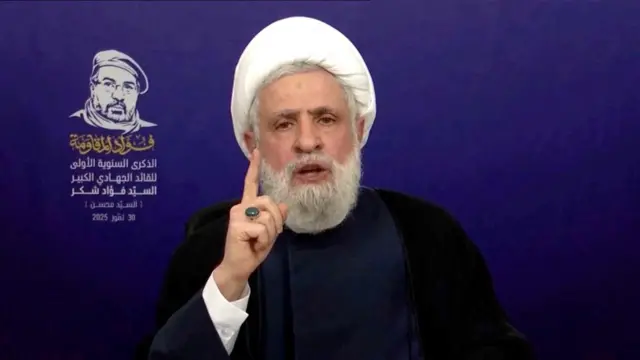
    Lebanon’s Hezbollah chief Naim Qassem pictured previously during a televised speech wearing black robes and white headdress while pointing at cameraImage source, Reuters
    Image caption,

    Lebanon’s Hezbollah chief Naim Qassem pictured during a televised speech broadcast last year

    Hezbollah says it has received assurances from Iran that it will demand a withdrawal of Israeli troops from Lebanon in its next phase of talks with the US - according to the Reuters news agency, citing the group’s media relations office.

    Meanwhile, Naim Qassem, Hezbollah's secretary general, has expressed his "profound gratitude" to Iran's Parliamentary Speaker Mohammad Bagher Ghalibaf on the matter.

    In a post shared on the Telegram account of the Hezbollah-affiliated Al-Manar TV station, Qassem thanks him for his "strong and supportive" stance towards Lebanon - including "compelling" Israel to cease military operations as a "fundamental clause" of the deal between Iran and the US.

  4. Analysis

    What did Trump do differently to Obama on Iran?published at 14:40 BST

    Gary O'Donoghue
    Chief North America correspondent, reporting from Washington DC

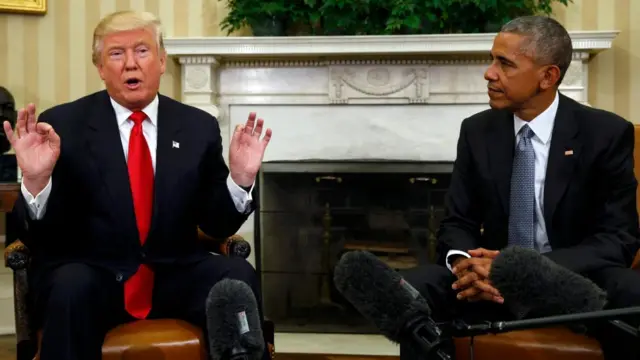
    Donald Trump and Barack Obama in the Oval Office in 2016, three boom microphones for television broadcasts are held out in front of them.Image source, Reuters
    Image caption,

    Trump and Obama in the Oval Office in 2016

    If there’s one thing Donald Trump has been clear about regarding the US deal with Iran, it’s promising that it will be better than the one Barack Obama signed in 2015.

    “We didn't pay for it like Obama did. He paid billions of dollars,” President Trump told reporters at the G7 summit in France this morning.

    Both deals, however, involve sanctions relief and unfreezing Iranian money - though the current White House says that will all depend on Iran meeting its obligations under the agreement.

    We were also briefed that one of the proposals still being discussed is a $300bn (£224bn) fund to help rebuild Iran. Who would pay for that was uncertain, but the president has now dismissed the idea as "fake news".

    There is undeniably some overlap. Both Trump’s deal and Obama’s Joint Comprehensive Plan of Action (JCPOA) involved inspections to ensure Iran doesn’t develop a nuclear weapon.

    What neither deal has directly addressed is the political plight of the Iranian people - they are no freer than before.

    The obvious difference, of course, is that Barack Obama never bombed Iran.

    Donald Trump did and said US strikes have destroyed much of the country’s nuclear facilities and buried its stockpiles of uranium.

    But war has come at a cost. Iran launched attacks on many of its neighbours in the region including Israel, further destabilising an already volatile Middle East.

    It also closed the Strait of Hormuz, pushing up energy and fertiliser prices worldwide - that was new and hugely damaging.

    That’s why Trump’s deal - at least in the first phase being announced this week - focuses less on the detail of limiting Iran’s nuclear programme, and more on containing a conflict.

  5. Price of Brent crude oil drops below $80 for first time since Marchpublished at 14:15 BST

    Nick Edser
    Business reporter

    We reported earlier that the oil price has fallen further on hopes that the US-Iran deal will lead to the Strait of Hormuz reopening.

    Now the price of Brent crude, the global benchmark, has dropped below $80 (£60) a barrel for the first time since early March, falling to $79.90.

    The price of Brent is now well below the peak it hit during the war, which was about $120 a barrel.

    Before the conflict began it was trading at around $70.

  6. No rush on confiscating enriched uranium - Trumppublished at 14:05 BST

    President Trump speaking at the G7 summitImage source, Reuters

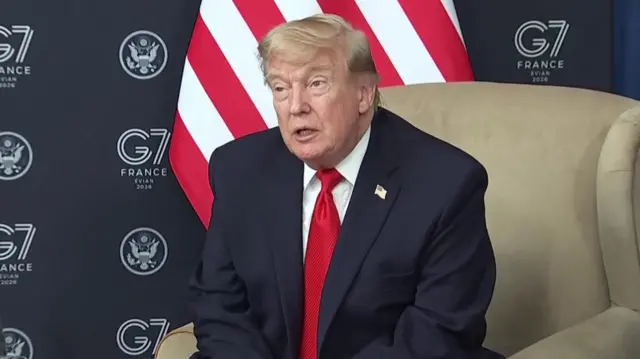
    Trump adds that the agreement is about one thing - Iran never having a nuclear weapon - "the rest of it's irrelevant frankly," he says.

    He describes the agreement as a "wall against a nuclear weapon," comparing it with former US President Barack Obama's JCPOA, which Trump says "could have destroyed the Middle East".

    Asked about retrieving the enriched uranium in Iran, Trump says there's no rush to when they confiscate it.

    Trump adds the deal will be sent to the United States Congress for approval.

  7. 'Iran wants to get it done,' Trump tells reporters at G7 summitpublished at 13:54 BST

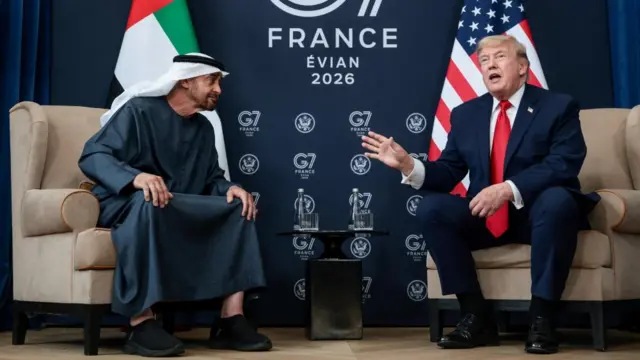
    Trump and President Sheikh Mohammed bin ZayedImage source, Reuters

    US President Donald Trump has been speaking alongside UAE President Sheikh Mohammed bin Zayed at the G7 Summit in France.

    Asked what he expects from the second stage of negotiations with Iran, Trump says he thinks "it's going to happen fairly on time".

    "Iran wants to get it done, they have to get back to business," he tells reporters.

    Asked why there's been no release of the text so far, he replies saying he wants "to get a formal setting first".

    Elaborating, he continues: "Iran will never have a nuclear weapon, that's what it says... That's about 99.9 per cent of what I wanted."

    He says the Strait of Hormuz is going to be opened "toll-free", including beyond the 60-day time period.

    Trump says he will hold a news conference to read out the agreement document "word by word".

    "Because it's a very important document," he says.

  8. BBC Verify

    Seven vessels have transited out of Strait of Hormuz since deal announcedpublished at 13:45 BST

    By Shruti Menon

    Vessel traffic leaving the Gulf and passing through the Strait of Hormuz remains low since the announcement of a deal to end the conflict on Sunday, ship-tracking data on MarineTraffic shows.

    BBC Verify has identified only seven vessels, three tankers and four cargo ships, transiting the waterway and exiting into the Gulf of Oman over that period.

    According to maritime intelligence firm Windward, one liquefied petroleum gas tanker transited without broadcasting its location, the other six ships exited with their trackers active.

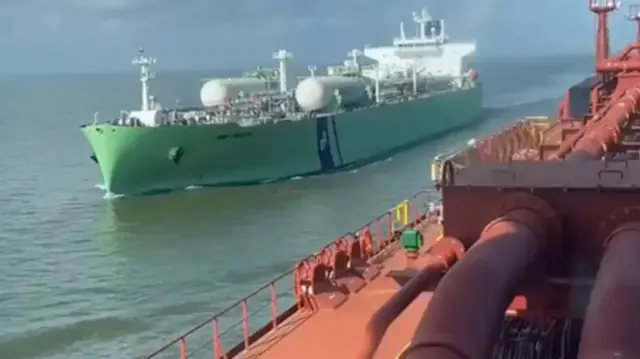
    LNG (liquefied natural gas) tanker Disha was reportedly the first to transit through the strait with its location transponders on. The ship has now sailed into the Arabian sea and is currently heading to Dahej port in India’s Gujarat state, according to the Indian authorities.

    BBC Verify has seen a video showing the tanker’s transit, which was first shared online yesterday and appears to have been filmed from another nearby ship.

    A screengrab from a video showing large green tanker is seen sailing past another shipImage source, X

    Ship movement through the strait has remained well below normal levels since early March. An average of five to six vessels have transited each day over the past week, compared with more than 100 daily crossings before the conflict.

  9. Qatar 'cautiously optimistic' over agreement between US and Iranpublished at 13:30 BST

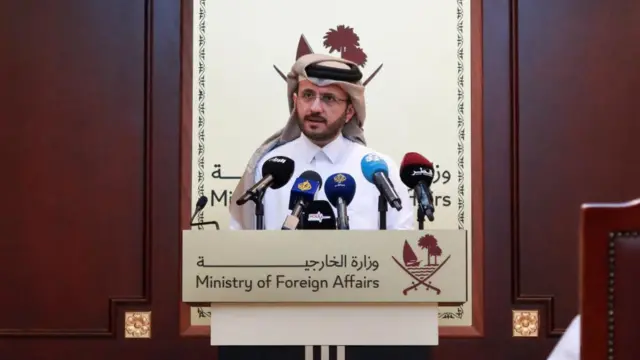
    Majed Al Ansari speaking into several microphones from behind a lecternImage source, Reuters
    Image caption,

    Majed Al Ansari speaking at a press briefing in February

    Qatar - one of the key negotiators in the deal to end the war between the US and Iran - says it believes the agreement could deliver security to the Middle East.

    Foreign ministry spokesman Majed Al Ansari tells reporters at his weekly press briefing that Doha is "cautiously optimistic" about the framework deal and that “the signing of the memorandum of understanding will lead to the next phase of regional security through the talks that will take place on the nuclear programme and on other issues."

    Confirming his country took part in the talks “as part of the mediation team led by Pakistan,” Al Ansari says the agreement will re-open the Strait of Hormuz which will “allow countries like Qatar to again be supplying energy to the world”.

    Details of the deal may be released before Friday, according to US Vice-President JD Vance.

  10. Oil prices fall further as investors show cautious optimismpublished at 13:03 BST

    Shanaz Musafer
    Business reporter

    The price of oil has fallen further today as investors continue to show cautious optimism around the US-Iran deal to bring about an end to the war.

    The price of Brent crude, the global benchmark, is currently down 2.6% on the day to about $81.05 (£60) a barrel.

    That follows a drop of 4.5% yesterday after the US and Iran said they had agreed a deal.

    The price of Brent is now well below the peak it hit during the war - about $120 - but still higher than the $70 it was trading at before the conflict began.

    Following broad stock market gains on Monday, leading share indexes in London, Paris and Frankfurt were all slightly higher by Tuesday lunchtime.

  11. Analysis

    Trump's Obama analogy is like comparing apples and orangespublished at 12:56 BST

    Paul Adams
    Diplomatic correspondent

    As the world waits for details of the deal he's reached with Iran, Donald Trump is at pains to say how much better it is than the work of his predecessor, Barack Obama.

    "This deal is a wall to a nuclear weapon," the president told reporters this morning. "His (Obama's) deal was a road to a nuclear weapon."

    But it’s a misleading analogy and the president is comparing apples and oranges.

    The deal due to be signed in Geneva on Friday is a short memorandum of understanding - US Vice President JD Vance says it’s a page-and-a-half long - which will outline a difficult set of negotiations that will follow over the course of 60 days.

    The 2015 Joint Comprehensive Plan of Action (JCPOA) was a 159-page detailed agreement, reached after 20 months of formal negotiations between Iran and the five permanent members of the UN Security Council, plus the European Union (the "P5+1").

    The JCPOA aimed to constrain Iran’s nuclear programme by placing limits on the number and type of centrifuges it could use and the level of uranium enrichment permitted.

    The deal wasn’t perfect and had plenty of critics, but it was working until Donald Trump pulled the US out in 2018.

    We will only know if Trump is capable of pulling off something better when negotiations end in two months' time.

    There's no shortage of scepticism.

    Writing in the Israeli daily newspaper Maariv on Monday, journalist Ben Caspit said Israelis were increasingly convinced that the JCPOA would look "perfect in comparison" to whatever emerges from this summer’s negotiations.

  12. Conflicting messages on details of deal from US and Iranpublished at 12:39 BST

    Nabiha Ahmed
    Live reporter

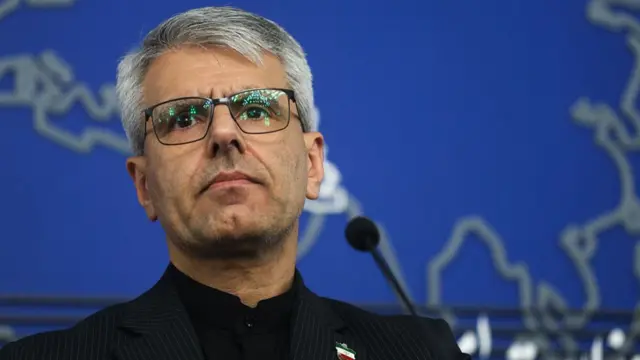
    Esmail Baghaei Hamaneh, spokesperson of Foreign Ministry seen during his weekly press conference.Image source, Getty Images
    Image caption,

    Baghaei discussed economic sanctions, the Strait of Hormuz, and Israeli military presence in Lebanon during a press conference yesterday

    The contents of a deal between the US and Iran to bring about an end to the war are yet to be released, but we've been hearing some details from officials on both sides.

    Since the deal was announced on Sunday, there have been conflicting messages from officials in Washington and Tehran on what it will look like:

    What has Iran said?

    Economic pledges: Iran'sforeign affairs spokesperson Esmail Baghaei said yesterday the US has committed to taking action to rebuild Iran and to lifting economic sanctions.

    The Strait of Hormuz: Baghaei also said that Oman and Iran would be taking "necessary measures" to ensure the "safe" passage of ships through the vital waterway.

    Lebanon: "Lebanon and the end of the war in Lebanon are an inseparable part of the agreement to end the war," Baghaei said yesterday, adding that the the US "must ensure" that Israel follows suit.

    What has the US said?

    Economic pledges:Trump has described the prospect of investing money in Iran as "ridiculous". It comes after reports that the US was prepared to allow an investment fund for Iran in exchange for Tehran’s agreement to a final settlement.

    The Strait of Hormuz: Trump said on Sunday the Strait of Hormuz would be opened when the initial agreement was signed, but has not provided details on who will control the strait.

    Lebanon: A senior US official said yesterday that Israel's withdrawal from Lebanon is not part of the deal.

  13. What we know about the US-Iran deal to end the warpublished at 12:21 BST

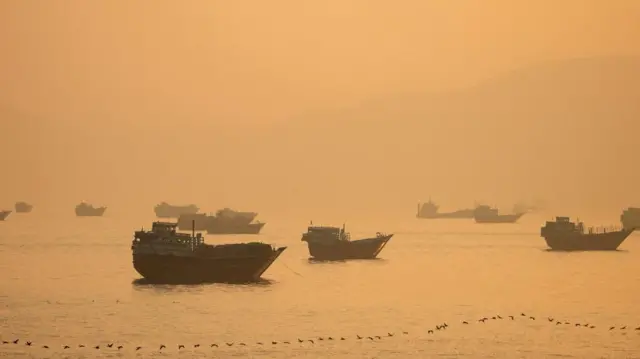
    Vessels at the Strait of Hormuz.Image source, Reuters
    Image caption,

    US officials say the Strait of Hormuz will re-open on Friday

    Donald Trump says the peace deal between the US and Iran is now progressing to the "second stage" - but did not provide more details.

    Here's the latest on the deal

    The deal was agreed on Sunday but details of its content have yet to be released.

    On Monday, the US president said "the deal is all signed" and the full text will be published "pretty soon".

    He also suggested it could be released once the two parties have formally signed the deal in Switzerland on Friday.

    Senior US officials have said that, as part of the deal, the Strait of Hormuz would re-open on Friday.

    US Vice-President JD Vance then said Trump may decide to release the contents of the deal earlier.

    The deal will extend a ceasefire for another 60 days, during which the sides will negotiate details of a final agreement.

    Iran's Foreign Minister Seyed Abbas Araghchi confirmed a new round of negotiations on reaching a final peace deal with the US would begin in Switzerland the same day.

    US officials also said technical talks on Iran's nuclear programme are expected to begin this week during negotiations.

  14. Analysis

    A political nightmare for Netanyahupublished at 12:05 BST

    Lucy Williamson
    Middle East correspondent

    Benjamin Netanyahu in a black suit with red tie.Image source, Getty Images

    The deal to end the US-Iran war has presented Israel's prime minister with a political nightmare, smashing the three cornerstones of Benjamin Netanyahu's political career.

    How can the man who styled himself as the political whisperer of Washington, with real influence over American politicians, be sidelined quite so comprehensively and insulted so publicly by his key US ally?

    How can the man who made taking on Iran the centre-piece of Israel's security policy end the war with Iran's regime arguably in a stronger position?

    And how can his old, tarnished political image as Israel's "Mr Security" survive the demand from Washington and Tehran that Israel cease attacking Hezbollah in Lebanon, months before an Israeli general election?

    Amid the cacophony of criticism and outrage from across the political spectrum, Israel's prime minister bristled at suggestions from journalists on Monday night that he had failed. But he also admitted there were cases in which he and Trump saw things differently.

    Often quick to claim victory, Israel's prime minister now faces a difficult task in deciding his next steps.

    Security has been the cornerstone of Netanyahu's offering to voters for decades. That is an increasingly difficult message to deliver.

    • You can read more analysis from Lucy Williamson on how the Iran deal weakens Netanyahu's positionhere
  15. Implications for Lebanon remain unclearpublished at 12:00 BST

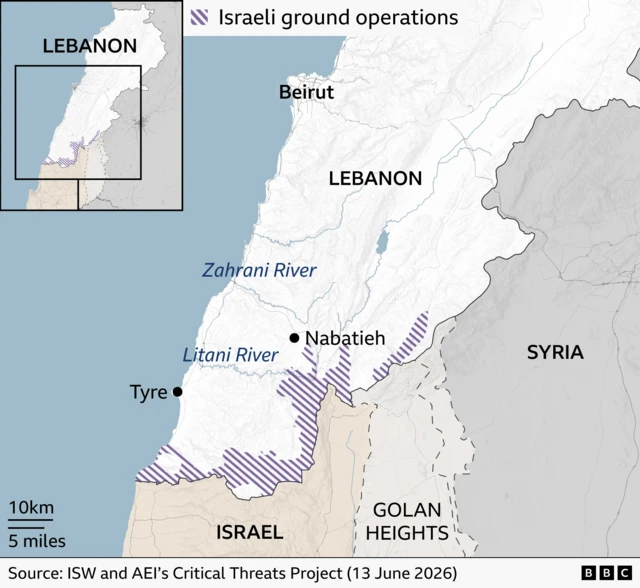
    The US and Iran have agreed a deal to end their conflict, but the implications for Lebanon remain unclear.

    Pakistan's Prime Minister Shehbaz Sharif, in his role as mediator, said on Sunday that Lebanon was included in the termination of military operations - however strikes have continued in recent days.

    US officials said that while Lebanon was covered by the ceasefire framework, the withdrawal of Israeli forces from Lebanese territory was not a condition of the deal. Israel would retain the right to self defence, they added.

    On Monday, Israeli Defence Minister Israel Katz opposed a withdrawal from Lebanese territory currently occupied by Israel. He pledged that if Iran attacked Israel due to events in Lebanon, it would strike "with full force".

    Israel’s Prime Minister Benjamin Netanyahu told reporters his forces would not withdraw from southern Lebanon and would maintain operational freedom to target any threats to Israel’s security.

    Lebanese President Joseph Aoun has welcomed the peace announcement, saying he looks forward to it translating into "practical steps that will put a definitive end to the cycle of violence".

    But overnight, Israel’s military confirmed it had carried out strikes on what it called terrorists who approached its soldiers in southern Lebanon.

    Israel says four people were killed in the strikes. Hezbollah said it had fired missiles and drones at Israeli forces in return.

    A map of southern Lebanon showing towns, rivers and borders near Israel and the Golan Heights. A shaded areas shows where ISW analysis puts Israeli ground operations along the south of Lebanon. Major towns are marked with black dots, including Beirut on the coast in the north and Tyre on the coast in the south and Nabatieh inland. The Zahrani and Litani Rivers are labelled in blue, flowing west to the Mediterranean Sea. The southern border with Israel is shown, and the Golan Heights lies to the southeast, and Syria to the east.
  16. Analysis

    Trump's harsh comments reflect his irritation with Israel's actionspublished at 11:47 BST

    Paul Adams
    Diplomatic correspondent

    President Trump has renewed his criticism of Israel’s actions in Lebanon during remarks to the press at the G7 summit at Evian-les-Bains.

    "You don’t have to knock down an apartment house every time you’re looking for somebody," the president told journalists during his meeting with the Emir of Qatar.

    "Because there are a lot of people in those apartment houses and they’re not all Hezbollah, I can tell you."

    It’s the latest in a string of harsh comments from the president, reflecting his irritation at the actions of Israel’s Prime Minister Benjamin Netanyahu - a man he earlier this week described as having "no judgement" - and his realisation that the continuing conflict in Lebanon still has the potential to derail the fragile peace process with Iran.

    But Donald Trump also called the fighting in Lebanon as "the minor war" and described the Iranian-backed group Hezbollah as "the little pinprick out there that constantly rears its head", suggesting that he thought the deal with Iran would survive even if Israel continues to attack Lebanon.

    The president knows that Lebanon matters a great deal more to Iran than it does to him.

    He may regard fighting there as minor, but his remarks this morning show he recognises that his Iranian interlocutors don't see it that way.

  17. Reopening Strait of Hormuz 'very, very important' for UK, Starmer sayspublished at 11:36 BST

    We can bring you more now from Keir Starmer, who says reopening the strait is "very, very important" for the UK because its impact on energy prices have affected "every house across the country".

    Energy costs have rocketed since Iran responded to US and Israeli attacks by effectively blocking the crucial Strait of Hormuz shipping route.

    Starmer also says he welcomes the deal between the US and Iran and congratulates Trump and the mediators.

    This Flourish post cannot be displayed in your browser. Please enable Javascript or try a different browser.

    Speaking to Times Radio about G7 countries, he adds: "It's going to make a material difference to our economies, to stability in the world and of course we're all united in saying that Iran must not get... a nuclear weapon."

  18. UK will play its 'full part' in getting Strait of Hormuz open - Starmerpublished at 11:30 BST

    UK Prime Minister Keir Starmer has also just spoken at the G7 Summit in France.

    Starmer says the UK will play its "full part" in getting the Strait of Hormuz open "as quickly as possible".

  19. What is the G7 and who's attending?published at 11:28 BST

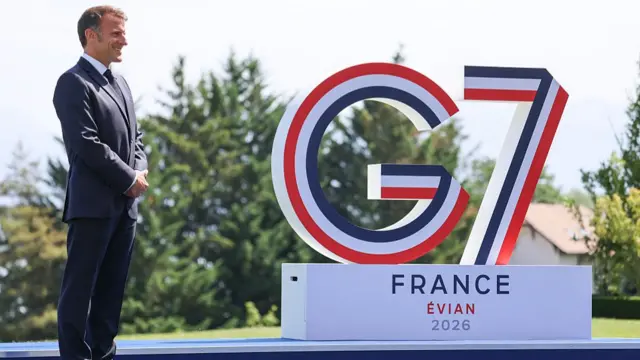
    France's President Emmanuel Macron waits for the official greeting ahead of a work lunch as part of the G7 summit.Image source, Getty Images

    The G7 (Group of Seven) is an organisation of the world's seven largest so-called "advanced" economies, which dominate global trade and the international financial system.

    They are: Canada, France, Germany, Italy, Japan, the UK and the United States.

    This year's summit is being held in the French town of Évian-les-Bains this week.

    Other leaders have also attended, with Ukrainian President Zelensky joining Tuesday's session.

    And there's also a strong presence from the Middle East - leaders from the UAE, Qatar and Egypt are also attending talks.

  20. Iran's nuclear programme - explainedpublished at 11:23 BST

    Ghoncheh Habibiazad
    Senior reporter, BBC Persian

    Iran's nuclear programme has been the focus of diplomatic talks, sanctions on Iran, and inspections for decades.

    It was often referred to by Donald Trump as the reason the US joined with Israel in launching strikes on the country in late February this year.

    Iran maintains its programme is peaceful.

    The US and Israel have consistently rejected this and say there have been efforts to develop nuclear weapons.

    Under a nuclear deal agreed in 2015, Iran had limited its enrichment to 3.67%, which can be used to produce fuel for commercial nuclear power plants. Weapons-grade uranium is 90% enriched or more.

    Iran began openly escalating its enrichment levels after Donald Trump abandoned the previous agreement in 2018.

    By June last year, Iran was enriching at 60% and had amassed a stockpile of 400kg, according to the International Atomic Energy Organization (IAEA).

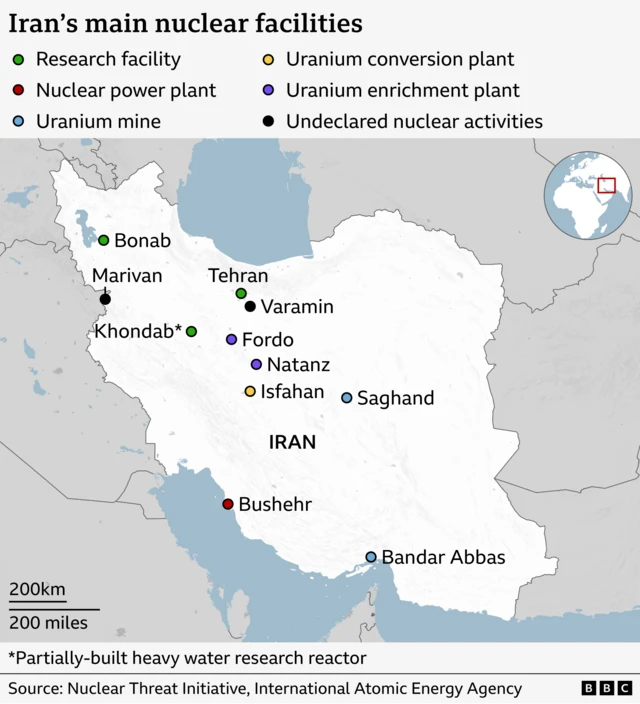
    The IAEA said last week it had been able to conduct a "routine inspection" at the Bushehr Nuclear Power Plant recently, but it had been almost a year since inspectors had been able to access other nuclear facilities.

    A map of Iran showing the location of its main nuclear facilities