Summary

Have questions?

  1. The voter registration deadline is tonight - here's what you need to knowpublished at 17:09 BST 20 April

    Nabiha Ahmed
    Live reporter
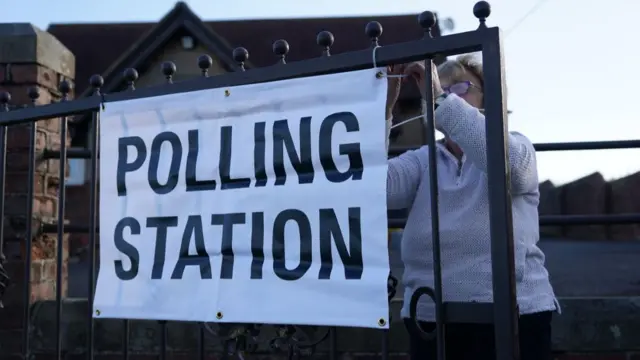
    A woman prepares a banner hanging on a gate at a polling stationImage source, Getty Images

    The deadline to register to vote is at 23:59 BST tonight, as Wales, Scotland and parts of England prepare for elections on 7 May. Our political editor Chris Mason has the run down on why they're important.

    All seats for the Scottish Parliament will be up for grabs. The same goes for the Senedd (Welsh Parliament) where members for 16 newly-devised constituencies will be decided through a proportional representation system.

    As for England, around 5,000 seats across 136 local councils will be decided, along with six mayoral - five of which are in London.

    Not all of these contests will be what's known as "all out" elections, explains Newscast presenter Adam Fleming.

    Those who want to case their votes have until 23:59 tonight to register. Here's how to do so - along with information on how old you need to be, how to vote by post, and whether you'll need ID at polling stations.

    As well as answering your questions on how the elections will work, we've been quizzing you on what you need to register. You can also test your knowledge on the minimum age to register to vote.

    We're ending our live coverage now. For more on the 7 May UK elections, you can read this guide on voting.

    And if you're looking for more, we've collated a handy index of all 2026 election-related articles on our website.
  2. Some postponed council elections in England were reinstated after challengepublished at 16:53 BST 20 April

    Some of the local elections in England - council seats in 30 different authorities - had been postponed until 2027.

    But those plans were abandoned by the government in February, and all of the votes are now going ahead.

    Ministers had previously said that postponing the polls would help to deliver a major shake-up of local government.

    In February, the government said the elections would now go ahead in these areas after legal advice, in the wake of a challenge from Reform UK.

    The delay had been criticised by opposition parties, whilst the Electoral Commission - which oversees UK elections - had warned it risked "damaging public confidence".

    Local election administrators have warned that councils will face "an uphill struggle" to be ready in time.

    You can read more about what happened here

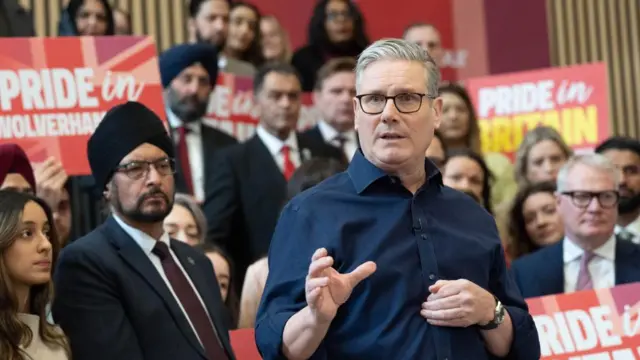
    Keir Starmer speaking at Labour's local elections launch in EnglandImage source, PA Media
  3. What can I do if I don't have any photo ID?published at 16:38 BST 20 April

    You need to show photo ID when voting in person in England's elections on 7 May - including if you're voting by proxy for someone else.

    You can use a passport, driving licence, or more than 20 other forms of ID to prove your identity.

    You can apply for a free voter ID if you don't have any ID, if you don't look like your photo on your ID, or if the name on your photo ID is different to your name on the electoral register.

    If you're applying for a Voter Authority Certificate, you'll need to submit a digital photo of yourself and your National Insurance number.

    The deadline to apply for the Voter Authority Certificate, external is 17:00 BST on Tuesday 28 April.

    • As a reminder, if you're voting in Scotland or Wales, you do not need to bring any photo ID
  4. Not all councillors are up for election in next month's English council votespublished at 16:29 BST 20 April

    Bins, social care, pot holes, planning permissions - these just some of things are things that are being shaped by local councils, says Newscast presenter Adam Fleming.

    Local council across parts of England are among the seats up for election on 7 May.

    That said, Adam also points out that not all the local authorities holding polls are going to hold what's known as "all out" elections. This is when all the councillors of a local authority are elected.

    Adam says it is important to remember that in "a big chunk" of these local councils, only a third of the councillors are being elected this May.

    Another third will be elected next year, and the final third in the year following.

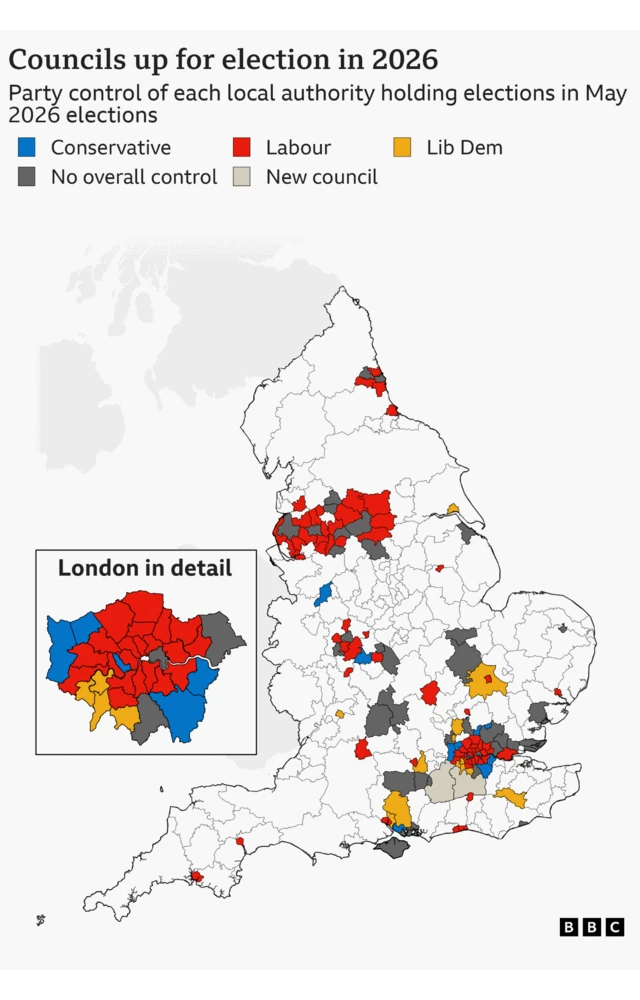
    Colour coded map showing the local authorities up for election in England. Most councils up for election are in North West England and London. In both, Labour control most.
    Purple banner reading YOUR VOICE
  5. How old do I need to be to vote?published at 16:20 BST 20 April

    To vote in the Scottish and Welsh Parliament elections next month, you need to be at least 16 years old.

    In England, you need to be at least 18 to vote in the local elections taking place.

    That said, you can register to vote from the age of 16 in England, and 14 in Wales and Scotland.

  6. How have the constituencies in Wales changed?published at 16:19 BST 20 April

    We can now bring you a little more from what we heard in our live stream this afternoon.

    Wales has been split into 16 new constituencies - each with 6 members, explains our Wales political editor Gareth Lewis.

    We've explained that in a little more detail, along with changes to how the vote is calculated in Wales, here.

    Gareth explains that some of these new constituencies are "absolutely enormous" - that's been "a bit of a bug-bear" for some critics, he says.

    The Gwynedd Maldwyn constituency, for example, stretches all the way from the Llŷn Peninsula to the English border.

    "It is a good three hours on a good day to get from one side of that constituency to the other," says Gareth.

    There will now be 96 members of the Senedd, compared to the 60 that there have been up to now.

    But Gareth goes on to say that the argument in favour of expanding the Senedd is that as the Parliament has gained more powers there is a need for more members to perform scrutiny, but this isn't the view of all parties.

    Purple banner reading YOUR VOICE
  7. Our live stream has ended - but keep reading for all you need to knowpublished at 16:07 BST 20 April

    Our live stream has now ended, but we will continue to bring you all you need to know about next month's elections across England, Wales and Scotland.

    A graphic showing a polling station sign in front of a colourful background
  8. How does voting work in Scotland?published at 15:52 BST 20 April

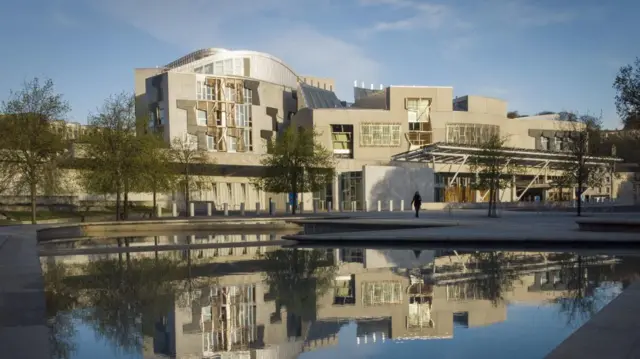
    Scottish Parliament building at Holyrood in EdinburghImage source, Jane Barlow/PA Wire
    Image caption,

    Scottish Parliament building at Holyrood in Edinburgh

    In our live stream, we have been hearing details about how voting works in Scotland for these elections.

    Here is what you need to know

    You can vote in Scotland from 16, unlike England and Wales where you have to be 18.

    In these elections, all 129 Members of the Scottish Parliament (MSPs) are up for re-election.

    There are 73 constituency MSPs, and 56 regional MSPs (seven per region) in Holyrood.

    Each voter has two ballot papers and casts two votes, one to elect their constituency MSP and one to elect their area's regional MSPs.

    Constituency MSPs are selected directly under first past the post, with the winner being the candidate who receives the most votes.

    The process to select regional MSPs uses a type of proportional representation, where voters choose between the political parties, rather than individual candidates.

  9. Watch live as we answer questions about next month's electionspublished at 15:33 BST 20 April

    Ahead of tonight's register to vote deadline, our BBC journalists are answering all the key questions about the 7 May elections across England, Wales and Scotland.

    Remember, you can also follow along by clicking watch live at the top of this page.

  10. What if I can't make it to a polling station on election day?published at 15:07 BST 20 April

    If you want to vote but can't make it to a polling station on 7 May, you still have some options.

    You can vote by post in the weeks before the election. If you do this, a ballot paper will be sent to you in a postal voting pack before the election.

    You can also ask someone else to cast your vote on your behalf - called a proxy vote.

    If you are already registered, the deadline to request a postal vote is 17:00 BST on Tuesday 21 April. You can apply for a proxy vote until 17:00 BST on Tuesday 28 April.

    If you haven't registered, you can find out more about how to register to vote in our earlier post.

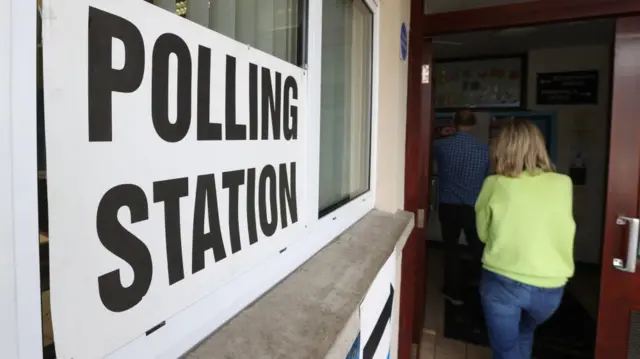
    A woman walking into a polling stationImage source, PA Media
  11. Where are the mayoral elections on 7 May?published at 14:41 BST 20 April

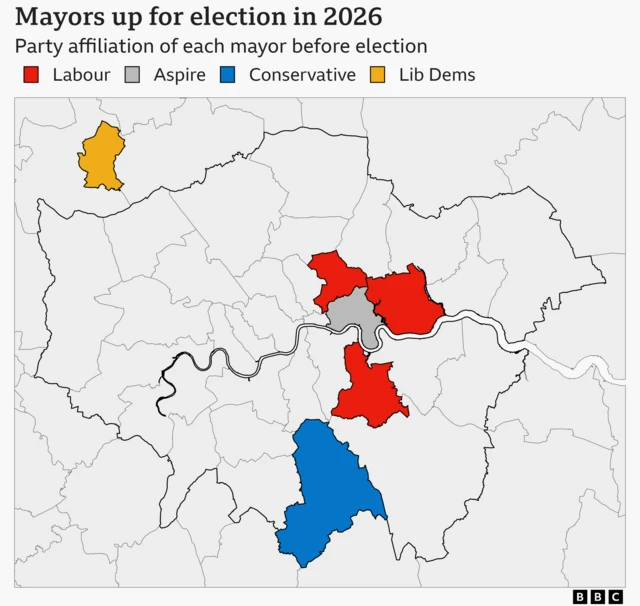
    The 7 May UK elections will see six mayoral elections taking place: five in London, and one in Watford.

    That includes Newham, Hackney and Lewisham - all of which have Labour mayors.

    Croydon, where there is a Conservative mayor, will also see a mayoral election. As will Tower Hamlets, where there is an Aspire mayor.

    The only mayoral election outside London will take place in Watford, where there is currently a Liberal Democrat mayor.

    A map of the mayors up for election in 2026. In London there are three Labour mayors in Newham, Hackney and Lewisham, a Conservative mayor in Croydon, and an Aspire mayor in Tower Hamlets. Outside of London in Watford, there is a Liberal Democrat mayor.
  12. What elections are happening in England?published at 14:13 BST 20 April

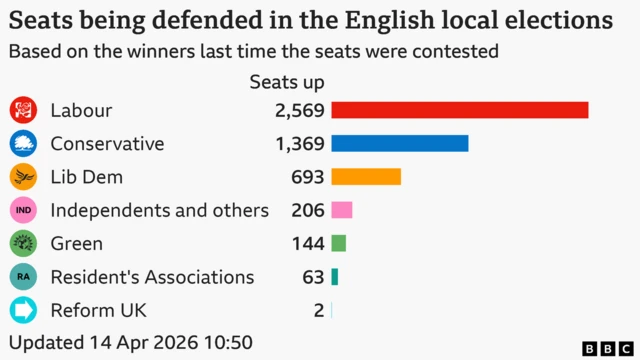
    Around 5,000 council seats across 136 councils will be up for election next month in England.

    The votes will be across county councils, as well as district, borough and unitary authorities.

    You can find out if there is due to be a vote in your area here

    There are six mayoral elections to be contested, most of which are in London.

    People living in the boroughs of Croydon, Hackney, Lewisham, Newham, and Tower Hamlets will get to vote for a mayor. There will also be a mayoral vote in Watford.

    Seats being defended in the local elections in England
  13. At a glance: What are next month's elections all about?published at 13:55 BST 20 April

    The elections on 7 May aren't for Westminster MPs - but they will still affect a lot of things we rely on every day.

    They're about electing a new Scottish Parliament and a new Welsh Parliament, and local councils - or even mayors - in parts of England.

    The BBC's political editor Chris Mason takes a look at why the 7 May elections matter.

  14. The Senedd will be elected through the D'Hondt voting systempublished at 13:41 BST 20 April

    A man walks past a polling station at Roath Park lake, CardiffImage source, Getty Images

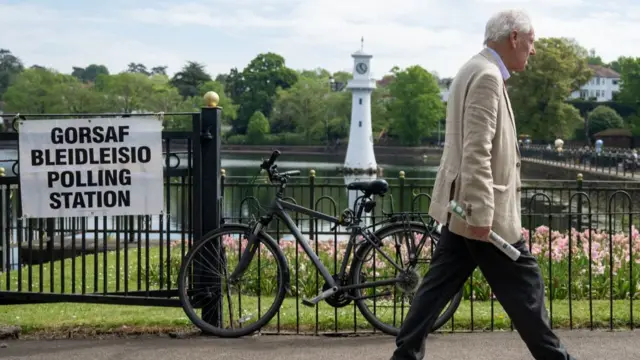
    As well as electing members of the Welsh Parliament on 7 May, Wales will also be scrapping the first-past-the-post voting system - where the candidate with the most votes wins.

    Instead, the election will use a proportional system, known as D'Hondt. The method uses a mathematical formula to distribute seats based on the proportion of votes won by each party.

    But how does it work?

    Each of Wales's newly-devised 16 constituencies will be represented by six Members of the Senedd (MSs). Parties choose six candidates to represent each constituency, ranked from one to six.

    Voters will then cast their ballot for a party, rather than a specific candidate.

    After voting has finished, votes for each party will be counted and seats are given out one-by-one, using the formula to determine how many of the area's six seats each party gets.

  15. BBC journalists to answer your election-related questions - watch livepublished at 13:22 BST 20 April

    Ahead of tonight's deadline to register to vote, BBC presenters Pria Rai and Adam Fleming will be answering your election-related questions with the help of our correspondents and contributors.

    You can tune in at the top of the page from 15:30.

    Remember, you can send us your questions using the 'Get in touch' button at the top of the page.

  16. Postpublished at 13:00 BST 20 April

    This Riddle post cannot be displayed in your browser. Please enable Javascript or try a different browser.

  17. What elections are happening in Wales?published at 12:29 BST 20 April

    If you're in Wales, you'll be voting to elect Members of the Senedd. This is Wales' Parliament, responsible for making laws in areas like health, education and transport.

    In this election, the number of Members of the Senedd (MSs) will be expanded from the current 60 to 96 representatives from 16 newly devised constituencies.

    Each constituency will elect six MSs under a new voting system known as D'Hondt, which uses a mathematical formula to distribute seats based on the proportion of votes a party wins.

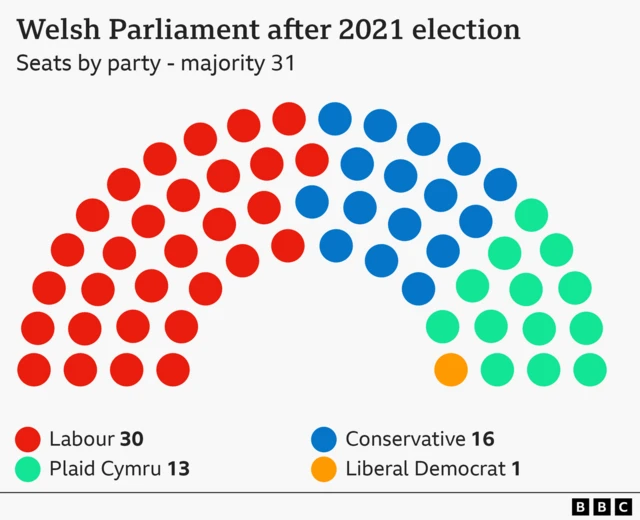
    Below shows the composition of the 60 Senedd seats following the last election in 2021.

    A hemicycle showing the composition of the Welsh parliament after the 2021 election. With 31 seats needed for a majority, Labour won 30, the Conservatives 16, Plaid Cymru 13, and Liberal Democrats 1.
  18. Postpublished at 12:02 BST 20 April

    This Riddle post cannot be displayed in your browser. Please enable Javascript or try a different browser.

  19. All members of the Scottish Parliament are up for re-electionpublished at 11:49 BST 20 April

    Elections to the Scottish Parliament are being held on May 7, and all 129 Members of the Scottish Parliament (MSPs) are up for re-election.

    The vote will determine who governs the country and makes decisions in areas such as health and education.

    There are 73 constituency MSPs, and 56 regional MSPs (seven per region) in Holyrood.

    Usually the party with the most MSPs forms the Scottish government, and its leader becomes first minister.

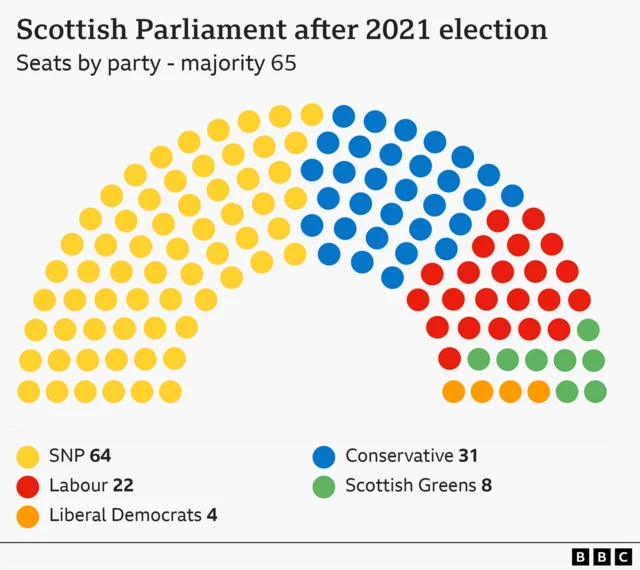
    Take a look below at the makeup in the Scottish Parliament following the last elections in 2021.

    A hemicycle showing the composition of the Scottish parliament after the 2021 election. With 65 seats needed for a majority, the SNP won 64, the Conservatives 31, Labour 22, Scottish Greens 8 and the Liberal Democrats 4.
  20. Do you have questions about registering to vote? Get in touchpublished at 11:29 BST 20 April

    You can contact us through the 'get in touch' box at the top of the page.

    In some cases a selection of your comments and questions will be published, displaying your name and location as you provide it unless you state otherwise. Your contact details will never be published.