Summary

  1. 'Ukraine has never wanted this war,' says Zelenskypublished at 18:04 BST
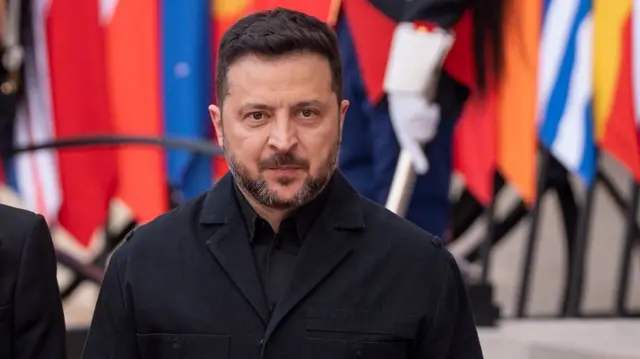
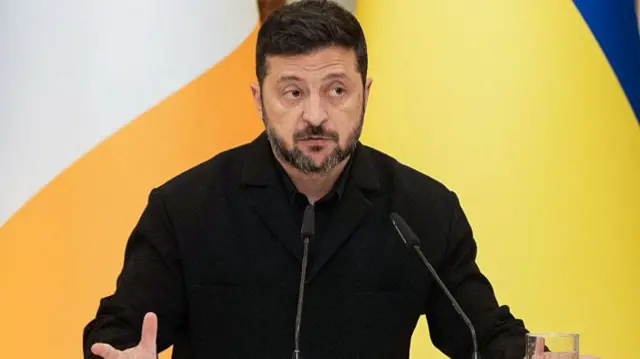
    Volodymyr Zelensky is pictured looking solemn wearing a black shirt and coat in front of a row of flags.Image source, Getty Images

    Here are some more lines from Ukrainian President Volodymyr Zelensky's speech a little earlier.

    "It is Ukraine that wants peace," he says. "Ukraine has never wanted this war – not for a single day."

    Russia, he tells Ukrainian diplomats, "is doing everything possible to prolong the war and inflict as much damage on human life as it can".

    Zelensky adds: "When Moscow does not want peace, Washington and Beijing can make it want peace."
  2. Russia accuses Nato and EU of sponsoring 'terrorist activity' after drone hits beachpublished at 17:45 BST

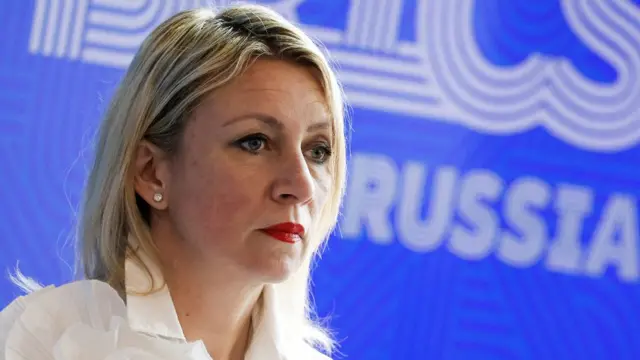
    A woman with shoulder-length blonde hair, wearing a white shirt, in a close up shot in front of a blue sign saying "Russia"Image source, Reuters
    Image caption,

    Russian Foreign Ministry spokeswoman Maria Zakharova

    Russia's foreign ministry is accusing Western nations of sponsoring "terrorist activity" in the wake of a tourist beach being hit by a drone.

    "Not long ago, Nato and the EU declared a policy of zero tolerance towards terrorism," spokeswoman Maria Zakharova says to Russia's state-affiliated news outlet Tass.

    "Now, they themselves have become part of international terrorist activity."

    Her comments were in response to questions about the drone that hit the Black Sea resort town of Gelendzhik earlier.

    Russia has blamed Ukraine for the deadly incident. Neither the Ukrainian military nor officials in Kyiv have commented so far.

    Our analyst writes that while it's not possible to completely rule out the possiblity of a deliberate strike on a beach, the history of this war suggests that Ukraine has not deliberately targeted such locations in the past and would have little to gain by doing so.

  3. Gunfire heard in videos suggests Russian air defences tried to down dronepublished at 17:21 BST

    Vitaly Shevchenko
    Chief analyst, BBC Monitoring

    Gunfire that can be heard in clips showing the drone that hit a tourist beach on the Black Sea coast suggests that there was an ongoing attempt by Russian air defences to bring it down.

    Is it possible to completely rule out the possibility of a deliberate attack on a beach in Russia?

    No, but the history of this war suggests that Ukrainians have not deliberately targeted such locations in the past and that they have little to gain from something like this.

    We have to also bear in mind that one of Vladimir's Putin's alleged palaces is located not far from Gelendzhik.

    While there's discussion going on about the possibility or impossibility of a deliberate Ukrainian attack we have to remember that there are numerous potential military targets in the area that Ukrainians would be interested in targeting.

    The key to answering that question of whether it was deliberate is the gunfire. There's also the possibility of radio electronic interference that brought it down. But, this also goes to show how dangerous and lethal these drones are no matter how far people are from the front lines.

  4. Tourists say they 'didn't have time to leave' before drone hit beachpublished at 16:57 BST

    Laura Gozzi
    Europe reporter

    Tourists and residents of Arkhipo-Osipovka have told local media outlet 93.ru that no sirens sounded ahead of the drone attack.

    "We were on the beach, we didn’t have time to leave," one unnamed holidaymaker was quoted as saying.

    "We covered ourselves with sun loungers, and didn’t see where it exploded."

    Another said that while they did not see the drone hit they could hear "gunfire, like a machine gun" followed by an explosion.

    "This all happened in front of my children. My child is having a nervous breakdown," a third person said.

  5. What to know about deadly attacks as Ukraine and Russia trade firepublished at 16:45 BST

    Krasnodar Krai regional governor Veniamin Kondratyev says seven people have died and more than 40 are injured after drone hit a beach near the resort town of Gelendzhik.

    Here's what we've learned about other deadly incidents in the past day.

    • A fire at the Wildberries warehouse in Russia's Vladimir region caused by a Ukrainian drone strike wounded four people, the regional governor says
    • Four were killed and two others injured in a Ukrainian attack in Russian-controlled Crimea, according to the region's Moscow-installed governor Sergei Aksyonov

    The attacks come after the countries continued to trade fire over the weekend, with Russia saying eight people had been killed in Ukrainian strikes overnight going into Sunday.

    Meanwhile, Volodymyr Zelensky says at least nine people were killed and a dozen injured during Russian ballistic missile strikes on Kyiv on Saturday.

  6. Drone strike hits area popular with Russian holidaymakerspublished at 16:34 BST

    Laura Gozzi
    Europe reporter

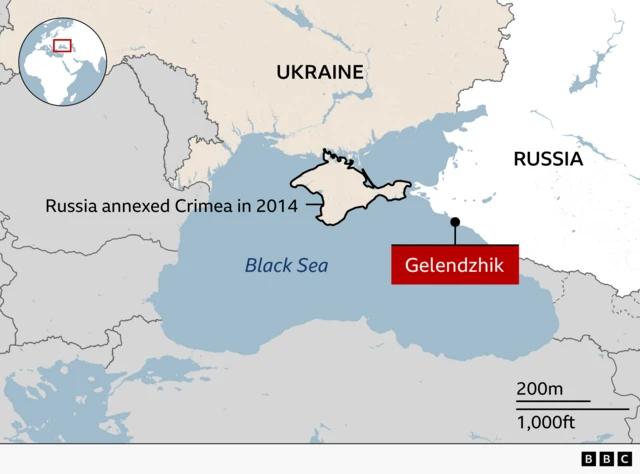
    BBC map of the Black Sea region showing Ukraine, Russia, and the Crimean Peninsula. Crimea is outlined and annotated with the text “Russia annexed Crimea in 2014.” A marker highlights Gelendzhik on Russia’s northeastern Black Sea coast. An inset globe shows the region’s location in Europe.

    A drone strike on the Russian Black Sea coast, which local authorities say has killed seven people, occurred in an area that has long been a favourite destination for Russian holidaymakers.

    The popularity of Arkhipo-Osipovka, near Gelendzhik, has only increased as overseas travel for Russians is complicated by sanctions and visa restrictions.

    Arkhipo-Osipovka is a village but the bigger town of Gelendzhik is only 37 miles (60km) away. Like much of the Black Sea coast, Gelendzhik enjoys warm temperatures in the summer. It has a pebble beach and a long promenade with restaurants and bars, and is popular with families.

    In 2021, an investigation by late opposition leader Alexei Navalny's Anti-Corruption Foundation focused on a sprawling and luxurious complex, dubbed "Putin's Palace", located between Arkhipo-Osipovka and Gelendzhik.

    The two-hour documentary, published on YouTube, amassed 137 million views and detailed the corruption scheme allegedly used to build the colossal palace. It reportedly cost over $1bn (£744m), which Navalny called "the largest bribe in history".

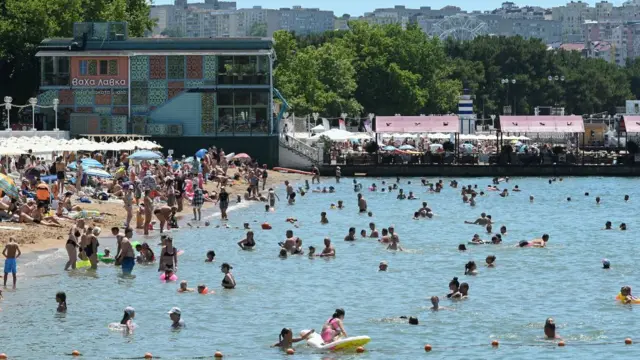
    A crowded beach on a sunny day, with seaside restaurants in the backgroundImage source, Reuters
    Image caption,

    The town of Gelendzhik has long been a favoured summer holiday destination for Russians

  7. At least seven killed after drone hits Russian beachpublished at 16:25 BST

    The Operational Headquarters of Krasnodar Krai says that the number of people killed in the drone attack on Arkhipo-Osipovka beach has risen to seven, with three children among the dead.

    In a statement on Telegram, the authority says 40 people sustained various injuries in the strike near the Russian Black Sea resort of Gelendzhik.

    An additional 21 people were taken to hospital, with 19 people receiving outpatient treatment, it adds.

    It's not clear if the drone was intercepted before landing on the beach. Ukraine hasn't yet commented on the strikes.

  8. Footage shows moment drone hits Black Sea resort in Russiapublished at 16:03 BST

    Warning: This video contains distressing content.

    A video verified by the BBC shows the moment a drone hits Arkhipo-Osipovka beach near the Russian Black Sea resort town of Gelendzhik.

    Krasnodar Krai's regional governor Veniamin Kondratyev says on Telegram that six people were killed, including three children. He has blamed Ukraine for the attack.

    The Ukrainian military has so far not commented on the incident.

  9. BBC Verify

    Why is Ukraine targeting Wildberries?published at 15:37 BST

    By Thomas Copeland

    We reported earlier that Ukrainian President Volodymyr Zelensky said the Wildberries strikes are “bringing the war back home” to Russia.

    Alexandra Prokopenko from the Carnegie Russia Eurasia Center told BBC Verify that Ukraine’s other strikes on energy infrastructure will have a far greater impact on the Russian economy, “but they don't generate public outrage the way a burning delivery warehouse does”.

    “Nobody has yet calculated” how many individuals and small businesses have been affected by the Wildberries strikes and “some say openly that bankruptcy and production shutdowns are inevitable,” she says.

    Kyiv also claims the warehouses are helping to supply the Russian military. The Kremlin has denied these claims.

    Emily Ferris from the Royal United Services Institute told BBC Verify that although Wildberries “mostly sells consumer goods” some of its products, like sports gear, uniforms, thermal-imaging cameras and electronic components “can be used on the front line to supply troops”.

    “Preventing their further distribution would technically disrupt military supply chains as well,” she said.

  10. Russia says it has struck four Ukrainian cargo shipspublished at 15:26 BST

    Russia says it has struck four Ukrainian cargo ships across both the Black Sea and port of Mykolaiv in southern Ukraine.

    Its ministry of defence says unmanned drones struck two cargo ships in Mykolaiv that it claims were "unloading military cargo".

    It adds a further two ships were struck in the Black Sea that were "carrying military cargo".

    There has been no acknowledgement of the attacks from Ukraine.

  11. BBC Verify

    Drone hits Russian beach resort killing at least six, governor sayspublished at 14:56 BST

    By Sherie Ryder

    BBC Verify has been checking footage of a drone hitting a beach near the Russian Black Sea resort town of Gelendzhik.

    Krasnodar Krai regional governor Veniamin Kondratyev posted on his Telegram account that six people had been killed, including three children. He said 40 more had been injured and blamed Ukraine for the attack. The Ukrainian military has so far not commented on the incident.

    It’s been reported the drone may have been targeted at the Russian naval base at Novorossiysk which is around 40km (25 miles) from Gelendzhik.

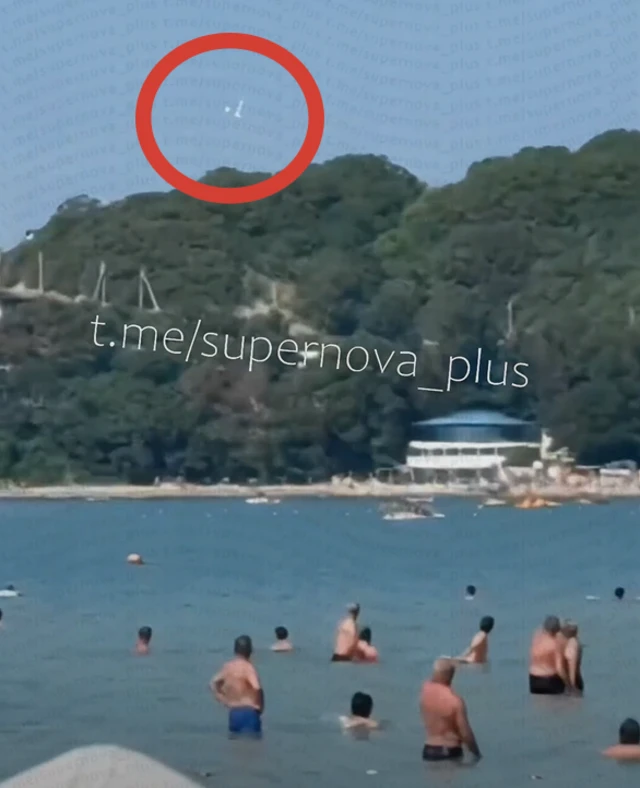
    We have geolocated the incident to Arkhipo-Osipovka, near Gelendzhik. Recency and AI checks confirm the footage is current and genuine.

    Footage posted online showed the drone hitting the busy beach in south-west RussiaImage source, Telegram
    Image caption,

    Footage posted online showed the drone hitting the busy beach in south-west Russia

  12. BBC Verify

    AI fake claims to show Russian warehouse’s message to Ukraine drone operatorpublished at 14:35 BST

    An AI-generated image of a warehouse with the words, in Russian, "This is not Wildberries. Fly past” written on its roof. We have added the label "AI-generated"

    By Thomas Copeland, BBC Verify, and Fridon Kiria, BBC Monitoring

    This image claiming to show a message on the roof of a warehouse belonging to Wildberries’ competitor Ozon saying in Russian “This is not Wildberries. Fly past” has spread widely across social media and has been used by some news outlets - but it’s AI-generated.

    OpenAI’s online verification tool detected a SynthID digital watermark on the image. This tells us it was made using one of OpenAI’s tools.

    We’ve traced the image back to a post on TikTok that has been viewed nearly eight million times.

    TikTok has added an AI-generated label to the post but it has since spread across other platforms where it’s being presented as real.

  13. Wildberries warehouse fire contained after a fourth person injuredpublished at 14:22 BST

    A fourth person has been injured as a result of a fire at the site of the Wildberries warehouse in Russia's Vladimir region, the local governor has said.

    Alexander Avdeyev says in a post on Telegram that the blaze has been contained after stretching over an area of 100,000 sq m (0.1 sq km).

    He adds the incident led to the deployment of 203 firefighters and 67 pieces of equipment, including specialists and a government helicopter.

  14. Moscow denies online retailer provides goods for Russian militarypublished at 14:17 BST

    Russia has denied that online marketplace Wildberries provides Russian military gear.

    Kremlin spokesman Dmitry Peskov denied accusations during a news conference on 21 July, following attacks on Wildberries hubs in the cities of Kotovsk and Elektrostal on 18 July.

    "That's not true," Peskov said in response to a question on the matter, Moscow's state news agency Tass reports.

    Last week, the Ukrainska Pravda news website reported that Wildberries had removed the product tag "Everything for the SMO" [special military operation] from its website, citing The Moscow Times.

  15. Putin hopes to 'drag war out further', Zelensky tells diplomatspublished at 13:59 BST

    Ukraine's President Volodymyr Zelensky speaks during a press conference in front of flags.Image source, Getty Images

    Ukrainian President Volodymyr Zelensky says that Russian President Vladimir Putin hopes to "drag this war out further" as Ukraine launches fresh strikes on targets across Russia.

    In a speech delivered to Ukrainian diplomats, Zelensky says he cannot predict "with 100% certainty" when Ukraine's diplomatic efforts, sanctions and strikes against Russia will leave Russia with "no alternative but peace".

    He says Ukraine will do what it can to ensure this "happens in the autumn", but says "we clearly understand who we are dealing with", adding that Putin "hopes to drag this war out further".

    "We see Russia’s true intentions [and] are uniting our partners and putting pressure on the aggressor," he adds.

  16. Ukraine's latest strikes come as it ups attacks on Russian infrastructurepublished at 13:49 BST

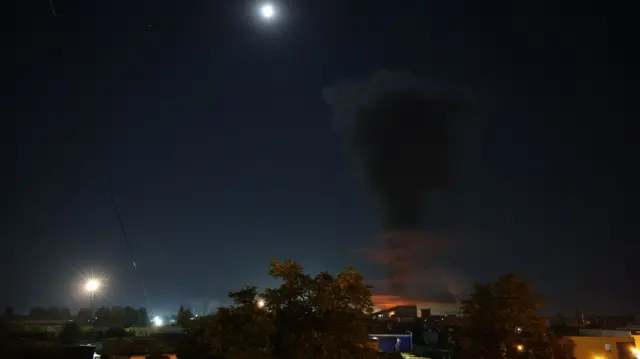
    A plume of black smoke rises into the night sky following a reported drone strike by Ukrainian forces in Belgorod, Russia, on August 3, 2026Image source, Getty Images
    Image caption,

    A plume of black smoke was seeing rising following reported Ukrainian strikes against a fuel depot in Belgorod overnight

    Ukraine's Ministry of Defence says it struck a number of Russian military targets overnight, in addition to apparent Ukrainian strikes against sites belonging to Russian retailer Wildberries.

    It says it hit several logistics and communications hubs in Crimea, a drone launch site in Bryansk and a fuel depot in Belgorod.

    It comes amid increasing Ukrainian attacks on Russian infrastructure, with Volodymyr Zelensky on Sunday announcing strikes against an oil refinery and military air base in Russia's Stratov region.

    "We are bringing the war back to where it came from," he said, adding that Ukraine continues to expand its "long-range capabilities".

    Other notable infrastructure strikes in recent months include:

  17. Crimea deaths come as Ukraine ramps up attempts to isolate regionpublished at 13:34 BST

    The latest set of blows between Russia and Ukraine has led to three deaths in the Russian-controlled territory of Crimea, the Moscow-installed governor has said, in what he described as a "barbaric attack".

    The region, which is internationally recognised as being Ukrainian, was illegally annexed by Vladimir Putin in 2014.

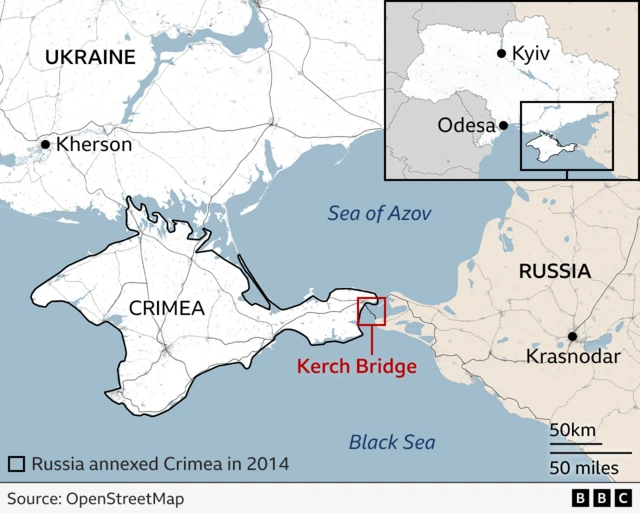
    It has since become linked to Russia by road and rail connections along a land corridor through occupied areas of southern Ukraine, and since 2018 by a road and rail bridge across the Kerch Strait.

    The future of the territory has remained a central point in peace talks between the two countries, with Ukrainian President Volodymyr Zelensky refusing the possibility of Kyiv recognising Russian control.

    Efforts from Ukraine to isolate Crimea have ramped up in recent months as multiple blackouts have been reported amid attacks on power facilities, with Kyiv also targeting key bridges connecting the peninsula to Russia, leading to fuel shortages.

    Map shows where the Kerch Bridge is located, also showing Crimea, Russia and Ukraine.
  18. Six people killed in Russian village, governor sayspublished at 13:30 BST

    The number of people killed in Gelendzhik, a Russian seaside resort village in the south-west of the country, has risen to six, the governor of Krasnador Krai says.

    In a post on Telegram, Veniamin Kondratiev says three of the six people dead are children and around 40 others are injured.

    Earlier, the governor said preliminary reports initially suggested three people had been killed in the area by falling drone debris.

    Kondratiev describes it as "a targeted attack by the Kyiv regime".

  19. Casualties and recruitment: The latest on the battlefieldpublished at 13:15 BST

    Kieran Kelly
    Live reporter

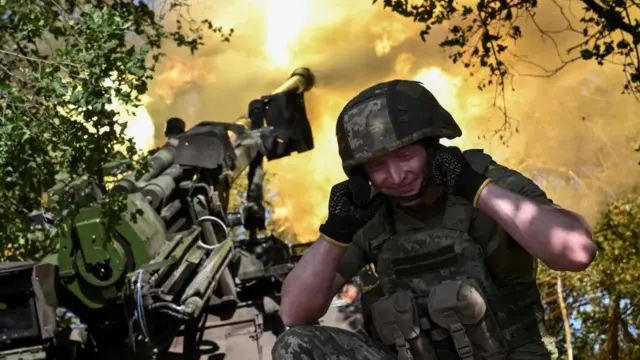
    A serviceman of the 148th Separate Artillery Zhytomyr Brigade of the Armed Forces of Ukraine fires a CAESAR self-propelled howitzer towards Russian troops at a position on the front lineImage source, Reuters
    Image caption,

    Ukrainian forces - pictured above - have been able to launch succesful counterattacks

    Progress on the battlefield

    Russia advanced on average 1.22 sq km per day in July, according to a recent report by, external the Institute for the Study of War (ISW).

    The ISW says that Russia's rate of advance has remained largely unchanged since February 2026 and that its summer offensive - launched the following month - has "failed to make any operationally significant gains".

    Casualty rates

    Russia reportedly suffered its highest monthly casualty rate of the war in July, with the Ukrainian army estimating 42,860 Russian casualties, a number that includes people killed or injured in the conflict. The Kremlin has repeatedly denied Ukrainian casualty estimates.

    The BBC's Russian service, working with Mediazona, has confirmed 236,066 Russian military deaths between 24 Feb 2022 and 26 July 2026.

    For Ukrainian soldiers, President Volodymyr Zelensky last acknowledged 55,000 deaths in February 2026.

    Recruitment struggles

    Ukraine is continuing to struggle to recruit enough men to fight in the war, with the country's military ombudswoman reporting "regular" attacks against recruitment officers as a "major problem".

    Russia, meanwhile, is increasingly turning to universities to boost recruitment. BBC Russian found evidence of recruitment activity in at least 95 universities and colleges by late February.

  20. The war is now in its fifth year - how did we get here?published at 12:54 BST

    It started when Russia launched its full-scale invasion of its neighbour on 24 February 2022.

    Russian President Vladimir Putin said his goal was to "demilitarise and denazify" Ukraine - he has repeatedly painted the country as a Nazi state. Our explainer looks at the distortions and untruths that Russia has previously spread about Nazis in Ukraine.

    The Russian leader has long questioned Ukraine's right to exist, claiming that "modern Ukraine was entirely created by Russia" after the communist revolution in 1917.

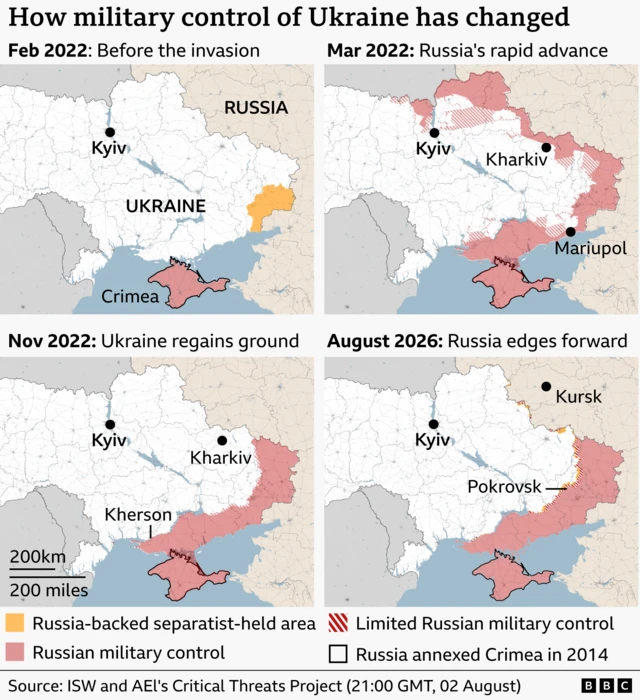
    Four-panel map titled “How military control of Ukraine has changed,” comparing territorial control at four points in time. In February 2022, before the invasion, Russia controls Crimea and Russia-backed separatists hold small areas in eastern Donetsk and Luhansk regions. By March 2022, areas under Russian military control expand rapidly across southern Ukraine and parts of the north and east, with limited Russian control shown around Kyiv and other front lines. In November 2022, Ukraine has regained much of the north and west, leaving Russian-held territory concentrated in the south and east, including a land corridor to Crimea. By August 2026, Russian-controlled territory remains in eastern and southeastern Ukraine and has expanded slightly westward around the front line near Pokrovsk. Key cities marked include Kyiv, Kharkiv, Mariupol, Kherson, Pokrovsk and Kursk. The legend distinguishes Russia-backed separatist-held areas, Russian military control, areas of limited Russian control, and Crimea, which Russia annexed in 2014. Source: ISW and AEI’s Critical Threats Project.

    In February 2022, troops moved in quickly, accompanied by dozens of missile strikes on cities across Ukraine.

    Within a few weeks, Russian forces were in control of large areas of eastern, northern and southern Ukraine - and had advanced to the suburbs of the capital Kyiv.

    However, they met strong Ukrainian resistance - and by November 2022 the picture had changed dramatically. Ukraine had regained ground in the north and Russia failed to take Kyiv.

    Since then, progress on both sides has slowed. In recent months, Russia has been gradually expanding the amount of territory controls - particularly in the east - but gains have been minimal.