Summary

Are you affected?

  1. Californian software engineer missing on pilgrimagepublished at 13:23 BST

    Gabriela Pomeroy
    Live reporter

    Prabhath Sajeepa is pictured wearing glasses and smiling against a colourful tent.Image source, Praneeth Sajeepa

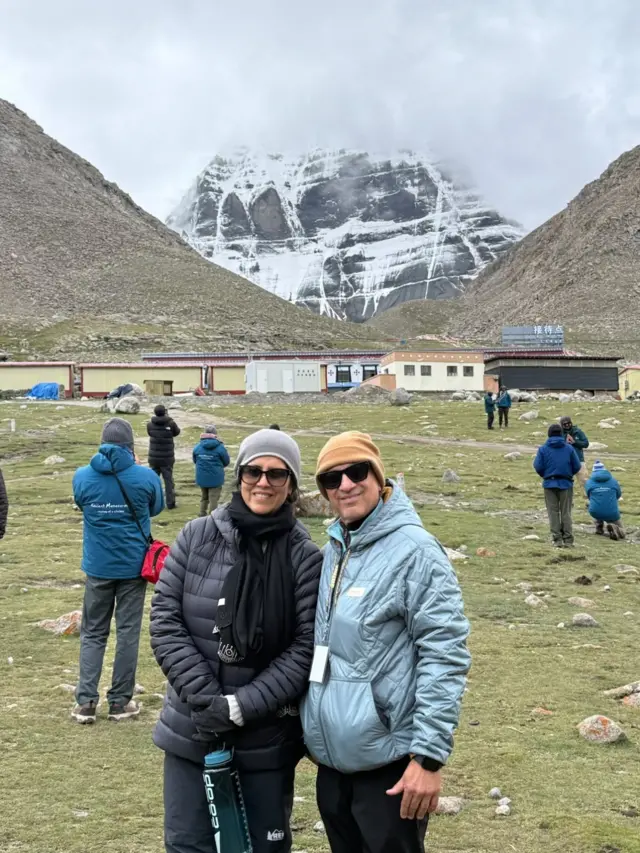
    I've been speaking to Kavya Koulagi Jayatheertha, whose uncle Prabhath Sajeepa is missing on a journey to the Kailash Yathra, a sacred pilgrimage for Hindus.

    Sajeepa, who works for a software company in California and has a wife and two children, was on his first pilgrimage with a group from the spiritual Isha Foundation organisation.

    “It has been the most devastating news," Kavya tells me.

    The family last had contact with Sajeepa on Monday. They’ve been told he was at the Gyirong border crossing when the flash flood hit the area.

    "It has been terrible. I hope he is somewhere safe," his niece says.

    "We are hoping for good news."
  2. Listen: What caused Nepal’s deadly flash floods?published at 13:07 BST

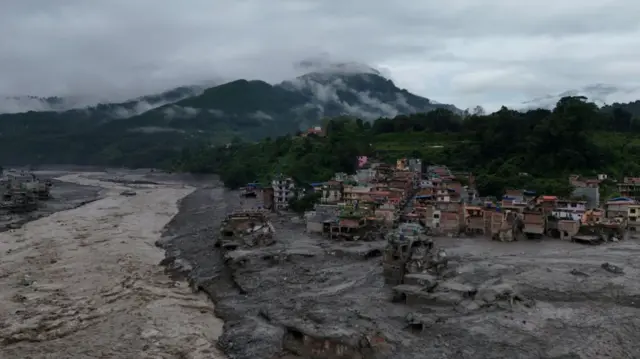
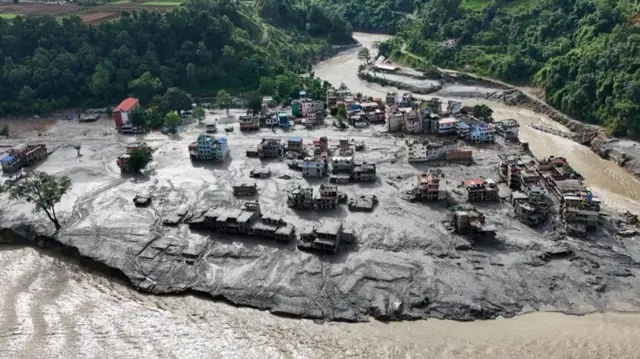
    A village is shown from the air in the bend of a river with buildings covered in mud.Image source, Reuters

    In the latest episode of the BBC's Asia Specific podcast, presenter Mariko Oi speaks to BBC Nepali journalist Sanjaya Dhakal in Kathmandu about the impact of the devastating floods and landslides that have struck Nepal and neighbouring Tibet.

    They discuss the search for survivors, the pressure on hospitals and rescue services, and the arrival of international aid as communities try to recover from the disaster.

    The programme also hears from Tom Robinson, a senior lecturer in disaster risk and resilience at the University of Canterbury in New Zealand, who has studied landslides and worked in Nepal.

    You can listen to the episode on BBC Sounds here.

  3. Nepal's PM visits areas devastated by flash floodspublished at 12:53 BST

    Prime Minister of Nepal, Balendra Shah is surrounded by people after visiting Bidur and surrounding areas of NuwakotImage source, PMO Nepal

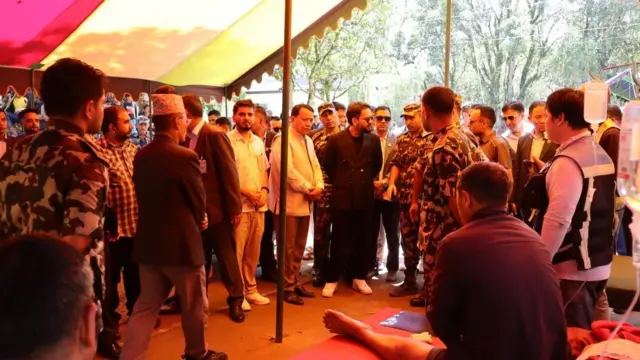
    Nepal's Prime Minister Balendra Shah has visited some of the areas worst affected by the flash floods, including Bidur and nearby communities in the Nuwakot district.

    During the visit he met local officials, security agencies and community representatives to assess the scale of the damage and discuss the response effort.

    The prime minister is reported to have instructed authorities to provide immediate support to families displaced by the floods, reopen blocked roads and restore damaged infrastructure as quickly as possible.

    He later returned to the capital, Kathmandu, after inspecting affected settlements.

  4. Death toll rises to 359 - Nepal policepublished at 12:42 BST
    Breaking

    A Nepal police update says the death toll has risen to 359, as of 17:00 local time (12:15 BST).

    This comes about an hour after police announced the death toll was 332.

  5. BBC Verify

    How the BBC verified shocking flood videospublished at 12:34 BST

    By Yi Ma and Paul Brown

    Warning: This post contains distressing content

    Among the many verified videos of yesterday's flood, two stood out in particular for the sheer devastation they captured.

    Both showed a wall of water engulfing a valley near a border crossing between Nepal and China, as people attempted to escape the oncoming deluge.

    They were so shocking that some social media users wondered if they were made using AI.

    Media caption,

    Video shows scale of flash flood hitting Nepal-Tibet border

    One of BBC Verify’s main responsibilities is ensuring video and images in BBC News output are genuine - and the sharing of AI-generated footage during high-profile incidents is increasingly common.

    As part of the verification process, we do a detailed visual analysis. Even as AI-generation becomes more sophisticated, there are still elements it occasionally fails to render convincingly such as human movement, text on signs or basic physics.

    We found no such glitches in a frame by frame analysis. All the details matched and made sense when compared to older videos showing the same location - and a comparison of the terrain to satellite imagery confirmed the water was flowing downhill.

    We also systematically run all clips through AI-checking software. These tools are not foolproof but both videos returned results indicating no evidence of AI generation.

  6. Gyirong - the border crossing that was destroyed by the floodpublished at 12:22 BST

    Laura Bicker
    China correspondent

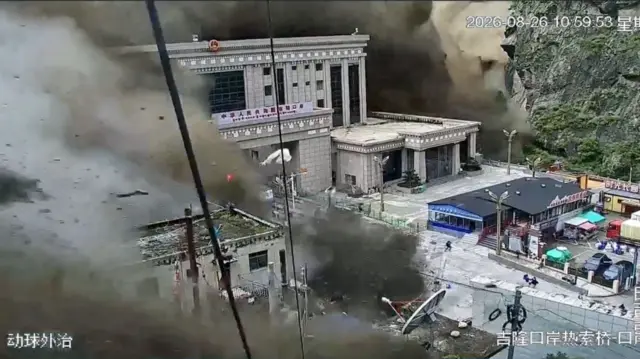
    A massive wall of mud and water is shown enveloping the border crossing buildings, which are at least six storeys high.Image source, Reuters

    Gyirong port has become the focal point of the disaster for rescue teams in China.

    Dramatic footage from surveillance cameras appeared to show the grand building marking the border being swept away by torrents of mud and water as hundreds of people ran for their lives.

    The building sat in the deepest of the five Himalayan valleys and had become a thriving hub after an earthquake in 2015 damaged other routes.

    It was the main passageway for tourists making their way between Nepal and Tibet. More than 100,000 people passed through in the first half of this year and it handled more than 30% of all Chinese-Nepali trade.

    Some social media users in China are questioning why the government decided to place such an important port in a deep valley in a geographically unstable region.

    Last year, 17 people were killed after severe rainfall led to a massive mudslide and triggered flash floods.

    However, history plays a part especially in a mountainous region where only valleys offer a passageway through the Himalayas between the two countries. For more than 1,300 years this port was used by nomadic herders, Nepali traders and local villagers.

  7. Race for survivors after violent flash flood kills at least 332 in Nepal, with hundreds still missingpublished at 12:04 BST

    Katie Williams
    Live reporter

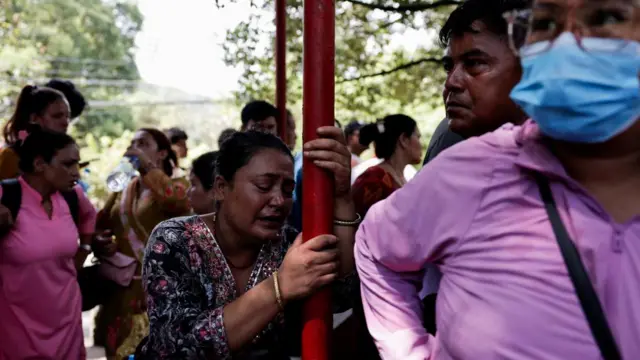
    A woman cries as she waits for updates on whereabouts of her missing family member, Nuwakot district, NepalImage source, Reuters

    Rescuers are in a race to find survivors after devastating flash floods hit the Nepal-Tibet border on Wednesday.

    The full scale of the disaster is still emerging, but officials say at least 332 people have died in Nepal while more than 900 are missing - the majority foreign citizens.

    In Tibet, three have been confirmed dead and at least 558 are missing, according to China's state broadcaster. It is unclear whether the missing figures overlap with Nepal's.

    An experienced mountaineer who has previously witnessed flash floods in Nepal tells the BBC he can't believe how "explosive" and "violent" the disaster was.

    Two sisters whose parents travelled to the region from Texas tell the BBC they "just love them a lot and want them to come home".

    Information on what triggered the flooding has been gradually emerging. Experts now believe "glacial collapse and debris flow" was the cause rather than an earthquake.

    And experts say there are concerns about possible "second and third waves", potentially caused by debris in rivers.

  8. Rasuwa district of Nepal no stranger to natural disasterspublished at 11:57 BST

    Justin Rowlatt
    Climate editor

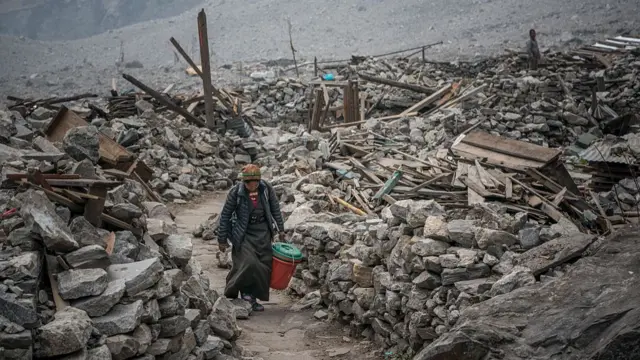
    A woman carrying a red bucket walks along the remains of a village destroyed by an avalanche. She's walking along the path, debris, stones and wood on both sidesImage source, Getty Images
    Image caption,

    The village of Langtang was completely destroyed by a catastrophic avalanche and landslide in April 2015. Pictured is a woman walking among the remains of the Rusuwa district village the year after the disaster

    It is worth noting a parallel with the 2015 Langtang disaster. This latest event also appears to have originated on Langtang Lirung, the mountain above the valley.

    In 2015, the earthquake triggered a vast avalanche of ice, snow and rock from the mountain that destroyed Langtang village below.

    I was the first journalist to reach the aftermath - at least 215 people had died and the village was almost totally covered in rock and ice.

    This latest collapse appears to have come from the north face of Langtang Lirung, rather than the south side involved in 2015.

  9. Did climate change contribute to the glacier collapse?published at 11:51 BST

    Justin Rowlatt
    Climate editor

    It is still very early days and scientists are trying to piece together exactly what happened. Satellite imagery and seismic analysis point to a huge avalanche of ice and rock crashing into the valley and triggering the flood.

    It is too soon to determine what role climate change played, although researchers acknowledge it could have contributed.

    Rising temperatures are causing mountain glaciers around the world to retreat and permafrost (the frozen ground below) to thaw - potentially destabilising steep slopes by weakening the ice that helps bind fractured rock together.

    Scientists say these kinds of high-mountain hazards are becoming an increasing concern across the Himalayas.

    Mohd Farooq Azam, a specialist with the International Centre for Integrated Mountain Development (ICIMOD), an intergovernmental scientific institution, said the increasing frequency of hazards in the cryosphere - or the frozen parts of the Earth - "is becoming more visible than ever before.

    The pace of change is so rapid that current efforts are struggling to keep up".

    We'll bring you more from our climate editor in our next post.

    This Flourish post cannot be displayed in your browser. Please enable Javascript or try a different browser.

  10. BBC Verify

    Deluge submerges valley in minutes, video showspublished at 11:43 BST

    By Adam Durbin and Benedict Garman

    Verified videos showing the sheer scale of yesterday’s flooding along the Trishuli River continue to emerge on social media.

    One video BBC Verify has checked shows an almost incomprehensible deluge of water, submerging buildings and fields near the town of Trishuli in a matter of moments.

    Here is what the start of the four-minute video looks like, as the flood begins to surge down the river:

    A screenshot of a video of the Trishuli River, there are fields and buildings on either side of it and the floodwater is beginning to rush down the river.Image source, X

    About three minutes later, the water has risen metres and filled the valley:

    A screenshot of a video of the same valley, but water has entirely submerged the previously visible fields and buildingsImage source, X
  11. Rescuers pushing to reach hardest hit areas in Nepalpublished at 11:37 BST

    Azadeh Moshiri
    Reporting from Nepal

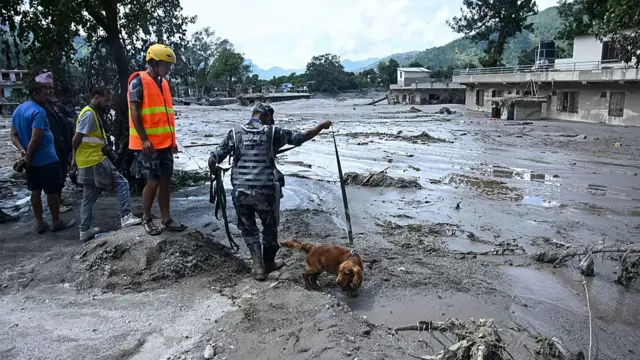
    Rescuers going through the mud with a sniffer dog, the damaged remains of a house covered in debris, water and mudImage source, AFP via Getty Images

    Rescuers are struggling to reach areas struck by flash flooding on the border of Nepal and Tibet.

    As we landed, we spotted an Indian plane delivering emergency supplies, which is just some of the aid pouring in.

    The region where the disaster happened is popular with pilgrims and trekkers, with tens of thousands of tourists making their way from Nepal to Lake Mansarovar every year.

    Survivors are sharing harrowing stories of friends and family swept away by the flood and torrents of mud.

    Hydropower facilities have been damaged, and there are fears for the workers inside them, many of whom are now missing.

    Experts believe a glacial collapse and debris may have triggered the flooding. There are warnings that some debris washed away into the river systems which could trigger more flooding.

    But there is also hope. Rescuers are pushing to reach the hardest-hit areas, and have managed to rescue dozens of people so far.

  12. Death toll rises to 332, Nepal police saypublished at 11:28 BST
    Breaking

    Nepal police have just issued another update, saying 332 people have died as of 15:50 local time (11:05 BST) on Thursday following the floods.

    It came shortly after an earlier update at 14:30 local time (09:45 BST), which placed the death toll at 289.

  13. Over 900 people missing, including 517 foreign citizens, says Nepal disaster agencypublished at 11:26 BST

    Nepal's National Disaster Risk Reduction and Management Authority says 910 people are missing and remain uncontactable following the floods.

    This includes 517 foreign citizens, 44 members of the Nepal Army and 28 Nepal police officers.

    It adds that 258 bodies have been recovered so far, while 351 people have been rescued.

    In our latest update, we reported figures from Nepal police saying the death toll has reached 289. Both organisations have been providing separate updates on the rescue operation as it develops.

  14. Nepal police says death toll now at 289published at 11:17 BST
    Breaking

    Nepal police says in its latest update that 289 people have died as of 14:30 local time (09:45 BST) on Thursday.

  15. Burnham pledges £5m support package to Nepalpublished at 11:07 BST

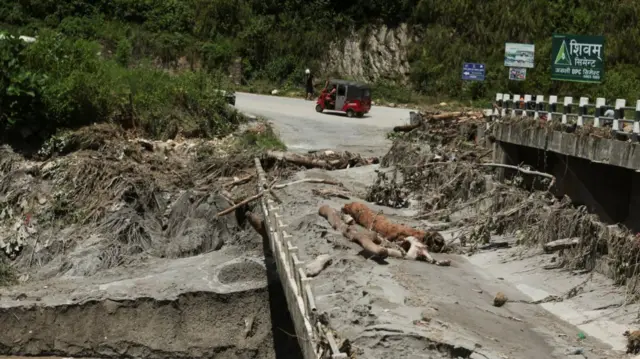
    A road in Nepal with a partially collapsed bridge covered in debris, including tree branches, and mudImage source, Reuters

    Prime Minister Andy Burnham says the UK has pledged £5 million to help with the response effort in Nepal following the flash floods on Wednesday.

    "It’s a devastating picture that is emerging from what has happened in Nepal," Burnham says during a visit to South Wales.

    "Immediate action" is being taken and the UK is deploying consular support staff to the region "so that British nationals will be able to access support 24/7", he adds. The latest from Nepali police is that 33 UK nationals are currently missing.

    “Obviously, there are a number of British nationals who currently are thought to be missing and we’ll be providing all the support we can to their families in what is a very distressing and devastating situation," he adds.

    Burnham says the UK has also offered to send emergency responders to the region, but "that’s obviously a matter for the Nepalese government".

  16. Over 350 people rescued so far today - Nepal Armypublished at 10:57 BST

    Phanindra Dahal
    BBC Nepali, reporting from Trishuli

    The Nepal Army says it has rescued more than 350 people so far today from areas affected by the flooding.

    The army’s spokesperson said 50 of those rescued were foreign nationals, including 30 Indians, eight Chinese, eight Koreans, two Americans and two Italians.

  17. 'We just want them to come home' - sisters seek information on missing parentspublished at 10:48 BST

    Anahita Sachdev
    BBC News, Delhi

    Shreya and Ashna Ahuja in a frame
    Image caption,

    Shreya and Ashna Ahuja's parents travelled from Texas to Mount Kailash on a pilgrimage

    Sisters Ashna and Shreya Ahuja are desperately waiting for news of their parents after flash floods struck Nepal.

    Deepak and Madhu Ahuja had travelled from Texas to Mount Kailash on a group pilgrimage organised by the spiritual group Isha Foundation to celebrate Deepak's 60th birthday.

    The couple had completed the trip and were crossing from Tibet into Nepal when floods hit near the border, their daughters say.

    One of the siblings spoke to their parents just hours before the floods.

    The sisters have contacted the US State Department and US embassies in Delhi, Nepal and China, but they say they have no concrete information on the whereabouts of their parents.

    “It’s only been one day, but it has felt like much longer,” the sisters tell the BBC. “We just love them a lot and want them to come home.”

    Deepak and Madhu Ahuja standing in front of Mount KailashImage source, Ahuja family
    Image caption,

    The couple had gone on the pilgrimage to celebrate Deepak's 60th birthday

  18. Military barracks in Nepal converted into temporary rescue basepublished at 10:42 BST

    Phanindra Dahal
    BBC Nepali, reporting from Trishuli

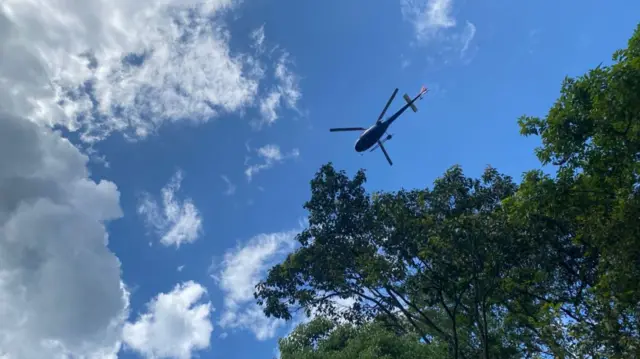
    A helicopter is pictured from the ground as it flies overhead above some trees

    I am outside a military training centre in Trishuli and have already seen a few rescue helicopters moving in and out.

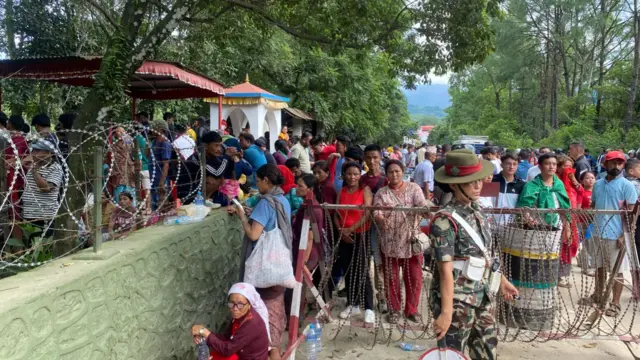
    Dozens of people are outside the barracks to find out the whereabouts of their missing relatives.

    It's a military training centre but the army has converted it into a forward rescue base with military and private helicopters co-ordinating search operations.

    A large crowd of people is queueing outside a military facility beside a road surrounded by trees. The crowd is standing next to a wall which has barbed wire on top, while a military official stands guard
  19. India says 288 nationals are missing following Nepal floodspublished at 10:38 BST

    India’s foreign ministry spokesperson Randhir Jaiswal sitting at a wooden table wearing a grey vest over a white shirtImage source, Getty Images
    Image caption,

    India’s foreign ministry spokesperson Randhir Jaiswal pictured here in March 2026

    India’s foreign ministry says there are 288 Indian nationals who remain uncontactable following the floods in Nepal and Tibet.

    Approximately 200 Indian nationals have been stranded in Tibet and are seeking to be evacuated following the floods, India’s foreign ministry spokesperson Randhir Jaiswal says in a press briefing.

    “There may be some people who are missing there and we are trying our best to locate them through the local authorities,” he adds.

    Jaiswal says 21 Indian nationals, who travelled to Nepal for the Kailash Mansarovar Yatra – a sacred pilgrimage to Mount Kailash - have been rescued.

  20. Possible 'second and third waves' a concern, disaster studies expert tells the BBCpublished at 10:19 BST

    Wide shot of one affected village near the Trinshui River showing extensive damage, large areas covered by water and mudImage source, Reuters

    The director of the Centre for Disaster Studies at the Tribhuvan University in Nepal, Basanta Raj Adhikari, has told BBC Newsday there is a risk of "second and third waves" today or tomorrow.

    "We don't know yet," he says, adding that he continues to discuss the situation with colleagues in China who are monitoring the situation. "There isn't high rainfall, but [a] landslide might happen."

    He adds that they have been monitoring Himalayas mountain hazards - "climate change is really happening here," he explains.

    "We are observing but we didn't know that that would happen on [a] particular day."