Summary

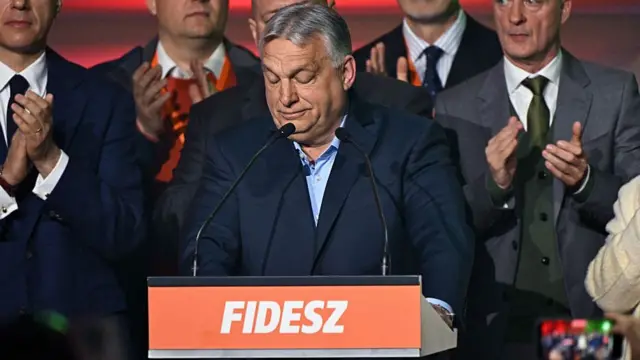
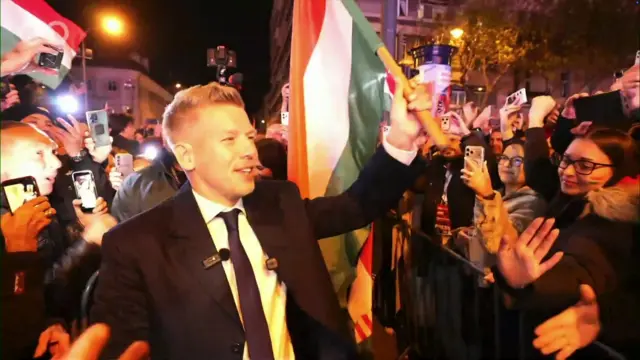
  • Record numbers have voted in Hungary, where Prime Minister Viktor Orbán and his party Fidesz are seeking to retain power after 16 years

  • Péter Magyar and his party Tisza are looking to oust the government in parliamentary elections, with most polls giving him the edge in a close two-horse race

  • The election is seen as pivotal for Hungary's future and will be watched closely in Brussels, Washington, Kyiv and Moscow

  • Orbán is a Donald Trump ally who has close ties with the Kremlin, has sought to block support to Ukraine and has been accused of undermining Hungary's democracy by the EU - more on his supporters abroad from Europe editor Katya Adler

  • Magyar has promised closer ties with Europe and to reverse controversial Orbán-era reforms if he wins

  • Polls were due to close at 19:00 local time (18:00 BST) but voters already waiting at polling stations can still cast their ballot. We'll bring you the latest results and analysis from our team in Budapest throughout - get up to speed on the background to the election here

Media caption,

How Hungary’s knife-edge election could impact the US and Russia

  1. Polls due to close in pivotal Hungarian election with record turnoutpublished at 18:00 BST
    Breaking

    Rita Palfi
    BBC World Service, Budapest

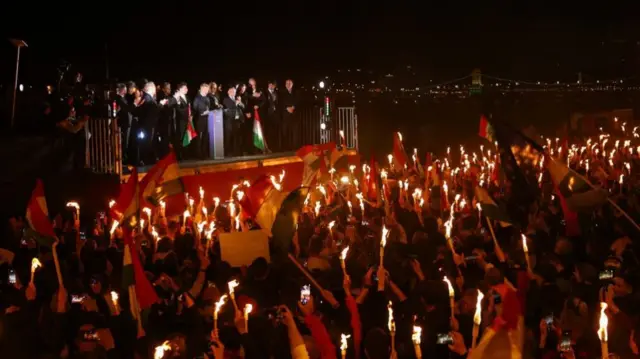
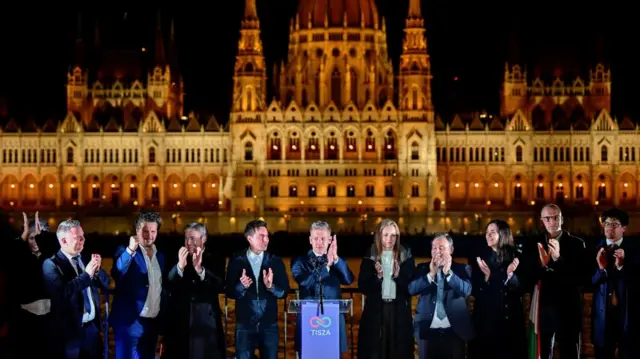
    Across Hungary, polling stations are due to close now. We won't know any results for a while and there's no exit poll in this election.

    But some of the polling stations won't close their doors immediately. They will remain open until everyone queuing up to vote at that time has had a chance to cast their ballot in this highly significant election.

    We already know there's been a record turnout - the latest figure from half an hour ago was 77.8% - well above the previous record in 2002 of 73.51%.

    The reason behind the long queues is partly due to the high turnout but also, under Hungarian electoral law, voters can choose to go to polling stations in other cities and vote for candidates in their hometown.

    That means thousands of extra voters have been turning up at polling stations particularly in big cities such as Budapest.

  2. What you need to know about Hungary's pivotal electionpublished at 17:59 BST

    Joe Coughlan
    Live reporter

    If you're just joining our coverage, we've had analysis and reporting from Hungary throughout the day. Here's what you need to know:

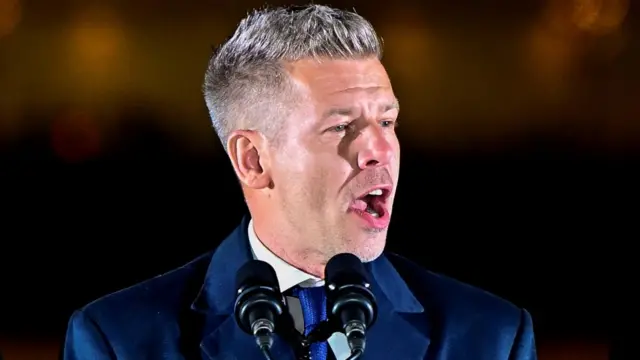
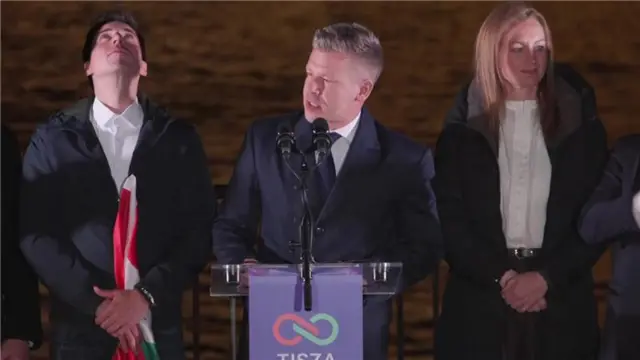
  3. Péter Magyar, the former Orbán ally who could replace him as PMpublished at 17:40 BST

    Roland Sebestyén
    BBC World Service

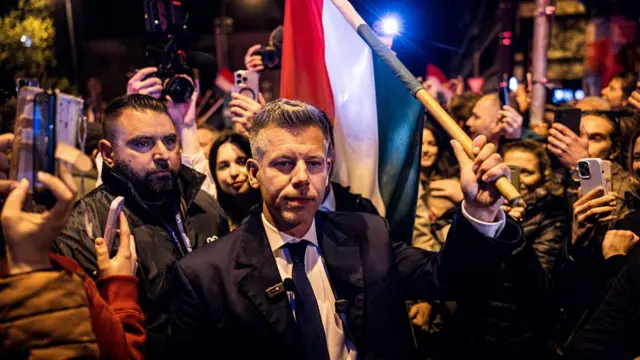
    Péter Magyar talks to media while wearing a navy suit and a black tie.Image source, EPA/Shutterstock

    Until recently, it was inconceivable that anyone could really challenge Viktor Orbán from within Fidesz’s circles - and Péter Magyar, the former husband of ex-justice minister Judit Varga, was certainly off the radar.

    But he quit the party following the resignations of President Katalin Novák and Varga after a child-abuse scandal in February 2024, becoming one of its fiercest critics and quickly establishing himself as Hungary's most visible opposition campaigner.

    Through his party connections, Magyar has had a front-row seat on how Fidesz operates, understanding what Orbán is all about.

    The prime minister dominates the political sceneand knows how to create an argument that he, and only he, can win.

    But Magyar, a 45-year-old lawyer, has taken every opportunity he has had to gain visibility since announcing he was running in the election.

    If Orbán organises a march, so does he. If Orbán tours the country, so does he.

    We'll know shortly whether that's enough to topple him after 16 years.

    You can click here to read a longer feature about Magyar's rapid rise in Hungarian politics.

  4. Who is Viktor Orbán, the Hungarian PM fighting to stay in power after 16 years?published at 17:29 BST

    Joe Coughlan
    Live reporter

    Hungarian Prime Minister Viktor Orban leaves after voting during the Hungarian parliamentary election in Budapest, Hungary, on 12 April 2026. He is wearing a white shirt and black blazer and is accompanied by several colleagues..Image source, Reuters
    Image caption,

    Orbán leaves a polling centre after voting in this year's election

    Viktor Orbán became leader of the Fidesz party in 1993, pushing it to the centre-right and leading it to election victory in 1998 - becoming Europe's youngest prime minister at 35.

    His political ideology is thought to have shifted during the second half of the 1990s, according to political scientist Zoltan Lakner, when he realised he had to transform his party into a nationalist force to combat the liberal-socialist coalition governing Hungary.

    Orbán suffered two political defeats in 2002 and 2006, before being swept back into office in the turbulence of the global economic crisis in 2010 and winning four consecutive elections.

    Since then, he has transformed Hungary with a host of changes to its laws and constitution, passing more than 40 "cardinal laws" in an attempt to secure his legacy.

    However, expensive state projects were placed in the hands of Orbán's inner circle and he has been accused of wielding huge influence over the country's media and judiciary, which many analysts say has undermined democracy in Hungary.

    Under Orbán, Hungary has been labelled the EU's most corrupt member by Transparency International - though the long-serving prime minister has won support from many voters during his time in office.

    You can read more about Orbán and how he has changed Hungary elsewhere on the BBC News website.

  5. Volunteer groups watch for voter intimidation at polling stationspublished at 17:22 BST

    Nick Thorpe
    Central Europe Correspondent, in Budapest

    A voting slip is examined by someone at a polling station in HungaryImage source, Getty Images

    "We are very happy and proud that so far, our film seems to have had a strong deterrent effect," says Aron Timar, the filmmaker behind The Price of the Vote documentary.

    The DE Action community spent six months documenting past and present voter intimidation in poor settlements across Hungary. Their film was posted on YouTube in March, and has 2.2 million views so far.

    They identified 100 districts where the population are particularly vulnerable to intimidation and vote buying.

    On voting day, their network of 2,400 volunteers and 200 motorcyclists have kept watch outside polling stations in those districts, to identify suspicious activities, in particular, bussing people to vote.

    Timar tells the BBC that "known organisers largely stayed away, fearing legal consequences", and turnout has consequently been far lower than the very high turnout registered elsewhere in those districts.

    The human rights and democracy office of the Organization for Security and Co-Operation (OSCE) has a full mission in Hungary. There are also a number of civic initiatives, watching for fraud.

    The Patriots for Europe group in the European Parliament, to which the governing Fidesz party in Hungary also belongs, has also organised there own monitoring mission. There have been several allegations of fraud.

  6. Who are the smaller parties on the ballot?published at 17:04 BST

    Zsofia Paulikovics
    BBC World Service

    A Hungarian election poster showing a cartoon of a dog with two tails wearing a tieImage source, Getty
    Image caption,

    A poster for the Hungarian Two-Tailed Dog Party

    While all eyes are on Fidesz and its challenger Tisza, there are some smaller parties vying for a place in parliament. To do so, they must secure at least 5% of the votes.

    The Hungarian Two-Tailed Dog Party (Magyar Kétfarkú Kutyapárt) is a satirical opposition party which gained some seats in local government in 2024 and now have their sights set on the national list.

    The Democratic Coalition (Demokratikus Koalíció) is a social democratic party founded by former Prime Minister Ferenc Gyurcsány in 2011, as a breakaway faction of the Socialist Party (MSZP). It is currently led by Klára Dobrev, an MEP and Gyurcsány’s ex-wife.

    The far-right Our Homeland (Mi Hazánk), led by László Toroczkai, is the small party which the polls predict is most likely to make it into parliament. While they claim they intend to act as a counter-balance to any reigning party, analysts have suggested that Our Homeland might informally support a minority Fidesz government.

  7. High turnout good news for opposition, says Magyar colleaguepublished at 16:51 BST

    Paul Kirby
    Europe digital editor, in Budapest

    Turnout being on course to break records is “absolutely good” for the opposition, the man picked by Péter Magyar to run his health policy, Zsolt Hegedűs, told me earlier today.

    “The message was all the time that every vote counts and everybody should turn out… so I hope that the two-thirds [majority]” will be achieved,” he said at a polling station a stone’s throw from Budapest’s parliament building.

    Hungarians complain their health system is dilapidated and underfunded and staff have gone to work abroad in big numbers.

    With a simple majority Hegedűs believes he could make a difference, with a change in attitudes across the healthcare system because “honesty and transparency and professionalism is missing in the Hungarian healthcare system”.

    “Obviously with a two-thirds majority it’ll be much easier, because… the government will be more stable, and in this way we can show much more easily some early achievement to the people and the pressure on the health system will be just a little bit less.”

    • For context, 133 parliamentary seats - a two-thirds majority - is the number needed to push through changes to Hungary's constitution. We have more on this in our earlier post.
  8. Turnout breaks Hungarian record - and voting isn't finished yetpublished at 16:38 BST
    Breaking

    Paul Kirby
    Europe digital editor, in Budapest

    We've just had the turnout figure for 17:00 (16:00 BST) and it's now 74.23%, a record for an election in Hungary.

    Last time around in 2022 it was 62.92%, and with more than an hour until polls close turnout has already surpassed the previous highest level of 73.51% in 2002.

    Political analyst Gábor Török suggests it could be on course for an 80% turnout when polls close.

    That doesn't necessarily mean it favours one party over another - although it's bad news for the far-right party Our Homeland and other smaller parties that need 5% of the vote to get into parliament.

    Péter Magyar's Tisza has already said it's good news for the opposition, but both leaders are calling on voters to get to the polls by 19:00.

    Here's Viktor Orbán's take on social media: "There are a lot of people voting. This means only one thing. If we want to protect Hungary's safety, not one patriot can stay at home!"

    Meanwhile Magyar says: "Now we have to give all we've got! Vote and encourage everyone to do this. Every vote could be decisive!"

  9. The oil pipeline fuelling tensions between Hungary and Ukrainepublished at 16:15 BST

    Joe Coughlan
    Live reporter

    Viktor Orban and Volodymyr ZelenskyImage source, Reuters

    Tensions between Budapest and Kyiv were heightened earlier this year when oil stopped passing through a major pipeline to Hungary and Slovakia.

    Deliveries via the Druzhba pipeline came to a halt after the major oil hub at Brody in western Ukraine was damaged in a Russian attack on 27 January.

    The channel supplies oil from Russia to Hungary and Slovakia and runs across Ukraine.

    Kyiv says the damage is severe and that it does not have the resources to repair it quickly, but Orbán's government has accused it of stalling.

    The situation highlights Hungary and Slovakia's continued dependence on Russian oil.

    Ukraine has accepted "technical support" and funding from the EU to speed up the mends.

    The stand-off resulted in Orbán vetoing a €90bn (£78bn) EU loan to Ukraine, holding up a crucial support package for the country.

  10. How Ukraine became central to the Hungarian election campaignpublished at 16:03 BST

    Rita Palfi
    BBC World Service, in Budapest

    A cyclist going past an election poster depicting Volodymyr Zelensky next to Peter MagyarImage source, Reuters

    Even before the first reports suggesting possible Russian efforts to bolster Orbán’s position, Ukraine had already become a central issue in Hungary’s parliamentary election campaign, dominating government messaging.

    It argues the EU and Kyiv risk dragging Hungary into the war, and that only Orbán’s Fidesz party can prevent it. The party has amplified the message using AI‑generated campaign videos.

    Fidesz has previously mobilised perceptions of external threat during election periods - most notably migration in 2018 and the war in Ukraine in 2022 - and analysts say the current campaign shows similar patterns.

    An anti‑migration billboard from 2017 that targeted Hungarian‑American philanthropist George Soros has been repurposed this time, his image replaced with Ukrainian President Volodymyr Zelensky.

  11. Would Magyar be able to change Hungary without a two-thirds majority?published at 15:47 BST

    Paul Kirby
    Europe digital editor, in Budapest

    Hungarians have become used to Orbán running their country with a majority that means his party had the power to sweep through changes to the constitution.

    But if Magyar’s Tisza party were to win a majority without that magic number of 133 seats, they could still change Hungary from where it is now.

    Meaningful structural change would be “almost impossible”, according to an ex-president of the Supreme Court, András Baka.

    Scrapping state control of the judiciary would be “very difficult”, he told our Budapest correspondent Nick Thorpe, but they could improve the “legal and political environment of the judiciary”.

    “Yes of course there are plenty of things that can be changed only with a two-thirds majority,” says Róbert László of Budapest-based think tank Political Capital.

    “But it’s not true that just because Péter Magyar didn’t get a two-thirds majority, he will be a lame duck.”

    He could reform health care and education - two of the biggest issues for voters. László also says Tisza could “shut down the propaganda machine of the public media”, raise salaries and change the tax system.

  12. A national vote with international importancepublished at 15:31 BST

    Aleksandar Miladinovic
    BBC News Serbian, in Budapest

    A woman is seen in front of an old building. She is smiling and has blonde hair, while also wearing a light green top and dark green leather jacket.
    Image caption,

    Borbála Szepes joined record numbers voting today

    The impact of today’s vote does not end at Hungary's borders, and one can feel that even in central Budapest.

    As they left a polling station, some voters said they had travelled from abroad just to exercise their democratic right. But not everyone appreciates the international focus on Hungary.

    A man, his eyes hidden behind sunglasses, asked me: “Why are you here? This is not your country. Why are you reporting from here?”

    Meanwhile, Borbála Szepes, a 32-year-old doctor, said she hoped “fewer of her friends would leave the country” after the election, which she says many have done in recent years.

    She was hopeful that hospitals and the country’s healthcare system would finally get more support from the next government.

  13. What the two main contenders in this election have said todaypublished at 15:16 BST

    Hungarian Prime Minister Viktor Orbán places his vote in a ballot box during the general election in Budapest, Hungary, 12 April 2026. He is wearing a black blazer and a white shirt.Image source, Reuters
    Image caption,

    Orbán smiled for the cameras as he cast his ballot earlier today

    Both Viktor Orbán and Péter Magyar cast their ballots earlier, surrounded by journalists and cameras.

    Orbán told reporters he was "here to win" and, asked if he had underestimated his rival, he added "I don't underestimate anyone".

    "There is a constitution in Hungary and it needs to be followed. The decision of the people needs to be respected," the Reuters news agency reported him as saying.

    AFP reported Orbán's warning of a "major crisis" awaiting Europe, adding: "Fortunately we have a lot of friends in the world. From America to China to Russia and the Turkish world."

    Péter Magyar places his vote in a ballot box during the general election in Budapest, Hungary, 12 April 2026. He is wearing a navy suit and a dark coloured tie.Image source, EPA/Shutterstock
    Image caption,

    Orbán's challenger Péter Magyar cast his ballot at a Budapest polling station

    The news agency also reported Magyar as calling on Hungarians to vote in the "decisive election".

    He said the vote represented the public choosing between "East and West", as well as "corruption or clean public life".

    Magyar claimed voting for Orbán would lead to "the complete collapse of public services", while urging the public to bring "EU funds home" to revive the Hungarian economy.

  14. Today's election on course for record turnoutpublished at 14:49 BST
    Breaking

    Updated turnout figures from Hungary's election authority show 66% of voters had cast their ballots by 15:00 local time (14:00 BST).

    That suggests this election could break the country's turnout record when compared with similar data by this time on previous polling days.

    Voting began at 06:00 local time (05:00 BST) and will continue until 19:00 local time (18:00 BST).

  15. Hungarians line up for 'most important vote' since collapse of communismpublished at 14:36 BST

    Nick Thorpe
    Central Europe Correspondent, in Budapest

    Hungarians line up to vote outside a Budapest polling station in the Újbuda district. A line is outside of the building along a street.
    Image caption,

    There were long queues at a polling station in the Újbuda district of Budapest earlier

    We've been speaking to Hungarians today outside a Budapest polling station.

    George says this is the "most important vote" since the collapse of the Berlin Wall in November 1989, adding that it is "extremely necessary" for both the older institutions and younger generation.

    Matthias describes today as an "absolutely incomparable opportunity" to replace Viktor Orbán, adding that he is "fed up" with the current prime minister.

    He says: "Each of the campaigns are driven by creating an enemy against whom the Orbán government is fighting."

    Ildikó echoes the sentiment, saying: "For many people, it doesn’t matter who runs the country, so long as it’s not Orbán."

    Judit voted for Orbán's Fidesz party. She says they have "kept all their promises so far", adding "we hope they'll win".

  16. Analysis

    An Orbán defeat would be a big blow to Trump and Putinpublished at 14:15 BST

    Katya Adler
    BBC Europe editor, in Budapest

    U.S. President Donald Trump (L) greets Prime Minister of Hungary Victor Orban as he arrives at the White House on November 7, 2025.Image source, Getty Images
    Image caption,

    Orbán met Trump at the White House last November

    Hungary may be a relatively small European country but under Viktor Orbán its influence abroad has been astonishing.

    Washington, Moscow, Beijing and Brussels are watching today's vote closely.

    President Trump has endorsed Orbán repeatedly. He sees him as a torchbearer for the nationalist Christian right.

    The Hungarian prime minister has courted considerable Chinese investment over the years. His opponents say that’s given China an indirect foothold into the EU.

    He’s also been hugely useful to Vladimir Putin - delaying EU sanction packages since Russia's full-scale invasion of Ukraine and now blocking a 90 billion euro EU loan Kyiv says it needs to buy weapons and survive.

    If Orbán loses this election, as polls predict - though we have to be careful with polls - it will be a blow for Trump and Putin, though many leaders in Europe won’t be unhappy to see the man they nickname the Obstructor walk offstage.

  17. Hungary election - the basics: Why 133 is the magic numberpublished at 13:47 BST

    Peter Magyar speaking on stageImage source, Getty Images
    Image caption,

    Péter Magyar will become prime minister if he wins 100 seats but needs a two-thirds majority to reverse key Orbán policies

    This is the last of five posts setting out the basics of this election - you can skip to the first by clicking here and scroll up to read them in order.

    Hungary’s National Assembly has 199 seats, so 100 seats are needed for a simple majority and for a party’s leader to become prime minister.

    Simple, yes? Not so.

    In reality, the real finish line that Péter Magyar’s Tisza have in their sights is 133 seats, a two-thirds majority.

    That is what has enabled Orbán to push through changes to Hungary’s constitution that have helped Fidesz take control of the media and judiciary, pass controversial electoral reforms, and, among several other laws, adopt a legal definition of marriage as being between a man and a woman.

    If Péter Magyar and his Tisza party want to fulfil their biggest election pledges to unpick Orbán’s policies, they will need a two-thirds majority.

    So 100 seats represents a significant win, but they would not be able to sweep away the Orbán years completely.

  18. Hungary election - the basics: The complicated bitpublished at 13:47 BST

    Ballots being counted in HungaryImage source, Getty Images
    Image caption,

    This is the first time Hungarians have gone to the polls for national elections since 2022

    Hungary’s election system is more intricate than many countries. The stuff you really need to know is in the post below - you should read that first.

    But if you want to get into the detail and understand why it matters, then here is the complicated bit.

    In Hungarian parliamentary elections, votes for losing parties in the constituency races are transferred to the national list tally, a sort of compensation system which in theory allows opposition groups to achieve some representation.

    However, under Orbán-era reforms, so-called excess votes for winning parties are also transferred to the national list tally - i.e, if a candidate wins a constituency by 5,000 votes, then 4,999 votes will be added to their party’s national list tally, increasing their chance of winning more seats.

    Critics say that change, as well as the redrawing of constituency boundaries, has helped Orbán’s party to win big, and Orbán has admitted the system benefits him.

    Take the last election in 2022 as an example. Fidesz won around 54% of the vote in the national list - but once so-called excess votes for Orbán’s party were transferred over from the constituency races, that contributed to them reaching a two-thirds majority.

  19. Hungary election - the basics: How the voting system workspublished at 13:46 BST

    The Hungarian parliament building
    Image caption,

    Hungary's parliament, the National Assembly, is based in the Országház building on the banks of the River Danube in Budapest - one of the city's most well-known landmarks

    The voting system for Hungary's parliament, the National Assembly, is… complicated.

    All 199 seats are up for grabs and a simple majority of 100 is needed for a party leader to become prime minister.

    However, there are effectively two systems happening at once, with most people getting two votes.

    First-past-the-post elections are held in 106 single-member constituencies, in which each party can field one candidate. Only Hungarian citizens who are resident in the country can vote in these.

    Then the remaining 93 are chosen via a semi-proportional national list system, whereby seats are awarded to a party based on vote share. Resident Hungarian citizens can vote again for this, as well as Hungarians abroad.

    The big test for Péter Magyar, if he wants to unseat Orbán after so many years is to win a simple majority of 100 seats. That in itself would end 16 continuous years of Orbán rule.

    But one respected opinion poll in recent days suggested Magyar could be on target for a two-thirds majority of 133 - we’ll have more on why that matters shortly.

  20. Hungary election - the basics: What is at stake?published at 13:46 BST

    Viktor OrbanImage source, Getty Images
    Image caption,

    Orbán has been at odds with other European leaders over his close ties with Vladimir Putin

    Viktor Orbán’s 16 years in power make him the longest-serving head of the state in the EU and he has used his time in power to transform Hungary into what the European Parliament calls an "electoral autocracy".

    Hungary is an EU and Nato member but Orbán’s close ties with Russia, and his decision to change his mind and veto tens of billions of euros of aid for Ukraine have put Hungary frequently at odds with most of his European partners.

    The Trump administration has thrown its support behind the sitting prime minister.

    The election has been framed as a choice between Orbán’s Eurosceptic, Kremlin-friendly approach, or better ties with the EU and a rejection of Russian influence under main opposition candidate Péter Magyar.