Summary

Media caption,

Equipment rattles in ramen restaurant as quake strikes

  1. Japan on high alert for large second quake after earthquake triggers tsunami warningspublished at 14:48 BST 20 April

    Maia Davies
    Live reporter
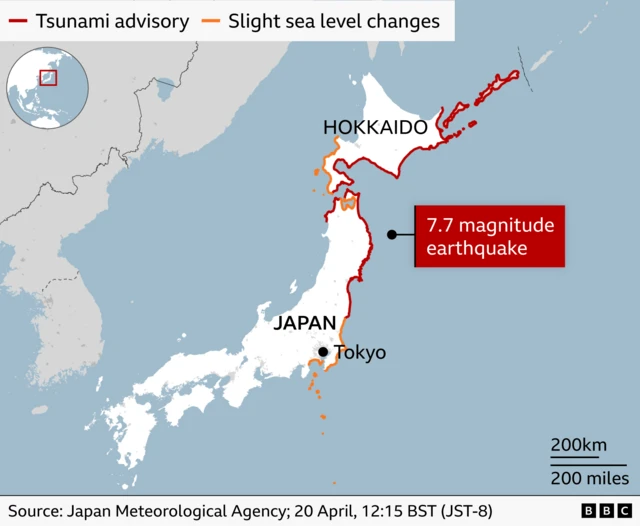
    A map of Japan illustrating the tsunami advisories along its north-east coast
    Image caption,

    A number of tsunami advisories remain in place across Japan's north-east coast

    Japan remains on high alert for aftershocks after its meteorological agency warned of an increased risk of a large earthquake - measuring 8.0 or higher - in the next week.

    It comes after thousands of people were urged to seek higher ground in the earthquake-prone country on Monday after a 7.7 magnitude quake struck off its north-east coast.

    The undersea activity off the Iwate prefecture triggered a string of tsunami warnings in the region and tremors as far away as the capital Tokyo, some 530km (330 miles) south.

    One resident said “everyone ran” after the earthquake alert sounded.

    The tsunami warnings were soon downgraded to advisories - the lowest level - but people are still warned to remain away from the coast.

    Waves reached heights of 80cm and no injuries or major damage were immediately reported.

    The UN’s nuclear watchdog said it had been informed by Japanese officials that no abnormalities occurred at the country’s nuclear facilities.

    We're ending our live coverage here, but you can read more in our news story.

  2. Further earthquakes occur in northern Japanpublished at 14:39 BST 20 April

    Smaller earthquakes often follow after larger ones - these are known as aftershocks.

    Following the 7.7 quake that occurred around 16:52 local time (08:52 BST) today, the Japan Meteorological Agency has recorded several smaller earthquakes.

    Off the coast of Sanriku, where today's large earthquake took place, there have been several smaller ones.

    The agency records the latest there at a magnitude of 5.4. Earlier, it reported one at 4.5 and another at 4.9.

    Elsewhere, a 4.3 magnitude earthquake was recorded off the Kiisuido Strait, in the south of the country.

  3. Japan reports no abnormalities at its nuclear sites, international agency sayspublished at 14:27 BST 20 April

    The International Atomic Energy Agency says it was informed by Japan that no abnormalities have occurred at its nuclear facilities following the earthquake and tsunami warnings.

    Earlier, Japanese media reported that there were no abnormalities at nuclear plants in the prefectures of Aomori and Miyagi, and the Fukushima Daini plant.

    The deadly 2011 earthquake caused a meltdown at the Fukushima Daiichi nuclear power plant,on the eastern side of the island - it took years to deal with the radioactive contamination.

  4. A 7.7 earthquake and tsunami advisories: What we knowpublished at 14:19 BST 20 April

    Imogen James
    Live editor

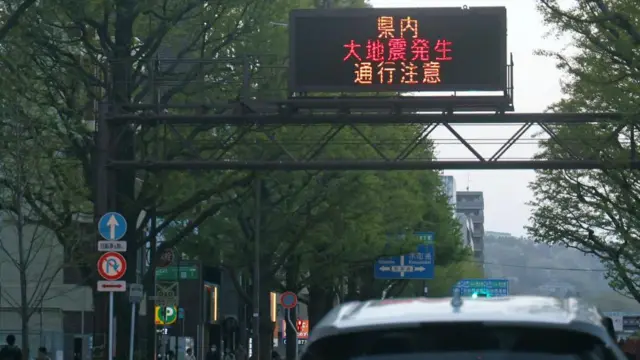
    A car drives underneath a digital sign with a warning written on it in JapaneseImage source, EPA

    A 7.7 magnitude earthquake occurred off Sanriku, off Japan's northeast coast, at 16:52 (08:52 BST) local time and had a depth of 19km (11.8 miles).

    Its strength was revised up, after previously being recorded at 7.5 and 7.4. The Japanese Meteorological Agency warns of aftershocks that could continue throughout the week.

    A tourist in Japan told the BBC he experienced the building "swaying and everyone's phone sounded the emergency alarm".

    Following the quake, tsunami warnings were triggered, covering much of the northeast. All the warnings have been downgraded to advisories, but people are still advised to remain away from the coast and large bodies of water.

    The first tsunami waves reached the Iwate prefecture, with one as high as 40cm recorded in Miyako port.

    The Japan Meteorological Agency initially forecast tsunami waves of up to 3m (10ft) reaching the Pacific coast of Hokkaido and Iwate prefectures - footage shows waves swelling in Hokkaido.

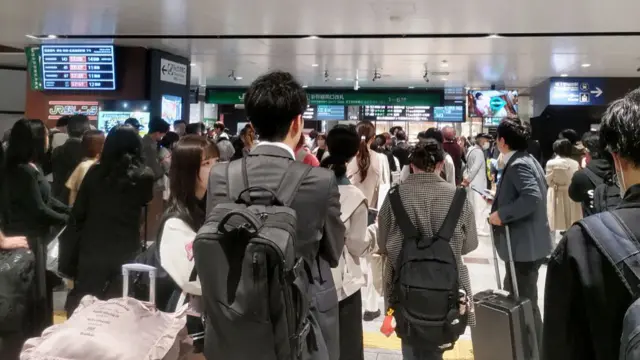
    As for public services, around 100 households are without power, according to the cabinet secretary, and some bullet train services have resumed after earlier cancellations, the operator announced.

  5. A few bullet train services resume but delays remain in place on some linespublished at 14:08 BST 20 April

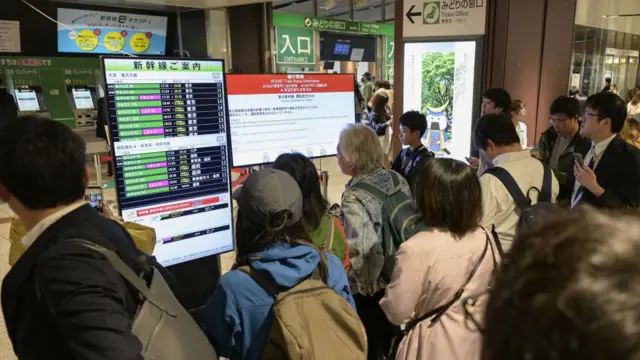
    A group of apssengers look at information boards in a Japanese railway station.Image source, Reuters

    The East Japan Railway Company says its bullet train operations between Tokyo and Hachinohe have resumed.

    The services between the capital and Morioka Station and Fukushima have also started back up again.

    Operations remain suspended between Morioka and Akita. There is currently no time scheduled for these services to resume. There are delays remaining between Fukushima and Shinjo.

    The operator said it had to suspend services due to the earthquake.

  6. About one in 100 possibility of another large earthquake following today'spublished at 13:56 BST 20 April

    Chika Nakayama
    Reporting from Tokyo

    The Japanese Meteorological Agency (JMA) says that the possibility of a large earthquake following today's 7.7 one is "relatively high".

    It has issued a subsequent earthquake advisory off the coasts of Hokkaido and Sanriku, but says that in such cases, the probability of the larger earthquake is only about one in 100.

    This represents a roughly tenfold increase in risk compared to normal conditions when it's usually 0.1% or less.

    Japanese authorities say it is essential that people remain vigilant for about a week, and are advised to make preparations to evacuate and confirm what routes they would take to do so should the need arise.

    The JMA says that it's not guaranteed a large quake will happen again, adding that there is no need for advance evacuation.

  7. BBC Verify

    Images show people on the move after Japan tsunami warningpublished at 13:45 BST 20 April

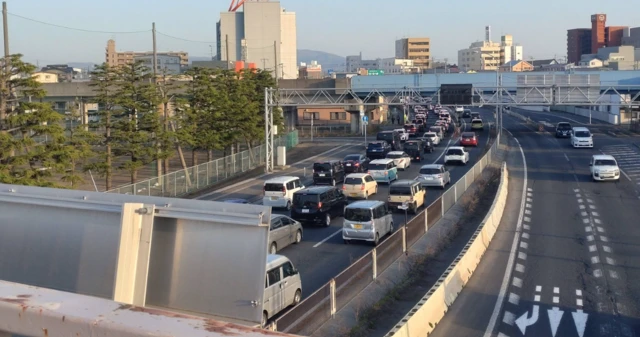
    Verified image of a busy road in north-east Japan as people attempt to leave the coast after an earlier tsunami warningImage source, Threads

    By Kumar Malhotra and Sherie Ryder

    Images verified by the BBC show busy roads heading away from the coast of northeast Japan after an earthquake earlier today resulted in tsunami warnings from local authorities.

    These have now been downgraded to advisories - although the authorities say people should stay away from the coast.

    In one image, which we located to the city of Hachinohe, three queues of heavy traffic can be seen heading southwards along a main road.

    Other images from the city show people in cars turning up at a military installation to seek shelter inland and away from the city’s port area.

    We checked these pictures emerged online today and geolocated where they were taken by using street view mapping.

  8. Alert gave us 30 seconds until earthquake hit, say British couple travelling Japanpublished at 13:28 BST 20 April

    Kris Bramwell
    BBC News

    A screenshot of a phone screen which shows the earthquake warning alerts coming in on a phoneImage source, Sophia Kapsalis

    Sophia Kapsalis and her partner Daniel Wilkinson have been travelling for six months and are currently at the end of a road trip around Hokkaido.

    The pair, both from England, say they were driving along the highway at 16:45 local time when the emergency alert app NERV "blew up saying we had 30 seconds until the earthquake hit".

    They pulled over and felt quite light shocks from the quake. "We definitely felt it,” Sophia says. “The car was wobbling and windows of houses near us were shaking".

    She says they've been driving inland since it happened but are struggling to get information about where they should be heading.

    They are “currently trying to get back to towns without going along the highway which is along the coast stuck going through rural small mountain roads in the dark," she says.

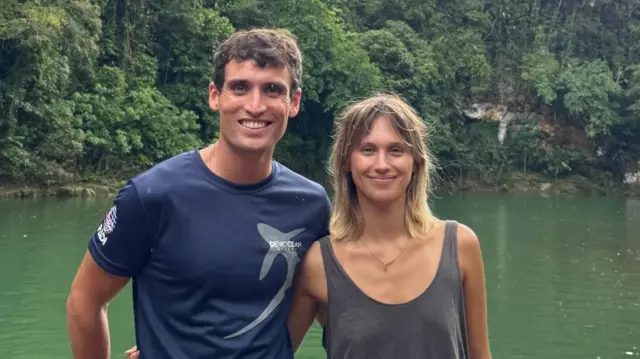
    Sophie and Danny smiling with their arms around each other facing the camera. They stand against a black railing in front of green water, which is surrounded by green vegetationImage source, Sophia Kapsalis
    Red graphic banner that is long and horizontal and says your voice in white lettering
  9. 'It was really surreal feeling the floors and walls move'published at 13:14 BST 20 April

    Kris Bramwell
    BBC News

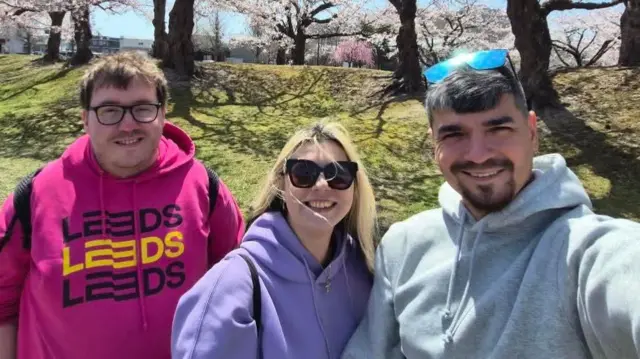
    David stood smiling with a man and a woman in front of a line of blossom treesImage source, David Park

    David Park from Leeds is currently on a plane travelling from Hakodate to Tokyo on the eighth day of a trip to Japan with his friends Diana and Alin from Newcastle.

    The 31-year-old says he and his friends felt today's earthquake whilst waiting in their hotel in Hakodate.

    He says while they sat in the lobby, there was "suddenly a really low rumbling".

    “All of a sudden, the building started swaying and everyone's phones sounded the emergency alarm alerting to an earthquake, then about 30 seconds later, a warning for the tsunami," he tells the BBC.

    “The shaking lasted for a good 20 to 30 seconds - it was really surreal feeling the floors and walls move and seeing the lights and plants sway around."

    He says everyone gathered to watch the TV, where they saw the news alerting them of the earthquake and tsunami warnings.

    “Nobody seemed to panic but there was a sense of unease."

    They left for the airport and David says lots of shops were closed and they got stuck in traffic.

    During the journey, he says they could hear tsunami warning sirens going off.

    A red banner that says your voice in white writing
  10. People advised not to return to coast despite tsunami warning downgradepublished at 13:03 BST 20 April

    As we have been reporting, the tsunami warnings have been downgraded to advisories across Japan’s northeast coast.

    However, emergency alert app NERV says people are still advised to remain away from the coast and to avoid any large bodies of water until the advisories have been lifted.

    Government evacuation orders, issued after the earlier tsunami warnings, mean around 156,000 people were told to evacuate across five prefectures.

  11. Tsunami warnings downgraded to advisoriespublished at 12:39 BST 20 April
    Breaking

    Japanese authorities have now downgraded the tsunami warnings in place around the northeastern coast to advisories., external

    Japan has three categories of tsunami alerts.

    • A Tsunami Advisory is the lowest-level alert, issued for waves below one metre. At this height, people are advised to get out of the sea and leave coastal areas immediately
    • A Tsunami Warning is the second-highest alert. These are issued for waves expected to be up to three metres high
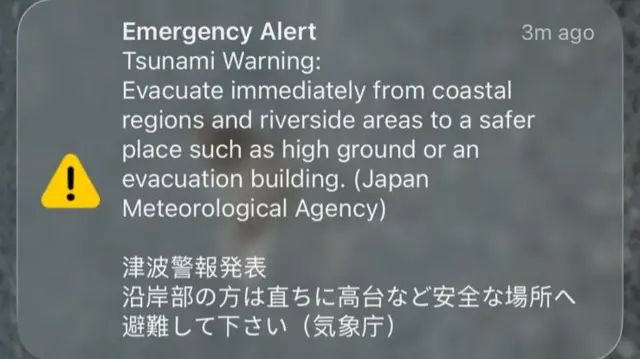
    • When a warning is issued, the agency says those in tsunami warning areas must evacuate immediately from coastal regions and riverside areas and move to higher ground or an evacuation building
    • The highest alert is called a Major Tsunami Warning where tsunami waves over three metres in height are expected to hit repeatedly.
  12. Japanese authorities revise magnitude of earthquake to 7.7published at 12:24 BST 20 April
    Breaking

    Japanese authorities have revised the magnitude of the earthquake which struck earlier to 7.7.

    It was initially announced as having a magnitude of 7.5.

    The depth at which the quake occurred has also been revised from 10km to 19km (11.8 miles).

  13. Watch: Waves swell in Hokkaido following earthquakepublished at 12:13 BST 20 April

    Video footage from Hokkaido shows waves swelling close to the shore.

    Hokkaido was one of the areas where a tsunami warning was issued, following the earthquake striking off Japan’s northeast coast.

  14. 'As soon as the alert went off, everyone ran'published at 11:46 BST 20 April

    A person stood on the roof of a buildingImage source, Reuters
    Image caption,

    People have also been warned to head to higher ground

    "As soon as we heard the earthquake alert, everyone ran downstairs," Chaw Su Thwe, a Myanmar national living in Hokkaido, tells the BBC. "However, this time the shaking was relatively mild."

    She's one of many young people who have moved to Japan from Myanmar for work after the military coup there in 2021.

    "Right now, local authorities are using loudspeakers in the neighbourhood to warn people about a possible tsunami and to stay alert. Office workers have been allowed to leave work early," she says.

    "At my workplace, the boss has told us to stay cautious and to come to them if anything happens."

  15. A look at Japan's tsunami warnings and advisoriespublished at 11:32 BST 20 April

    Damaged houses next to a beach following a tsunamiImage source, Reuters
    Image caption,

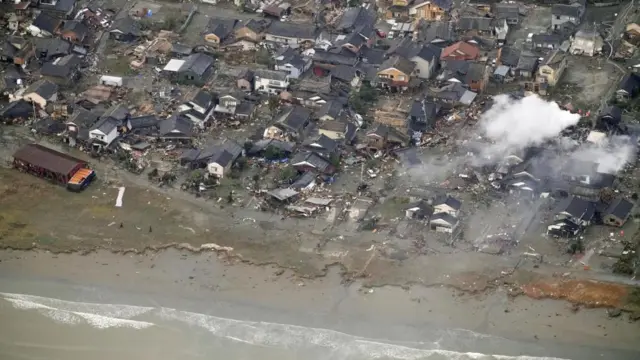
    A tsunami damaged a residential area in Suzu in 2024

    Tsunami warnings and advisories for various parts of Japan’s northeastern coast are in place.

    Japan has three categories of tsunami alerts, according to the Japan Meteorological Agency., external

    A Major Tsunami Warning is for waves considered “huge”. These are issued when waves of 5 to 10m are expected.

    A Tsunami Warning is the second-highest alert, issued for waves expected to be around 1 to 3 metres high.

    The agency says those in the warning areas must evacuate immediately from coastal regions and riverside areas and move to higher ground or an evacuation building.

    A tsunami advisory is the lowest-level alert, issued for waves below 1 metre. People are advised to get out of the sea and leave coastal areas immediately when these are issued.

  16. Bullet trains in northeast Japan suspendedpublished at 11:16 BST 20 April

    Severla people waiting it at a railway stationImage source, Getty Images
    Image caption,

    Shinkansen services are among those suspended

    As we have just reported, several bullet train services in the northeast of Japan have been suspended due to the earthquake, according to transport operators.

    A few lines serving the capital, Tokyo, are affected. These include the Tohoku Shinkansen line, the Yamagata Shinkansen line and the Akita Shinkansen.

  17. Around 100 households without power following earthquakepublished at 11:04 BST 20 April

    Minoru KiharaImage source, Reuters
    Image caption,

    Minoru Kihara photographed in 2025

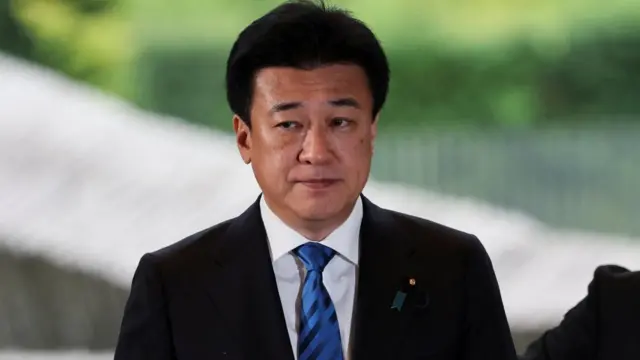
    Japan’s Cabinet Secretary Minoru Kihara is giving an update and says residents should stay inland until tsunami warnings are lifted.

    Around 100 households are without power, he says, and some bullet train services are currently on hold.

  18. Are you affected by the earthquake in Japan?published at 10:59 BST 20 April

    A wide purple banner with the words 'Your Voice' across it

    Please get in touch, but only if it is safe to do so.

    You can get in touch in the following ways:

    Please read ourterms & conditions andprivacy policy

    In some cases a selection of your comments and questions will be published, displaying your name and location as you provide it unless you state otherwise. Your contact details will never be published.

  19. Earthquakes of similarly high magnitude could strike over next week - authoritiespublished at 10:53 BST 20 April

    The Japan Meteorological Agency is warning that earthquakes of a similar scale to today's 7.5-magnitude quake could strike over the next week.

    Warnings such as these are standard procedure following a major earthquake.

    Officials have warned people to keep watch for landslides or similar earthquakes later this week, and that an even bigger tsunami could still hit after the first wave.

  20. Japan sees major earthquakes around once a yearpublished at 10:32 BST 20 April

    Kurumi Mori
    Tokyo correspondent

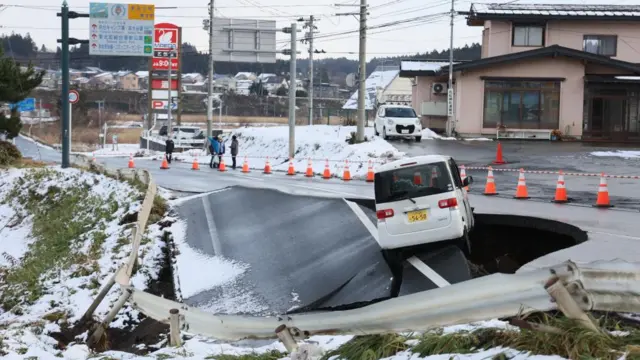
    A white car balances across a hole in the rode following an earthquake.Image source, EPA
    Image caption,

    A powerful 7.5 magnitude earthquake hit northeastern Japan in December 2025

    Statistically speaking, Japan gets an earthquake with a magnitude seven or above about every 16 months, so that’s just under once a year on average.

    According to the Japan Meteorological Agency, the country accounts for more than 10% of all earthquakes with a magnitude of six or higher that occur worldwide.

    The most recent major quake was a magnitude 7.6 off Aomori prefecture in December 2025, but the deadliest modern event was the 2011 Tohoku earthquake which was magnitude 9.0, triggering a tsunami, killing more than 18,000 and causing a nuclear meltdown in Fukushima prefecture.

    When the tsunami warnings were triggered then, many people didn’t think the tsunami would be so big and didn’t seek high enough ground.

    Now, the government issues tsunami warnings and advisories and urges residents to flee the area as soon as possible.

    There’s been more education about tsunami waves since 2011 about how even a 30cm wave can be life-threatening.