You're a former winner of the North West Poetry Slam, what made you turn your attention to novel-writing?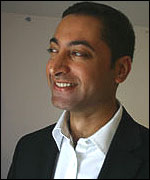 | | Zahid Hussain |
"I began writing when I was very young. I absorbed a love for books and reading from my mother and I attempted to write my first novel when I was 14 – it was a fantasy novel inspired by the Lord of the Rings.
"I began to seriously write poetry when I was 17 after moving to Manchester from Blackburn and that’s when I joined the Identity Writers’ Workshop based in city centre Manchester. "Lemn Sissay used to run the workshop at the time – many big Poetry Slam names have come out of it, people like Diké Omeje, Shamshad Khan, John Siddique to name just a few. I personally didn’t get into slam poetry until after university, in 1997. So, to cut a long story short, writing fiction was my first love, not poetry. 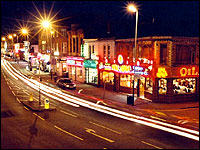 | | The Curry Mile in Rusholme |
"When I won the NW Slam, it was during the year when we had to ‘slam’ in a group of two or more. Although originally intending to convene a four-person slam group, we ended up with two: Diké Omeje and me. We called ourselves ‘2Face’ and we went on to the North West Slam after a series of heats – and that was despite the fact I had never performed in public before." What's The Curry Mile about?"In a snapshot, it’s a story of real-life Manchester, peering into the lives of the members of an Asian family that’s in the restaurant trade. The story is narrated through the eyes of two characters: father and daughter. | "It is a flaming beacon dispelling the darkness of right wing extremism by showing that different communities can intermingle, adapt, change..." | | Zahid on why he thinks the Curry Mile is so important |
"The father’s journey is about survival and succession and the daughter’s journey is about identity, recognition and self-determination. It’s an old story rewoven for modern times. It’s very much a Mancunian dish that gives, I hope, a sense of the raw energy of life on the Mile." What made you decide to write about the Curry Mile?"For a very long time, I wanted to articulate a vision of what means to be Asian in modern Britain and yet give a sense of the turbulent waters of multi-cultural existence and I found a perfect setting for it. For anyone who lives in Manchester it is one of those thoroughfares – the busiest bus route in Europe – that defines Manchester, and perhaps defines the reality of modern day Britain. "The Curry Mile is an incredible location for a novel – definitely equal if not better than Brick Lane, but with the combination of university students, college students, restaurant and takeaway workers, newsagents, Pakistanis, Arabs, Kurds, Indians, Jamaicans, Somalis – and all the other denizens and citizens of our city, it has become ‘home’. 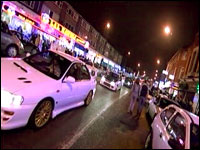 | | Rusholme during Eid |
"If you come in the early hours of the morning on a weekend, you find it teeming with people sampling late night curries, kebabs… if you come during the day, you’d be mistaken to think it belonged only to students – and on Eid, well, that’s another story - watch this space! "Ultimately, I suppose I chose to write about it, because I love it for what it is and what it represents – the Curry Mile is the one place in our city where I think you get a sense of Manchester being united. I sometimes feel that Manchester with its superb marketing machine has missed a trick or two when it comes to the Mile. It is a flaming beacon dispelling the darkness of right wing extremism by showing that different communities can intermingle, adapt, change, learn from each other and share each other’s cuisine." How have you captured the feel of the area in the book?"I think I have drawn a strong and colourful vision of the physicality of the Curry Mile, but I have also tried to create a sense of the competitiveness, the streak of ruthlessness that underpins the daily reality of many who work there. I have tried to convey this energy through the style of writing and also through the dialogue of the characters. 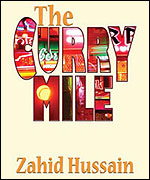 | | Zahid's novel: The Curry Mile |
"Simultaneously, I have attempted to deal with the multi-lingual nature of the characters’ reality and what language means to them which again conveys some of that entrepreneurial, diasporic energy of the Mile. I think it reflects the multi-layered realities of the protagonists and for me this reveals a powerful dynamism, a sense of how people are crossing continents through speech in order to achieve their dreams and ambitions." Your father advised you to leave creative writing to your spare time. Do you still think that was good advice?"I think it was brilliant advice. Anything that is worth doing takes effort and commitment. Five years were spent writing the novel and I don’t think I would have had the discipline, drive and vision if my father had not tried to do the safe thing and advise me to take a more practical route. "Also, I would add that I think that writing has to be something that you love doing and if it became a job I probably wouldn’t have enjoyed it. Most writers make very little money from writing – there are a few notables, who make a lot of money, but it is actually quite rare – and I hate to think I was doing it for the money. I’m not. My father’s advice forced me re-evaluate my priorities and ultimately I decided that this was what I wanted to do. "There are writers or potential writers who have the ambition of writing a best-seller, to become another J K Rowling or Stephen King, but I don’t think that’s how those writers came to the world of words. If you read what great writers have written about their motivation for become authors, you’ll find first and foremost, it’s a total passion and zeal for writing." The Curry Mile is published by Suitcase Books and is out on Thursday 2 November. |