Image: Getty


Introduction
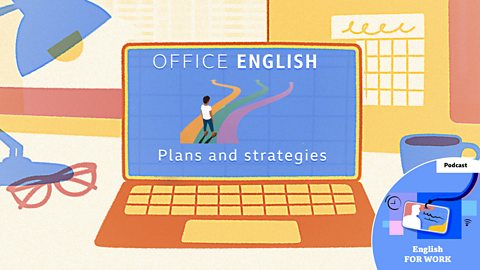
Do you talk about the future at work? In this episode of Office English, Pippa and Phil talk about targets, objectives and how to plan for the future.
TRANSCRIPT
Note: This is a transcript of a spoken conversation and is not a word-for-word script.
Pippa
Do you make long-term plans at work?
Neil
It's quite easy to make long term plans that you haven't thought about very thoroughly. It's more difficult to make detailed plans that you've thought through really well.
Georgie
I find it quite hard to make long-term plans myself because I'm not very organised. I find it hard to see into the future and make a structured timetable of events. I'm not very good at that.
Phil
In this episode we'll talk about plans and strategies.
Pippa
So Phil, today we're talking about plans and strategies. What do we mean by strategy at work?
Phil
Well, a strategy is a plan to do something, but it's a very detailed plan to do something. So you've probably got lots of steps and perhaps different ways that you want to do something.
Pippa
Mhm. Yeah. And it's what you want to do but also how you want to do it. So it usually involves some deadlines and targets some success criteria, but it can also be a particular way of approaching a problem. So, for example, a sales strategy, you might want to increase your sales at a company. The strategy is the way that you approach that problem. How do you do it?
Phil
Yeah. And so today, we're going to discuss how to come up with plans and strategies and also how to decide whether they're working or not.
Pippa
OK. Let's imagine you've been asked to come up with a strategy to improve results in your team at work. Maybe your bosses want to increase sales or improve productivity. What words and phrases can we use to talk about plans like this, Phil?
Phil
Well, we've got the what. Which is thinking about what you want to do and what you can achieve. So, for example, you might say we're aiming to cut costs by 25%. And you could call this an objective. We also might call them success criteria. And these are the things that when you meet them, you'll know that your strategy has worked.
Pippa
Yes. We also need to think about the when. So timelines or deadlines are useful. You'll often hear people in this context talking about quarters of the year. So, imagine the year broken up into three-month quarters. They're often abbreviated to Q1, Q2, Q3, Q4. So, for example, someone might say the first phase of our plan will be implemented in Q2 and we'll evaluate its impact at the end of Q3. That means we'll start in the second quarter of the year, and then we'll review things in the third quarter of the year.
Phil
And then we have the how. And those are what specific things are you going to do to try and meet these targets. And it's quite good when you're specifying these to use definite language, say we will do something rather than we'll try to do something.
Pippa
Yeah, I think that's really important. So, strategy is not just a target. It is all of the things that you want to do. Your approach to meeting those targets that you've got for yourself.
Phil
OK. We've talked about creating a strategy, but how can we decide whether the strategy is working and make changes?
Pippa
Well, one way is to look at the evidence. So, we mentioned there might be success criteria, um, these might have numbers attached. So, say your target is we want to cut costs by 25%. You would measure, look at the evidence. What percentage have you cut costs by at the end of a certain amount of time.
Phil
Yeah. And sometimes these things might be called key performance indicators or KPIs. And they're just the things that are measured so you can assess how well or how badly a strategy is doing.
Pippa
Yeah. So, it may be that everything's gone well and you've met your targets, your strategy is working. But if it's not, if you've not seen the results that you'd hoped for, then it's probably a good time to talk about changes, what you can change in your strategy that might make things better. Um, how would we do this, Phil? What are some options?
Phil
Well, you might talk about priorities. You might say um, well maybe cutting costs isn't, isn't working. But why don't we prioritise increasing sales instead?

Pippa
OK, we've talked about strategies, but what about long term plans? How much should you plan for the future at work, Phil?
Phil
Well, this is going to depend a lot on the industry you're in and the kind of work you do. It might be that something's probably not going to change that much. So, you can look way off into the future. Or you might be in a really fast moving field where it's just impossible to predict what happens next.
Pippa
Mhm, yeah. And it depends on your role and responsibilities. So, some people work shifts or in jobs which are much more day to day. They're really just dealing with what happens on the day. So, imagine a doctor for example. They really are just treating the people that walk into the hospital on that day. Whereas other people focus on strategy and planning a lot more in their job, their, their job is to look into the future and to build something over time. But I think it can be useful to think about the future even if your job is quite day to day. It can be tempting sometimes to just worry about what's in front of us and not make long term plans. So, how can people think about these long-term plans if they're not used to doing it at work?
Phil
Well, what's probably a good idea is to think about what your ultimate goal is. What do you want to achieve in the future? What would you really like to have achieved? And maybe, yeah, try and write that down, quantify that and go, this is what I'm aiming at.
Pippa
Another thing to think about is are there any events or changes coming up that might impact you, your job or your company? Um, so will there be a big shift away from the kind of work that you do? Is there a big thing happening in the future that you need to prepare for?
Phil
Yeah. So, when you, when you've thought about all these things, you've got your ultimate goal. You've considered what kind of threats or what kind of opportunities there are for things that could change. Then think, OK, how do we work back from that goal? What are the things that I need to do to make sure that I can achieve it?
Pippa
OK. That's it for this episode of Office English. Find more programmes to help you with your business English on our website bbclearningenglish.com.
Phil
And if you want to keep updated about our latest programmes, subscribe to our free email newsletter. There's a link in the notes below this programme. Bye for now.
Pippa
Bye.
Now try this...
Subscribe to our email newsletter

Office English ล่าสุด
Formal or informal?
Episode 260810 / 10 Aug 2026
Learn what kind of language to use in different situations at work.
Career development
Episode 260511 / 11 May 2026
Learn to talk about training, promotions and networking.
Writing notes
Episode 260504 / 04 May 2026
Learn what you should and shouldn't write down in a meeting.
Extra work
Episode 260427 / 27 Apr 2026
Learn to talk about new opportunities and having too much work.
Suggestions and advice
Episode 260413 / 13 Apr 2026
Learn how to make suggestions without sounding rude
Describing your job
Episode 260330 / 30 Mar 2026
Learn how to explain what you do to people in and outside of work.
Small talk
Episode 260209 / 09 Feb 2026
Learn which topics to use at work with people you don't know.
Deadlines and logistics
Episode 250526 / 26 May 2025
Learn the language for organising things at work