| 28 October 2014 |

| |
| BBC Homepage | | |
| |||
| Contact Us | | |
FeaturesYou are in: Lancashire > Nature > Features > Conservation heroes: Jane Bryson 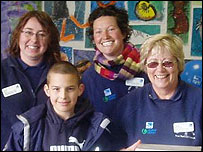 Jane (far right) in the Ribble Discovery Conservation heroes: Jane BrysonJane spends her day teaching about the 'magic of the mud' at the RSPB's Ribble Discovery Centre in Lytham St Annes... What's your job title?"I work for the RSPB as the lead Field Teacher at The Ribble Discovery Centre in Lytham St Annes." What does your job involve?"Part of the role of the Ribble Discovery Centre is to introduce school children (along with their teachers and parent helpers) to the wonders that are found in the special habitat of the Ribble Estuary. The Ribble Discovery Centre is one of the RSPB's nationwide network of centres of environmental education excellence, or ‘Living Classrooms’. I take groups of young people, who come to the Centre from schools around the North West, for a voyage of discovery to find out at first hand why the estuary is so important for wildlife." Can you describe a typical day?"A typical day sees me working with the groups of children who come to the Centre to experience a day on the mud with the RSPB. The wonderful thing is that no descriptions of the day prior to the visit can capture the 'magic of the mud' - it has to be a hands on experience as the children venture into the tiny, tiny world of the invertebrates, molluscs and crustaceans that inhabit the estuary. "Behind the whole day lies the message of the need to conserve and protect this estuarine habitat, within it lies many of the subtle changes taking place on our planet, which could have a devastating long term effect if overlooked." Is there a part of your job that you find difficult?"The children always enjoy getting stuck in! But, because the estuary is such an unfamiliar environment for many people, it can be difficult to convey to some adults the importance of understanding the 'specialness' of this habitat and the long term impact that not looking after it could have on their futures." What's the most satisfying part of your job?"Seeing the sheer joy and excitement that our 'technologically minded' children still show when they find these miniscule creatures and experience 'nature' at first hand. " In one sentence, why is conservation important?"Life as we know it depends on it." If you could have conservation-related wish, what would it be?"That the Marine Bill proposed by the Government is included in the November 2007 Queen’s Speech and that the importance of the marine environment receives the prominence and protection it deserves. Wildlife on the mainland is generally well protected but out at sea there is virtually no protection at all. Some of the most fascinating creatures on the planet – basking sharks, bottle-nosed dolphins, sea horses, sponges, sea slugs and corals – and a spectacular variety of sea birds – such as gannets, puffins and kittiwakes – are under pressure from human activities and developments at sea." Any funny stories?(Parent helper from school in inner Manchester) "Well, I wish I’d come here when I was a kid. I’m 38 years old and I never knew that all these sea shells had living things in them! I can't believe it." How can people get involved?"Supporting the RSPB is a great way to help make a difference for wildlife. It’s really important to help spread the word to the next generation. You could volunteer to help with our work at the Ribble Discovery Centre, or one of our nature reserves and conservation projects in Lancashire. Find out more at www.rspb.org.uk or contact the Ribble Discovery Centre on 01253 796292. The Ribble Discovery Centre is run by the RSPB in partnership with United Utilities and Fylde Borough Council." last updated: 05/03/2008 at 12:05 Have Your SayWhat do you do to help conservation? Joan Bryson S C Wearne SEE ALSOYou are in: Lancashire > Nature > Features > Conservation heroes: Jane Bryson    |
| | About the BBC | Help | Terms of Use | Privacy & Cookies Policy |