On Friday 13th April, 1821 the prison hosted its first public execution.
John Horwood was hanged above the gatehouse entrance, three days after his 18th birthday, for the murder of Eliza Balsum, an older girl with whom he had became infatuated and had openly threatened to kill.
Eliza died from a fractured skull after being struck by a large stone thrown by Horwood as she crossed a stream.
John Horwood was tried and sentenced to hang at the New Gaol prison. His remains were then to be given over to the surgeons at the Bristol Royal Infirmary for their dissection classes.
Hanging in those days was not a quick process.
The 'long drop' method had yet to be developed. This used the victim's own weight, combined with a fall, to break their necks, creating merciful unconsciousness.
Instead the condemned, bound hand and foot, were dropped through a trap door on a short rope to strangle to death over a period of minutes - usually accompanied with much writhing around.
Finding himself within the oppressive confines of the condemned cell, John Horwood abandoned his previous indifference to his victim and reverted to his chapel upbringing.
"Lord, thou knowest that I did not mean then to take away her life but merely to punish her: though I confess that I made up my mind, some time or other, to murder her," he confessed. 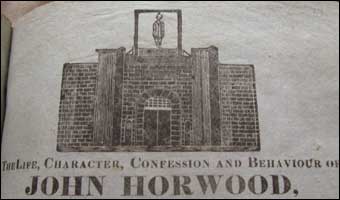 | | | | A contemporary print showing John Horwoods hanging. This illustration comes from a book detailing his trial and execution and is bound with his own skin. | | |
John Horwood was publicly hanged on top of the prison gatehouse in front of an assembled crowd.
Such was the appeal of these open air executions that some parts of the crowd risked being pushed into the unfenced New Cut river by their sheer weight of numbers.
After the execution, a group of friends and family lay in wait hoping to prevent the conclusion of the boy's sentence - his dissection.
They planned to ambush the cart carrying his body and spirit it away by boat back to his home town of Hanham.
However, the gaol authorities thwarted this plan by delivering the corpse under cover of night to the Bristol Royal Infirmary, where the surgeon Richard Smith carried out the dissection as one of his classes.
In an even more gruesome twist, Smith had the boy's skin preserved and tanned. 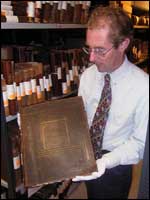 | | | | This book contains the account of John Horwood's trail and execution and is bound with his own skin. | | |
A book binder was engaged to put Horwood's skin around a ledger containing the account of the murder he carried out, the trial and his execution.
Its black cover was embossed with a skull and crossbones at each corner and on its front bore the gilded legend Cutis Vera Johannis Horwood which translated means, "The skin of John Horwood."
A bill for ten pounds from the binder sits inside its covers.
For years the macabre book lay within the vaults of the BRI but it now resides in the Bristol Record Office, ironically located at the opposite end of the Cumberland Road where John Horwood's life was ended for him.
The book has now become too fragile over the passing years to allow the public access to it.
The Record Office, however, has made its contents available on microfiche within their searchroom.
Gruesome Bristol: New Gaol prison.
John Horwood and his macabre book legacy.
The Bristol Riots, the breaching of the Gaol and its revenge on the mob.
Bristol's traumatic last hanging and the Gaol's closure
|








 Motorway gridlock special
