| 28 October 2014 |

| |
| BBC Homepage | | |
| |||
| Contact Us | | |
FilmsYou are in: Bradford and West Yorkshire > Entertainment > Films > 'A great pleasure!'  Ken Loach 'A great pleasure!'There are few film directors who have done more to change the face of British cinema than Ken Loach. We caught up with Ken as he came to West Yorkshire to accept the Bradford International Film Festival (BIFF) 2007 Lifetime Achievement Award. In 2006 Ken Loach's most recent film, The Wind That Shakes the Barley, received the world's most prestigious cinema award, the Cannes Film Festival's Palme d'Or. Now Ken's lifetime contribution to film is being marked in Bradford. Previous recipients of the BIFF Lifetime Achievement Award include Lord Attenborough and Jenny Agutter of Spooks and Railway Children fame. Ken is no stranger to the Film Festival. Last year he was in Bradford to take part in a re-union of the cast and crew of his 1969 film Kes. Shot in Hoyland - just across the South Yorkshire border - Kes is often named as one of the greatest British films ever made. Asked how he feels about returning to Bradford this year, Ken says: "It'll be a great pleasure. Bradford do a great job in keeping the variety of films alive - the diet we get in the multiplexes is so narrow." From his earliest days as a film director, first for TV and then the big screen, Ken Loach has been doing his best to add to our experience of cinema. Based on a novel by Yorkshire author Barry Hines, Kes - his second film - is the story of a boy in a Barnsley mining village who for a short time escapes from the grim reality of his life when he finds a wild kestrel. 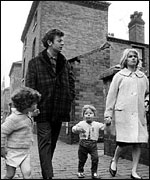 Cathy Come Home, 1966 Asked what impact he thinks Kes made on its release, Ken is modest: "I don't know. It's really difficult to judge these things. Obviously what we tried to do was to make a film that got closer to real experience than most films traditionally did. I'm not the best person to say whether it really happened or not. I think it touched quite a lot of people because a lot of people have been in Billy Casper's situation of being in a school where no one regarded them very highly, having to find their own way of escape whatever that was." Ken doesn't think today's cinema is any better in the way it reflects people's everyday experiences: "Well, it's not something the cinema does traditionally, is it? Traditionally the cinema encourages us just to go and admire Americans, and how rich they are, or how violent they are, or how they conquer the world, or how they won World War Two. That's primarily what cinema does and anything that doesn't have an American accent is an unusual thing. By and large cinema pursues a narrow vision of the world - mainly to get our money." But it doesn't have to be like this: "It's a medium, it can do anything. There should be a huge variety of films to see, and different types of films from different countries and different cultures. If you went to a library and all you could find were American airport books then you'd think it was a rather poor library, but that's effectively what we have in the cinema."
One film, directed by Ken Loach, which certainly had an impact, was the ground-breaking docudrama Cathy Come Home. Made for TV, Cathy's experience showed what it was like to be homeless in the Britain of the so-called 'Swinging Sixties' and led directly to the creation of the charity Shelter. Forty years on, Ken still sees homelessness as an ongoing problem: "If you ask the queston, 'Why?', I'd say it was because of the ongoing economic situation which doesn't marry employment to where people are. People have to leave home, villages get closed down, people travel to other parts of the country for work, families are disrupted and find they've got nowhere to live. There'll be more immediate causes but I think that's the root cause. Yes, you could make lots of films about that." Nor does he see any easy way out of this situation: "There is hope but not while we've got New Labour and the Tories and the Liberals all occupying the same political space. I mean, they are all free marketeers of one political stripe or another. If it's the market economy which is producing these anomalies and this inability to provide the space, the homes, the jobs, the security and the job security - which I'd argue it is - then obviously you've got to look for a different kind of politics." As well as seeing Ken receive the BIFF 2007 Lifetime Achievement Award at the Festival, there's also an opportunity to listen to him discuss his career with the Festival's Artistic Director, Tony Earnshaw. This special Festival Screentalk will be preceded by a showing of The Wind That Shakes the Barley. The film deals with the birth of the Republican movement in Ireland: "We just tried to tell the story of what happened in Ireland. Before the War of Independence Ireland was a colony, and after that it had a large measure of independence but the deal that was foisted on the Irish by the British left a legacy of pain and suffering and discrimination, the suspension of human rights and all those things. The responsibility for that in a way lies with all those people who insisted that the Irish accept it and who armed one side to kill the other side. I mean if the word wicked means anything then that was a pretty wicked thing to do." Ken is now in the cutting room with his latest film, These Times, which has a very contemporary theme. It's about two women who run an employment agency and the people who come to the UK to find work. We ask Ken if he thinks he might make another film in Yorkshire. He says: "I'd love to come back. I've worked a lot with Barry Hines and it's always been a real pleasure to work with Barry, and to work in Yorkshire. There's a particular sense of comedy that's always refreshing." And, if this is true of Yorkshire, then - no matter how serious or disturbing the subject - it's also true of many a Loach film. Ken explains: "It's very difficult to keep comedy out. It always sneaks under ther bedclothes somewhere." last updated: 20/05/2008 at 16:29 You are in: Bradford and West Yorkshire > Entertainment > Films > 'A great pleasure!'   External Links
The BBC is not responsible for the content of external websites |
| | About the BBC | Help | Terms of Use | Privacy & Cookies Policy |