


The Bank's worst decision
- 5 Jun 07, 11:19 AM
Mervyn King, the Bank of England governor never comments on the past decisions of the Monetary Policy Committee.
He's often invited to admit to a mistake, or a regret, or even allow a moment of self-congratulation. But he generally declines to comment, explaining that the Bank has to focus on the next decision, not the last one.
He's right to remain silent. If he comments on one decision, he'll be invited to comment on another, and he'll soon be forced to comment on everything, which would be fine except his extensive commentary would then inevitably be over-interpreted.
But just because he doesn't comment, doesn't mean we can't.
And there is one decision taken by the MPC that deserves to be named and if not shamed, at least named and regretted.
It was taken in August 2005, and it was one Mervyn King himself did not agree with. Indeed, it was noteworthy as the first decision in the history of the independent Bank of England in which the governor had been overruled, and it was in retrospect probably also the worst decision the Bank has taken.
It was 4 August 2005, not long after the 7 and 21 July attacks on London. The Bank cut rates by a quarter point, from 4.75 to 4.5%, after a year of having held them constant, and prior to that having raised them from a low of 3.5%.
The upward swing in rates of the previous two years had actually taken the steam out of the economy and the housing market, and it had done so rather gently and rather successfully. I had personally described it as a "perfect slowdown".
So why cut rates in August 2005?
Well, the city expected a cut, and indeed another one to follow. Inflation was bang on target, the economy had slowed down to a 0.4% quarterly growth rate in the latest data, and there was a little concern that consumer spending would slow a bit too much.
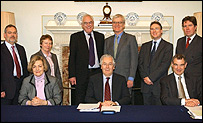 Interestingly, the people on the committee who voted to cut were the professional economists. Charlie Bean, the late David Walton, Kate Barker and Stephen Nickell, plus Richard Lambert. They are all competent and sensible people, worthy members of the MPC; they acted on their interpretation of the data, and were clearly fulfilling the expectations of other economists too (the Reuters poll of analysts showed a large majority expecting a cut).
But in hindsight, they got it wrong.
The signal provided by that cut in August 2005 sent people back out into the shops and estate agents, and made them far too relaxed about the natural limits of the economic cycle.
It made them think 4.75 was the highest rates needed to go. And in unwittingly sending that message, the lower rate enticed people to borrow amounts that now seem incautious. In stirring up the economy. it sewed the seeds of what we now face -- impending rates of 5.75%.
Cutting the base rate was an easy mistake to make. Hindsight was not available to those supporting the move, and it was nine months before there was a single vote to reverse it (it was David Walton who led the way in May 2006, a month before he died).
But it seems to me there are four lessons from the episode that any new member of the MPC might choose to draw.
1. The committee should not attempt to fine tune the economy. Trying to be too precise in steering a course for the economy in response to quarterly growth rates is a mistake. And it is even more of one if the goal is to get rates as low as possible as quickly as possible consistent with the inflation target.
2. The committee should not be a hostage to city expectations of rates. Unless there is a danger of serious financial turmoil, the fact the City thinks rates will be cut is of no relevance to the decision whether to cut them.
3. For good or ill, interest rate moves have some signalling value. But it is the public who are the important signalees - not the city.
4. It is worth looking more closely at the evidence that does not fit the theory you have of the economy, than at the evidence which does fit the theory. In the August 2005 case, money supply was providing the oddball data. (One monetarist hawk, Gordon Pepper, who sits on the Shadow MPC of the Institute of Economic Affairs actually supported a quarter point rise in rates at the time). Money's importance was too lightly dismissed by the MPC. For me, this is not an argument for monetarism, as an argument for looking at all the data more open-mindedly. We are all subject to the strong tendency to frame a view of the economy, and then to select the evidence we define as important, and unsurprisingly to then find it supportive of the view we first thought of.
The minutes of the discussion at that fateful meeting suggest several members of the committee had reservations about the decision, and thought the City was far too inclined to think rates were about to enter a new downward cycle, and thought it was worth waiting more than usual, to obtain more information.
Looking at the consequence of the decision, one can say that it had a benefit - in probably mildly contributing to the 2.8% growth rate we enjoyed in 2006.
But the cost has been a degree of overheating that we are now dealing with, and a degree of over-borrowing. Much of that borrowing was on two-year fixed interest rates, and so the consequences of August 2005 will only come home to roost later this year.
PS Given I'm arguing with hindsight, I think it is only right to re-publish my words on the subject at the time, which were a bit equivocal (as they would be from a BBC journalist). But among my comments on the Ten O'Clock News were these:
"Looking back over the last few years, you could say consumers had a bit of a party and the Bank of England tried to damp it down. They brought out the strong black coffees to sober us up a bit. Cutting the rate again, it's like discovering a couple of unopened bottles of wine in the fridge and saying we can carry on. "
The BBC is not responsible for the content of external internet sites
I'm Evan Davis, the former BBC economics editor.
I've now moved on to a new job, presenting Radio 4's Today programme. Evanomics will continue to exist in some form, as yet undecided.
Evan's categories
- (Latest entries, and comments)
- Notes on Real Life
 | Are we stupid? (63) Central banks get together (32) Flat market (55) |
Small Change
 | Taboo of nationalisation (11) Chancing it (10) Shrinking economy (3) |
Vital Statistics
| Setting prices (17) Unsustainable deficit (68) The first quarter... (20) |
Stars and strife
 | Dollar thrill (13) Prompts v causes (9) Dow vs ABX (11) |
Evan's Reading List
 | Irrationality (72) |
Archive
« January 2008
| Sun | Mon | Tue | Wed | Thu | Fri | Sat |
|---|---|---|---|---|---|---|
| 1 | 2 | 3 | 4 | 5 | ||
| 6 | 7 | 8 | 9 | 10 | 11 | 12 |
| 13 | 14 | 15 | 16 | 17 | 18 | 19 |
| 20 | 21 | 22 | 23 | 24 | 25 | 26 |
| 27 | 28 | 29 | 30 | 31 |
Evan's TV/Radio reports
- Banks' share trading probed
Broadcast: 19 Mar 2008 - Evan Davis on the economy
Broadcast: 18 Mar 2008 - Banks unite on credit crisis
Broadcast: 11 Mar 2008 - Housing slump hits flat prices
Broadcast: 29 Feb 2008 - Bank predicts soaring inflation
Broadcast: 13 Feb 2008
- The above links are to some of Evan's recent TV & Radio reports.
You will need Windows Media or Real Player to watch/listen (help).
Feeds

- News Editors
- Sport Editors
- Journalism Labs
- BBC Internet Blog
- Radio 4 Blog
- Peston's Picks
- Nick Robinson's Newslog
- Stephanomics
- Mark Easton's UK
- Mark Mardell's America
- Nick Bryant's Australia
- Andrew Harding on Africa
- Gavin Hewitt's Europe
- Soutik Biswas' India
- dot.Rory
- Science: Jonathan Amos
- Richard Black on environment
- Today: Tom Feilden
- Fergus Walsh's medical files
- Newsnight: Paul Mason
- Newsnight: Mark Urban
- Torin Douglas
- Will Gompertz's arts
- Phil Coomes on photojournalism
- Magazine Monitor
- Mark D'Arcy in Westminster
- NI: Mark Devenport
- Scotland: Brian Taylor
- Scotland: Douglas Fraser
- Wales: Betsan Powys
- Martin Rosenbaum on FOI
- 5 Live Breakfast
- Newsnight
- PM programme (iPM)
- World Tonight: Robin Lustig
