


Stansted expansion
- 30 May 07, 11:17 AM
A new public inquiry into expansion of passenger numbers and flight slots at Stansted airport opens this morning. The airport won’t get an easy ride. Opponents of Stansted will argue that providing extra flight capacity is contrary to the goal of limiting greenhouse gas emissions.
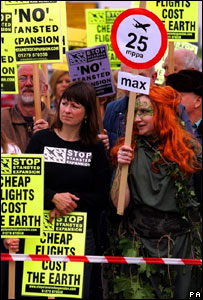 Indeed, my impression is that climate change has moved to the centre of our arguments about airports, above noise and countryside destruction. But airports weren't always so controversial.
The former Labour cabinet minister, the late Douglas Jay, wrote of his life as a civil servant in the war, helping to make one particular decision. He remembered taking a bus up the Strand in London, attending a meeting about post-war planning at which it was decided Heathrow would be London's main civil airport, and then he went back to his office again by bus. Job done, at a cost of a one penny or so on bus fares.
It’s quite a while since we were so casual about airports. We now set more demanding criteria.
But before we let climate change become the dominant issue in decisions about airport expansion, we need to make an important decision. Assuming we want to reduce aviation emissions (an argument I won’t go into) should we constrain airports and runways to discourage us from flying? Or should we discourage flying and see whether that constrains the growth of airports and runways?
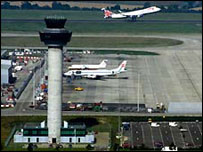 It’s not an academic question. It is not environmentally irresponsible to restrain aviation to an appropriate atmosphere-protecting size, and then to build as much airport as that aviation comfortably needs (subject to the old arguments about noise and greenspace) rather than using overcrowded airports as a means of restraining aviation.
In essence, the argument comes down to one about what instrument government should use.
And as a first thought on it, most economists would argue that some kind of pricing mechanism, not airport space, is the obvious tool. In other words, if you don’t want people to fly, make flying more expensive.
Indeed, here's a thought. Suppose we taxed Ryanair like we tax car drivers, for whom two-thirds of the cost of petrol is tax. What would the effect on Ryanair fares be, given that fuel accounts for 40 per cent of the company’s costs?
The maths is a bit opaque - as indeed Ryanair fares sometimes are. But here’s my back of an envelope calculation. Ryanair says its average fare is £28, but with compulsory add-ons I think it is more like £40, and with tax it comes up to about £50 (one-way) for the passenger.
With its 10 per cent net margin, Ryanair’s total costs per average seat should be about £36, of which 40 per cent is fuel, which we will call £15. Now suppose – overcoming all the practical obstacles – we taxed that fuel by £30 (so the tax is twice the cost of the fuel). And suppose we applied VAT to the rest of the price of the ticket (raising about £5), there is a total tax of £35, not £10. There would be extra tax of about £25. In other words, the typical £50 fare would need to rise to about £75 for Ryanair passengers and car drivers to be treated the same way.
Treat this as a very ball park kind of figure. But if your goal is to limit air travel - it's an option.
Now, how does this compare to the other option, constraining the amount of runway slots that are available? Well, here’s a funny thing. If scarce slots really do bite as a constraint on flights, then guess what: airline prices will rise. As demand for flying grows, airlines will not be able to increase capacity, so they'd have to raise prices.
In fact, they'd be silly not to - if they didn't raise prices, they'd have queues of dissatisfied passengers who could never get a seat despite being willing to pay more. So the simple message is, however you constrain airline flight, the passenger will likely pay more.
But there is a big difference between higher taxes, and fewer landing slots. If it's a tax, it's the government which keeps the money. While if runway slots are constrained, the airlines who have runway slots win, because they keep the extra fares they can charge.
It's an important task in thinking about different constraints on flying. Deciding who pays and who keeps the money from any policy.
A similar issue comes up with another policy option: putting airlines into the emissions trading scheme. What this does is put a cap on the emissions of airlines, but it allows them to buy the right to emit more. (They can also sell their rights to emit).
Once the caps bite, this would have the effect of raising prices – at the margin the airlines would be paying to emit. But of course, the airlines would have the right to emit up to their cap without paying. That would make it quite hard for a new airline – with no rights to emit at all – to compete. It would have to pay for all its emissions, whereas those airlines that have a cap will only face a penalty on some.
If it is new airline entry which dictates the ability of existing airlines to exploit us, then the existing airlines will be able to make a handsome profit before any new airline is enticed into the market. Again therefore, the cap-and-trade system has some consequences for the conduct of the market. In fact, it is not surprising that the existing airlines are campaigning for emissions trading to be the chosen way of restraining them.
This is all fascinating stuff. And it is quite complicated.
But whereas we are quite organised in having big planning inquiries into airport policy – that has moved on since Douglas Jay's day – our decisions on the tax treatment of aviation seem every bit as haphazard and ad hoc as our war-time decisions about airports.
Maybe, before we open more debates about runway slots, we should have an inquiry into flying.
The BBC is not responsible for the content of external internet sites
I'm Evan Davis, the former BBC economics editor.
I've now moved on to a new job, presenting Radio 4's Today programme. Evanomics will continue to exist in some form, as yet undecided.
Evan's categories
- (Latest entries, and comments)
- Notes on Real Life
| Are we stupid? (63) Central banks get together (32) Flat market (55) |
Small Change
 | Taboo of nationalisation (11) Chancing it (10) Shrinking economy (3) |
Vital Statistics
 | Setting prices (17) Unsustainable deficit (68) The first quarter... (20) |
Stars and strife
 | Dollar thrill (13) Prompts v causes (9) Dow vs ABX (11) |
Evan's Reading List
 | Irrationality (72) |
Archive
« January 2008
| Sun | Mon | Tue | Wed | Thu | Fri | Sat |
|---|---|---|---|---|---|---|
| 1 | 2 | 3 | 4 | 5 | ||
| 6 | 7 | 8 | 9 | 10 | 11 | 12 |
| 13 | 14 | 15 | 16 | 17 | 18 | 19 |
| 20 | 21 | 22 | 23 | 24 | 25 | 26 |
| 27 | 28 | 29 | 30 | 31 |
Evan's TV/Radio reports
- Banks' share trading probed
Broadcast: 19 Mar 2008 - Evan Davis on the economy
Broadcast: 18 Mar 2008 - Banks unite on credit crisis
Broadcast: 11 Mar 2008 - Housing slump hits flat prices
Broadcast: 29 Feb 2008 - Bank predicts soaring inflation
Broadcast: 13 Feb 2008
- The above links are to some of Evan's recent TV & Radio reports.
You will need Windows Media or Real Player to watch/listen (help).
Feeds

- News Editors
- Sport Editors
- Journalism Labs
- BBC Internet Blog
- Radio 4 Blog
- Peston's Picks
- Nick Robinson's Newslog
- Stephanomics
- Mark Easton's UK
- Mark Mardell's America
- Nick Bryant's Australia
- Andrew Harding on Africa
- Gavin Hewitt's Europe
- Soutik Biswas' India
- dot.Rory
- Science: Jonathan Amos
- Richard Black on environment
- Today: Tom Feilden
- Fergus Walsh's medical files
- Newsnight: Paul Mason
- Newsnight: Mark Urban
- Torin Douglas
- Will Gompertz's arts
- Phil Coomes on photojournalism
- Magazine Monitor
- Mark D'Arcy in Westminster
- NI: Mark Devenport
- Scotland: Brian Taylor
- Scotland: Douglas Fraser
- Wales: Betsan Powys
- Martin Rosenbaum on FOI
- 5 Live Breakfast
- Newsnight
- PM programme (iPM)
- World Tonight: Robin Lustig
