


That pensions raid
- 2 Apr 07, 03:48 PM
What have we learnt about Gordon Brown's first Budget from the release of a set of 1997 Treasury documents about it?
In truth, not perhaps as much as some of the commentary might imply.
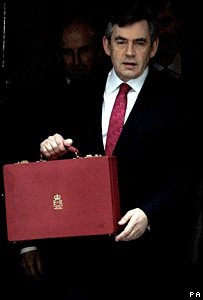 It is not the case that Gordon Brown was warned not to proceed with the tax rise on the grounds that it would damage Britain's pensions system.
Instead, he was given some detailed and equivocal advice about the consequences of what he was proposing, with the overall suggestion that the pension system would suffer as a result of it, but would probably end up coping with it adequately.
In many respects, that advice is unsurprising. The tax change that Gordon Brown implemented was not one that he had thought of out of the blue. It was a much-discussed idea familiar to people in tax circles. And it was so obviously a tax on pension funds, there could never have been any doubt in the minds of ministers or officials as to its implications.
If there had been any doubt, it was dispelled by Geoffrey Robinson's memoirs, The Unconventional Minister. He had been paymaster general at the time, and had helped Gordon Brown and Ed Balls devise a package or corporate tax changes back when they were in opposition. He makes quite clear that they were fully aware of the losers.
Before outlining some thoughts on what the episode tells us about our pensions industry, and the chancellor's role in its downfall, it's worth having a bit of background on the tax system itself, and the reforms Gordon Brown made in his first two Budgets.
What Gordon Brown wanted to do was raise about five billion pounds. And his idea was to reform the particular way that corporation tax and income tax overlapped, in their treatment of company dividends.
There is a long history to this, and of awkward interactions between the two tax systems. It is an issue that all developed countries grapple with.
In what's called a classical corporation tax system, company profits are hit with corporation tax. And dividends paid out of those profits are then hit with income tax in the hand of the recipient shareholders. (Some shareholders - like pensions funds - are exempt from income tax, so they don't pay income tax obviously.)
It was actually Harold Wilson's Labour government which introduced this corporate tax system to Britain in 1965.
But the classical system has long had critics who argue it is unfair because profits paid out as dividends are being hit by two taxes.
The opposite of the classical system is known as the imputation system, which removes the double tax. And in 1973, Britain (under a Conservative government) decided to opt for something called partial imputation. Corporation tax was paid on all profits, but when receiving their dividends, shareholders were allowed to assume that basic rate income tax had already been paid on their dividends.
Part of the corporation tax was in other words, counted as a pre-payment of income tax. This meant shareholders should have avoided paying the double tax on the same income.
In practice, this system was implemented in a complicated way with implications beyond the remit of this article. But it's worth knowing that the tax bill was divided into two: the company paid advance corporation tax at the basic income tax rate on dividend pay outs. And then later, paid any remaining corporation tax owed (the corporation tax rate was higher than the basic income tax rate, and there were the profits not paid out as dividend to be taxed as
well).
In keeping with the imputation principle, those shareholders who were not meant to pay income tax, were thus entitled to an income tax rebate. That mainly affected the pension funds.
However, in our progression from the classical to partial imputation systems, the most striking fact now was that some shareholders were in effect paying no tax on dividends, even though retained earnings were taxed. In particular, concern grew that this gave too much of an incentive for those shareholders to seek dividend pay-outs.
So what Gordon Brown did in 1997 was to move us someway back to the classical system.
It was a wide-ranging package over two Budgets that cut the headline rate of corporation tax, abolished advance corporation tax, brought forward the payment of corporation tax generally, limited the degree to which income tax payers could deem income tax had been paid on dividends, and above all, stopped the payment of tax rebates going to pension funds and others.
Was Mr Brown’s package more likely to lead to investment? Or to be neutral between retained earnings and dividends? Up to a point. (Although one consequence was that pension funds had more incentive now to structure their investments as loans, receiving interest rather than as dividends on shares, a potential boost to private equity).
But the most important thing about the reforms was simply that they raised a lot of money. That was the point of them, and once that goal had been satisfied, it was never very likely the Treasury could come up with a package to benefit the corporate sector.
So what does this whole story of the chancellor's first, big tax reform tell us? It doesn’t allow us to say he destroyed the pension system, for two reasons. Firstly there were enough other, bigger things going on that did more damage.
And secondly, it was open to us to keep our pensions alive, by investing more in them if we wanted to fill the hole he had left. The chancellor may have put an obstruction in the pensions road, but he wasn't driving the car that crashed into it. That was in the hands of employers who were free to increase contributions but chose instead to accelerate the closure of final salary schemes.
The story also doesn’t allow us to say Mr Brown fails to heed the advice of civil servants. The advice he was evidently getting in that particular case was far too ambivalent to make it impossible for him to have proceeded with the tax rise.
But the story perhaps did provide an early lesson on the way the chancellor likes to present tax changes. In many ways, it is similar to the episode around the last Budget, in which the Treasury's own assessment of its tax plans was so imbalanced, (in only presenting winners without presenting losers) that people felt cheated when the full implications of the tax package were spelt out.
Had the chancellor, back in his 1997 Budget, given a straight and open explanation of the extent of the tax rise, the risks attached to it, the advice he had about how much more we would need to put into pensions, about how small the positive effect on investment would be... then the delayed anger now erupting might have been rather diminished.
If he had told us that we needed to top up our pensions, then some of the worst effects might have been avoided by people topping up their pensions.
Or to put it another way, if the chancellor put an obstruction in the pensions road, he might have put a warning notice up, so unwitting drivers knew what to face.
But as it happened, anyone listening to his account of the tax change - and indeed, even the account given by Ed Balls this weekend - might have been forgiven for thinking it was simply designed to remove some technical distortions prevailing in the tax system.
They knew it was more than that. And the civil servants advice to them makes that clear for anyone who could have supposed otherwise.
The BBC is not responsible for the content of external internet sites
I'm Evan Davis, the former BBC economics editor.
I've now moved on to a new job, presenting Radio 4's Today programme. Evanomics will continue to exist in some form, as yet undecided.
Evan's categories
- (Latest entries, and comments)
- Notes on Real Life
| Are we stupid? (63) Central banks get together (32) Flat market (55) |
Small Change
 | Taboo of nationalisation (11) Chancing it (10) Shrinking economy (3) |
Vital Statistics
 | Setting prices (17) Unsustainable deficit (68) The first quarter... (20) |
Stars and strife
 | Dollar thrill (13) Prompts v causes (9) Dow vs ABX (11) |
Evan's Reading List
 | Irrationality (72) |
Archive
« January 2008
| Sun | Mon | Tue | Wed | Thu | Fri | Sat |
|---|---|---|---|---|---|---|
| 1 | 2 | 3 | 4 | 5 | ||
| 6 | 7 | 8 | 9 | 10 | 11 | 12 |
| 13 | 14 | 15 | 16 | 17 | 18 | 19 |
| 20 | 21 | 22 | 23 | 24 | 25 | 26 |
| 27 | 28 | 29 | 30 | 31 |
Evan's TV/Radio reports
- Banks' share trading probed
Broadcast: 19 Mar 2008 - Evan Davis on the economy
Broadcast: 18 Mar 2008 - Banks unite on credit crisis
Broadcast: 11 Mar 2008 - Housing slump hits flat prices
Broadcast: 29 Feb 2008 - Bank predicts soaring inflation
Broadcast: 13 Feb 2008
- The above links are to some of Evan's recent TV & Radio reports.
You will need Windows Media or Real Player to watch/listen (help).
Feeds

- News Editors
- Sport Editors
- Journalism Labs
- BBC Internet Blog
- Radio 4 Blog
- Peston's Picks
- Nick Robinson's Newslog
- Stephanomics
- Mark Easton's UK
- Mark Mardell's America
- Nick Bryant's Australia
- Andrew Harding on Africa
- Gavin Hewitt's Europe
- Soutik Biswas' India
- dot.Rory
- Science: Jonathan Amos
- Richard Black on environment
- Today: Tom Feilden
- Fergus Walsh's medical files
- Newsnight: Paul Mason
- Newsnight: Mark Urban
- Torin Douglas
- Will Gompertz's arts
- Phil Coomes on photojournalism
- Magazine Monitor
- Mark D'Arcy in Westminster
- NI: Mark Devenport
- Scotland: Brian Taylor
- Scotland: Douglas Fraser
- Wales: Betsan Powys
- Martin Rosenbaum on FOI
- 5 Live Breakfast
- Newsnight
- PM programme (iPM)
- World Tonight: Robin Lustig
