


Migration intricacies
- 29 Mar 07, 05:24 PM
In a wistful reflection, the cartoon character Homer Simpson once described alcohol as "the cause of all life's problems - and the solution to them".
 These days, migration gets similarly ambivalent billing, receiving the blame and the credit for so many of the things we observe: for some, it's caused higher unemployment. For others, it's made our economy strong.
And for some, it's Polish construction workers who've done more than anyone to help us build homes. For others, migrants are the ones who are taking homes away from us.
And it is the impact of immigration on the housing market which is the subject of a brief Migration Watch report, which uses government figures to argue that inward migration requires us to build an extra 200 homes a day for the next couple of decades.
It's worth making clear what 200 homes a day means. If we build at that rate for the two decades, at the current target density of 40 homes per hectare, the area covered would be 19 kilometres by 19 kilometres.
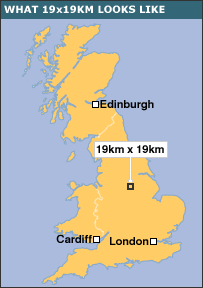 One wouldn't want to down play the impact of that portion of the UK being given over to new housing. Every hectare is a struggle for a planning authority somewhere. But it is also worth looking at Google Earth, and marking out an area of 19 by 19 kms to see what it means in the context of the UK as a whole (or take a look at the graphic on the right).
But there's no doubt that the issue is one that raises passions. And the reason why we can simultaneously hold optimistic or pessimistic views about migration is that its effects are often quite complicated.
On jobs, there is no lump of labour in the economy to be parcelled out, so while migrants probably take some jobs that would go to domestic labour, they equally create other jobs that would otherwise not exist.
And on housing, migration can be complicated too.
Of course its right that the more people there are, the more properties we need. So migration does exacerbate a shortage of housing.
But if we don't have enough properties, migrants can also help ease the shortage.
 For example, I recently met a Bulgarian family - three of whom were working - in a small one-bedroomed flat in an expensive part of London. Now, I'm not sure how typical that is, but if migrant workers generally are happier to squash up to save money than the British, what would happen if they left?
Arguably, you would release a one bedroom flat, but lose three workers. If the flat was taken by a single British person, the London economy would still be down two workers. Employers might soon say, they need more building in London, to accommodate more staff.. Even if there are spare houses elsewhere.
I have no idea how significant this effect is, though my impression is that the very reason why some crowded parts of the economy have grown so reliant on migrant workers, is down to their willingness not to undercut British wages, as much as to undercut our requirement for a bedroom per person.
Of course, it could go differently. Migrants might settle in the areas of the country where there is spare room to build homes, or even where there are spare homes. In this case, the migrant demand may not put as much pressure on the housing market in the crowded areas.
And then, there are other complexities.
Migrants are not one group, but many varied groups.
 And some migrants will undoubtedly go native, and soon aspire to a large suburban house with garden, where they don't have to share rooms. That'll add to the pressure here.
But if prices go up, and British folks decide to buy homes to retire to in Bulgaria, that'll subtract from the pressure here.
It's a difficult subject this... even Homer Simpson would struggle to cope with its intricacies.
The BBC is not responsible for the content of external internet sites
I'm Evan Davis, the former BBC economics editor.
I've now moved on to a new job, presenting Radio 4's Today programme. Evanomics will continue to exist in some form, as yet undecided.
Evan's categories
- (Latest entries, and comments)
- Notes on Real Life
| Are we stupid? (63) Central banks get together (32) Flat market (55) |
Small Change
 | Taboo of nationalisation (11) Chancing it (10) Shrinking economy (3) |
Vital Statistics
 | Setting prices (17) Unsustainable deficit (68) The first quarter... (20) |
Stars and strife
 | Dollar thrill (13) Prompts v causes (9) Dow vs ABX (11) |
Evan's Reading List
 | Irrationality (72) |
Archive
« January 2008
| Sun | Mon | Tue | Wed | Thu | Fri | Sat |
|---|---|---|---|---|---|---|
| 1 | 2 | 3 | 4 | 5 | ||
| 6 | 7 | 8 | 9 | 10 | 11 | 12 |
| 13 | 14 | 15 | 16 | 17 | 18 | 19 |
| 20 | 21 | 22 | 23 | 24 | 25 | 26 |
| 27 | 28 | 29 | 30 | 31 |
Evan's TV/Radio reports
- Banks' share trading probed
Broadcast: 19 Mar 2008 - Evan Davis on the economy
Broadcast: 18 Mar 2008 - Banks unite on credit crisis
Broadcast: 11 Mar 2008 - Housing slump hits flat prices
Broadcast: 29 Feb 2008 - Bank predicts soaring inflation
Broadcast: 13 Feb 2008
- The above links are to some of Evan's recent TV & Radio reports.
You will need Windows Media or Real Player to watch/listen (help).
Feeds

- News Editors
- Sport Editors
- Journalism Labs
- BBC Internet Blog
- Radio 4 Blog
- Peston's Picks
- Nick Robinson's Newslog
- Stephanomics
- Mark Easton's UK
- Mark Mardell's America
- Nick Bryant's Australia
- Andrew Harding on Africa
- Gavin Hewitt's Europe
- Soutik Biswas' India
- dot.Rory
- Science: Jonathan Amos
- Richard Black on environment
- Today: Tom Feilden
- Fergus Walsh's medical files
- Newsnight: Paul Mason
- Newsnight: Mark Urban
- Torin Douglas
- Will Gompertz's arts
- Phil Coomes on photojournalism
- Magazine Monitor
- Mark D'Arcy in Westminster
- NI: Mark Devenport
- Scotland: Brian Taylor
- Scotland: Douglas Fraser
- Wales: Betsan Powys
- Martin Rosenbaum on FOI
- 5 Live Breakfast
- Newsnight
- PM programme (iPM)
- World Tonight: Robin Lustig
