- Peter Barron
- 7 Jul 06, 03:14 PM
If you read this column regularly you probably subscribe to Newsnight’s daily email. But as of the last couple of weeks it’s also been available in a different corner of the web, to a much larger audience, on the BBC’s new blog called The Editors. If you’ve arrived here via one route you might want to take a look at the other.
 The reason I mention this is that normally we’d use this column to tackle the subject which has provoked the most feedback, but since The Editors site has been on fire all week about the rights and wrongs of our Scottish car experiment (and I accept there are many - including some at the BBC - who think we got this wrong), I’m going to suggest moving on to a new, if not unrelated, seam.
One of the things that struck me about the torrents of comments we received about the car item was that many viewers questioned if this was the sort of thing a “serious news programme” should be doing.
“Come on Newsnight. This isn’t the sort of attempted sensationalist dumbed down news we expect from you”
"It's a totally incongruous notion for a so-called serious news programme."
 One blog (Beau Bo D’Or) even suggested a rebranding as News of the Night.
They’re not alone in questioning what Newsnight should be. Our resident grumpy old man Eric Dickens sees two factions within the programme – 'Old Newsnight' and the 'Modernisers' - and clearly favours the former. I hesitate to mention Emily Bell again, but in our (good natured) discussions about Newsnight she displays a suspicion of items like Justin Rowlatt’s Ethical Man and Michael Crick’s World Cup tour and cries “more news on Newsnight”.
So was there a Newsnight golden age when all items were pure, serious and relentlessly high-minded? I don’t think so.
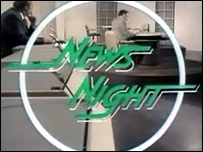 If you look at the very first edition 26 years ago (watch it here) it is pretty heavy duty stuff: industrial relations, tension in the Gulf and the Soviet war in Afghanistan. But in those days there was also a sports section, and I’m prepared to bet that at the time many were critical of Peter Snow’s analysis of the Afghan conflict using a sandpit and model tanks. What are toys doing on a serious news programme?
I first started on Newsnight in 1990 as a junior producer and worked under two editors – Tim Gardam and Peter Horrocks (now head of BBC TV News). Both were of course committed to serious journalism, analysis and intelligent debate, but in my experience equally committed to wit, mischief and humour. I suspect if you asked a focus group to think of words to sum up Jeremy Paxman, who joined the programme in that era, they might come up with all those words and a few more besides.
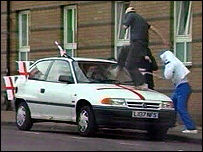 Programmes must, of course, evolve as times change – if they didn’t they would, like Grandstand and Top of the Pops, eventually go out of business. And there is no tablet of stone on which it’s written what Newsnight or any other programme should be. Take Top Gear. Who’d have thought that what was once all William Woollard and driving gloves would one day have a studio audience and be trashing reasonably-priced saloons?
Anyway, let us know what you think Newsnight should and shouldn’t be by leaving a comment below. Or if you want to talk trashing cars, click here, or maybe try Top Gear.
Peter Barron is editor of Newsnight

- Piers Parry-Crooke
- 7 Jul 06, 12:50 PM
Reader Reg Davison e-mailed this blog on Wednesday saying:
When Longbridge car plant closed you devoted untold amounts of time to covering that story in the national news bulletins. Whilst I have sympathy for the people who lost their jobs, it was in Britain's second largest city, with numerous opportunites to find other work. [On Tuesday] Imerys, the local china clay producing company in Cornwall, announced 800 job losses. This in a county with a total population of just 500,000, and few other opportunities to find work. It will devastate small communities in a county that is so poor it receives Objective One funding because it is poorer than the eastern European countries who have just joined the enlarged Europe. Did I hear anything on your national news? No, of course I didn't. Does the world exist west of Bristol? In the minds of the people in London, it appears not.
I know that part of Cornwall quite well, and am very conscious of the china clay industry's significance, now and historically. Here in the business unit the job cuts were discussed pretty fully that morning in the early editorial meeting.
I'm afraid it's just not the case that the news went unreported. Radio, in particular, covered it extensively, from the moment the company announcement came out. The first voiced report from Sarah Ransome in Plymouth was on Five Live at 1000, unions and company were in later news summaries, and Sarah did a much longer piece for the six o'clock and midnight news on Radio 4. Looking back at the day's output it looks to me as if the news was broadcast, in one form or another, every hour on the radio between 1000 and about 1900. And the next morning Today had an interview with a representative from the county council.
On television, News 24 carried the story several times during the day, including a report from a correspondent in the region.
It has to be said the papers give it pretty scant coverage as well. It's one of the mysteries of news, how one story fizzles out and another soars.
Piers Parry-Crooke is assignments editor in the business and economics unit

- Liliane Landor
- 7 Jul 06, 10:40 AM
In the run-up to the first anniversary of 7/7 I've been a bit troubled.
 It all started on Tuesday when I came across the phrase "moderate" Muslims in one of our stories. Why the need to qualify, I found myself thinking? Are Muslims automatically radical unless we stick "moderate" somewhere visible? And what is a "moderate" Muslim exactly? Do we mean Muslims we can identify with, whatever "we" means? Or perhaps secular not-so-Muslim Muslims? And in any case, aren't most Muslims in this country British? So what are we actually saying when we describe them as Muslims? Why don’t we describe Christians or Jews in the same way? And what about the Muslim community? Surely there is more than one?
Very troubled, as you can see...
Which is why when in the wake of Tony Blair's remarks on the defeat of extremism and the need to "mobilise the moderate majority within the Muslim community", every one of my programmes decided they had to look at Islam, extremism, moderation and identity, I made a point of listening to everything.
Newshour had an outspoken liberal Muslim academic taking a representative of the Muslim Association of Britain to task, claiming the organisation had not tackled the extremists in its midst.
World Have Your Say, interactive, edgy and global, decided to ask four Muslims to occupy the first half hour of their programme. No presenter intrusion there. A passionate discussion ensued which had to continue off air as the participants were too engaged to stop when the news summary came on.
But the idea I liked best came from the the World Today. They chose to speak to a Muslim rapper MC Riz, a young rapper whose latest hip hop track "post 9/11 Blues" is making waves. MC Riz has an interesting turn of phrase; he says beards have taken on a different meaning, and that Muslims have been pushed to the middle of the room. That sentence stayed with me. With Friday upon us, I need to make sure that we're not pushing anyone to the middle of the room.
Liliane Landor is editor of World Service news and current affairs

- Simon Waldman
- 7 Jul 06, 10:20 AM
I was the editor in charge of the output on News 24 - and then BBC One - on the morning of 7 July last year.
 From the moment the first wire copy broke - referring to a "power surge" on the Underground, the News 24 team went into overdrive. Inside and outside the newsroom, everyone was focused on getting live pictures and accurate information on air as fast as possible. Several BBC producers, as well as correspondents, provided compelling eye-witness reports from Kings Cross and elsewhere.
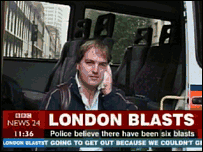 Clearly, we were dealing with a huge story. To begin with, information was sketchy and often conflicting. As soon as we had reports of a second explosion, it was plain that a terrorist attack was a likely cause. The presenters and correspondents talked on air in those terms - but we did not say categorically that London had been targeted by terrorists until the police said so.
At the time our coverage of the breaking news was criticised by some for being too cautious. We were even accused of deliberately withholding information from the public - and of being little more than a government mouthpiece. With the benefit of hindsight, I think it's fair to say we were over-cautious to some extent, particularly when talking about the casualty figures. But we emphatically did not deliberately suppress information.
Those were the ground rules a year ago. News 24 was not a channel that would cheerfully boast of being "never wrong for long" - on such an important news event, we knew we had to be 100% sure of our facts before we transmitted them as facts. And we were broadcasting to a huge audience on BBC One, which added to the sense of needing to deliver sober, responsible coverage.
Since then, much audience feedback has flowed. Many people felt we were slower than we should have been in updating information. That criticism hurt - but the overall effect has been beneficial. We are now less reliant on "official" sources; we won't wait always for copper-bottomed confirmation of every element of a story. The audience has a different expectation of a continuous news channel covering a breaking story than it does of a "built" bulletin which is broadcasting after the event. Viewers expect and want us to share with them the developments as they unfold - without, of course, abandoning our commitment to accuracy. One example: Sir Ian Blair talked late in the morning of "seven" explosions - that's what HE believed at the time and so did we, along with all other news organisations.
One important source of information not properly exploited by us on July 7 was "the public". Much has been made of the fact that citizen journalism came of age a year ago. News 24 made very good use of eye-witness accounts live on air but we were unprepared for the volume of material from viewers and listeners on that day. From blogs to mobile phone photos, we simply couldn't cope quickly enough with the vast amount of information and the number of pictures flooding into the BBC.
That first, iconic, image of the bus in Tavistock Square was on air very fast, but many more viewers' photos and stories went unbroadcast until hours after the event. But since then, new and robust systems have been put in place. So, when the Buncefield oil depot went up in flames, a fantastic flow of audience stills and video was on air before you could say "breaking news".
Simon Waldman is morning editor on BBC News

- Vicky Taylor
- 7 Jul 06, 10:17 AM
It has been quite an experience.
 At the rehearsal the day before the interactive webcast with President Putin there were about 50 Russian officials in the hastily-made (but state of the art) studio, all giving their view on who should sit where. That was probably what you would expect inside the Kremlin.
What has been different is the apparent keenness to take on questions from around the world. There have been no no-go areas. No asking to see any script or enquiries (gently or not so gently) asking what we were going to pick as our main questions. The main issues of contention was should Bridget Kendall (our presenter) sit next to the President. In the end she did.
Arriving at the Kremlin today though, our initial entry was delayed as we weren’t all in one group as the form suggested we would be, and any bags we were carrying had to be decanted and anything you needed taken in by hand. A bit tricky when you are carrying technical equipment. Still it gave the whole proceeding an edge.
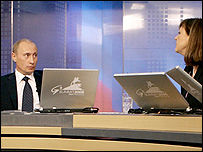 The President arrived exactly one minute late and didn’t stop for the next two hours and fifteen minutes (watch it here) - an extra half hour suddenly found in his diary. It was a marathon performance by any standards - every one of our 12 questions on a vast range of topics from North Korea, relations with George Bush to the problems with getting visas to travel to Russia, was asked.
The one topic which has been preoccupying the Russian press - about why he kissed a young boy on the tummy during a visit to Red Square - also got put. He picked a couple of questions himself; poverty, pension and the military were his choices. We even got the impression the President enjoyed answering them all.
Vicky Taylor is editor of Interactivity

- Craig Oliver
- 7 Jul 06, 09:33 AM
I'm relatively new to the BBC - and I'm discovering one of its great joys is the ability to show all sides of a story from around the world:
 • When North Korea test fired a missile earlier this week - we were able to get the view from South Korea, China, Japan and Washington (watch one of the reports here).
• Our diplomatic correspondent James Robbins had an original, epic and revealing take on how India and China are competing with each other to become the greatest economic power with a series of stories called "The Race to the Top" (watch here, here and here).
• And Fergal Keane showed how violence in one country can have a devastating impact around the world in a moving interview with the mother of a Nigerian killed in the 7/7 bombings (watch here).
The result is fascinating television, and greater understanding of our impact on the world and its impact on us.
Craig Oliver is editor of BBC News at Six and BBC News at Ten

The audience response given to the BBC in the past 24 hours included people thinking it was wrong to give emphasis to the video of 7 July bomber Shehzad Tanweer, which was revealed on al-Jazeera. Opinion divided between those who applauded the Today programme interview with John Prescott and those who thought it was too much.
We also received this e-mail: "While I fully realise the importance of the anniversary of the London Bombings, I feel you are just wallowing in it. This is an increasing trend. Anniversaries need to be recognised, but not made into media show-pieces."
The BBC is not responsible for the content of external internet sites