

bbc.co.uk Navigation

Robinson's curse

  • Nick
  • 12 Sep 08, 06:48 PM

The curse of Robinson has struck. No sooner had I penned a piece saying the threat to Gordon Brown had receded than the first call came from within the government for a leadership contest.

Siobhain McDonagh is the first government member (now ex) to call, in effect, for Gordon Brown to go, She is not, though, the first Labour MP to do so and others look set to follow. What no-one expects is that there will be the 70 necessary under Labour's rules for a contest.

The piece I wrote was based on extensive conversations with critics and backers of Gordon Brown's at the top of the party reflecting the view that now is not the time for a putsch.

Today's news is a useful reminder that sometimes it is the peasants that revolt. It was, after all, Sir Anthony Meyer - the obscure Tory backbencher - who first stood against Margaret Thatcher. It was relatively junior members of the Lib Dems who ed the revolt against Charles Kennedy. The same was true of the autumn push two years ago against Tony Blair. If there were a couple of dozen Siobhain McDonaghs that would make Gordon Brown's position difficult whatever the rules said.

Tomorrow, a group of backbenchers have penned their own critique for Progress magazine of Brown's leadership although they don't call for a contest.

Team Brown must now await nervously to see what happens next. One of them has expressed his hope that I do not turn out to be the Michael Fish of the political world!

07:15 PM UPDATE
The article written by a dozen Labour backbenchers, including former Health Secretary Pat Hewitt, is a no-holds-barred critique of the way Gordon Brown is leading the party.

It says that Labour has "no explanation yet" as to how it will "steer the economy through the troubled waters ahead" claiming that "one-off taxes and pay-outs, no matter how justified in their own terms, do not amount to a strategy." There is a "yawning chasm" which the Labour party needs to fill, or the government will suffer a "hammer blow".

They suggest the government needs to be better at communicating what it's "going to do about the things that affect people day to day", noting that Harold Wilson's "pound in your pocket" and Thatcher's likening of the economy to a household budget may have been "derided by the pundits" but "understood by the public".

The MPs label recent policies to deal with the crises of 10p tax and the housing market "defensive" and suggest instead Labour needs to be "championing change", "leading the debate about new ideas" and "renewing confidence in our economic competence".

Some of the 12 authors are known critics of Brown's. They all claim that their thoughts are unconnected with calls for a leadership contest although they know that their views will make one more likely.
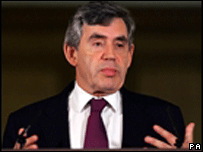

Gordon in limbo

  • Nick
  • 12 Sep 08, 09:41 AM

"Save money, save energy" read the slogan on the lecturn at the prime minister's news conference yesterday. Not so long ago, some journalistic wag - who knows, even me - might have quipped that the words "save Gordon" belonged there as well. Somehow, though, it didn't quite feel right. Gordon Brown no longer appears to be under threat. The cool political climate of the autumn has replaced the heated frenzy of the summer.

Gordon BrownBack then, David Miliband would not answer the simple question "Can Gordon Brown win the next election?" This week, he insisted that he could whilst leading members of the cabinet in praise of Mr Brown. In the summer, ministers believed that Jack Straw might lead a cabinet coup. Now, though, he declares that there will be no leadership challenge. Then, there was talk of letters to be signed by dozens of Labour MPs calling on the PM to stand down - like those that forced Tony Blair to bring forward his departure. Now, Charles Clarke calls for his leader to buck up or stand down and no-one comes out to support him.

So, what has changed? Why has the "centre of gravity moved in Gordon's favour" as one cabinet minister put it to me. The critics admit that they cannot see a way to get from here to there - from a world with Brown as leader to a world without him. He'd resist being removed, they say and you can say that again. There's no-one obvious alternative, they go on - aware that neither the party or the public rallied to David Miliband when he emerged as the young pretender. There would, in any case, have to be a leadership election lasting at least six weeks since the public wouldn't accept another leader being imposed on them. Indeed, the demands for a general election would be hard to resist.

Friends of the prime minister put it more positively. MPs have come to realise, they say, that it's not Gordon Brown that's the problem but "the economy stupid" and he's the best man to sort it. In this respect, and this one only, the polls are helpful for Mr Brown. The public does not say it wants a change of Labour leader nor that the party's position would be improved if there was one.

So it is that Gordon Brown has neither been backed or sacked. So it is that he has not re-launched his leadership but does not face a challenge to it. So it is that ministers say "we'll give him his conference" or "we'll wait until the by-election" without saying or knowing what they'll do when those supposed milestones are reached.

The PM, it seems, has been saved for now at least not by anything he's done but by an atmosphere of weary resignation that has taken over much of his party.

The BBC is not responsible for the content of external internet sites

BBC.co.uk