A victory, say Gordon Brown allies, is a victory. The prime minister, they say, ignored warnings that he'd lose the vote, he stuck to his principles and he did what he believed was right.
It was though a nine vote victory delivered thanks to nine unionist votes and was a victory that came at a price.
Ministers and the DUP insist that no deals were done but Unionist MPs grin widely when asked about future financial help for the province.
Labour MPs meeting in the Commons tearoom asked each other "What have you been offered by Gordon?" Some have been told about a relaxation of sanctions against Cuba, others about improved support for sick miners.
Talking of the sick, one Labour MP fighting cancer was asked to leave his hospital bed to vote with the government. Another was wheeled in to the building in a wheelchair after an operation.
So, Gordon Brown did win but he could not do so with the votes of his party alone - even after all the wooing, the arm twisting and the cajoling
It was not the victory he would have wanted.
These are good days to be a potential rebel with a cause. If you're willing to trade your opposition to 42 days for pretty much anything you may well get it from the government whips or from Gordon Brown.
 One MP is boasting that they were told that the prime minister would oppose American sanctions on Cuba. Another that they've been promised an improvement in the miners' compensation scheme. A third, who's not had a phone call from Gordon Brown in 20 years, was granted 20 minutes of his time in a phone call.
Will these converts, if they convert, prove enough? My hunch is probably yes. There it is, just a hunch. I do not smell panic in the Labour whips' office or around the corridors of the House of Commons.
However, Gordon Brown wants not just to win but to win without the help of the Democratic Unionist party, or of a handful of Tory MPs like Ann Widdecombe who might back his cause.
He wants tonight's vote to be the first symptom in the story of his recovery. The moment in which he is seen no longer as a ditherer but as a principled leader who took a stand.
As for the DUP, they are receiving more attention than they have in a very long time. Yesterday David Cameron spoke to their leader. Today, Gordon Brown is expected to speak to, if not meet, him and other DUP MPs. If they or anyone else can think of something they want from the government in return for their vote in the 'Aye' lobby tonight, this is a very good time to ask for it.
It's a serious allegation. Liberty's Shami Chakrabarti alleges that the government have sexed up the evidence for an extension of detention without charge to 42 days. Her claim comes because ministers have cited the example of two people alleged to have taken part in the alleged plot to blow up planes across the Atlantic in 2006. In these cases yet to come to court the suspects were held by the police for 27 and 28 days respectively - up to, in other words, the current legal maximum.
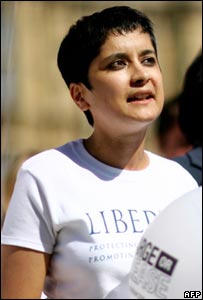 Liberty's claims are right but their defence lawyer has revealed that the police had the evidence to charge them after four days and 12 days respectively, thus demonstrating that no extension of the period allowed to the police to question terror suspects is needed.
Ministers are sure to angrily deny the charge of sexing up, a phrase that deliberately echoes the allegation made about weapons of mass destruction on the eve of the Iraq war. They will say that the police only hold suspects for as long as is necessary to gather the evidence necessary to bring the appropriate charge.
This allegation is a sign of how desperate both sides have become to sway the last few votes. Gordon Brown has taken to calling MPs who've not heard from him in two decades for long, very long, conversations.
UPDATE, 11:50AM: The government angrily reject claims that they sexed up evidence on 42 days and without talking about specific cases, point to the remarks of Sue Hemming, head of the counter-terror division in the CPS, giving evidence to the public bill committee in the House on 22 April 2008, who said:
"We certainly did not keep people in unnecessarily. There has to be a certain amount of time for the police to investigate. If you arrest people, the police have to look at what the plot is, who is involved and what the evidence is. As with any case, the pre-charge detention time has to allow a certain amount of time for the police to investigate and question. I seriously dispute any allegation that we kept people in any longer than we had to."
In the same session, Ken MacDonald, director of public prosecutions, said:
"The idea that we have sufficient evidence after 14 days, but, for some reason best known to ourselves, wait until 26 or 27 days to charge is wrong."