Unit 1, Section A
The material on this page is designed to help you with revision and preparation for your CCEA GCSE English Language exams. It applies to Unit 1, Section A: Writing for purpose and audience.
- Unit 1 is assessed by a written exam, worth 30% of your final mark
- There is one task in Section A of the Unit 1 exam, worth 87 of the 150 marks available
- For this task, you will be expected to produce a piece of writing, usually a speech or article, in response to specific instructions
You can practice for your English Language GCSE exams with a range of CCEA past papers and mark schemes.
INTERIM SPECIFICATION – NOTE FOR YEAR 11 PUPILS
If you are in Year 12 and completing your CCEA English Language GCSE in summer 2027, the above information is correct.
However, if you're in Year 11 and began studying for your CCEA English Language GCSE in September 2026, an interim specification has been introduced.
The external written exam for Unit 1 will now be worth 40% of your final mark.
Key points about boosting your vocabulary
- The more words you know, the better you can express yourself; keep a word journal, read widely, and use tools like a dictionary and a thesaurus to learn and remember new words
- Use words that match your audience and purpose; big or fancy words aren’t always better
- Action words (verbs) can make your writing more lively; use words to reveal to the reader the actions or behaviour of a character
- Choose more interesting words to make your writing stand out
- Think about the mood you want to create with your writing and choose words that help bring that feeling to life
How to expand your vocabulary
The more words you know, the more clearly and powerfully you will think…and the more ideas you will invite into your mind.
Wilfred Funk, 30 Days to a More Powerful Vocabulary
There are plenty of ways to expand your vocabulary. One particularly effective method is to keep your own word journal where you list new words as you find them.
You could organise this by date, topic, alphabetical order or you could group words with similar meanings together. When you encounter a new word, make a note of it. Look it up in a dictionary to establish its correct meaning and to find out how best to use it in a sentence. Use a A book that lists synonyms (words that have similar meanings) - useful for expanding your vocabulary. to find A synonym is a word or phrase that means exactly or nearly the same as another word or phrase..
Aim to use your new vocabulary as soon as possible to establish its meaning in your mind.
You can discover new words:
- by reading widely and including challenging reading material
- by using a dictionary and thesaurus
- by listening to talks, talk radio shows, news programmes
- by listening to your teachers
- by using apps that offer you a ‘word of the day’
Be wise with your word choices
Use your vocabulary wisely and aim for a good range that suits your audience and purpose. This is true for both your fiction and non-fiction writing.
Long words are not always the most effective ones, eg:
It was a sweltering sunny day.
is different to:
It was a thermogenic, undarkened sunrise-to-sunset.
Make sure you understand how to use the words in a sentence. For example ‘thermogenic’ doesn’t make much sense in the above sentence. It means to produce heat, but is used to describe drugs or products that produce heat in the body.
When you proofread your work, try alternative words – synonyms – and notice the effects of these different vocabulary choices. Where possible, use precise words, full of descriptive energy, to bring your writing to life.
Boost your writing with precise verbs
A way to liven up a piece of writing is to choose action words – verbs – with great care. Use words to show the reader the actions or behaviour of a character. For example:
He walked into the room and said, “This is what I was waiting for.”
By choosing more precise verbs, you can give ‘depth’ to your writing. This gives the reader a more vivid impression of your scene and characters.
Notice how each of the following sentences changes your perception of the character:
He strolled into the room and muttered, “This is what I was waiting for.”
He marched into the room and barked, “This is what I was waiting for.”
He shuffled into the room and sobbed, “This is what I was waiting for.”
Think about the impression and the atmosphere you’re aiming to create as you make your vocabulary choices.
Use lively, interesting words
Here are some examples of overused words:
- good
- nice
- very
- happy
- big
- hate
- said
- walked
Can you think of alternative words that you could use for each – words that are more precise, lively or interesting? Consider what the reader should feel about the place, person or topic that you are describing.
Some different words you could use instead
- Good – superb, fantastic, excellent, brilliant, outstanding, spectacular
- Nice – marvellous, enjoyable, pleasant, wonderful, glorious
- Very – extremely, highly, deeply, terribly, hugely, massively
- Happy – ecstatic, cheerful, pleased, overjoyed, elated, thrilled
- Big – huge, gigantic, ginormous, enormous, colossal, immense
- Hate – despise, detest, repulsed, loathe, condemn, dislike
- Said – shouted, bellowed, whispered, sniggered, mumbled, grunted, sang, exclaimed
- Walked – strutted, bounded, sprinted, ambled, trudged, wandered, trundled
Use words to spark emotion
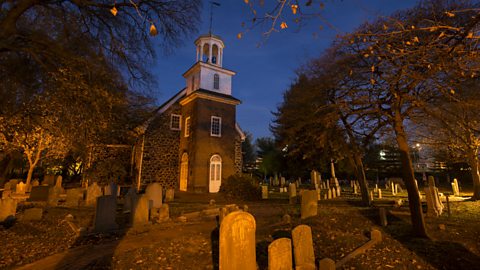
Vocabulary can be used to influence the way a reader feels about a scene or topic. By selecting words carefully you can create the atmosphere your scene requires or the tone your article needs.
For example, in a ghost story, you might select vocabulary to create a sense of fear:
Bats swooped dangerously close to my head as the haunting outline of the moon glared over the silhouette of the gravestones. The stench of decay hung in the damp night air, as a warning to those who dared to enter.
Here the vocabulary choices imply a feeling of danger and create a sinister tone. The language is lively and precise, full of energy to enliven the scene.
Notice how in this second piece, also set in a churchyard, a positive mood is created:
Doves soared overhead as we bustled from the church doorway. The clouds parted for the beaming sun that warmed the backs of the guests. Confetti and the scent of perfumed flowers filled the air; laughter twirled like ribbons around the bride and groom.
By making careful vocabulary choices, you can create the mood to draw the reader emotionally into your story.
A similar approach can be used for non-fiction writing where your vocabulary choices will affect the tone and mood of the piece you write.
Here are examples of different settings, and moods with sample sentences:
| Setting | Mood | Example vocabulary |
|---|---|---|
| City | Happy | A bright sun glinted from the skyscraper windows… |
| Jungle | Sad | The baboons’ plaintive cries pierced our hearts… |
| Desert | Determined | The sand burned, the dust stung; but we marched on regardless… |
| Mountains | Hopeful | Small white cloudlets hovered so close to our heads we felt we could touch them… |
| Beach | Excited | Crabs scuttled hither and thither, children squealed in delight… |
Things to remember
- Get into the habit of using a A book that lists synonyms (words that have similar meanings) - useful for expanding your vocabulary.
- Experiment with different words in your writing
- Keep a word journal to collect new words
- List or mind map your key vocabulary choices at the planning stage of your writing
- Read back over your work to check your vocabulary choices; are the words ambitious AND do they ‘fit’ with the style of writing?
- Check that you haven’t accidentally repeated words in nearby sentences
Quiz: Vocabulary
More help with your English Language
English Language revision resources. revision-guide
Get ready for your English Language exams with help from Bitesize.

English Language past papers
CCEA past papers and mark schemes, plus top tips to help you prepare for your English Language GCSE.
More on Unit 1: Writing for purpose and audience
Find out more by working through a topic
- count1 of 6

- count2 of 6

- count3 of 6

- count4 of 6