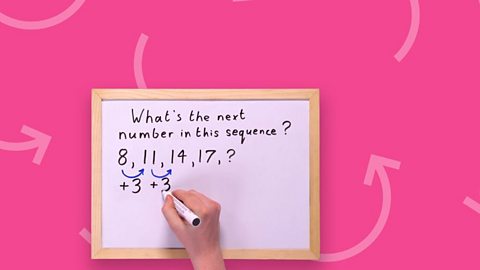
- A linear sequence repeatedly increases or decreases by the same amount.
- The number added (or subtracted) at each stage of the linear sequence remains the same.
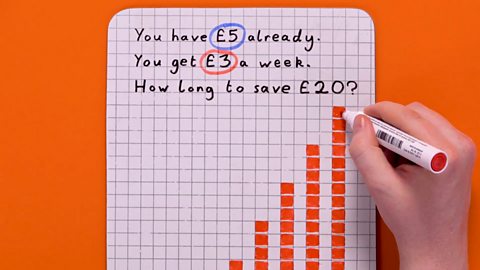
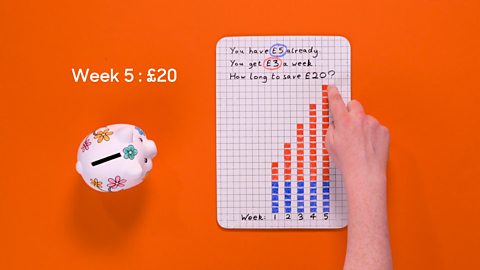
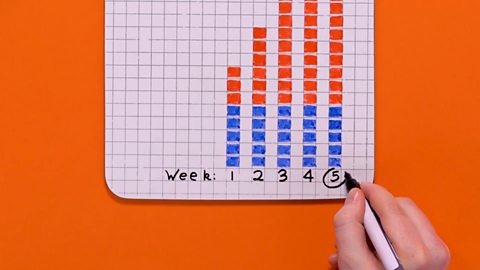
Learn how to visualise a linear sequence.
Have a go yourself
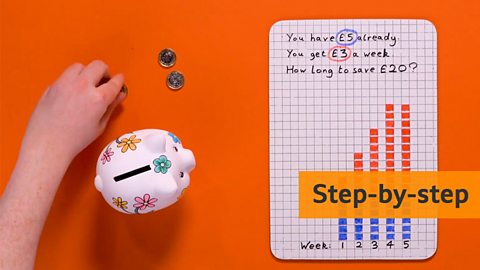
Image caption, Click to see a step-by-step slideshow.

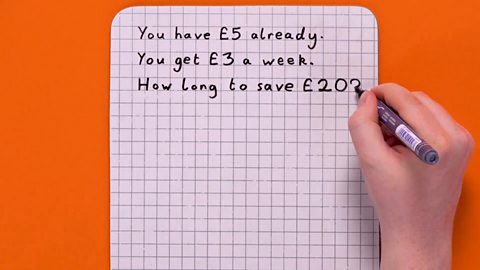

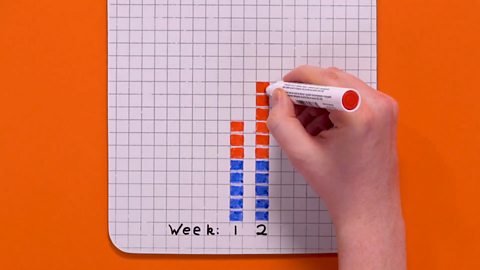
1 of 8
A linear sequence goes from one term to the next by always adding (or subtracting) the same value.
The number added (or subtracted) at each stage of the linear sequence is called the common difference.
Examples of linear sequences occur when things change by the same amount each time.
How to find the next term in a linear sequence
Have a go yourself

Image caption, Click to see a step-by-step slideshow.


1 of 5
How do they work?
Example 1
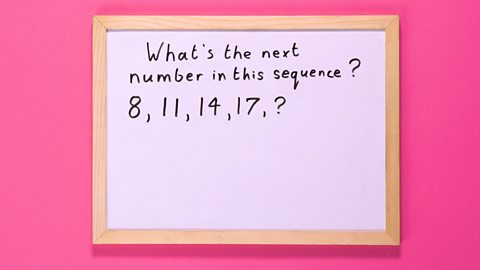
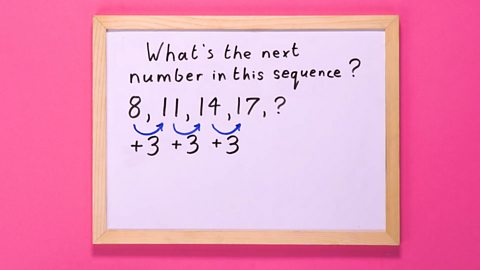
Here is the linear sequence:
8, 11, 14, 17…
- To find the next term in this sequence we calculate the common difference.
- In this example the common difference is +3.
8 (+3) 11 (+3) 14 (+3) 17 (+3) …
Therefore, the next term in the sequence would be 20 (17 + 3)
Example 2
Here is another linear sequence:
70, 60, 50, 40 …
In this example the common difference is -10, because 10 is subtracted from each term to give the next term in the sequence.
70 (-10) 60 (-10) 50 (-10) 40 (-10) …
The next term in the sequence will be 30 (40 – 10)
When a linear sequence is plotted on a graph, it always gives a straight line.
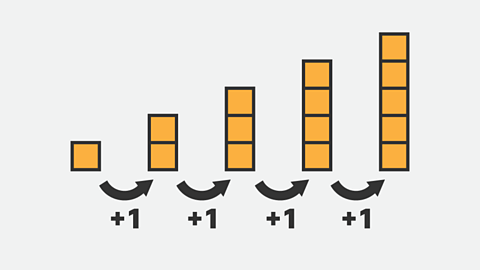
Common examples of linear sequences
- Shape patterns (see image).
- Someone walking the same distance every 10 minutes.
Linear sequence activity
Find out how much you know in this quick activity.
Exploring number patterns
- \({2}\), \({6}\), \({10}\), \({14}\)\({…}\) is a number pattern that follows the rule 'add \({4}\)'.
The next number is \(14 + 4 = 18\).
- \({81}\), \({27}\), \({9}\), \({3}\)\({…}\) is a number pattern that follows the rule 'divide by \({3}\)'.
The next number is \(3 \div 3 = 1\).
- \({5}\), \({8}\), \({14}\), \({23}\)\({…}\) is a number pattern that follows the rule 'add \({3}\), add \({6}\), add \({9}\) \({…}\)'
The next number is \(23+12=35\).
Each number in a number pattern is called a term.
So in the number pattern \({2}\), \({6}\), \({10}\), \({14}\) \({…}\) the first term is \({2}\), the second term is \({6}\) and the third term is \({10}\), etc.
Question
Write down the rule and the next two terms in the number pattern: \(2\), \(4\), \(8\), \({16}\) \({…}\) and then check your answer.
Answer
The rule is 'multiply by \({2}\)' and the next \({2}\) terms are \(32\) and \(64\).
Notice how patterns change from one term to another.
Work out the rule that will get you from the \({1}^{st}\) term to the \({2}^{nd}\) term, and then check that the same rule will get you from the \({2}^{nd}\) term to the \({3}^{rd}\) term.
If it doesn't work, find a different rule to get to the \({2}^{nd}\) number and then check that it gets you to the \({3}^{rd}\) number.
Number patterns in diagrams
A number pattern in a diagram often requires counting shapes to find the rule.
Look at how the pattern grows from one term to the next.
pattern \({1}\) has \({0}\) purple tiles and \({3}\) blue tiles, so it has \({3}\) tiles altogether
pattern \({2}\) has \({1}\) purple tile and \({5}\) blue tiles, so it has \({6}\) tiles altogether
pattern \({3}\) has \({2}\) purple tiles and \({7}\) blue tiles, so it has \({9}\) tiles altogether
Question
Q1. Based on the number patterns above, draw pattern \({4}\).
Q2. Look again at the number patterns above. Write the rule and the fourth terms for:
- a) purple tiles
- b) blue tiles
- c) all the tiles
A1.
Pattern \({4}\) has \({3}\) purple tiles and \({9}\) blue tiles, so it has \({12}\) tiles altogether.
A2.
a) The rule for the number pattern of purple tiles is 'add \({1}\)' and the \({4}^{th}\) term is \(3\).
b) The rule for the number pattern of blue tiles is 'add \({2}\)' and the \({4}^{th}\) term is \(9\).
c) The rule for the number pattern of all tiles is 'add \({3}\)' and the \({4}^{th}\) term is \(12\).
The common difference
To find the The difference between successive terms in a linear sequence., you need to work out how much the terms are increasing or decreasing by from one term to the next.
For example, find the common difference and the next two terms of this sequence.
We can see that these terms go up by \({3}\) every time, or we state that the common difference is \({3}\).
The next two terms will then be \({16}\) and \({19}\).
Question
Find the common difference and the next two terms of the following sequence.
Answer
The common difference is \({-2}\).
The next two terms are \({8}\) and \({6}\).
Finding the nth term of a linear sequence
Sometimes, rather than finding the next number in a linear sequence, you want to work out the \({41}^{st}\) number, or the \({110}^{th}\) number.
Writing out \({41}\) or \({110}\) numbers takes too much time, so you can use a general rule.
To find the value of any term in a sequence, use the \(n^{th}\) term rule.
Question
What is the \({n}^{th}\) term of this sequence?
Answer
\({1}^{st}=5\times1=5\)
\({2}^{nd}=5\times2=10\)
\({3}^{rd}=5\times3=15\)
So the \(n^{th}\) term is \(5 \times n\) or \(5n\)
For example, to find the \({10}^{th}\) term, work out \(5 \times 10 = 50\).
To find the \({7}^{th}\) term, work out \(5 \times 7 = 35\).
So the \({41}^{st}\) term is \(5 \times 41 = 205\) and the \({110}^{th}\) term is \(5 \times 110 = 550\).
Question
What are the \(n^{th}\) term and the \({10}^{th}\) term of this sequence:\({2},~{4},~{6}, …\)?
Answer
\({n}^{th}\) term \(= 2n\)
\({10}^{th}\) term \(= 20\).
To work this out, \(n = 10\), so \(2n = 2 \times 10 = 20\)
More on finding the nth term
So the sequence of numbers in the \({5}\) times table has a common difference of \(5\) and an \({n}^{th}\) term of \(5n\).
How do you find the answer in more complex sequences?
We know that the \({n}^{th}\) term should contain ‘\({5n}\)’.
The \({5}\) times table is \({5},~{10},~{15}, …\)
The sequence is \({7},~{12},~{17}, …\)
Each term in the sequence is \({2}\) more than the corresponding term in the \({5}\) times table, so the \(n^{th}\) term is \(5n + 2\).
Question
What is the \(n^{th}\) term of the sequence \({8},~{11},~{14}, …\)?
Answer
The common difference is \(3\), so it must be related to the \(3\) times table (\(3n\)).
The \(3\) times table is \({3},~{6},~{9}, …\)
The sequence is \({8},~{11},~{14}, …\)
Every term in the sequence is \(5\) more than the corresponding term in the \(3\) times table, so the \({n}^{th}\) term is \(3n + 5\).
How can linear sequences help you to tile your bathroom?
Find out which rule you need to work out any number in the sequence.
Sophie: Aaaah!? This is impossible!
Mathsmutt: Come on Sophie, linear sequences aren’t impossible!
Sophie: No, Mathsmutt! Working here with you two is impossible! With Dad constantly banging, I’m never going to get my homework done.
Mathsmutt: Come on! Let’s go see if we can help!
Dad: Oh I give up, Sophie. I’m putting the kettle on.
Mathsmutt Ok, this is just like your homework. Let's make some pretty patterns! Ta da! My patterns are always 3 wide, with 2 tiles on the top. And the number of tiles at the bottom of each one increases by the same amount each time. See? 5 tiles, 8 tiles, 11 tiles, 14 tiles. Do you see a pattern?
Sophie: It goes up by 3 each time!
Mathsmutt: Yup! And that means it’s connected to the 3 timestable. So, now you can work any number in the sequence!
Sophie: Err… I can?
Mathsmutt: Ok, let's look at the patterns again. 1 blue row, times 3, plus 2 white is 5 tiles. 2 blue rows, times 3, plus 2 white is 8 tiles.3 blue, times 3, plus 2 white, is 11 tiles! And so on!
So what if we want to make a really big pattern? How do we know how many tiles we need in total?
Let’s break it down.
Well, our blue rows are always 3 tiles wide.
So it's times 3. If we don't know how many tiles there are in each blue column, we cancall that the Nth, or Unknown.
And then we add the 2 white. Now we can work out how many tiles there are in anypattern we want, just by finding the rule, which is 3 times N, plus 2, or 3N+2!
Sophie So, if it’s 20 blue tiles tall, it’s 3 times 20, plus 2. 62 tiles!
Mathsmutt: Correctamundo!
Sophie: A-ha! Now I can finish my homework!
Dad: Eh? Wow, Sophie! You did all this? Brilliant! But have you finished your homework?
Sophie: Yes, Dad. And now I'm all… ‘tiled’ out! Heheh!
Mathsmutt: Cheers!
Test section
Question 1
What is the rule for the number pattern \({3}\), \({6}\), \({9}\), \({12}\), \({…}\)?
Answer
The correct answer is add \({3}\) - as every term in the number pattern increases by \({3}\).
Question 2
What is the rule for the number pattern \({5}\), \({9}\), \({13}\), \({17}\), \({…}\)?
Answer
The correct answer is add \({4}\) - as every term in the number pattern increases by \({4}\).
Question 3
What is the rule for the number pattern \({2}\), \({4}\), \({8}\), \({16}\), \({…}\)?
Answer
The correct answer is multiply by \({2}\) - as each number in this number pattern is twice as much as the previous term.
Question 4
What's the common difference in the sequence \({6}\), \({8.5}\), \({11}\), \({13.5}\), \({…}\)?
Answer
The correct answer is \({2.5}\) - as the difference is \({2.5}\) each time.
Question 5
What's the next number in the pattern \({6}\), \({8.5}\), \({11}\), \({13.5}\), \({…}\)?
Answer
The difference is \({2.5}\) each time - so the next number is \({16}\).
Question 6
What's the common difference in the sequence \({6}\), \({3}\), \({0}\), \({…}\)?
Answer
The common difference is \({-3}\) - as it's a downward sequence, the difference is negative.
Question 7
What's the \({n}^{th}\) term in the sequence \({7}\), \({14}\), \({21}\), \({28}\), \({…}\)?
Answer
The correct answer is \({7n}\) - as the difference between the terms is \({7}\), but the answer is the nth term in this instance (which is \({7n}\)).
Question 8
What's the \({n}^{th}\) term in the sequence \({9}\), \({16}\), \({23}\), \({30}\), \({…}\)?
Answer
The correct answer is: \({7n}+{2}\).
The difference is \({7}\), but the sequence doesn't start at \({7}\).
You need to add \({2}\) to each term too.
Question 9
The \({n}^{th}\) term in a sequence is \({3n}-{10}\).
What's the \({10}^{th}\) term?
Answer
The correct answer is: \({20}\).
To get the \({10}^{th}\) term, you need \({n}={10}\).
So the \({10}^{th}\) term is \({3}\times{10}-{10}={20}\).
Question 10
Find the \({n}^{th}\) term in the sequence \({3}\), \({7}\), \({11}\), \({15}\)\({…}\) and use it to find the \({1000}^{th}\) term?
Answer
The correct answer is: \({3999}\).
The \({n}^{th}\) term is \({4n}-{1}\), so the \({1000}^{th}\) term is \({4000}-{1}={3999}\).
More on Sequences
Find out more by working through a topic
- count2 of 5
- count4 of 5
- count5 of 5