Form
The Some poems adopt specific 'forms'. For example, they could be sonnets or narrative poems. Many don’t have an identifiable form. of a text is the type of text you are reading or watching.
The form of How Many Miles to Babylon? is a novel. This means it is a Narrative is another word for story. text, telling a fictional story which is written in Ordinary language both spoken or written; different from poetry (which does not reflect everyday speech patterns)..This novel is written using aWriting about your own life and memories, usually focusing on one aspect. style, flashing back to the narrator’s childhood.There is no division into chapters as the flashback A technique used in literature to help make a point or show an idea creates a sense that we hear only a series of events that had emotional significance in Alec’s life.
The novel could also be seen as a A 'coming of age' story, describing a character’s emotional growth as they move from childhood to adulthood. as it traces the events of a young boy’s life.
Structure
The The way the poet has organised the poem on the page eg number of stanzas, lines per stanza, breaks in between lines and stanzas. of a text refers to the way in which events are organised in the work as a whole. This novel can be broken into four main sections:
- Our introduction to Alec and his present situation
- Alec’s childhood
- Alec’s time in the trenches
- Alec’s present day situation when we learn the reason he is awaiting execution
- How Many Miles to Babylon? is written in the The 'I' or 'we' used by a narrator who is a participant in a narrative, in contrast to the third person - 'he', 'she' or 'they' - of a narrator who is not directly involved. narrative voice. First person is where the story is told by one of the characters involved in the story, who describes the action from their point of view and regards events with their own understanding. This novel is told from the point of view of an adult man, Alexander Moore (known as Alec), who describes himself as “an officer and a gentleman”.
- When we first meet him, he is in a military jail, awaiting execution during World War One. There is a A cyclical process is one in which a series of events occurs in a repeating pattern, for example the change of seasons each year. structure to the novel, meaning it circles round in the end to the place where it began. The story starts in Alec’s present situation in jail, then jumps back in time with a flashback to Alec’s childhood. From there it cycles through the events leading up to his sentence embedded in the present tense narrative of the adult Alec. This structure hooks the reader from the beginning as there are clues that the character is awaiting execution, but we must read on to find out what has led to this situation.
- From the beginning then, we know that there is no hope and that death is inevitable for the narrator. The final revelation that he has shot his best friend is an unexpected and shocking conclusion.
- The flashback device – written in the past tense – allows Johnston to explain the events that led to Alec’s sentencing in Chronological means following the time order in which events happened. Stories told chronologically start with the earliest event and end with the last. order and gives us an in-depth insight into the character’s thoughts and feelings.
- The prose style changes when Alec talks about his memories of childhood fun with Jerry. Here, the joy in his narration is shown through the The use of language to create images and pictures in the reader's mind. used in his poetic descriptions of nature. This contrasts with his unhappy family life.
- Alec’s narration, in polished A form of speech that lays claim to a grammatical 'correctness' and clear pronunciation, avoiding slang and valuing precision., allows us to identify his class and therefore to see the differences when Jerry speaks in Everyday language.. The first person voice therefore allows Johnston to imply or suggest a lot about the character without having to explicitly tell us.
- The novel ends on a tragic note as we see that both men – whom we have known since their childhood innocence – have been broken and killed by war. Both characters are still young, with great potential and many dreams for the future. Through them Johnston is therefore able to make a strong comment about the futility of war.
Literary devices and narrative techniques
Language refers to the choice of style and vocabulary made by the author. When analysing the language Johnston uses you should think about:
- What: The author’s choice of specific words and dramatic devices
- Where/How: The way in which the writer uses specific words and dramatic devices
- Why: The effect on the reader
Imagery
Johnston uses a lot of imagery – language that create images and pictures in the reader's mind – in her descriptions of setting, characters and weather.
There are examples of this throughout the Bitesize articles on the characters and themes of this novel. Some further significant examples are noted below.
| Type of imagery | How and why it is used |
|---|---|
| Recurring imagery of swans | There are recurring references to swans throughout the novel. We first see the swans as the object of Alicia’s affection. She refers to them as “my loves” in “a voice so unlike her own recognisable voice”. The swans are used here to show that Alicia is such a distant mother that she reserves her love and affection for these animals instead of her own son. The swans become part of the Representing or regarding something as being perfect or too good to be true. memory that Jerry and Alec share of their childhood. Even in the final death scene Alec asks Jerry if he remembers “The lake. The swans …”. The fact that Jerry replies “only that their wings sound like gunshots” Hint at something that will happen later and have greater significance. what is going to happen to him minutes later. Earlier, a soldier senselessly shoots at a pair of swans, killing one. This too establishes an ominous tone, making the reader feel there is danger ahead. The swans symbolise peace and childhood innocence; the destruction of one by the soldier is symbolic of the shattering of that innocence and the overall devastation of war. |
| Animal imagery | Animal imagery is used to show the horrors of the trenches. The references to rats and fleas show the uncomfortable living conditions endured by men there. Soldiers are warned not to eat pork as “the pigs that remained alive … fed and grew temptingly fat on human flesh”. This horrific image emphasises the extent of human loss, and how little dignity these men had in death. The “wild-looking mongrel” dog that frequently stays in Alec and Bennett’s room is perhaps meant to parallel the men when Johnston writes that all Alec cares about now is “survival”. |
| Dehumanising imagery | To take away the features that make a person human, such as free will or dignity. imagery is used by Major Glendinning when he refers to his desire that there be “no flaw in the machinery”. This shows that he has no care for his men as people, but only as cogs in a machine. Johnston uses this to show the senseless sacrifice of young men who were metaphorically “Food for cannons”, just as Frederick suggested – consumed by the war, swallowed and destroyed. |
Title
The title of the novel is derived from an English nursery rhyme which is referred to several times in the Narrative is another word for story..
The lyrics are generally considered to be as follows:
How many miles to Babylon?
Three score and ten.
Can I get there by candlelight?
Yes, and back again.
If your heels are nimble and light,
You may get there by candlelight.
Alec sings the rhyme to the priest who comes to visit him in prison as the novel opens. The priest is disturbed by his “frivolity”, but the rhyme seems less Something deemed to be of little weight or value. when we see the references to it at other times in the novel.
When Alec is a child the nursery rhyme offers a glimpse of another world. He thinks on it again as he is having his last “glimpse of the two swans rocking gently on the lake” before he leaves for war and contemplates the journey ahead of him. He wonders, “Will I get there by candlelight?” He says of the rhyme: “It was the only thing in my mind.”
The associations with the rhyme in Alec’s mind therefore make his singing it during his time with the priest not frivolous but Bringing about a sense of sadness or regret.. Indeed, the association of the title with a childhood poem reminds the reader of the youth and innocence of those killed by war.
Setting
The language Alec uses to describe his surroundings often conveys the atmosphere and his mood.
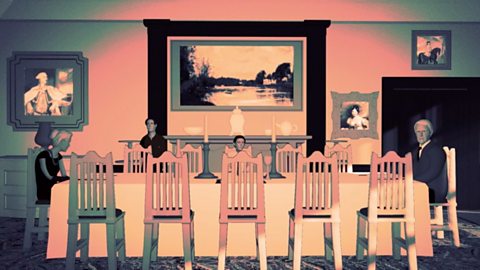
For example, his description of the Something that looks expensive or lavish. surroundings in his house reflects the metaphorical coldness of his parents’ relationship and his family life. He describes the dining room as “unwelcoming” with light that “lay on the walls and furniture without kindness”.
This contrasts with his recollection of “lying on my mattress in West Outre” when at war. In these basic and grim surroundings he describes how it was “warm and I could smell bacon frying” and that “rain thudded on the roof, but it was almost pleasant”.
Even in these horrible frontline conditions Alec is more relaxed in his description of the setting. This reinforces how unhappy and tense his childhood was.
Juxtaposition
Johnston employs To place two or more contrasting ideas, images or words close together to highlight their differences. when Alec describes Jerry’s feet as “bare, dust-grey and with soles obviously as hard and impervious to stones, thorns, damp, as were the soles of my expensive black leather shoes”. The juxtaposition of Jerry’s bare feet with the expensive shoes Alec wears immediately shows the difference in class between the two characters.
We see Alicia Moore’s beauty juxtaposed with the ugliness of her personality. For example, soon after Mr Cave describes her as “Such a beautiful woman” she cruelly dismisses him because of her disgust at his “appalling smell” and “his disease and poverty”. This cruel snobbery makes her a dislikable character despite her beauty.
Johnston also uses juxtaposition to highlight how cold and distant Alicia is as a mother. Her “theatrical” and seemingly insincere grief at Alec’s leaving is juxtaposed with the emotional farewell from the servants who “gathered round clutching at my hands and touching my coat”. This serves to show just how distant the relationship between Alec and his parents is. The only tears at his leaving are from Mrs Williams, the cook.
Intertextuality
When Frederick is trying to persuade his wife that Alec should not go to war she responds with the Latin phrase “Dulce et decorum est …”.
This is significant In English literature this is when one literary text makes a connection with, refers to, or is influenced by a separate text. because today (and at the time Johnston wrote the novel) we know the phrase from Wilfred Owen’s poem of the same name.
It comes from a line written by the Roman poet Horace, “Dulce et decorum est pro patria mori” which means ‘it is sweet and fitting to die for one’s country’. Owen – who fought and died in World War One – uses Horace’s line Happening in the opposite way to what is expected and maybe causing amusement because of it. in an anti-war poem about the horrors of the trenches and the futility of war. As modern readers familiar with Owen’s poem, this intertextuality only reminds us of the horrific scenes of despair and devastation Owen depicted in his poems.
There are also frequent references to The Croppy Boy, a tragic Irish folk song from the 19th century. ‘Croppy’ was a nickname given to Irish rebels fighting for independence from Britain during an uprising in 1798. The song tells the story of a croppy who stops at a church confessional on his way to battle. After confessing his story the ‘priest’ reveals himself as an English soldier, and arrests the man who is sentenced to death.
The parallels between this and Jerry and Alec’s story are clear, and it is very poignant that Jerry is singing the song as he dies. The final lines he sings – “I bear no hate against living thing, / But I love my country above my king” – ring true for men who go to war for their country but who “bear no hate” for any of the men they are recruited to kill.
Foreshadowing
Hint at something that will happen later and have greater significance. is used at times in the novel to create an ominous tone and to hint at what is to come.
Alec’s Lack of interest or emotion. in his attitude to his mother when he states in the opening scene that “My heart doesn’t bleed for her”, foreshadows the Something that does not operate correctly or to social norms. family relationships that we see in the flashback.
The senseless killing of the swan near the end of the novel – and Alec’s disgust at the man who shot it – seems to foreshadow the shooting of Jerry soon afterwards.
Rhetoric
Language devices employed to convince and persuade an audience - eg questions, groups of three, alliteration. is used in the printed An official instruction or order. issued to the men before they sail to France. They are told to keep and “read it in moments of temptation”.
The directive states: “You are ordered abroad as a soldier of the King to help our French comrades against the invasion of a common enemy.” This language reminds them of their duty.
It also includes a list of requirements/virtues: “You have to perform a task which will need your courage, your energy, your patience”. Such language is persuasive and typical of the kind of rhetoric that was used to influence young soldiers.
Repetition
Johnston uses repetition for effect in various occasions in the novel.
Alec’s only comment about his mother is “My heart doesn’t bleed for her.”
He repeats this phrase later: “Poor Jerry I thought, my heart bleeds for you.”
Dialogue
Johnston uses characters’ The words said by a character in a story or play. to tell us more about them. Their accents and Everyday language. are different depending on their class.
Alec’s narrative uses the standard English of an educated and affluent member of the A term often used to describe people from a social class which was often made up of descendants of Protestant landowners and professionals, from the Protestant Ascendancy of Ireland. upper classes.
Mr Cave uses colloquialisms such as “fellamelad” and “sonny” and Jerry teases Alec as a “queer eejit”.
Jerry’s use of the Irish “omadhán” from the Irish (Gaeilge) ‘amadán’, meaning fool or idiot.
Test yourself
Further study
Bookclub. audio
James Naughtie and readers talk to one of Ireland's finest writers, Jennifer Johnston.

Remembering Jennifer Johnston
Friends and family reflect on the life of the award-winning Irish novelist and playwright.

English Literature past papers
CCEA past papers and mark schemes, plus top tips to help you prepare for your English Literature GCSE.

More on How Many Miles to Babylon?
Find out more by working through a topic
- count1 of 5

- count3 of 5