Key points about the capture-recapture method

Capture-recapture is a method used to To give a rough or approximate answer. the total population of an environment when it is difficult or impossible to count every individual.
It uses A part-to-whole comparison. Where each part of a ratio is considered as a fraction of the whole. Eg, in the ratio 3 : 5, the first part is 3/8 of the whole. This is a proportion of the whole. to estimate the population.
It is a practical method that is used by scientists. For example, to monitor the populations of endangered species.
Make sure you understand the idea of proportion and are confident at re-arranging and solving equations.
What is capture-recapture?

The capture-recapture method is used to work out the estimate of a total population.
In the capture-recapture method, a sample of individuals is captured from a total population and marked or tagged. After a period of time, a second capture or recapture is taken.
By comparing the proportions of the marked individuals in the new sample, an estimate of the total population is made.
Find out more about the capture-recapture method below
GCSE exam-style question

A student used the capture-recapture method to estimate the number of bees in a hive (𝑁).
They caught and marked 30 bees (𝑀 = 30). A day later, they caught 40 bees (𝑛 = 40) and saw that 6 of them were marked (𝑚 = 6).
They then wrote down their calculation as:
\(𝑁= \frac {(40×6)}{30} \)
Why is this calculation incorrect? Using the notation 𝑀, 𝑛 and 𝑚, show what the correct calculation should be.
The student had mixed up the total second sample (𝑛) and the first sample (𝑀) with the recaptured number of bees (𝑚).
They divided by the first sample size (𝑀 = 30) but in the capture-recapture method you have to divide by the number of individuals that were recaptured with marks (𝑚 = 5).
The correct calculation is:
\(𝑁= \frac {(𝑀×𝑛)}{𝑚} \)
- 𝑀 = 30 (first sample)
- 𝑛 = 40 (second sample)
- 𝑚 = 6 (recaptured number)
\(𝑁= \frac {(30×40)}{6} \)
\(𝑁= 200\)
The total estimated population of bees (𝑁) is 200.
Check your understanding
How to work out an estimate of the total population
To find an estimate of a population using the capture-recapture method, use the following A fact, rule, or principle that is expressed in terms of mathematical symbols. The plural of formula is formulae. :
\( \frac {M}{N} = \frac {m}{n} \)
- 𝑀 equals the number of marked individuals in the first capture.
- 𝑁 equals the total population of the environment.
- 𝑚 equals the number of marked individuals in the second capture (recapture).
- 𝑛 equals the number of individuals in the second capture (recapture).
The capture-recapture method assumes:
- the population is a fixed number, eg there are no births or deaths.
- there has been sufficient time for the captured creatures to redistribute and mix in the original population before the recapture.
- the creatures are unable to lose their tag or mark.
- all creatures have an equal probability of being captured.
Follow the worked example below
GCSE exam-style questions
- Chloe wants to find an estimate for the number of frogs in a lake.
On Saturday she catches 30 of the frogs.
She puts a mark on each frog and releases them.
On Monday she catches 40 of the frogs and sees that 8 of the frogs have marks.
Work out an estimate for the total number of frogs in the lake.
150 frogs
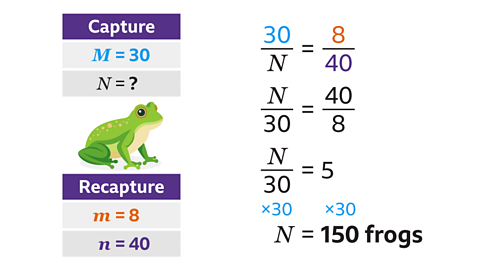
Let 𝑁 equal the estimate of the total population of the frogs. In the first capture, the number of marked frogs is 30, so 𝑀 = 30.
In the second capture, 8 of the 40 frogs caught are tagged. So, 𝑚 = 8 and 𝑛 = 40.
Substituting the values into the formula 𝑀/𝑁 = 𝑚/𝑛 gives 30/𝑁 = 8/40.
To solve this equation, take the reciprocal of each fraction. The reciprocal of the first fraction must be equal to the reciprocal of the second fraction, so 𝑁/30 = 40/8.
The right-hand side of the equation simplifies.
40 ÷ 8 = 5
- To find the value of 𝑁, multiply both sides of the equation by 30.
5 × 30 = 150
So, 𝑁 = 150.
There are approximately 150 frogs in the lake.
- A beekeeper wants to estimate the number of bees living in their beehive.
On Tuesday, they catch 400 bees from the beehive, marking them and then returning them to the hive.
On Friday, the beekeeper catches 360 bees and marks 30 of them.
Work out an estimate for the total number of bees in the beehive.
4800 bees
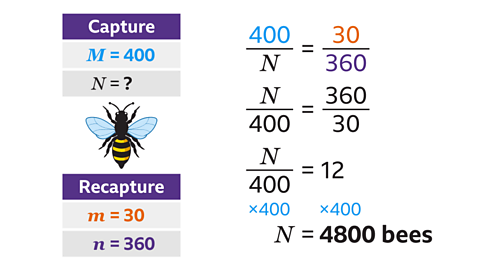
- Let 𝑁 equal the estimate of the total population of the bees.
In the first capture, the number of marked bees is 400, so 𝑀 = 400.
- In the second capture, 30 of the 360 bees caught are marked.
So, 𝑚 = 30 and 𝑛 = 360.
Substituting the values into the formula 𝑀/𝑁 = 𝑚/𝑛 gives 400/𝑁= 30/360.
To solve this equation, take the reciprocal of each fraction. The reciprocal of first fraction must be equal to the reciprocal of the second fraction, so 𝑁/400 = 360/30.
The right-hand side of the equation simplifies.
360 ÷ 30 = 12
So 𝑁/400 = 12.
- To find the value of 𝑁, multiply both sides of the equation by 400.
12 × 400 = 4800
So, 𝑁 = 4800.
There are approximately 4800 bees in the beehive.
- An ecologist wants to work out an estimate of the number of fish living in a pond.
They capture some fish (𝑀) and mark them.
They then return the fish to the pond.
The following day they catch 40 fish and mark 32 of them.
The ecologist then estimates the number of fish in the pond to be 140.
Work out how many fish were originally marked.
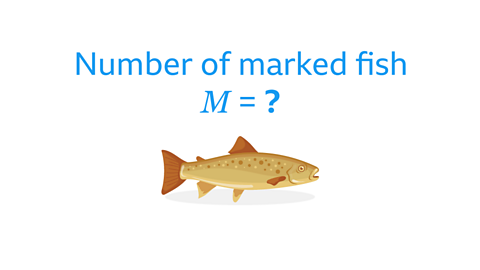
112 fish
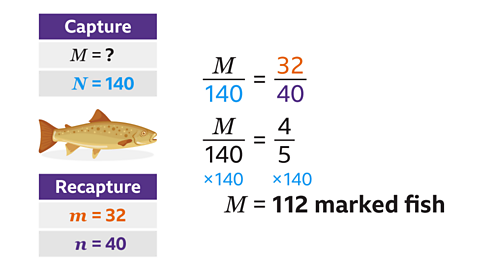
- Let 𝑀 equal the number of marked fish in the first capture.
The ecologist estimates the total number of fish to be 140, so 𝑁 = 140.
- In the second capture, 32 of the 40 fish caught are marked.
So, 𝑚 = 32 and 𝑛 = 40.
Substituting the values into the formula 𝑀/𝑁 = 𝑚/𝑛 gives 𝑀/140 = 32/40.
The right-hand side of the equation simplifies.
32/40 = 4/5
So 𝑀/140 = 4/5.
- To find the value of 𝑀, multiply both sides of the equation by 140.
4/5 × 140 = 112
So, 𝑀 = 112.
The ecologist marked 112 fish.
Quiz – Capture-recapture
Practise what you've learned about the capture-recapture method with this quiz.
Now you've revised capture-recapture, why not look at probability?
More on Statistics
Find out more by working through a topic
- count1 of 8

- count2 of 8

- count4 of 8